
Free Tools
Catfish Probability Detector
Check whether a dating profile has suspicious identity or photo signals.
Dating Bio Red Flag Detector
Review a bio for scam, pressure, or trust-warning language.
Dating Safety Checklist
Use free GuyID tools before moving from chat to a real date.
Next step
Create your GuyID trust profile
Share consent-based trust signals before a date without turning the conversation into an interrogation.
Catfishing is a form of online deception that can create financial, privacy, and emotional harm. Whether you are dating online, connecting on social media, or networking professionally, understanding catfishing and how to respond is an important digital-literacy skill. This guide covers the definition, common motivations, warning signs, and practical verification tools.
NavigateTable of Contents24 sections
What Is Catfishing? The Complete Definition
Catfishing is the act of creating a fake online identity to deceive another person into an emotional, romantic, or financial relationship. A catfish uses stolen photographs, fabricated personal details, and invented life stories to build trust with their target. The deception can last days, months, or even years before the victim discovers the truth.
To fully understand what is catfishing, it’s important to distinguish it from related but different forms of online deception:
| Type of Deception | Definition | Key Difference from Catfishing |
|---|---|---|
| Catfishing | Creating a complete fake identity to build a relationship | This IS catfishing — the baseline definition |
| Romance scamming | Catfishing specifically for financial fraud | Always involves money; catfishing doesn’t always |
| Fake profiles/bots | Automated or low-effort fake accounts | No active human relationship-building |
| Embellishing | Exaggerating real details (age, job, height) | Real identity, inflated details — not a fake person |
| Impersonation | Pretending to be a specific real person | Targeted identity theft; catfishing often uses generic fakes |
The defining element of catfishing is the creation of a false identity used to manipulate someone into a relationship they wouldn’t have entered if they knew the truth. The catfish may use someone else’s photos, AI-generated images, or heavily edited versions of their own photos combined with a fabricated backstory.
Catfishing occurs on every platform where people connect: dating apps like Tinder, Bumble, and Hinge; social media platforms like Facebook, Instagram, and TikTok; messaging apps like WhatsApp and Telegram; professional networks like LinkedIn; and even gaming platforms and online communities. Wherever trust can be exploited, catfishing exists.
Where the Term “Catfishing” Comes From
The term “catfishing” entered mainstream vocabulary through the 2010 documentary film “Catfish,” directed by Henry Joost and Ariel Schulman. The documentary follows Nev Schulman as he discovers that the woman he’d been having an online relationship with had fabricated her entire identity — using stolen photos, fake social media accounts, and an invented persona.
The name comes from a story told in the documentary: cod fishermen reportedly placed catfish in tanks with live cod during transport because the catfish kept the cod active and alert, preventing the meat from becoming mushy. The metaphor suggests that catfish (in the dating sense) keep us on our toes — forcing us to question, verify, and stay sharp in our online interactions.
Since the documentary, MTV produced the television series “Catfish: The TV Show” (2012-present), which investigates online relationship deceptions and brought the concept to millions of viewers. The term has since been adopted globally and is now recognized by major dictionaries. Understanding what is catfishing and its cultural origins helps explain why the phenomenon is so widespread — it taps into fundamental human desires for connection, love, and trust.
5 Types of Catfishing
Not all catfishing looks the same. Here are the five main categories, each with different motivations and risk levels:
1. Romance Catfishing
The most common type. The catfish creates a fake dating profile or social media identity to pursue a romantic relationship with their target. This may or may not involve financial fraud — some romance catfish seek emotional connection rather than money. However, romance catfishing frequently escalates into full romance scams where the catfish eventually requests money.
Primary risk: Emotional devastation + potential financial loss
High Risk
2. Financial Catfishing (Romance Scams)
A subset of romance catfishing where the explicit goal is extracting money. The catfish may build emotional dependency, manufacture a crisis, or introduce an investment. The FTC warns about these recurring stories. Examples include pig butchering investment fraud, military romance scams, and traditional money-request romance scams.
Critical Risk
3. Revenge Catfishing
The catfish creates a fake identity to target a specific person — often an ex-partner, a rival, or someone they hold a grudge against. The goal may be to humiliate the target, damage their reputation, collect compromising information, or manipulate them into embarrassing situations. Revenge catfishing can involve impersonating the target or creating a fake persona to get close to them.
Primary risk: Reputational damage, emotional harm, harassment
Medium Risk
4. Predatory Catfishing
The most dangerous type. The catfish creates a fake identity to gain access to vulnerable individuals — including minors, elderly people, or emotionally distressed individuals — for exploitation, abuse, or trafficking. The fake identity provides a mask of trustworthiness that enables contact the predator couldn’t achieve under their real identity. This form of catfishing is a criminal offense in virtually every jurisdiction.
Primary risk: Physical safety, exploitation, abuse
Critical Risk
5. Validation Catfishing
The catfish creates an idealized online persona to receive attention, compliments, and emotional connection they feel unable to obtain as themselves. They don’t want money — they want to be seen, admired, and loved, even if it’s for a fabricated version of themselves. While the motivation may seem less harmful, the emotional impact on victims who invest genuine feelings in a fabricated person is real and significant.
Primary risk: Emotional betrayal, trust damage
Medium Risk
Why Do People Catfish?
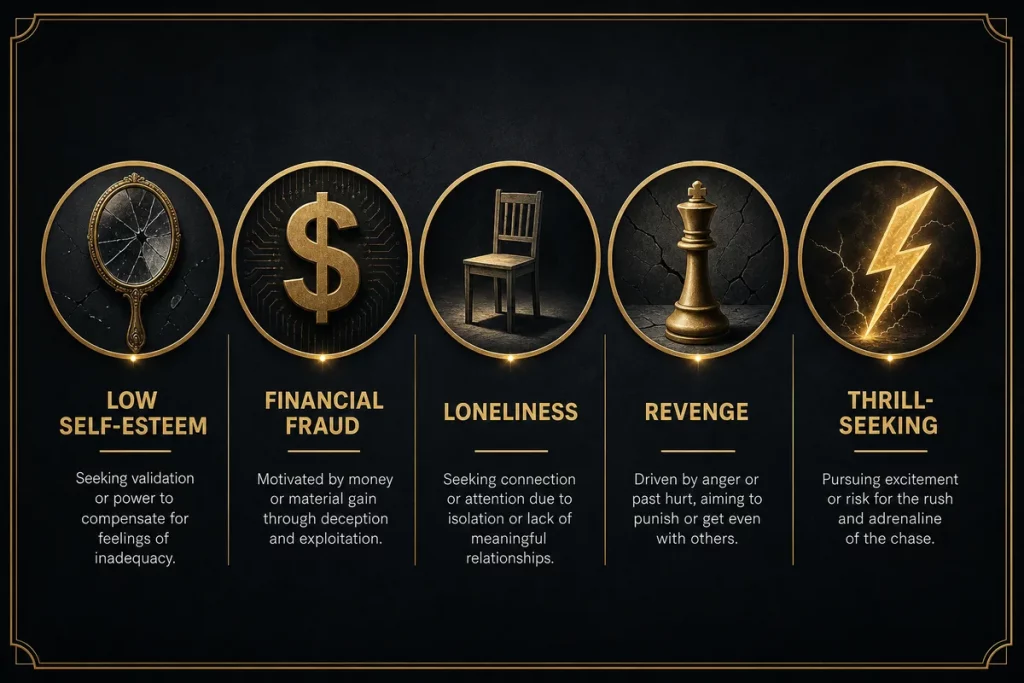
Understanding the psychology behind catfishing helps explain its persistence and helps you recognize patterns. Research identifies several primary motivations:
Low self-esteem and body image issues. Many catfish are deeply unhappy with their own appearance, social status, or life circumstances. Creating an idealized online persona allows them to experience the social acceptance and romantic attention they believe their real self can’t attract. This doesn’t excuse the harm they cause — but it explains why catfishing is so persistent despite increasing awareness.
Financial desperation or professional fraud. Organized scam networks employ catfish operators — sometimes hundreds at a time — to target victims for financial extraction. For these catfish, it’s a job. They’re given photos, scripts, and quotas. The FBI’s IC3 has documented fraud compounds in Southeast Asia where workers are trafficked and forced to run catfishing operations against their will.
Loneliness and social isolation. Some catfish are genuinely lonely and lack the social skills or confidence to form real connections. The fake identity becomes a crutch — a way to experience intimacy without the vulnerability of being known. These catfish often develop genuine feelings for their targets, creating emotionally complex situations where both parties are hurt when the truth emerges.
Revenge and control. Catfishing can be a weapon. Ex-partners, jealous rivals, and grudge-holders use fake identities to monitor, manipulate, or humiliate their targets. This form of catfishing is often connected to broader patterns of stalking, harassment, and domestic abuse.
Thrill-seeking and power. Some catfish are simply addicted to the power of deception — the thrill of maintaining a false identity, controlling someone’s emotions, and watching the manipulation unfold. This motivation is less common but particularly dangerous because these catfish are skilled manipulators who view their targets as entertainment.
12 Warning Signs of a Catfish
Now that you understand what is catfishing and why it happens, here are the concrete signs that someone you’re talking to online may not be who they claim to be:
1. They repeatedly refuse video calls. Repeated avoidance is a meaningful warning sign, but it is not proof by itself. Consider accessibility, privacy, and personal circumstances alongside the broader pattern of evidence.
2. Their photos are too perfect. All professional-quality shots, no casual candids, no tagged photos from friends. Real social media histories include blurry group shots, unflattering angles, and imperfect moments. A curated portfolio of flawless images suggests stolen or AI-generated content.
3. Their account is new. Check creation dates on all platforms they’re on. A genuine person has years of social media history. A catfish account was created recently — often within weeks of contacting you.
4. Reverse image search finds their photos elsewhere. The definitive test. Run their photos through Google Reverse Image Search, TinEye, or GuyID’s screening tools. If the same images appear under different names or on stock photo sites, you’ve confirmed the deception. See our full guide on reverse image search for dating.
5. They profess love unusually quickly. “I’ve never felt this way,” “You’re my soulmate,” “I love you” — within days or weeks, before meeting in person. This love bombing creates emotional dependency that overrides critical thinking.
6. Their stories have inconsistencies. They said they live in Dallas but their timezone doesn’t match. They claim to work in finance but can’t discuss basic market concepts. They mentioned two siblings last month but three this week. Catfish managing multiple identities often slip on details.
**7. One or two cancellations happen naturally. A pattern of avoidance over weeks is a clear signal.
8. They ask for money. Any financial request — emergency funds, travel costs, medical bills, investment opportunities, gift cards — confirms either a catfish scammer or a scam operating under a catfish identity. This rule has no exceptions regardless of circumstance.
9. No tagged photos from real people. On Facebook and Instagram, real people are tagged in friends’ photos. Catfish upload their own images but cannot appear in other real people’s content. Zero tags from genuine connections is a major red flag.
10. Low-quality engagement on their profiles. Followers with no profile photos, generic “nice pic” comments, or engagement that looks purchased rather than organic. Real social media engagement includes inside jokes, birthday wishes, and genuine interaction from real friends.
11. They want to move off-platform immediately. A push to move from the dating app or social media platform to WhatsApp, Telegram, or text within the first few messages. Catfish want you away from platforms with reporting tools. Follow safe transition guidelines before moving off-app.
12. Your gut says something’s off. Intuition is a real signal. If the person feels too good to be true, if conversations feel scripted, or if you sense something isn’t right — trust that feeling. Use verification tools to check what your instincts are telling you.
For an even more detailed checklist, see our comprehensive fake profile red flags checklist and our guide on how to tell if someone is catfishing you.
AI Catfishing: The 2026 Threat
AI has fundamentally changed the answer to “what is catfishing” by making it dramatically easier and harder to detect. Here’s what’s changed:
AI-generated faces are nearly undetectable. Tools like Midjourney, DALL-E 3, and Stable Diffusion XL generate photorealistic faces that have never existed. These images don’t appear in reverse image search databases because they’re unique creations. A catfish can now generate an entire photo set — multiple angles, outfits, and settings — of a completely fictional person in minutes.
AI chatbots maintain convincing conversations. Large language models can generate natural-sounding text that adapts to conversation context, remembers details, and mimics emotional engagement. Scam operations now use AI to manage dozens of simultaneous catfish conversations, with human operators stepping in only for high-value targets or critical moments.
Deepfake video threatens the video call test. Real-time deepfake technology can overlay one person’s face onto another during a video call. While still imperfect — look for unnatural lip sync, lighting inconsistencies, and artifacts when the person turns their head — the technology is improving rapidly. This threatens what has been the most reliable catfish detection method.
How to protect yourself in the AI era: Reverse image search remains valuable but isn’t sufficient alone. Combine it with video calls (deepfakes still have visible flaws at close attention), social media cross-referencing (AI can generate faces but not years of social history), and identity verification through GuyID’s government ID system — which confirms a real person’s legal identity regardless of what photos they use. For detailed AI detection techniques, see our guide on AI-generated dating profile detection.
How to Catch a Catfish: 5 Verification Steps
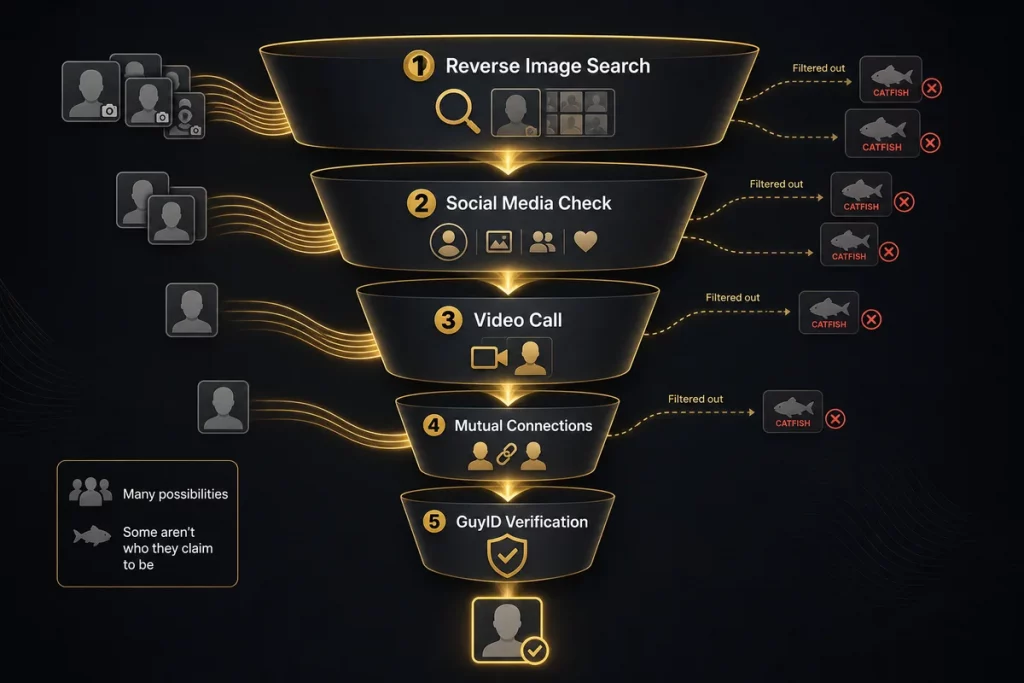
If you suspect someone might be catfishing you, follow these steps in order. Each builds on the previous one:
Step 1: Reverse image search (30 seconds). Run every photo they’ve shared through Google Images and TinEye. Also use reverse image search tools designed for dating. If their photos appear elsewhere under different names, you’ve confirmed the catfish.
Step 2: Cross-reference social media (5 minutes). Ask for their Instagram, Facebook, and LinkedIn. Check account creation dates, engagement quality, friend/follower authenticity, and consistency across platforms. A real person’s social media tells a coherent story spanning years.
Step 3: Request a video call (5 minutes). Ask for a live video call on FaceTime, Google Meet, or Zoom. This eliminates catfish who can’t show the face they’re impersonating. During the call, ask them to do something specific — wave, turn their head, hold up a specific number of fingers — to rule out pre-recorded video.
Step 4: Verify mutual connections. Ask about shared contacts, mutual friends, or professional references. A real person can be corroborated by other real people. A catfish exists in isolation — they have no verifiable connections to the real world.
Step 5: Request GuyID verification (2 minutes). For connections that are becoming meaningful, ask them to verify through GuyID. Government ID verification confirms their legal identity. Social vouching confirms real people know them. The Trust Score provides an objective credibility metric. Share your Date Mode link to make it mutual.
What to Do If You’ve Been Catfished
Discovering you’ve been catfished is emotionally devastating. Here’s the practical and emotional action plan:
Stop contact immediately. Block the catfish on every platform. Don’t confront them — this may provoke threats, guilt manipulation, or evidence deletion. A clean break protects you and preserves evidence.
Preserve all evidence. Before blocking, screenshot every conversation, profile detail, photo, and transaction. Save phone numbers, email addresses, and any links they shared. This documentation is essential for reporting and potential legal action.
Report the fake profile. Report to the platform where you connected — the dating app, Facebook, Instagram, etc. Also report to the FBI’s IC3 and the FTC if money or personal information was compromised. For the complete process, see our guide on how to report a scammer.
If money was lost, contact your financial institution. Ask promptly which dispute, recall, or fraud-reporting options apply to the payment method.
Process the emotional impact. Being catfished is a real form of betrayal. The feelings of grief, anger, shame, and broken trust are valid — you invested genuine emotions in what you believed was a genuine person. Consider speaking with a therapist, joining a support community, or confiding in a trusted friend. The Cybercrime Support Network offers free victim resources. See our full guide on what to do if you’ve been catfished.
How to Prevent Catfishing
Now that you fully understand what is catfishing, here’s how to prevent it from happening to you:
Make verification a habit, not a reaction. Don’t wait until something feels wrong. Run a reverse image search on every new match or connection as standard practice. It takes 30 seconds and catches the majority of catfish before any emotional investment occurs.
Video call before emotional investment. Set a personal rule: no developing feelings until after a live video call. This single boundary prevents virtually all catfishing attempts because the catfish cannot pass the visual verification test.
Never send money to anyone you haven’t met in person. This rule prevents the most financially devastating catfishing outcomes. No exception — no matter the story, the emergency, or the emotional connection.
Protect your own identity. Set social media to private, limit photo sharing, and be cautious about the personal information you share online. Your photos could be stolen for a catfish account targeting someone else.
Use GuyID for serious connections. When an online connection becomes meaningful, both parties benefit from verified identity confirmation. GuyID’s government ID verification and peer vouching system provides the certainty that photos and stories alone never can. Build your Trust Score to signal that you’re the real deal — and expect the same from anyone who wants to date you.
How GuyID Helps
GuyID should appear when it is useful, not as a banner ad. A GuyID Trust Profile gives someone a portable way to share trust signals before a date, while identity verification and social vouching help turn vague profile claims into clearer next steps.
Useful next steps:
- Create a GuyID Trust Profile when you want a cleaner way to share verified trust signals.
- Use GuyID free tools and related guides when you need a checklist before meeting someone.
- Treat identity verification as confidence-building, not a guarantee.
- Use social vouching when you want context from people who already know the person.
- Sign up only when the extra trust layer helps the decision you are already trying to make.
Frequently Asked Questions
What is catfishing in simple terms?
Catfishing is when someone creates a fake identity online — using stolen photos and made-up details — to trick another person into a relationship. The catfish pretends to be someone they’re not in order to gain trust, emotional connection, money, or personal information from their target.
Is catfishing illegal?
Catfishing itself — creating a fake profile — isn’t illegal in most U.S. states. However, when catfishing involves financial fraud (wire fraud, mail fraud), identity theft, sextortion, targeting minors, or harassment, it becomes criminal and prosecutable under federal and state laws. Several states have introduced specific anti-catfishing legislation, and the legal landscape is evolving toward greater accountability.
How common is catfishing?
There is no single reliable prevalence rate across all dating apps and social networks. Catfishing is a documented risk, and generated content can make fabricated profiles easier to create. Assess the specific evidence rather than relying on a broad percentage.
What is the fastest way to catch a catfish?
Two methods: (1) Reverse image search their photos — takes 30 seconds and catches catfish using stolen images. Use Google Images, TinEye, or GuyID’s screening tools. (2) Request a live video call — takes 5 minutes and is conclusive, since a catfish cannot show the face they’re impersonating. Together, these catch virtually every catfish.
What is catfishing on dating apps specifically?
Catfishing on dating apps follows the same pattern as other platforms but with accelerated timelines because users are actively seeking romantic connection. The catfish creates a fake profile on Tinder, Bumble, Hinge, or similar apps using stolen or AI-generated photos, then builds emotional connection through messaging before pursuing their goal — money, personal information, intimate content, or emotional validation. See our platform-specific guides for Hinge, Bumble, and Tinder.
Can someone catfish you with AI-generated photos?
Yes — and this is the biggest emerging threat. AI tools can generate photorealistic faces that don’t exist, complete with multiple angles and settings. These images don’t appear in reverse image search. Detection requires looking for subtle AI artifacts (irregular skin texture, asymmetric jewelry, distorted backgrounds) and using AI detection tools. The most reliable defense is identity verification through GuyID that confirms a real person beyond just photos.
What should I do if I was catfished?
Stop all contact, screenshot and save all evidence, report the fake profile to the platform, and file reports with the FBI’s IC3 and FTC if money or personal data was involved. Contact your bank if you sent money. Seek emotional support — being catfished is a genuine form of betrayal. See our full guide on what to do if you’ve been catfished.
Why is catfishing so emotionally damaging?
Because you invested real emotions in what you believed was a real relationship. The love, trust, vulnerability, and hope were genuine — even though the person was fabricated. Discovering the truth forces you to grieve a relationship that never existed while simultaneously processing the betrayal. Many victims report trust issues in future relationships. Professional support can help — the experience is valid and recovery takes time.