Free Tools
Catfish Probability Detector
Check whether a dating profile has suspicious identity or photo signals.
Dating Bio Red Flag Detector
Review a bio for scam, pressure, or trust-warning language.
Dating Safety Checklist
Use free GuyID tools before moving from chat to a real date.
Next step
Create your GuyID trust profile
Share consent-based trust signals before a date without turning the conversation into an interrogation.
If you’ve tried running a people search free in Canada using American tools like BeenVerified or TruthFinder, you already know the problem — they don’t work north of the border. Canadian privacy laws are stricter than U.S. laws, Canadian public records are structured differently, and most commercial people search databases have minimal Canadian coverage. But free options do exist. This guide covers the 8 methods that actually work for a people search free in Canada, explains what Canadian privacy law allows and restricts, and provides the dating safety application for Canadians verifying matches on apps like Tinder, Bumble, and Hinge.
NavigateTable of Contents25 sections
Why Canadian People Search Is Different
Running a people search free in Canada is fundamentally different from doing the same in the United States for three reasons:
PIPEDA restricts data collection. Canada’s Personal Information Protection and Electronic Documents Act (PIPEDA) governs how private-sector organizations collect, use, and disclose personal information. Unlike the U.S., where public records are broadly accessible and commercial aggregation is largely unregulated, PIPEDA requires consent for most personal data collection. This means American-style people search databases that scrape and aggregate personal data don’t legally operate the same way in Canada.
Provincial laws add additional layers. Quebec has its own privacy legislation (Law 25, formerly Bill 64), British Columbia has PIPA, and Alberta has its own PIPA — all with stricter provisions than PIPEDA in some areas. This patchwork means data availability varies by province, making a unified people search free Canada tool nearly impossible to build.
Court records are less accessible. While Canadian court records are technically public, online access varies dramatically by province and court level. Some provinces offer robust online search (Ontario’s case search portal), while others require in-person requests. Criminal records are particularly restricted — the Canadian Police Information Centre (CPIC) database is not publicly searchable, and criminal record checks typically require the person’s consent.
The result: the “enter a name, get a full report” model that works in the U.S. doesn’t exist for Canadian residents. Instead, a people search free Canada approach requires combining multiple specific tools — each covering a different data category. This is frustrating if you’re used to U.S. convenience, but it also means your personal data is better protected in Canada than it is south of the border — a trade-off that benefits you as much as it complicates your searches of others.
What this means for dating safety in Canada: The restricted access to background information makes consent-based verification even more important for Canadian daters. In the U.S., you can cobble together a reasonable background picture from public records without the other person’s knowledge. In Canada, the most effective approach is mutual verification — where both people voluntarily prove their identity through a service like GuyID. This consent-based model actually aligns better with healthy relationship dynamics than one-sided surveillance, and it’s the model Canadian privacy law was designed to encourage.
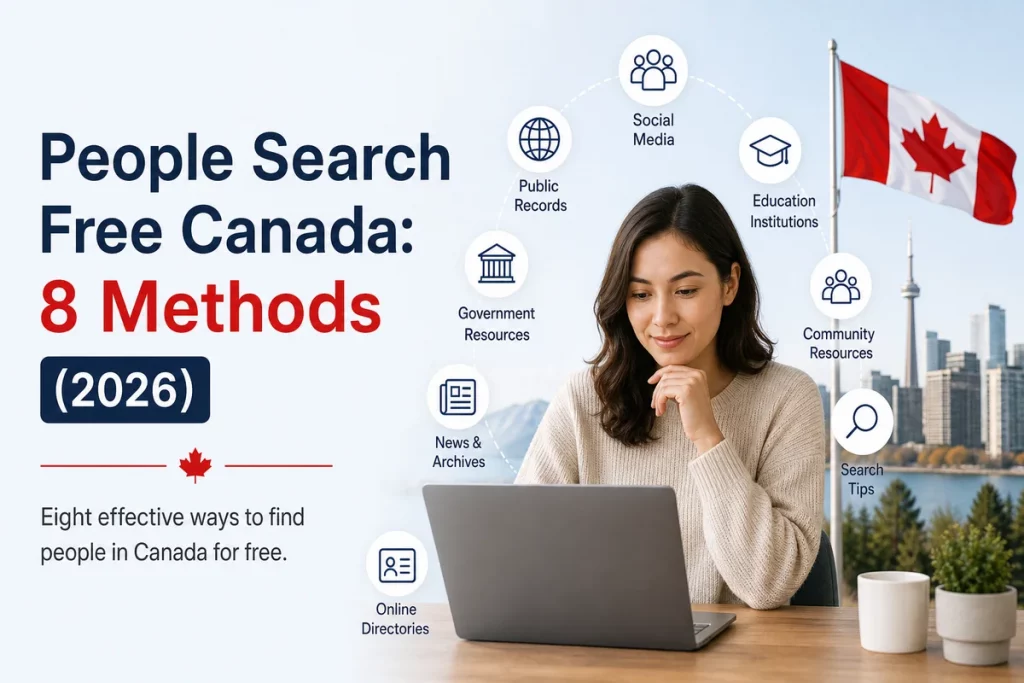
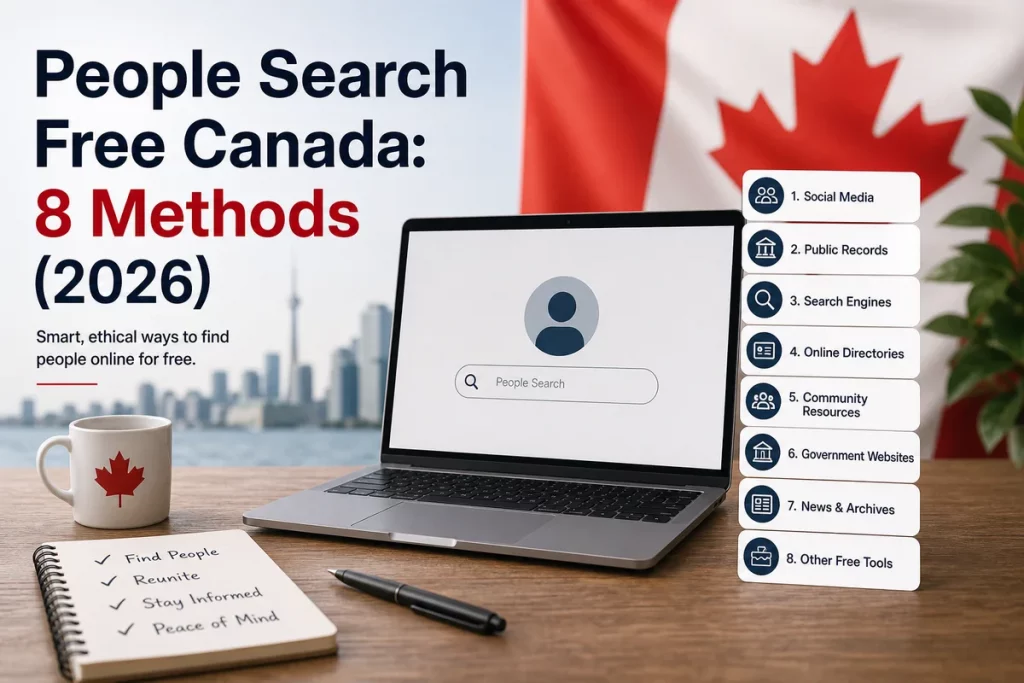
8 Free Methods for People Search Free Canada
1. Google Search (Free — Best Starting Point)
Search the person’s name in quotes plus their Canadian city: “Jane Doe” Ottawa. Google indexes Canadian social media, news sites, professional directories, court mentions, and business registrations. For Canadian-specific results, add “site:.ca” to filter for Canadian websites. Google is the most versatile people search free Canada tool because it crosses every data category.
2. Canada411 (Free)
Canada411.ca is the Canadian equivalent of WhitePages. Search by name, phone number, or address to find listed phone numbers, addresses, and reverse lookups. Coverage is limited to people with listed landline numbers (which excludes most mobile-only users under 40), but it remains the most recognized free Canadian directory and a solid starting point for any people search free Canada effort.
3. LinkedIn (Free)
Search by name and filter by location, company, or industry. For dating safety, LinkedIn confirms whether someone’s claimed employment and professional background are genuine. A LinkedIn profile with years of history, endorsements, and connections from Canadian companies provides strong identity confirmation.
4. Provincial Court Records (Free — Varies by Province)
Court records access varies by province. Ontario offers Ontario Courts online case search. British Columbia provides eCourt for civil cases. Alberta has ACIS. Quebec’s SOQUIJ database covers Quebec court decisions. Search “[province name] court records search” to find your provincial portal. Coverage and ease of access vary significantly — Ontario and BC have the best online systems.
5. Provincial Land Registry (Free or Low Cost)
Each province maintains a land title registry searchable by address or owner name. Ontario’s Teranet offers limited free searches. BC’s Land Title and Survey Authority provides paid online access. Alberta’s SPIN2 system is available for a small fee. Property ownership records confirm whether someone lives where they claim and whether they own or rent — useful context for dating verification.
6. Elections Canada Voter Registry (Restricted)
Unlike the U.S., Canada’s voter registry is not publicly searchable online. However, during election periods, voter lists are available to candidates and registered parties. Outside election periods, the voter registry is not a viable tool for a people search free Canada. Mentioned here to prevent wasted time — this is a common dead end.
7. Social Media (Free)
Facebook, Instagram, and Twitter/X have massive Canadian user bases. Search the person’s name directly on each platform. For Canadian-specific verification, check for: local Canadian friends and followers, references to Canadian cities, schools, and employers, and engagement from other Canadian users. Social media cross-referencing is the strongest free identity verification method available to Canadians because it circumvents the data access limitations that affect other approaches.
8. GuyID Screening Tools (Free)
GuyID’s free screening toolkit works for Canadian users — reverse image search, catfish probability detection, and fake profile analysis don’t depend on country-specific databases. For dating safety in Canada, GuyID’s tools fill the gap left by the absence of American-style people search services. GuyID’s identity verification through government ID also works with Canadian identification documents.
Canadian Privacy Law: What’s Allowed
Understanding Canadian privacy law helps you know what’s legally accessible for a people search free Canada:
What you can search freely: Publicly available information — social media profiles set to public, published news articles and media coverage, business registrations through provincial and federal corporate registries, court decisions that have been made publicly available through provincial portals, property records through provincial land registries, and any information the person has voluntarily made publicly accessible themselves. Google searches, LinkedIn profiles, and public social media are all fair game for personal safety purposes.
What requires consent in Canada: Criminal record checks through the Canadian Police Information Centre (CPIC) — these require the individual’s fingerprints and signed consent. Credit reports through Equifax or TransUnion Canada. Employment records held by employers. Medical and health records. Any personal information held by private organizations under PIPEDA. You cannot run a Canadian criminal background check on a dating match without their direct knowledge, participation, and signed consent — this is a fundamental and important difference from the U.S. system where criminal court records are broadly searchable by anyone.
What’s illegal: Accessing personal information through deception, hacking, or unauthorized database access. Using personal information for harassment, stalking, or discrimination. Impersonating someone to obtain their records. The Office of the Privacy Commissioner of Canada enforces these protections with meaningful penalties.
The dating safety implication: In Canada, you cannot run a criminal background check on a dating match without their participation. This makes consent-based verification — where the person voluntarily proves their identity through a service like GuyID — the most legally appropriate and practically effective dating safety approach for Canadians.
Using Free People Search for Dating Safety in Canada
For Canadians verifying dating matches, here’s the adapted verification protocol that works within Canadian legal and data availability constraints:
Step 1 (2 min): Reverse image search their photos. This works identically in Canada — Google Images, TinEye, and Yandex are all accessible. See our reverse image search guide. Also check for fake profile red flags and catfishing indicators.
Step 2 (5 min): Social media cross-reference. Search their name on Facebook, Instagram, and LinkedIn. Look for Canadian-specific markers — references to Canadian cities and provinces, Tim Hortons or Canadian Tire check-ins, Canadian university alumni groups (U of T, UBC, McGill, Queen’s, Ottawa U), connections with other verifiable Canadians, and mentions of Canadian holidays like Canada Day or Thanksgiving in October. A genuine Canadian has years of Canadian social media history with authentic local references that someone impersonating a Canadian from overseas would struggle to replicate convincingly.
Step 3 (3 min): Phone number verification. Canada411 and Truecaller both work for Canadian phone numbers. Check for name consistency between the registered name and what your match told you, and verify carrier information. Canadian mobile numbers follow predictable area code patterns by province — an Ottawa match with a 416 (Toronto) or 604 (Vancouver) number isn’t necessarily a red flag (people keep numbers when they move between provinces), but it’s a data point worth noting and potentially asking about casually. A number registered to a completely different name, however, is a significant red flag regardless of area code.
Step 4 (5 min): Video call. The most effective verification step for any country. Catches all catfish, confirms the person matches their photos, and provides real-time interaction that no background check can replicate.
Step 5 (2 min): Ask for GuyID verification. Share your Date Mode link and ask your match to verify through GuyID. Government ID verification with Canadian documents provides the identity confirmation that Canada’s privacy framework makes difficult to obtain through other means. This is the most legally sound approach to dating verification in Canada because it’s consent-based — the person chooses to verify.
For complete dating safety protocols, see our background check for dating guide and first date safety tips.
Do Paid Services Work in Canada?
The short answer: poorly. Here’s what to expect from each category of paid service:
U.S.-based people search (BeenVerified, TruthFinder, Spokeo): These services have minimal Canadian data. Their databases are built primarily from U.S. public records, Social Security data, and state-level databases that don’t exist in Canada. Canadian privacy law (PIPEDA) restricts the type of commercial data aggregation these services rely on in the U.S., which means they can’t legally build equivalent Canadian databases. Not recommended for Canadian users. See our BeenVerified review for the full analysis.
Canada-specific people search services: Services like Instant Checkmate Canada, PeopleFinders Canada, and Canadian-branded offshoots of U.S. services exist but have limited and inconsistent databases. Coverage varies dramatically by province — Ontario data is typically the most complete, while Atlantic provinces and territories have minimal coverage. The same bait-and-switch subscription model applies: free teaser results, paid full reports, auto-renewal, phone-call cancellation. Most Canadian users report that the paid results don’t contain significantly more information than the free methods described in this guide.
Formal Canadian criminal record checks: A Canadian Police Information Centre (CPIC) criminal record check — the only comprehensive criminal background check in Canada — requires the subject’s consent and typically their fingerprints. You can request a check through your local police service or through accredited service providers. This is the legitimate way to check someone’s criminal record in Canada, but it requires their participation — you cannot run it without their knowledge and consent.
The better Canadian option for dating: For dating safety specifically, GuyID is Canadian-built (headquartered in Ottawa), accepts Canadian government identification documents (driver’s licence, passport, provincial health card), and addresses the consent-based verification model that Canadian privacy law favors. Free screening tools provide reverse image search, catfish detection, and fake profile analysis. The paid tier adds government ID verification — producing the same certainty that a formal identity check would provide, but designed specifically for the dating context. This provides more dating-relevant protection than any paid people search service with inadequate Canadian data.
Province-by-Province Court Records Access
For Canadians trying to check court records as part of a people search free Canada process, here’s what each major province offers online:
Ontario: The most accessible province for free online court records. The Ontario Court of Justice and Superior Court of Justice offer online case search through their portals. You can search by party name for criminal, civil, and family court filings. Coverage is comprehensive for recent years. This is the closest Canada gets to the U.S. model of free, searchable court records.
British Columbia: BC offers the eCourt system for civil cases searchable by party name. Criminal case information is more limited online — detailed records often require in-person requests at the courthouse. The BC Court Services Online portal provides some access to court schedules and filed documents.
Alberta: The Alberta Courts Information System (ACIS) provides online search for Provincial Court criminal and civil cases by party name. Coverage is reasonably good for recent cases. The Court of Queen’s Bench has a separate search system with more limited online access.
Quebec: SOQUIJ (Société québécoise d’information juridique) maintains a database of Quebec court decisions searchable online. The scope covers published decisions rather than all filings, so minor cases may not appear. Quebec’s privacy legislation (Law 25) adds additional restrictions on personal information searches compared to other provinces.
Saskatchewan, Manitoba, Atlantic provinces, and territories: Online court record access is more limited in these jurisdictions. Some offer basic case search portals; others require in-person or mail requests. For people search free Canada purposes in these provinces, social media cross-referencing and Google searches become more important to compensate for the court records access gap.
How GuyID Helps
GuyID should appear when it is useful, not as a banner ad. A GuyID Trust Profile gives someone a portable way to share trust signals before a date, while identity verification and social vouching help turn vague profile claims into clearer next steps.
Useful next steps:
- Create a GuyID Trust Profile when you want a cleaner way to share verified trust signals.
- Use GuyID free tools and related guides when you need a checklist before meeting someone.
- Treat identity verification as confidence-building, not a guarantee.
- Use social vouching when you want context from people who already know the person.
- Sign up only when the extra trust layer helps the decision you are already trying to make.
Frequently Asked Questions
Is there a free people search for Canada?
There is no single Canadian equivalent to the broad people-search databases marketed in the United States. You can consult lawful public sources and verify specific claims with the person’s consent, but coverage varies by province and no search result establishes safety or trustworthiness.
Does BeenVerified work in Canada?
Poorly. BeenVerified’s database is built primarily from U.S. public records. Canadian searches return minimal or no results. Canadian privacy law (PIPEDA) restricts the type of data aggregation that BeenVerified relies on in the U.S. For Canadian people search, use Canada-specific tools like Canada411, provincial court records, and GuyID instead.
Can I run a criminal background check in Canada for free?
Not in the same way as the U.S. Canadian criminal records (CPIC) require the individual’s consent and fingerprints. Some provincial court records are searchable online for free (Ontario, BC, Alberta), which shows court filings in those jurisdictions. For dating safety, consent-based identity verification through GuyID is the most legally appropriate approach in Canada.
What is Canada411?
Canada411 is the Canadian white pages directory — searchable by name, phone number, or address. It’s free and covers listed landline numbers across Canada. The limitation: it doesn’t include mobile-only numbers, which means most people under 40 won’t appear. It remains useful for confirming whether a person with a given name exists at a given Canadian address.
How do I verify a dating match in Canada?
Use the 5-step Canadian dating verification protocol: (1) reverse image search their photos, (2) cross-reference on social media with Canadian markers, (3) verify their phone number through Canada411/Truecaller. (4) Video call before meeting, (5) ask them to verify through GuyID with Canadian government ID. This approach works within Canadian privacy law and catches most dating threats.
Is it legal to search someone’s name in Canada?
Yes — searching publicly available information (Google, social media, published directories, public court records) is legal in Canada for personal use. What’s restricted: accessing non-public databases without consent, running criminal record checks without the person’s participation, and using any information for harassment or stalking. The Office of the Privacy Commissioner provides guidance on legitimate personal information searches.
Does GuyID work for Canadian users?
Yes. GuyID is Canadian-built (headquartered in Ottawa), accepts Canadian government identification for verification, and its free screening tools work regardless of country. For Canadian dating safety, GuyID is the most privacy-compliant option because it uses consent-based verification — the person chooses to prove their identity rather than having their information searched without their knowledge.
What Canadian court records can I search online for free?
Ontario offers online case search through the Ontario Courts portal. British Columbia provides eCourt for civil cases. Alberta has the ACIS system. Quebec offers SOQUIJ for court decisions. Saskatchewan, Manitoba, and the Atlantic provinces have more limited online access. Federal court decisions are searchable through the Federal Court’s online database. Coverage varies significantly by province and court level.