

Reader Briefing
Reader Briefing
Start here if you need a practical read on emotional abuse relationship symptoms: 15 signs you shouldn’t ignore: who should use verification, what signals to check, and what to do before moving from online interest to an in-person plan.
Who this is for
- Readers preparing for a first in-person date.
- Anyone checking identity, profile consistency, and trust signals.
- People trying to avoid romance scams, fake profiles, or pressure tactics.
- Online daters improving conversations, profiles, or match screening.
You’ll learn
- How to evaluate identity signals without treating any single check as certainty.
- Which trust signals matter and how to weigh them together.
- How to spot inconsistencies, pressure, or behavior patterns that deserve caution.
- How to move from online conversation to a safer first meeting.
- Where GuyID tools fit into a quick pre-date screening workflow.
- When to slow down, ask for more context, or walk away.
Bottom line
Verification reduces uncertainty; it does not guarantee future behavior. Use a layered approach: confirm identity signals, compare profile consistency, ask for a short video call, keep early plans public, and slow down when someone pressures you to skip normal safety steps.
Key takeaways
- Identity verification improves confidence, not certainty.
- Patterns matter more than isolated incidents.
- Verify before meeting privately or sharing sensitive details.
- A short video call can reveal many inconsistencies.
- Pressure to skip reasonable safety steps is useful information.
Free Tools
Catfish Probability Detector
Check whether a dating profile has suspicious identity or photo signals.
Dating Bio Red Flag Detector
Review a bio for scam, pressure, or trust-warning language.
Dating Safety Checklist
Use free GuyID tools before moving from chat to a real date.
Next step
Create your GuyID trust profile
Share consent-based trust signals before a date without turning the conversation into an interrogation.
Emotional abuse doesn’t leave bruises — it leaves confusion. The most insidious emotional abuse relationship symptoms aren’t the dramatic explosions that outsiders can witness; they’re the quiet, cumulative patterns that erode your sense of self so gradually you don’t recognize the damage until your confidence, your mental clarity, and your ability to trust your own perception have been deliberately and systematically dismantled over time. Understanding emotional abuse relationship symptoms means learning to see the patterns that abuse is specifically designed to make invisible — because the first defense against emotional abuse is the ability to name what’s happening to you while it’s happening, not just in retrospect.
NavigateTable of Contents29 sections
Internal Emotional Abuse Relationship Symptoms: What You Feel
The earliest emotional abuse relationship symptoms are internal — changes in how you feel about yourself, your relationship, and your reality that develop so gradually and insidiously they can be mistaken for personal failings or natural relationship growing pains rather than recognized as responses to systematic mistreatment. According to the American Psychological Association’s research on emotional abuse impact, internal symptoms often precede behavioral symptoms by months — meaning the damage is accumulating before any external signs become visible.
1. Chronic Self-Doubt
You used to trust your judgment. Now you second-guess everything — your memories, your perceptions, your decisions, your emotional responses. “Am I remembering this correctly?” “Am I overreacting?” “Maybe they’re right and I AM the problem.” This self-doubt isn’t random anxiety; it’s the direct product of sustained gaslighting that has systematically taught you that your perception of reality is unreliable. Research from the National Library of Medicine confirms that chronic self-doubt is the most frequently reported symptom among emotional abuse survivors — and its presence should be taken seriously as a signal that something in the relationship is actively undermining your self-trust.
2. Walking on Eggshells
You monitor your words, tone, timing, and behavior to avoid triggering your partner’s anger, criticism, silence, or withdrawal. The hypervigilance is exhausting — every interaction requires careful calculation about what’s safe to say and what might provoke a negative response. Walking on eggshells is one of the most recognizable emotional abuse relationship symptoms because it reverses the emotional labor: instead of both people working to make the relationship safe, ONE person is working constantly to manage the other’s volatility while the volatile partner takes no responsibility for the climate they’ve created.
3. Feeling “Crazy”
“Maybe I AM too sensitive.” “Maybe I AM imagining things.” “Maybe I really am the difficult one.” The feeling of going crazy — questioning your sanity, your emotional calibration, your grip on reality — is perhaps the most alarming of all emotional abuse relationship symptoms because it mimics actual mental health deterioration. But you’re not losing your mind; you’re responding predictably to an environment specifically designed to make you doubt yourself. The narcissistic abuse signs guide explains the deliberate mechanisms that produce this specific symptom.
4. Chronic Shame
Not guilt about specific actions (which is healthy and proportionate) — but pervasive shame about who you ARE. You feel fundamentally flawed, unworthy, and grateful that anyone “puts up with you.” This shame isn’t pre-existing; it’s been installed by the cumulative weight of criticism, contempt, and the persistent message that you’re not good enough. Chronic shame as a symptom distinguishes emotional abuse from normal relationship friction: healthy relationships may produce occasional guilt; abusive relationships produce systemic shame that permeates your entire self-concept.
5. Emotional Numbness
After months or years of emotional abuse, many people develop numbness — a protective disconnection from their own emotions. You stop feeling the hurt because feeling hurt was never acknowledged or addressed; you stop feeling joy because joy triggers the anticipation of the next painful episode; you stop feeling anger because anger was punished. The numbness isn’t depression (though it resembles it) — it’s the nervous system’s adaptation to an environment where feeling emotions is dangerous because emotions were consistently weaponized, dismissed, or used against you.
Behavioral Changes as Emotional Abuse Relationship Symptoms
6. Social Withdrawal
You’ve gradually stopped seeing friends, calling family, and maintaining the social connections that existed before the relationship. The withdrawal may feel like your choice (“I’ve been busy,” “I just haven’t felt like socializing”), but examining the WHY reveals the abuse pattern: you withdrew because social events triggered your partner’s jealousy, because your friends expressed concerns you weren’t ready to hear, because the emotional cost of maintaining friendships alongside the relationship became too high, or because your partner’s criticism of your friends made spending time with them feel like a betrayal of the relationship. Isolation is both a tactic the abuser uses and a symptom the target displays — making it simultaneously cause and effect. Our platonic relationship guide covers why maintaining friendships outside the partnership matters for exactly this reason.
7. People-Pleasing Escalation
You’ve become increasingly focused on keeping your partner happy — anticipating needs before they’re expressed, apologizing preemptively, adjusting your behavior to avoid any possible trigger. The people-pleasing isn’t generosity; it’s a survival strategy developed in response to the unpredictable consequences of failing to manage your partner’s emotions. Over time, the people-pleasing extends beyond the relationship: you become conflict-avoidant at work, over-accommodating with friends, and unable to express needs or preferences in any context because the relationship has trained you that having needs is dangerous.
8. Abandoning Interests and Goals
Hobbies you once loved feel pointless. Career ambitions you once pursued feel unrealistic. Personal goals you once worked toward feel selfish or unattainable. This abandonment of personal identity is among the most devastating emotional abuse relationship symptoms because it represents the successful completion of the abuse’s core project: making you smaller, less autonomous, and more dependent. The abuser hasn’t explicitly forbidden your interests — they’ve created an environment where pursuing them feels impossible, selfish, or pointless through sustained deflection and criticism.
9. Explaining and Defending Constantly
You find yourself explaining your behavior, your decisions, your feelings, and your memories to your partner constantly — defending your perception of events that you KNOW happened, justifying emotional responses that you KNOW are reasonable, and providing evidence for experiences that shouldn’t require evidence. This constant defense posture is one of the most exhausting emotional abuse relationship symptoms because it reverses the burden of proof: instead of the abuser demonstrating that your perception is wrong, YOU must constantly demonstrate that your perception is right — a task that becomes progressively impossible as your self-trust erodes.
10. Difficulty Making Decisions
You used to be decisive. Now choosing what to eat for dinner feels paralyzing. Career decisions feel impossible. Even simple choices produce anxiety about making the “wrong” choice and suffering consequences. This decision paralysis results from the moving-goalposts pattern of emotional abuse: when every decision you make is criticized, corrected, or punished, your brain learns that decisions = danger, producing the avoidance that manifests as inability to choose.
Relational Patterns as Symptoms
11. The Apology Cycle
You may notice that you apologize most of the time, including after you were hurt: “I’m sorry I was upset,” “I’m sorry I brought it up,” or “I’m sorry for making a big deal out of nothing.” Look at what happens when you express a need. Repeated punishment, ridicule, or retaliation for raising concerns can train a person to apologize for having them.
12. Confusion After Conversations
You enter a conversation about your partner’s behavior. You leave the conversation apologizing for yours. How did that happen? The confusion after arguments is a hallmark of deflection and gaslighting working together: the conversation was redirected so skillfully that you didn’t notice the pivot until after the interaction ended and you’re left wondering why you’re the one who apologized when THEY were the topic.
13. Keeping Secrets From Your Support System
You hide the worst moments of your relationship from friends and family — either because you’re ashamed, because you know they’d be concerned, or because explaining the dynamic requires revealing how much you’ve tolerated. This secrecy is one of the most diagnostically significant emotional abuse relationship symptoms because it indicates you’ve internalized the abuser’s framing: that the relationship’s problems are too complex for outsiders to understand, that sharing would be betrayal, or that the consequences of exposure would be worse than the abuse itself. The National Domestic Violence Hotline identifies secrecy around relationship dynamics as a primary indicator that the dynamics being hidden are harmful.
Bonus: Defending Your Partner to Others
When friends or family express concern about how your partner treats you, your automatic response is defense: “They didn’t mean it that way.” “You don’t see the good side.” “It’s not as bad as it sounds.” “They’re under a lot of stress.” The defensive response happens because the trauma bond produces loyalty to the person causing harm — and because acknowledging the concern would require confronting a reality you’re not yet ready to face. The specific emotional abuse relationship symptom isn’t that you defend your partner occasionally (everyone does); it’s that you defend them AGAINST observations that you privately know are accurate, which reveals the internal conflict between what you see and what you’ve been conditioned to accept.
Bonus: Losing Your Sense of Humor
You used to laugh easily. You used to find things funny. Now humor feels distant — partly because the persistent emotional stress suppresses the neurological capacity for levity, and partly because your partner has used “humor” as a delivery vehicle for criticism so often that jokes now produce wariness rather than amusement. When laughter returns — in the company of friends, during a rare good day, watching something genuinely funny — it feels startling and unfamiliar. That startlement at your own laughter is data: your baseline emotional state has shifted so far from joy that joy itself feels foreign.
Physical Symptoms of Emotional Abuse
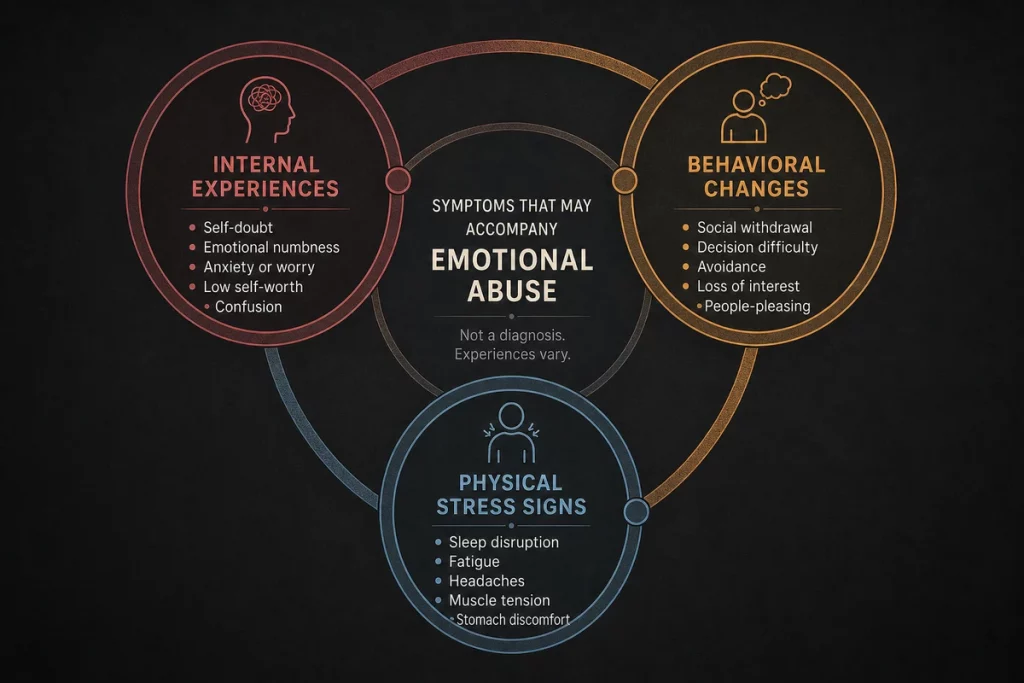
Emotional abuse doesn’t just damage your psychology — it damages your physical body too. The chronic stress of living in an emotionally abusive environment produces measurable physiological consequences that your doctor may attribute to lifestyle factors, genetics, or “stress” without identifying the relational source. Understanding these physical manifestations as emotional abuse relationship symptoms rather than isolated medical issues provides the diagnostic clarity that connects the body’s distress signals to their actual cause:
14. Sleep Disruption
Insomnia, nightmares, hypersomnia (sleeping too much as escape), or the inability to feel rested regardless of sleep duration. Your nervous system is in a state of chronic hypervigilance that prevents the deep restorative sleep your body requires. The sleep disruption compounds every other symptom — reducing emotional regulation capacity, cognitive function, and physical resilience at the same time the relationship is demanding maximum resources from all three.
15. Chronic Physical Complaints
Unexplained headaches, stomach problems, muscle tension, jaw clenching, chest tightness, or frequent illness. The body stores what the mind can’t process — and the chronic stress of emotional abuse produces inflammation, immune suppression, and stress-hormone dysregulation that manifest as physical symptoms your doctor may struggle to explain because the cause isn’t physical; it’s relational. If you’ve developed persistent physical symptoms that correlate with the timeline of your relationship, the relationship itself may be the diagnosis your body is trying to communicate.
What to Do If You Recognize These Emotional Abuse Relationship Symptoms
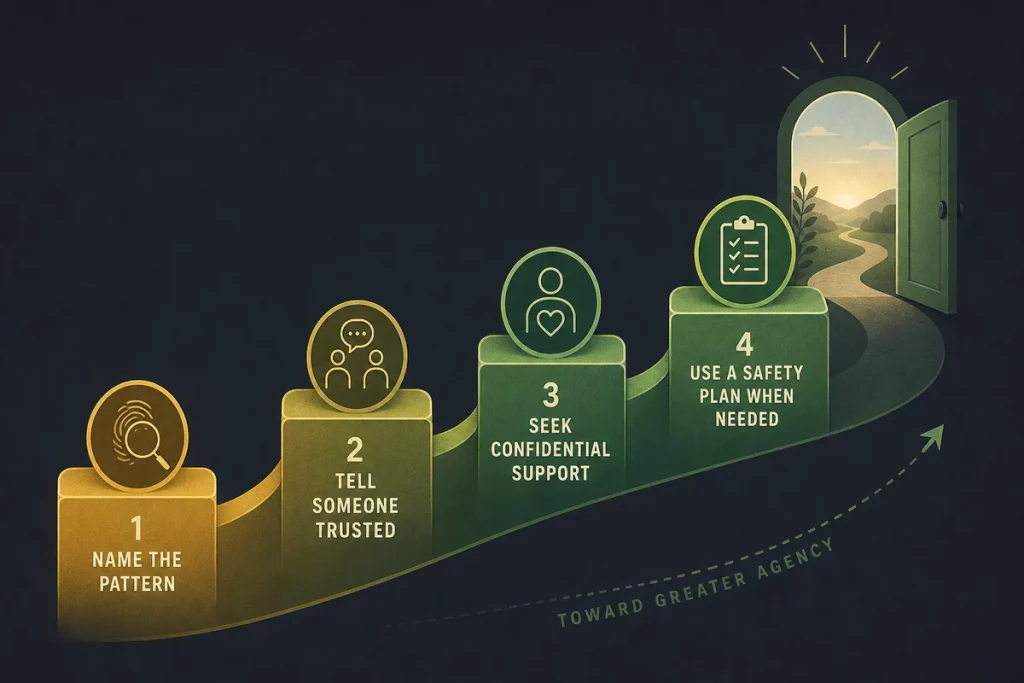
Name what’s happening. “This is emotional abuse” is one of the most powerful sentences a person in this situation can form — because the naming itself breaks the gaslighting spell that depends on your inability to categorize your experience. You don’t need your partner to agree with the label. You don’t need a therapist’s confirmation before you’re “allowed” to use it. If the patterns described in this guide match your experience, calling it what it is — emotional abuse — is the first step toward reclaiming the self-trust that the abuse has eroded. The naming may feel dramatic, premature, or unfair to your partner — and that reluctance to name it is itself a symptom of how thoroughly your perception has been undermined. Trust the pattern recognition that brought you to this page rather than the internal voice that tells you to minimize what you’re reading.
Tell someone. Break the secrecy. Tell a friend, a family member, a therapist, or a crisis counselor. The act of describing your experience to someone who isn’t the abuser provides the external reality-check that gaslighting has stolen from your internal self-assessment. The reaction you receive — concern, validation, recognition — provides data that your partner’s gaslighting has systematically prevented you from accessing. The National Domestic Violence Hotline (1-800-799-7233) provides confidential support regardless of where you are in the process — you don’t need to be ready to leave to call. You just need to be ready to talk to someone who understands what these emotional abuse relationship symptoms mean and won’t dismiss them the way your partner has trained you to dismiss them yourself.
Seek individual therapy. A therapist experienced in emotional abuse dynamics provides the sustained, professional support that recovery requires — helping you rebuild self-trust, process the accumulated trauma, and develop the clarity to make decisions from a position of strength rather than confusion. The right therapist won’t tell you what to do (leave or stay); they’ll help you see clearly enough to make that decision yourself — which is the capacity that emotional abuse specifically targets and destroys. Couples therapy is NOT recommended while active abuse is occurring because it gives the abuser therapeutic language to refine their manipulation and an audience to perform for. Individual therapy first; couples therapy only after individual safety and clarity have been established.
Document the patterns. Keep a private record of incidents — dates, what was said, what happened, how you felt. Documentation serves two purposes: it provides evidence that counters the gaslighting (“I’m not imagining this — I have a record”), and it reveals the pattern frequency and escalation trajectory that individual incidents can obscure. Use a secure method your partner can’t access — a password-protected note on your phone, a journal kept at a friend’s house, or a confidential email to yourself.
Use the emotionally abusive test for structured assessment. The 25-question assessment provides the diagnostic framework that transforms the vague sense of “something is wrong” into specific, scored evaluation across five dimensions. Combined with the red flag quiz and psychological abuse quiz, these tools provide comprehensive evaluation that supports — but doesn’t replace — professional guidance.
For people entering new relationships: Recognize these emotional abuse relationship symptoms as an early-warning framework. The internal symptoms (self-doubt, walking on eggshells, feeling “crazy”) can appear within the first 3-6 months of a relationship with an emotionally abusive partner — long before the behavioral and physical symptoms develop. Trust the earliest signals rather than waiting for overwhelming evidence. Verify identity through GuyID’s free screening tools before investing emotionally, share your Date Mode link through GuyID, and watch for the green flags that characterize genuinely healthy connections — because knowing what healthy looks like is the best protection against accepting what isn’t.
How GuyID Helps
GuyID should appear when it is useful, not as a banner ad. A GuyID Trust Profile gives someone a portable way to share trust signals before a date, while identity verification and social vouching help turn vague profile claims into clearer next steps.
Useful next steps:
- Create a GuyID Trust Profile when you want a cleaner way to share verified trust signals.
- Use GuyID free tools and related guides when you need a checklist before meeting someone.
- Treat identity verification as confidence-building, not a guarantee.
- Use social vouching when you want context from people who already know the person.
- Sign up only when the extra trust layer helps the decision you are already trying to make.
Frequently Asked Questions
What are the most common emotional abuse relationship symptoms?
The most commonly reported symptoms include: chronic self-doubt (questioning your own perception), walking on eggshells around your partner, feeling like you’re “going crazy,” social withdrawal and isolation, persistent people-pleasing, difficulty making decisions. Chronic shame about who you are (not just what you do), the compulsion to constantly explain and defend yourself, keeping relationship problems secret from your support system, and physical symptoms like insomnia, headaches, and digestive problems linked to chronic relational stress.
Can emotional abuse cause physical symptoms?
Yes — the chronic stress of emotional abuse produces measurable physiological consequences including sleep disruption, chronic headaches, gastrointestinal problems, muscle tension, weakened immune function, and cardiovascular stress. The body’s stress response system (the HPA axis) becomes dysregulated under sustained emotional threat, producing inflammation and hormonal imbalances that manifest as physical symptoms. If you’ve developed unexplained physical complaints that correlate with your relationship timeline, the relationship itself may be a significant contributing factor.
How do I know if it’s emotional abuse or just relationship problems?
Key differentiators: emotional abuse produces progressive erosion of your self-trust and identity over time (normal relationship problems don’t). Emotional abuse involves one partner systematically controlling, demeaning, or manipulating the other (normal problems involve two imperfect people navigating disagreements). Emotional abuse creates fear (of your partner’s reactions, of raising concerns, of being yourself) — normal relationship friction creates frustration but not fear. If you’re afraid of your partner’s response to your honest thoughts and feelings, that fear is diagnostic.
What should I do first if I think I’m being emotionally abused?
Tell one trusted person. Breaking the secrecy is the single most impactful first step because it provides the external reality-check that gaslighting has compromised internally. You don’t need to make any decisions about the relationship to take this step. You don’t need to be ready to leave. You just need to describe what’s happening to someone who isn’t the person doing it. From there: the National Domestic Violence Hotline (1-800-799-7233) provides confidential guidance, and a therapist specializing in emotional abuse can provide sustained professional support.