

Reader Briefing
Reader Briefing
Start here if you need a practical read on green flags in a relationship: 12 signs you’re in a healthy partnership: who should use verification, what signals to check, and what to do before moving from online interest to an in-person plan.
Who this is for
- Readers preparing for a first in-person date.
- Anyone checking identity, profile consistency, and trust signals.
- People trying to avoid romance scams, fake profiles, or pressure tactics.
- Online daters improving conversations, profiles, or match screening.
You’ll learn
- How to evaluate identity signals without treating any single check as certainty.
- Which trust signals matter and how to weigh them together.
- How to spot inconsistencies, pressure, or behavior patterns that deserve caution.
- How to move from online conversation to a safer first meeting.
- Where GuyID tools fit into a quick pre-date screening workflow.
- How to compare options using practical safety and trust criteria.
Bottom line
Verification reduces uncertainty; it does not guarantee future behavior. Use a layered approach: confirm identity signals, compare profile consistency, ask for a short video call, keep early plans public, and slow down when someone pressures you to skip normal safety steps.
Key takeaways
- Identity verification improves confidence, not certainty.
- Patterns matter more than isolated incidents.
- Verify before meeting privately or sharing sensitive details.
- A short video call can reveal many inconsistencies.
- Pressure to skip reasonable safety steps is useful information.
Free Tools
Catfish Probability Detector
Check whether a dating profile has suspicious identity or photo signals.
Dating Bio Red Flag Detector
Review a bio for scam, pressure, or trust-warning language.
Dating Safety Checklist
Use free GuyID tools before moving from chat to a real date.
Next step
Create your GuyID trust profile
Share consent-based trust signals before a date without turning the conversation into an interrogation.
Red flags get all the attention — but knowing what healthy looks like matters just as much as knowing what unhealthy looks like. Green flags in a relationship aren’t just the absence of problems; they’re the active presence of behaviors, patterns, and qualities that predict long-term satisfaction, emotional safety, and genuine partnership. While our green flags in dating guide covers what to watch for when you’re MEETING someone, this guide focuses on what healthy looks like once you’re IN a committed partnership — because the green flags that matter on date three are different from the ones that matter at year three. If you recognize most of these green flags in a relationship you’re already in, you’ve found something worth protecting. If you don’t, this framework helps you identify what’s missing and whether the gap is addressable.
NavigateTable of Contents23 sections
What Green Flags in a Relationship Actually Look Like
Green flags in a relationship aren’t dramatic gestures — they’re the consistent, daily behaviors that create the emotional safety both people need to be vulnerable, honest, and fully themselves within the partnership. According to the American Psychological Association’s research on relationship satisfaction, the strongest predictors of long-term partnership health aren’t passion, chemistry, or compatibility on paper — they’re the micro-behaviors that accumulate over months and years: how conflict is handled, how repair attempts are received, how individual growth is supported, and how both people show up during the ordinary, unglamorous moments that comprise 95% of shared life.
This distinction matters because many people confuse intensity with health. A partner who sends flowers after every argument isn’t demonstrating a green flag — they may be demonstrating the love bombing pattern that compensates for harmful behavior with dramatic gestures. Healthy patterns are boring by comparison: they’re the person who listens without checking their phone, who says “that’s a fair point” during a disagreement, who does the dishes without being asked because they noticed you’re tired. Consistency, not drama, is the signature of genuine relational health.
Research from the National Library of Medicine on Gottman’s “Sound Relationship House” model identifies seven components that predict partnership longevity — and every one of them manifests through the kind of quiet, daily behaviors that this guide identifies as positive indicators. The grand romantic gestures that culture celebrates are statistically irrelevant to whether a relationship survives; the mundane behavioral patterns this guide describes are statistically everything.
It’s also worth noting that healthy relationship indicators look different across cultures, personality types, and life stages. A couple in their 20s navigating career ambitions will demonstrate these patterns differently than a couple in their 60s navigating retirement. An extroverted couple will show emotional availability through different channels than an introverted couple. The PRINCIPLES are universal — the specific behavioral expressions are personalized to the two people involved. What matters isn’t whether your relationship matches someone else’s idea of healthy; it’s whether both people consistently feel safe, heard, respected, and valued through the patterns that have developed between them specifically.
12 Green Flags in a Relationship That Predict Long-Term Health
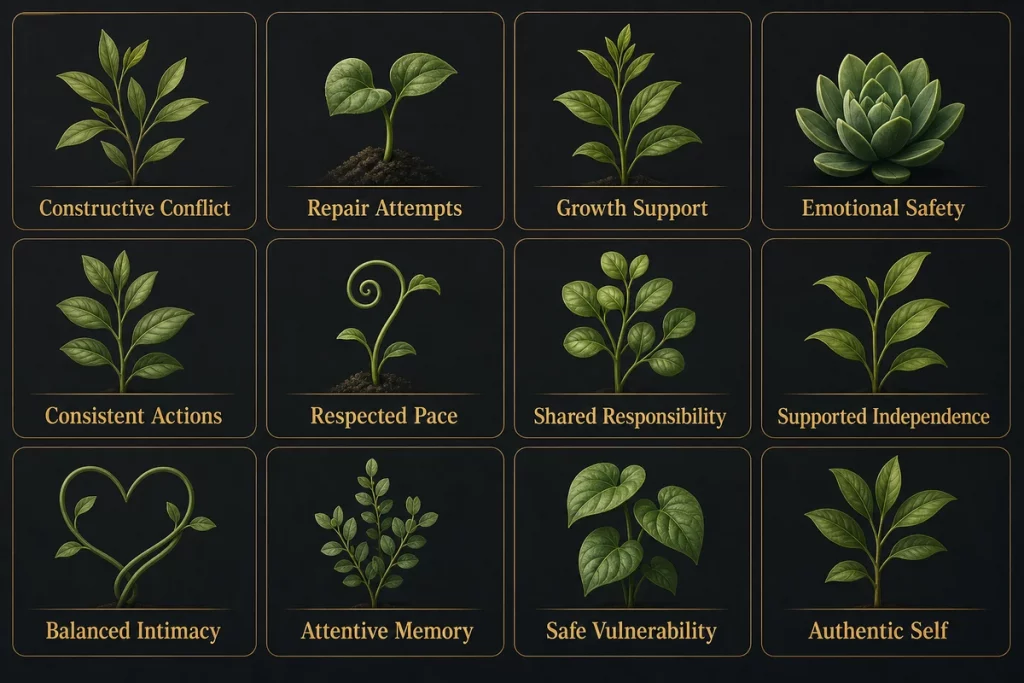
1. Conflict Produces Resolution, Not Wreckage
Every relationship has conflict — the green flag isn’t the absence of disagreement but how disagreement is handled. In healthy partnerships, conflict follows a pattern: issue raised → both people listen → both people acknowledge the other’s perspective → compromise or resolution reached → repair made → relationship is strengthened rather than damaged. If your arguments end with both people feeling heard (even when you don’t fully agree), that’s one of the most reliable green flags in a relationship. Compare this to the destructive patterns: stonewalling, deflection, gaslighting, or emotional manipulation — where conflict produces winners and losers rather than mutual understanding.
2. Repair Attempts Are Made AND Accepted
Gottman’s research identifies the repair attempt — any gesture that de-escalates tension during or after conflict — as the single strongest predictor of relationship survival. The repair attempt itself can be small: a touch during an argument, a joke that breaks the tension, “I’m sorry I raised my voice,” or “Can we start this conversation over?” The green flag isn’t just that repair attempts are made — it’s that both people ACCEPT them rather than rejecting the bid for reconnection. Partnerships where repair attempts are consistently rejected deteriorate rapidly regardless of how compatible the couple appears otherwise.
3. Both People Support Each Other’s Individual Growth
Healthy partnerships are composed of two people who are growing individually AND together — not two people whose identities have merged into a single unit that can’t function independently. Green flags in a relationship include: encouraging your partner’s career ambitions (even when they’re inconvenient for you), supporting their friendships and platonic relationships, celebrating their achievements without competitive comparison, and accepting that personal growth sometimes means your partner changes in ways you didn’t anticipate. A partner who resists your growth — who says “you’ve changed” as an accusation rather than an observation — is demonstrating a red flag, not protecting the relationship.
4. Emotional Availability Is Consistent
Your partner is emotionally present — not just physically present. They notice when something is off. They ask “how was your day?” and actually listen to the answer. They’re accessible when you need to talk about something difficult. They don’t withdraw warmth as punishment or dispense it as reward. The contrast: the partner whose emotional availability is transactional — available when things are good, withdrawn when things are hard.
5. Boundaries Are Respected Without Resentment
When you say “I need space tonight” or “I’m not comfortable with that” or “This is a boundary for me,” your partner responds with respect rather than guilt, pressure, or punishment. Boundary respect is among the most fundamental green flags in a relationship because it demonstrates that your partner values your autonomy as much as they value their access to you. The critical detail: “without resentment.” A partner who technically respects your boundary but sulks, gives the silent treatment, or brings it up later as ammunition isn’t respecting the boundary — they’re complying under protest while punishing you for setting it.
6. Accountability Flows in Both Directions
“I was wrong about that. I’m sorry.” “You’re right — I should have handled that differently.” “I see how what I did hurt you, and I want to do better.” When both partners can take genuine accountability — not deflected accountability (“I’m sorry BUT you…”), not performative accountability (apologizing without behavioral change), but genuine ownership of mistakes followed by visible effort to improve — the relationship has the self-correcting mechanism that prevents small problems from becoming relationship-ending resentments.
7. Trust Is Demonstrated Through Behavior, Not Demanded Through Words
Your partner doesn’t SAY “trust me” — they SHOW you they’re trustworthy through consistent behavior: following through on commitments, being honest about difficult topics, maintaining transparency about their life, and handling your vulnerabilities with care rather than weaponizing them during arguments. Trust as a green flag is earned through accumulated evidence, not established through declaration. A partner who demands trust verbally while behaving inconsistently is demonstrating a player pattern, not a green flag.
8. Your Social Life Exists Outside the Relationship
Your partner encourages (or at minimum doesn’t discourage) your friendships, family relationships, hobbies, and independent activities. They don’t compete with your friends for your time, criticize your family to isolate you, or make you feel guilty for having a life beyond the partnership. This independence-supporting behavior is a critical green flag because the opposite — isolation from your support system — is one of the earliest and most reliable indicators of controlling dynamics. The National Domestic Violence Hotline identifies isolation from friends and family as a primary warning sign of abuse trajectory — making the opposite (active support of your independent connections) one of the most important green flags in a relationship.
9. Physical and Emotional Intimacy Are Both Present
The partnership includes both physical connection AND emotional depth — not one at the expense of the other. Physical intimacy without emotional connection produces a hollow relationship; emotional connection without physical intimacy (assuming both people desire it) produces a friendship. Green flags in a relationship include: both people initiating physical affection, comfort discussing intimacy needs, willingness to adapt as needs change over time, and the absence of pressure, guilt, or obligation around physical connection. Intimacy that feels chosen rather than obligatory is the hallmark of healthy physical dynamics.
10. They Remember and Act on What Matters to You
Not grand gestures — small acts that demonstrate they PAY ATTENTION: remembering your coffee order, asking about the work presentation you mentioned was stressful, picking up the specific brand of something you mentioned liking. This attentiveness signals that they’re building a mental model of who you are — your preferences, your stresses, your joys — and using that model to make your life slightly better through small, consistent acts of care. Genuine interest manifests as remembered details; performative interest forgets them the moment the conversation ends.
11. They Handle Your Vulnerabilities With Care
When you share something difficult — a fear, an insecurity, a past trauma, a current struggle — your partner responds with empathy rather than judgment, and they NEVER use that disclosure against you later. Vulnerability safety is the foundation of emotional intimacy: if sharing your inner world feels risky because it might be weaponized, you’ll stop sharing, and the relationship will plateau at surface level regardless of how long it lasts. Partners who handle vulnerability with care build the trust that makes deepening possible; partners who weaponize it build the walls that make deepening impossible.
12. You Feel Like Yourself — Not a Performance
Perhaps the most important positive indicator in any partnership: you feel like the real you rather than a curated version designed to maintain your partner’s approval. You can express unpopular opinions, have bad days, look messy, make mistakes, and change your mind — without fear that any of these normal human experiences will cost you the relationship. If you’re constantly managing your presentation, filtering your thoughts, or suppressing your needs to maintain relational peace, the relationship isn’t providing the safety that genuine partnership requires. The contrast: narcissistic dynamics where you perform for approval, and trauma-bonded relationships where you suppress yourself to avoid punishment.
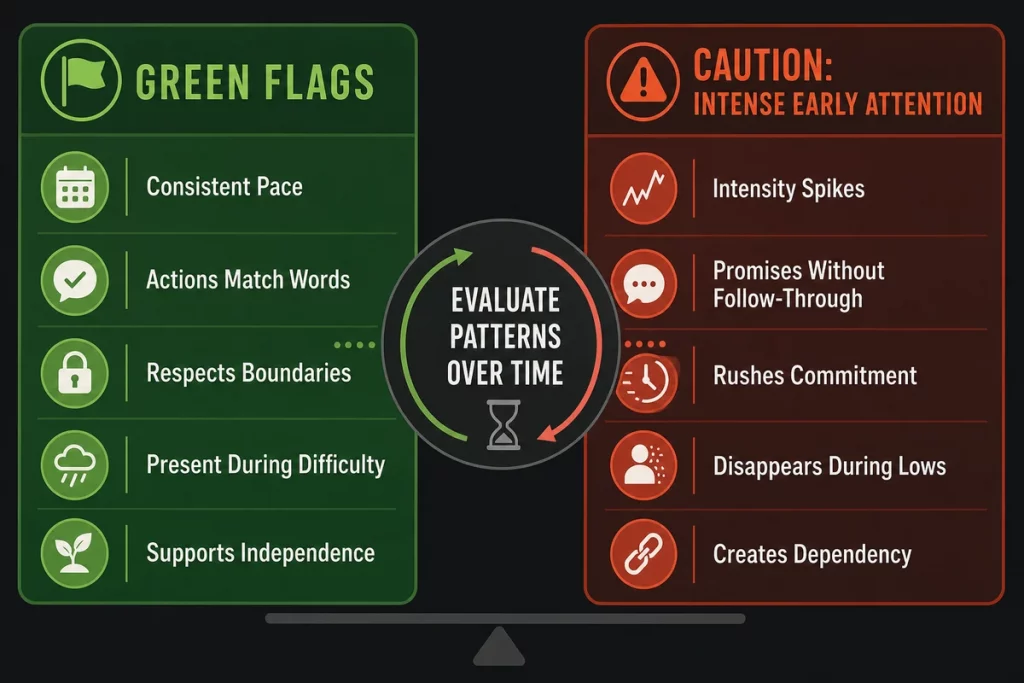
Green Flags in a Relationship vs. Love Bombing: The Critical Distinction
| Green Flags | Love Bombing |
|---|---|
| Consistent intensity that matches relationship stage | Disproportionate intensity too early |
| Actions match words over months | Grand promises with inconsistent follow-through |
| Respects your pace and boundaries | Rushes commitment and overrides boundaries |
| Present during boring, ordinary moments | Spectacular during highs, absent during lows |
| Supports your independence | Creates dependency through overwhelming attention |
| Builds trust gradually through reliability | Demands trust immediately through intensity |
| Sustainable — same person at month 12 as month 1 | Unsustainable — dramatic decline once attachment secured |
Time helps distinguish sustainable behavior from a short campaign, but there is no universal month when intent becomes clear. If intense early attention changes into dismissiveness, unavailability, or coldness once commitment feels secure, reevaluate the broader pattern. The shift may reflect incompatibility, changing circumstances, poor communication, or a manipulative love bombing pattern; one timeline cannot determine which. Our red flag quiz offers structured reflection questions rather than a diagnosis.
What to Do When Green Flags Are Missing
Missing one or two: address through communication. No partnership exhibits all twelve green flags perfectly — and the absence of one or two is normal relationship friction that direct conversation can address. “I’ve noticed we haven’t been handling conflict well lately — can we talk about how to improve that?” addresses a missing green flag constructively rather than catastrophically. Most these healthy patterns can be developed through mutual effort — they’re skills, not innate traits.
Missing several: consider couples therapy. When four or more green flags are consistently absent — particularly the foundational ones (conflict resolution, accountability, boundary respect, emotional availability) — the relationship has structural gaps that self-help approaches may not address. Emotionally Focused Therapy (EFT) or Gottman Method couples therapy provides the structured intervention that builds the skills producing these green flags. The willingness to attend therapy itself is a green flag: it demonstrates that both people value the relationship enough to invest in professional development of it. Conversely, a partner who refuses therapy when multiple green flags are missing is communicating that the current dynamic — however unsatisfying for you — serves them well enough that they don’t want to change it.
Missing most: honest assessment required. If the majority of these green flags are absent and have been absent throughout the relationship — not just during a rough patch but as the baseline — the relationship may lack the foundation that green flags represent. This assessment is painful but important: you can’t build a healthy partnership on a foundation that doesn’t include conflict resolution, accountability, boundary respect, or emotional safety. Use the emotional abuse checklist and toxic relationship quiz to evaluate whether the missing green flags indicate skill deficits (addressable through therapy) or character patterns (unlikely to change without the person’s own voluntary commitment to deep personal work). The boundary-setting guide provides the framework for communicating what you need regardless of the assessment’s outcome — because naming what’s missing is the first step toward either building it together or recognizing that the relationship can’t provide what you deserve.
The green-flag inventory as a relationship health check. Consider revisiting these twelve indicators every 6-12 months as a deliberate relationship health assessment — not because healthy relationships require constant monitoring, but because patterns shift gradually enough that erosion can go unnoticed until significant damage has accumulated. A quick mental review (“Which of these twelve do we still demonstrate consistently? Which have faded?”) provides early-warning data that allows course correction before small gaps become structural failures. The couples who stay healthy over decades aren’t the ones who never experience problems — they’re the ones who notice problems early and address them collaboratively before resentment calcifies into permanent relational damage.
For future relationships. Use these twelve indicators as your evaluation framework when dating — watching for their emergence over the first 3-6 months rather than checking them off on date one. The early dating versions of these indicators are subtler but detectable: does this person listen genuinely during conversation? Do they respect the pace you set? Do they follow through on small commitments like showing up on time? Do they respond to mild disagreement with curiosity rather than defensiveness? These early signals predict whether the mature green flags will develop as the relationship deepens. Verify identity through GuyID’s free screening tools and share your Date Mode link through GuyID to build the verified trust foundation that makes healthy patterns possible from the start. Because the greenest flag of all is transparency — and verified trust is transparency made concrete.
How GuyID Helps
GuyID should appear when it is useful, not as a banner ad. A GuyID Trust Profile gives someone a portable way to share trust signals before a date, while identity verification and social vouching help turn vague profile claims into clearer next steps.
Useful next steps:
- Create a GuyID Trust Profile when you want a cleaner way to share verified trust signals.
- Use GuyID free tools and related guides when you need a checklist before meeting someone.
- Treat identity verification as confidence-building, not a guarantee.
- Use social vouching when you want context from people who already know the person.
- Sign up only when the extra trust layer helps the decision you are already trying to make.
Frequently Asked Questions
What are green flags in a relationship?
Green flags are consistent behaviors associated with a respectful relationship. Examples include constructive conflict resolution, mutual accountability, respected boundaries, emotional availability, support for individual growth, and room for both people to communicate authentically.
How do I tell the difference between green flags and love bombing?
Time is the key differentiator. Green flags are consistent from month 1 through month 12 and beyond — they’re sustainable patterns, not strategic campaigns. Love bombing is intense at the beginning but fades or reverses once attachment is secured. If the wonderful behavior from month one has disappeared by month six, it was love bombing. If it’s still present and growing naturally, those are genuine healthy patterns worth investing in.
Can green flags develop over time, or should they be present from the start?
Many green flags develop and strengthen over time — conflict resolution skills improve with practice, accountability deepens as trust builds, and emotional availability increases as both people feel safer. The foundational green flags (basic respect, boundary acknowledgment, honesty, and the absence of manipulation) should be present from the start. The more sophisticated ones (expert conflict navigation, deep vulnerability safety, seamless mutual support) develop as the relationship matures. Expecting perfection from day one is unrealistic; expecting basic respect and honesty from day one is not.
What should I do if my partner shows some green flags but also some red flags?
Most relationships contain a mix — the question is which category dominates and whether the red flags are addressable. Communication red flags (poor conflict skills, avoidance) are often addressable through therapy. Character red flags (gaslighting, narcissistic patterns, manipulation) are much harder to change. Use the red flag quiz to assess severity, and consult a therapist for professional evaluation if you’re unsure whether the red flags are skill deficits or character patterns.