
Online Dating Safety Tips: The Complete 2026 Guide (26 Expert Tips)
80 million Americans use dating apps (SSRS, 2026). 57% of women believe online dating isn’t safe (Essence). $1.3 billion is lost to romance scams every year (FTC, 2026). 630,000+ cybercriminals run scam operations targeting daters (SpyCloud, Feb 2026). And 1 in 4 users encounter fake profiles or AI bots (McAfee, Feb 2026). These online dating safety tips aren’t the recycled “meet in a public place” advice you’ve read a hundred times — they’re the complete 2026 framework for staying safe in an era of AI-generated identities, deepfake video calls, and scam operations that have become billion-dollar criminal enterprises.
This guide organizes every online dating safety tip into the sequence that actually matters: before you match, during conversations, before you meet, and during/after dates. Each tip is actionable, free to implement, and calibrated for the 2026 threat landscape — not the 2018 advice that most safety guides still repeat. By the end, you’ll have a complete safety framework that works on Tinder, Bumble, Hinge, and every other dating platform.
The 2026 Safety Mindset: Proactive, Not Reactive
Most online dating safety tips are reactive: they teach you to recognize red flags after you’ve already matched, started conversations, and developed emotional investment. “Watch for love-bombing” assumes you’re already being love-bombed. “Be suspicious of anyone who avoids video calls” assumes weeks of conversation have passed. By the time you’re Googling “dating safety tips,” the scammer may have already established emotional leverage.
The proactive dating safety mindset flips the sequence: verify first, invest second. Every online dating safety tip in this guide follows this principle — verification happens before emotional investment, not after suspicion arises. This isn’t paranoia. It’s the same reasonable diligence you’d apply to any important decision: checking references before hiring, inspecting before buying, researching before investing. Dating deserves the same standard.
In 2026, the proactive approach isn’t just better — it’s necessary. AI-generated profiles don’t trigger suspicion because they’re designed not to. Deepfake video calls pass casual inspection. AI chatbots maintain 60+ emotionally intelligent messages in 12 hours (McAfee Labs, 2026). The red flags that reactive safety taught you to watch for are being erased by technology. Proactive verification catches threats that reactive detection no longer can.
Before You Match: Profile Screening Safety Tips
These online dating safety tips apply before you swipe right or send the first message — the phase where verification costs the least effort and prevents the most harm.
Tip 1: Reverse Image Search Every Profile That Interests You
Reverse image search is the #1 individual safety action for online dating. Save the profile photo, upload to GuyID’s free reverse image search, and check if it appears under a different name elsewhere. This 30-second check catches stolen photos, stock images, and photos recycled across scam operations — the foundation of 60-70% of fake profiles. For maximum coverage, also check Google Images, TinEye, and Yandex.
Tip 2: Scan Photos for AI-Generation Signs
With 35% of Americans spotting AI-generated photos on dating apps (McAfee, Feb 2026), visual inspection is essential. Look for excessively smooth skin, background artifacts (distorted text, impossible architecture), accessory inconsistencies (mismatched earrings), hand anomalies (wrong finger count), and the “uncanny valley” quality of photos that are too perfect for casual selfies.
Tip 3: Evaluate Bio Specificity
Run the profile bio through GuyID’s bio red flag detector for automated analysis. Manually check: does the bio contain specific, verifiable details (“marathon runner, works at Shopify, obsessed with Thai food”) or only vague platitudes (“love to travel, laugh, and enjoy life”)? Specific bios indicate real people describing real lives. Vague bios may indicate fabricated identities avoiding verifiable details. See our complete fake profile detection guide for detailed bio analysis.
Tip 4: Check for Photo Variety and Friends
Real people’s profiles show photos across different settings, times of day, outfits, and activities — and typically include at least one group shot with friends. Profiles with 3-4 photos of identical quality, lighting, and style (no friends, no variety) may be using photos from a single source — either stolen or AI-generated.
Tip 5: Use the Catfish Probability Detector
Before deepening any conversation, run the profile through GuyID’s catfish probability detector for an objective, holistic risk assessment. This is especially valuable when attraction biases your judgment — the tool evaluates multiple signals simultaneously, catching patterns your emotionally interested brain might rationalize away.
During Conversations: Communication Safety Tips
These online dating safety tips protect you during the messaging phase — after matching but before meeting.
Tip 6: Request a Video Call Within the First Week
Frame it naturally: “I’d love to put a face to the voice — can we do a quick video call this week?” The majority of catfish and scammers still refuse video calls. One declined call with a reasonable explanation is normal. Three+ declined calls with escalating excuses is diagnostic — someone who can’t video-call after multiple requests is hiding their identity. If they agree, apply active deepfake detection: full head turns, hand-over-face movements, room changes.
Tip 7: Watch for Conversation Red Flags
Key warning signs during messaging include: instant, constant responses at all hours (possible AI chatbot), love-bombing within the first week (“I’ve never felt this connection”), perfect mirroring of all your interests with no genuine disagreement, avoidance of verifiable specifics about their daily life, and urgent pressure to move off the dating platform to WhatsApp or personal phone within the first few messages.
Tip 8: Don’t Share Personal Information Too Fast
Before verification is complete, limit what you share. Don’t disclose your home address, workplace address, daily schedule patterns, financial information, or family details. These are information assets that a scammer can use for targeted manipulation, social engineering, or — in worst cases — stalking and physical safety threats. Share gradually as trust is verified, not assumed.
Tip 9: Verify Before Moving Off-Platform
When a match asks to move to WhatsApp, complete at least these checks while still on the dating app: reverse image search (done), video call (completed or scheduled), and social media cross-reference (their claimed name on LinkedIn/Instagram/Facebook). Once you’re on WhatsApp, you’ve left the dating app’s monitoring and reporting tools behind. Verify while you still have the platform’s infrastructure supporting you.
Tip 10: Track Inconsistencies
Scammers managing multiple targets confuse details across conversations. If their age, career details, family story, or hometown shifts between conversations — note it. A single inconsistency could be a typo or miscommunication. Multiple inconsistencies over weeks is a pattern of fabrication. For a complete list of romance scammer warning signs, see our dedicated detection guide.
Before You Meet: Pre-Date Verification Tips
These online dating safety tips apply to the critical window between deciding to meet and actually showing up — the phase where verification has the highest stakes and the greatest impact.
Tip 11: Request a Verified GuyID Trust Profile
The single most important pre-meeting safety action: ask for their GuyID Trust Profile link. Government ID verification + social vouching confirms real-world identity that no catfish, AI-generated identity, or deepfake operator can produce. Frame it naturally: “I take safety seriously when meeting people online — do you have a verified profile on GuyID?” Women check for free. The response is diagnostic: genuine people cooperate, scammers deflect.
Tip 12: Cross-Reference Their Digital Footprint
Search their name on LinkedIn (career verification), Instagram (lifestyle consistency), and Facebook (social network authenticity). Google their full name + city + claimed profession. A real person has years of consistent digital footprint across platforms. A fabricated identity has thin, recently created, or inconsistent online presence. This 5-minute check provides essential context that in-app profiles can’t. See our complete verification guide for the detailed process.
Tip 13: Tell Someone Your Plans
Before every first date with someone from a dating app: tell a trusted friend or family member who you’re meeting, where you’re meeting, and when. Share your match’s profile photo with your friend. Set a check-in time (“I’ll text you at 8pm”). Share your live location if possible. This isn’t dramatic — it’s the minimum standard for meeting a stranger from the internet. 80 million Americans use dating apps; smart ones tell someone when they meet a match.
Tip 14: Plan a Public, Well-Lit, Populated Location
First dates should always be in public places with other people present — restaurants, coffee shops, busy bars, daytime venues. Avoid private locations (their home, your home, secluded restaurants, remote parks) for at least the first several dates. Don’t allow isolation until trust has been established through verified identity and consistent real-world behavior. Review our guide to in-person scammer signs for what to watch for during the date.
Tip 15: Arrange Your Own Transportation
Drive yourself, take a rideshare, or use public transit. Don’t let your date pick you up at home — this reveals your address before trust is established and creates a dependency where you can’t leave independently. Having your own transportation means you can leave at any moment if you feel uncomfortable, without needing to explain, negotiate, or wait.
During the Date: In-Person Safety Tips
These online dating safety tips apply to the in-person meeting itself.
Tip 16: Check That They Match Their Profile
When you first see your date, verify they match their dating profile and video call appearance. If they look significantly different — different age, different body type, completely different from their photos — this is catfishing. You have every right to leave immediately. You are not obligated to stay for someone who started the interaction with deception.
Tip 17: Monitor Your Drink
Keep your drink in your sight at all times. Don’t leave it unattended while using the restroom — take it with you or order a fresh one when you return. If you feel suddenly and unexpectedly intoxicated beyond what your consumption should produce, contact a friend immediately, alert staff, and leave.
Tip 18: Watch for Control and Isolation Behaviors
In-person red flags include pressure to move to a private or isolated location, resistance to letting you leave when you want to, excessive possessiveness or jealousy during a first meeting, and boundary-testing behaviors that escalate when you push back. Any attempt to isolate you from public spaces, your phone, or your transportation is a serious warning sign that warrants immediate departure.
Tip 19: Trust Your Instincts
If something feels wrong — even if you can’t articulate why — trust that feeling and leave. Your subconscious processes social cues, body language, and environmental signals that your conscious mind may not register. The vague feeling that “something is off” during a date is your safety system working correctly. You can always apologize later if you were wrong. You can’t undo staying when you should have left.
Financial Safety: The Rules That Prevent $1.3 Billion in Losses
The most consequential online dating safety tips are financial — because financial exploitation is where the quantifiable damage occurs. Every dollar of the $1.3 billion in annual romance scam losses could have been prevented by these rules.
Tip 20: Never Send Money — The Absolute Rule
Never send money, gift cards, cryptocurrency, wire transfers, or financial information to anyone you’ve communicated with only online — regardless of how long you’ve been talking, how genuine the connection feels, or how urgent their emergency sounds. This rule has zero exceptions. Every romance scam described in our guides on spotting scammers, pig butchering, and WhatsApp scam patterns ends the same way: a money request. If you never send money, you cannot be financially scammed. Full stop.
Tip 21: Never Invest Based on a Dating Match’s Recommendation
Pig butchering scams — the fastest-growing financial fraud type — work by combining romance with fake investment platforms. Any dating match who introduces you to an investment opportunity, trading platform, or cryptocurrency scheme is executing a scam playbook, regardless of how organically the recommendation feels. Legitimate investment advice comes from licensed financial advisors — not dating app matches. With $12.5 billion lost to investment scams in 2024 (FTC), this single online dating safety tip prevents the highest-dollar fraud type in existence.
Tip 22: Never Pay “Recovery Fees”
If you’ve been scammed, you may be contacted by people claiming they can recover your money — for an upfront fee. These are secondary scams targeting romance scam victims. Legitimate financial recovery occurs through your bank (wire recall, chargeback) and law enforcement — never through fee-based “recovery services.” See our complete reporting guide for the actual recovery process.
Digital Privacy Tips for Online Dating
These online dating safety tips protect your digital identity and personal information throughout the dating process.
Tip 23: Use a Separate Phone Number or Google Voice
When moving off-platform, consider using a Google Voice number or secondary phone number rather than your primary number. This prevents a match from finding your primary number’s associated accounts (email, social media, home address through reverse phone lookup) before trust is established.
Tip 24: Review Your Social Media Privacy Settings
Before joining dating apps, audit your public social media. Can someone who knows your first name and city find your address, workplace, daily routine, or family members through your public profiles? Tighten privacy settings so that dating matches can see enough to verify your existence (positive) without accessing information that could be used for stalking or social engineering (negative).
Tip 25: Don’t Link Dating Apps to Social Media Unnecessarily
Some dating apps allow linking Instagram, Facebook, or Spotify. Linking provides authenticity signals (good) but also gives matches access to more personal information before trust is established (risky). The trade-off is individual — but be intentional about what you link and what that makes visible to unverified matches.
Tip 26: Be Cautious with Location Sharing
Don’t share your live location with a match until you’ve met in person multiple times and verified their identity through GuyID. Many dating apps show approximate distance — this is sufficient for matching purposes without revealing your precise location. Avoid geotagged photos in your dating profile that could reveal your home, workplace, or daily routine locations.
The Complete Online Dating Safety Checklist
Here’s every online dating safety tip from this guide organized as an actionable checklist by phase.
☐ Reverse image search profile photos through GuyID (30 sec)
☐ Scan photos for AI-generation characteristics
☐ Bio red flag detector on profile text (10 sec)
☐ Check photo variety (different settings, friends visible)
☐ Catfish probability detector (10 sec)
☐ Get verified yourself on your dating app + GuyID
☐ Video call within the first week (with deepfake testing)
☐ Watch for love-bombing and conversation red flags
☐ Limit personal information sharing before verification
☐ Verify before moving to WhatsApp or phone
☐ Track any story inconsistencies over time
☐ Request GuyID Trust Profile link (free to check)
☐ Cross-reference name on LinkedIn, Instagram, Facebook
☐ Tell a friend: who, where, when + share match’s photo
☐ Choose public, well-lit, populated venue
☐ Arrange your own transportation
☐ Confirm they match their profile and video call appearance
☐ Keep drink in sight at all times
☐ Watch for control/isolation behaviors
☐ Trust your instincts — leave if something feels wrong
☐ Text your check-in friend as scheduled
☐ NEVER send money in any form — zero exceptions
☐ NEVER invest based on a match’s recommendation
☐ NEVER pay “recovery fees” after being scammed
☐ Report immediately if money was requested or sent
☐ Consider Google Voice number for dating communication
☐ Audit social media privacy settings
☐ Be intentional about linking social accounts to dating apps
☐ Don’t share live location until trust is verified
☐ Avoid geotagged photos revealing home/work locations
Summary: The 2026 Online Dating Safety Framework
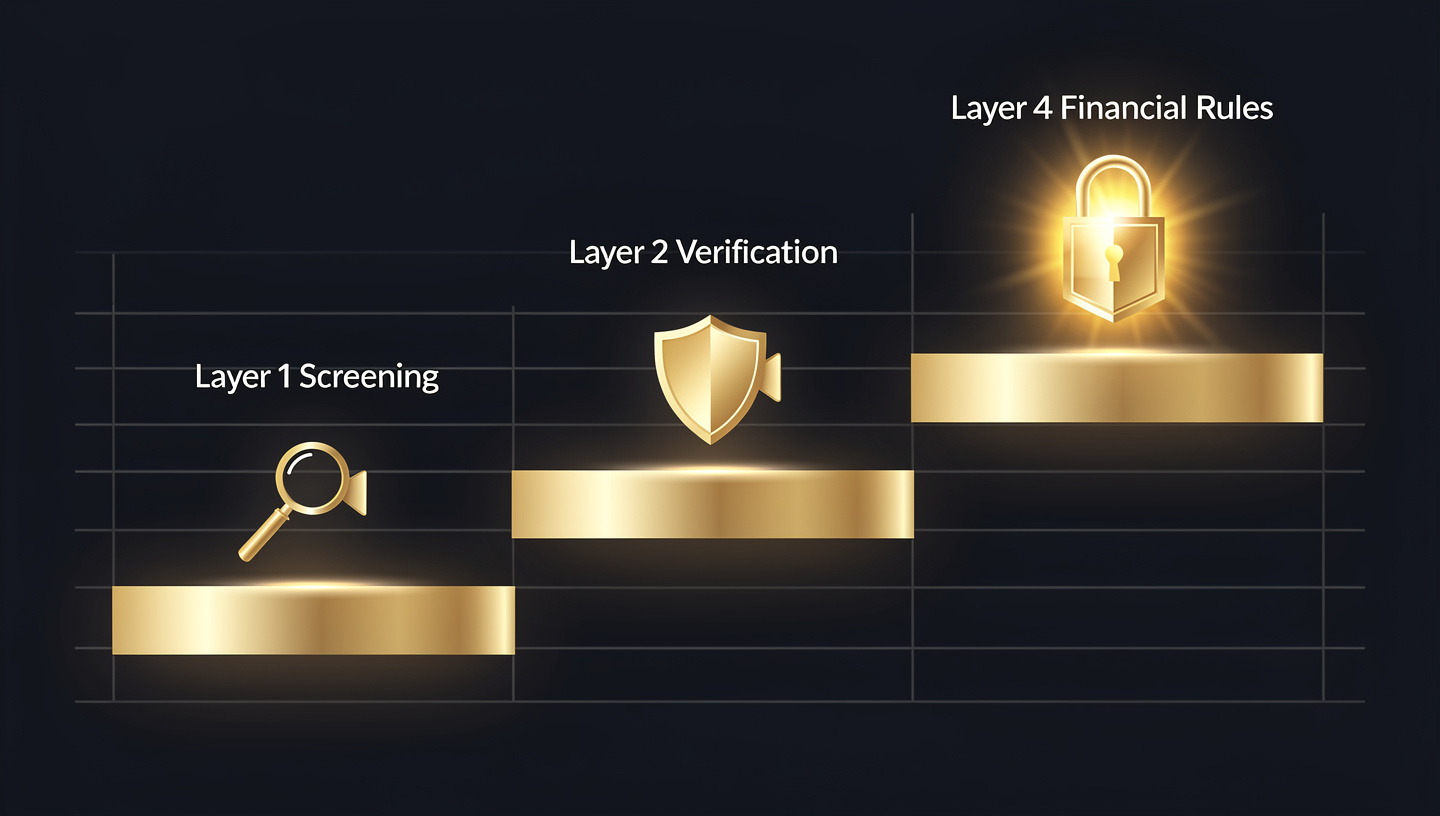
These online dating safety tips aren’t a random collection of precautions — they’re a structured framework built for the 2026 threat landscape. The framework has three layers that work together to provide comprehensive protection.
Layer 1: Proactive Screening (Before Investment)
Reverse image search, catfish probability detection, bio red flag analysis, and AI photo inspection — all performed before emotional investment begins. This layer catches 60-70% of fake profiles at the cost of 2-3 minutes per match and $0. Use GuyID’s 60+ free safety tools as your screening platform.
Layer 2: Active Verification (During Conversations)
Video calls with active deepfake testing, social media cross-referencing, and conversation consistency tracking — performed during the messaging phase before meeting. This layer catches sophisticated fakes that pass photo screening, including AI-enhanced identities and well-constructed catfish profiles. Cost: 10-15 minutes per serious match.
Layer 3: Identity Confirmation (Before Meeting)
GuyID Trust Profile verification — government ID + social vouching + Trust Tiers — confirms real-world identity that no scam operation can fabricate. This layer eliminates all remaining fraud risk regardless of sophistication. Cost: 2 minutes to check, free for women. Combined with telling a friend your plans and choosing safe meeting locations, Layer 3 provides the definitive confirmation that converts “relatively safe” into “comprehensively safe.”
Layer 4: Absolute Financial Rules
Never send money. Never invest based on a match’s recommendation. Never pay recovery fees. These three rules — applied without exception — prevent 100% of the $1.3 billion in annual financial losses from romance scams. They require zero tools, zero time, and zero cost. They only require discipline.
Together, these four layers cover every phase of the dating journey — from first swipe to first date to ongoing relationship — with verification proportional to the investment at each stage. The framework works on Tinder, Bumble, Hinge, and every other dating platform because it’s platform-independent — it adds verification layers that all apps lack rather than depending on any app’s built-in features.
The trust gap in online dating exists because dating apps verify photos but not identity. These online dating safety tips close that gap for anyone who applies them. The tools are free. The process is structured. The protection is comprehensive. The 80 million Americans who date online deserve a safety framework that matches the sophistication of the threats they face — and this is it.
GuyID provides every tool this framework needs: reverse image search, catfish detection, bio red flag analysis, and the only Level 3 identity verification (government ID + social vouching + Trust Tiers) that works across every platform. Women check for free.

Frequently Asked Questions: Online Dating Safety Tips
What is the #1 online dating safety tip for 2026?
How can I stay safe on dating apps without being paranoid?
What are the biggest red flags in online dating?
Is online dating safe in 2026?
How do I verify someone before meeting them from a dating app?
What should I never do on a dating app?
Are dating apps safe for women?
What free tools can I use for online dating safety?

Founder, GuyID · Dating Safety Researcher · 13+ Years in Data Analytics
Ravishankar Jayasankar is the founder of GuyID, a consent-based dating trust verification platform. With 13+ years in data analytics and a deep focus on consumer trust, Ravi built GuyID to close the safety gap in digital dating. His research found that 92% of women report dating safety concerns — validating GuyID’s mission to make online dating safer through proactive, consent-based verification. GuyID offers government ID verification, social vouching, a Trust Tiers system, and 60+ free interactive safety tools.