
Fake Dating Profile Statistics 2026: Every Number You Need to Know
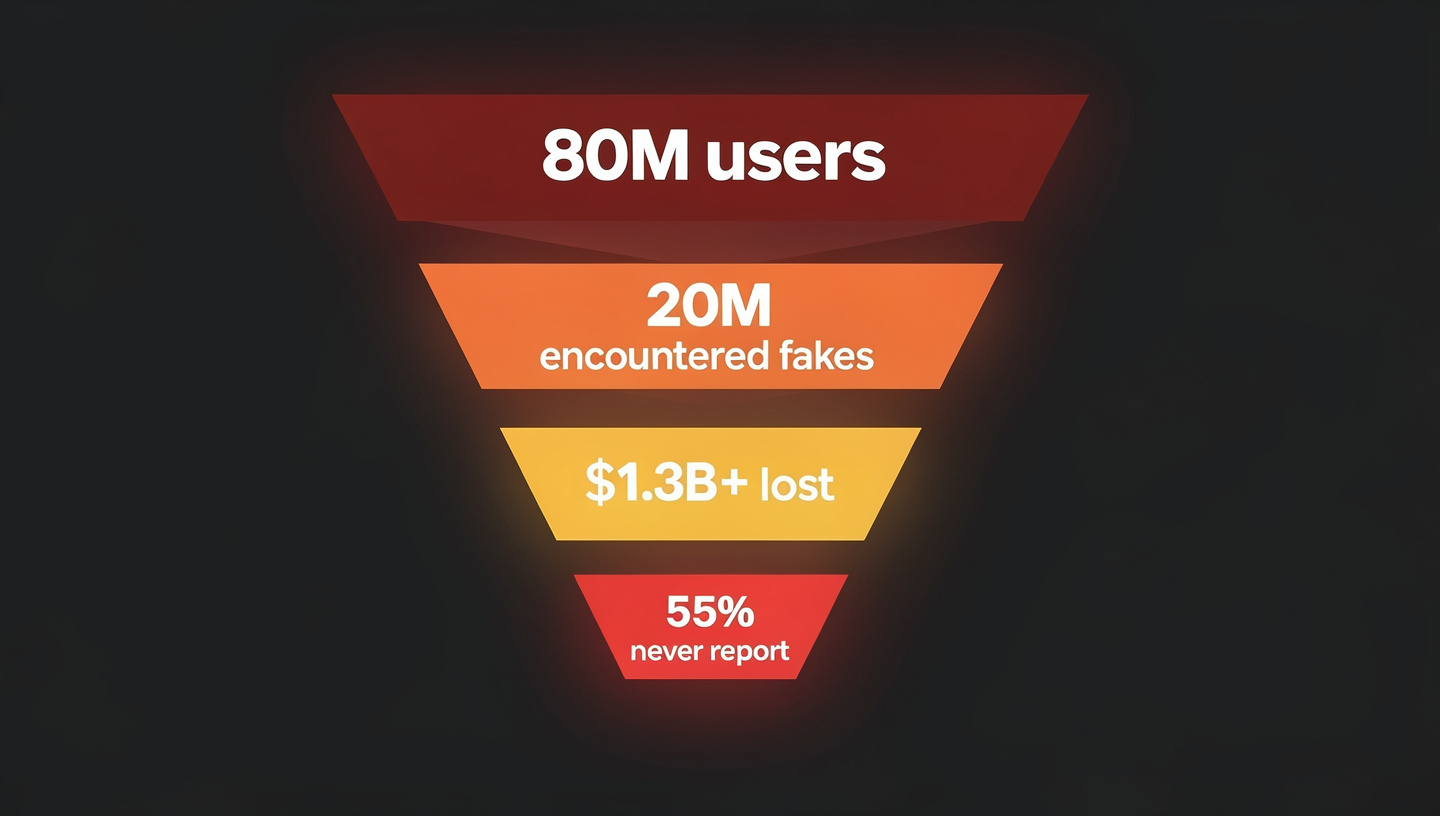
How big is the fake dating profile problem? The numbers tell a story that no dating app’s marketing department wants you to hear. 1 in 4 Americans encounter fake profiles on dating apps (McAfee, Feb 2026). 78% of all fake dating app installations trace to a single platform (McAfee Labs, 2026). 630,000+ cybercriminals operate romance scam networks using those fakes (SpyCloud, Feb 2026). And the financial damage — $1.3 billion annually in the US alone (FTC, 2026) — makes fake dating profiles one of the most costly consumer fraud categories in existence. These fake dating profile statistics aren’t abstract — they describe the environment that 80 million Americans navigate every time they open a dating app.
This guide compiles every verified fake dating profile statistic from 2026 research into a single reference — organized by category: scale of the problem, financial impact, platform-specific data, demographic targeting, AI-era threats, and detection and reporting. Every statistic is sourced, every number is current, and the complete picture reveals why the trust gap in online dating demands the verification solutions that detection alone can’t provide.
Scale: How Big Is the Fake Dating Profile Problem
These fake dating profile statistics quantify the scale of the problem — how many fake profiles exist, how many people encounter them, and how large the criminal infrastructure behind them has become.
| Statistic | Number | Source |
|---|---|---|
| Americans who have encountered a fake profile or AI bot on a dating app | 1 in 4 (25%) | McAfee, Feb 2026 |
| Americans who use dating apps | 80 million | SSRS, 2026 |
| Estimated Americans who’ve encountered fakes (25% of 80M) | ~20 million | Calculated from McAfee + SSRS data |
| Cybercriminals operating romance scam networks | 630,000+ | SpyCloud, Feb 2026 |
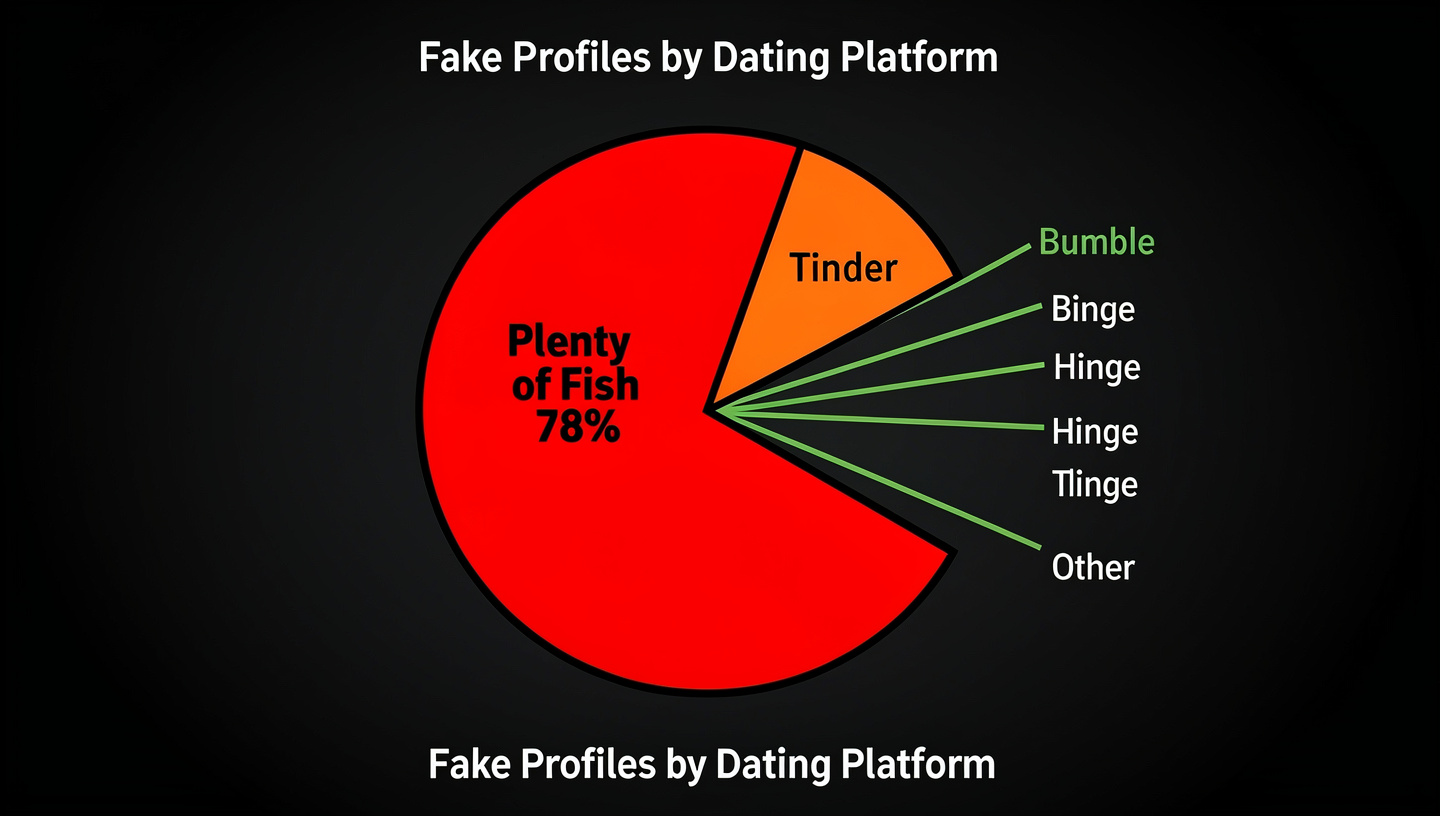
| Share of fake dating app installations traced to POF | 78% | McAfee Labs, Feb 2026 |
| Share of malicious dating app activity on Tinder | ~50% | McAfee Labs, 2026 |
| Americans 50+ targeted through online romantic connections | 11 million | AARP, Feb 2026 |
What These Numbers Mean
An estimated 20 million Americans have personally encountered fake dating profiles. Behind those fakes, 630,000+ professional criminals operate scam networks — not amateur pranksters but organized operations with training, infrastructure, and AI tools. The scale of the problem makes fake profile detection a core survival skill for anyone who dates online — and explains why proactive verification through tools like GuyID’s free safety suite is essential rather than optional.
Financial Impact: What Fake Dating Profiles Cost
Fake profiles aren’t just a nuisance — they’re the entry point for the most costly consumer fraud category. These fake dating profile statistics quantify the financial damage.
| Statistic | Number | Source |
|---|---|---|
| Annual US romance scam losses | $1.3 billion+ | FTC, 2026 |
| Average individual victim loss (romance scams) | $2,001–$4,000 | NordProtect, Jan 2026 |
| Investment scam losses (often originating from dating apps) | $12.5 billion (2024) | FTC |
| Men who reported losing money to dating scams | 21% | McAfee, 2026 |
| Women who reported losing money to dating scams | 10% | McAfee, 2026 |
| Men 65% more likely to encounter scams weekly | 65% higher frequency | McAfee, 2026 |
| Victims who find romance scams harder to discuss than other fraud | 53% | NordProtect, Jan 2026 |
The Hidden Financial Damage
The $1.3 billion figure represents only reported losses. With 55% of victims never reporting (AARP, Feb 2026), the actual figure is conservatively double — potentially $2.5 billion+ in real annual losses. The $12.5 billion in investment scam losses includes pig butchering operations that frequently originate through fake dating profiles — meaning the total financial impact of fake dating profiles extends well beyond the romance scam category alone.
Men lose money more frequently (21% vs 10%) and encounter scams more often (65% more likely weekly), but women face broader threats beyond financial — physical safety, harassment, stalking — that these financial statistics don’t capture. The full cost of fake dating profiles includes both the quantifiable financial losses and the unquantifiable emotional, psychological, and physical harms.
Platform-Specific Fake Dating Profile Statistics
Fake profiles aren’t distributed evenly across platforms. These fake dating profile statistics show which platforms carry the highest and lowest risk.
| Platform | Key Statistic | Safety Ranking | Source |
|---|---|---|---|
| POF | 78% of all fake dating app installations | #7 (7/35) | McAfee Labs, 2026 |
| Tinder | ~50% of all malicious dating app activity | #4 (11/35) | McAfee Labs, 2026 |
| Bumble | 80% of Gen Z prefer verified profiles | #2 (19/35) | Bumble survey |
| Hinge | Verified users go on 200%+ more dates | #1 (19/35) | Match Group |
| Facebook Dating | Hacked accounts with years of genuine social proof | #6 (11/35) | Platform analysis |
The Platform Concentration Effect
The fake profile problem is not equally distributed. POF alone accounts for more fake installations than all other dating apps combined. Tinder’s massive user base (75+ million) creates the largest attack surface by volume. The safety features comparison explains why: platforms with weaker verification and fewer messaging controls attract more scam operations because the barrier to entry and cost per target are lowest. Choosing a platform higher on the safety ranking reduces — but doesn’t eliminate — fake profile exposure.
Demographic Targeting Statistics
Fake profiles don’t target everyone equally. These fake dating profile statistics reveal which demographics face the highest risk.
| Statistic | Number | Source |
|---|---|---|
| Americans 50+ targeted through online romantic connections | 11 million | AARP, Feb 2026 |
| Men more likely to encounter scams weekly | 65% more likely | McAfee, 2026 |
| Men who lost money vs women who lost money | 21% vs 10% | McAfee, 2026 |
| Women who believe online dating isn’t safe | 57% | Essence |
| Women reporting dating safety concerns | 92% | GuyID research |
| US adults who feel online dating is somewhat safe | Only 48% | SSRS/Pew |
| US college students not using dating apps, half citing safety | 79% not using; ~40% cite safety | IDscan.net, 2024 |
| Online daters wanting background checks required | 47% | Pew/SSRS |
| Victims who never report romance scams | 55% | AARP, Feb 2026 |
The Targeting Pattern
Men face higher scam frequency and higher financial loss rates — targeted for financial extraction. Women face broader safety concerns including physical threats — targeted for financial, emotional, and physical exploitation. Adults 50+ are targeted disproportionately due to higher financial resources — 11 million have already been targeted. And the next generation of daters (college students) is already deterred: 79% don’t use dating apps, with approximately half citing safety concerns. The fake profile problem isn’t just harming current users — it’s preventing potential users from entering the market entirely. For the complete demographic analysis, see our guides on safe dating apps for women and safe dating apps for over 50.
AI-Era Fake Dating Profile Statistics
The newest dimension of the fake profile problem: AI-powered fraud. These fake dating profile statistics document the AI threat that most users are only beginning to recognize.
| Statistic | Number | Source |
|---|---|---|
| Americans who spotted AI-generated photos on dating apps | 35% | McAfee, Feb 2026 |
| AI bots sending messages in scam operations | 60+ messages in 12 hours | McAfee Labs, 2026 |
| Americans who encountered fake profiles or AI bots | 1 in 4 | McAfee, Feb 2026 |
The AI Acceleration
AI has transformed fake dating profiles from a manual craft into an automated industry. AI-generated photos create fictional people with no source photos to detect through reverse image search. AI chatbots maintain 60+ emotionally intelligent messages in 12 hours — volume and quality impossible for a single human operator. Deepfake face-swapping defeats selfie-based verification by overlaying synthetic faces during liveness checks. And 35% of Americans have already spotted these AI-generated photos — meaning 65% may not have noticed the ones they encountered.
The AI dimension makes traditional detection methods increasingly insufficient. Stolen photos (detectable through reverse image search) are being replaced by generated photos (invisible to reverse search). Broken English (a traditional scam indicator) is being replaced by fluent AI-generated text. Refusal of video calls (the classic catfish tell) is being replaced by deepfake video calls that look convincing. The detection techniques in our complete fake profile detection guide include the AI-era methods that address these evolving threats — but the statistics make clear why identity verification through GuyID (government ID that AI can’t generate) is the one detection layer that AI cannot defeat.
Detection and Reporting Statistics
These fake dating profile statistics reveal how effectively the current system detects and responds to fake profiles — and where the critical gaps remain.
| Statistic | Number | Source / Implication |
|---|---|---|
| Romance scam victims who never report | 55% | AARP, Feb 2026 — more than half of cases are invisible to data |
| Victims who find romance scams harder to discuss than other fraud | 53% | NordProtect, Jan 2026 — shame prevents reporting and recovery |
| Online daters wanting background checks on dating apps | 47% | Pew/SSRS — demand for screening exists; supply doesn’t |
| Gen Z preference for verified profiles | 80% | Bumble survey — verification is becoming an expectation, not a bonus |
| Hinge verified user dating advantage | 200%+ more dates | Match Group — verification behavioral impact is massive |
| Tinder verified user match improvement (18-25) | ~10% higher | Tinder via Imagga, 2025 — meaningful but modest vs Hinge |
The Reporting Gap
55% of victims never report. This means every published statistic — the $1.3 billion, the 11 million targeted, the 1 in 4 encountering fakes — represents only the documented fraction of the actual problem. The true scale is likely double the published numbers. The shame factor (53% find romance scams harder to discuss) compounds the reporting gap: victims don’t report because they’re ashamed, and the low reporting rate means the problem appears smaller than it is, which reduces the urgency for platform and policy action.
The 47% who want background checks and the 80% who prefer verified profiles reveal overwhelming demand for stronger safety measures — demand the platforms haven’t met. The behavioral data (200%+ more dates for Hinge verified users) proves users reward verification with engagement. The gap between user demand for safety and platform supply of safety is the trust gap — and it’s what GuyID exists to close.
Verification and Trust Statistics
These statistics document the current state of verification — what exists, what’s demanded, and what the behavioral data shows about user preferences.
| Statistic | Number | Implication |
|---|---|---|
| Dating apps that verify legal identity (government ID) | 0 mainstream platforms | All verify photos only |
| Dating apps that do background checks | 0 mainstream platforms | None screen users |
| Gen Z who prefer verified profiles | 80% | Verification is becoming a baseline expectation |
| Verified Hinge users: dating advantage | 200%+ more dates | Strongest verification reward in dating |
| Verified Tinder users (18-25): match improvement | ~10% | Meaningful but weaker reward than Hinge |
| Women who believe online dating isn’t safe | 57% | Majority of women don’t trust current safety levels |
| Women reporting dating safety concerns | 92% | Nearly universal safety anxiety among women |
| Users wanting background checks required | 47% | Nearly half want more screening than any platform provides |
The verification statistics tell a clear story: zero platforms verify identity, zero do background checks, yet 80% of the next generation wants verified profiles, 47% want background checks, and 92% of women have safety concerns. The supply-demand mismatch is enormous. The dating trust score concept — implemented through GuyID’s Trust Tiers — represents the market response to this mismatch: providing the identity verification (government ID), character assessment (social vouching), and progressive trust measurement that every statistic in this section proves users want and platforms don’t deliver.
What the Statistics Mean for You: The Practical Takeaway
These fake dating profile statistics aren’t abstract research — they’re the operating environment you navigate every time you open a dating app. Here’s what the data means for your practical safety decisions.
The Probability Assessment
If you’re one of 80 million American dating app users: there’s a 25% chance you’ve already encountered a fake profile. There’s a measurably higher chance on POF (78% of fakes) and Tinder (50% of malicious activity) than on Bumble or Hinge. If you’re over 50, you’re in the demographic where 11 million people have been specifically targeted. If you’re a man, you’re 65% more likely to encounter scams weekly. If you’re a woman, you’re navigating a landscape where 92% of your peers share your safety concerns.
The Response
The statistics validate three conclusions. First, proactive screening on every match isn’t paranoia — it’s proportionate to a 25% encounter rate. The 60-second check through GuyID’s free tools is the minimum rational response. Second, platform choice matters — the difference between POF (7/35 safety score) and Bumble (19/35) is statistically meaningful in your probability of encountering fakes. Choose platforms at the top of the safety ranking. Third, identity verification is the unfilled need — 47% want background checks, 80% want verified profiles, 92% of women have concerns, and zero platforms provide identity verification. GuyID Trust Profiles fill this gap: government ID + social vouching + Trust Tiers, free for women to check.
The fake dating profile statistics describe the problem. The online dating safety framework — proactive screening, identity verification, and absolute financial rules — is the solution. The statistics prove the solution is necessary. The tools to implement it are free.
1 in 4 Americans encounter fakes. $1.3B lost annually. 0 apps verify identity. GuyID provides the verification the statistics prove is needed: reverse image search, catfish detection, bio analysis, and Trust Profiles (gov ID + social vouching). Women check for free.
Frequently Asked Questions: Fake Dating Profile Statistics
How many fake profiles are on dating apps?
How much money is lost to fake dating profiles?
Which dating app has the most fake profiles?
Who is most targeted by fake dating profiles?
How many romance scam victims never report?
What percentage of dating profiles are AI-generated?
Do any dating apps verify identity to prevent fake profiles?
How can I protect myself based on these statistics?

Founder, GuyID · Dating Safety Researcher · 13+ Years in Data Analytics
Ravishankar Jayasankar is the founder of GuyID, a consent-based dating trust verification platform. With 13+ years in data analytics and a deep focus on consumer trust, Ravi built GuyID to close the safety gap in digital dating. His research found that 92% of women report dating safety concerns — validating GuyID’s mission to make online dating safer through proactive, consent-based verification. GuyID offers government ID verification, social vouching, a Trust Tiers system, and 60+ free interactive safety tools.