
Reader Briefing
Reader Briefing
Start here if you need a practical read on love test io: what online love tests actually tell you: who should use verification, what signals to check, and what to do before moving from online interest to an in-person plan.
Who this is for
- People meeting someone from a dating app or social platform.
- Readers preparing for a first in-person date.
- Anyone checking identity, profile consistency, and trust signals.
- People trying to avoid romance scams, fake profiles, or pressure tactics.
You’ll learn
- How to evaluate identity signals without treating any single check as certainty.
- Which trust signals matter and how to weigh them together.
- How to spot inconsistencies, pressure, or behavior patterns that deserve caution.
- How to move from online conversation to a safer first meeting.
- Where GuyID tools fit into a quick pre-date screening workflow.
- How to compare options using practical safety and trust criteria.
Bottom line
Verification reduces uncertainty; it does not guarantee future behavior. Use a layered approach: confirm identity signals, compare profile consistency, ask for a short video call, keep early plans public, and slow down when someone pressures you to skip normal safety steps.
Key takeaways
- Identity verification improves confidence, not certainty.
- Patterns matter more than isolated incidents.
- Verify before meeting privately or sharing sensitive details.
- A short video call can reveal many inconsistencies.
- Pressure to skip reasonable safety steps is useful information.
Free Tools
Catfish Probability Detector
Check whether a dating profile has suspicious identity or photo signals.
Dating Bio Red Flag Detector
Review a bio for scam, pressure, or trust-warning language.
Dating Safety Checklist
Use free GuyID tools before moving from chat to a real date.
Next step
Create your GuyID trust profile
Share consent-based trust signals before a date without turning the conversation into an interrogation.
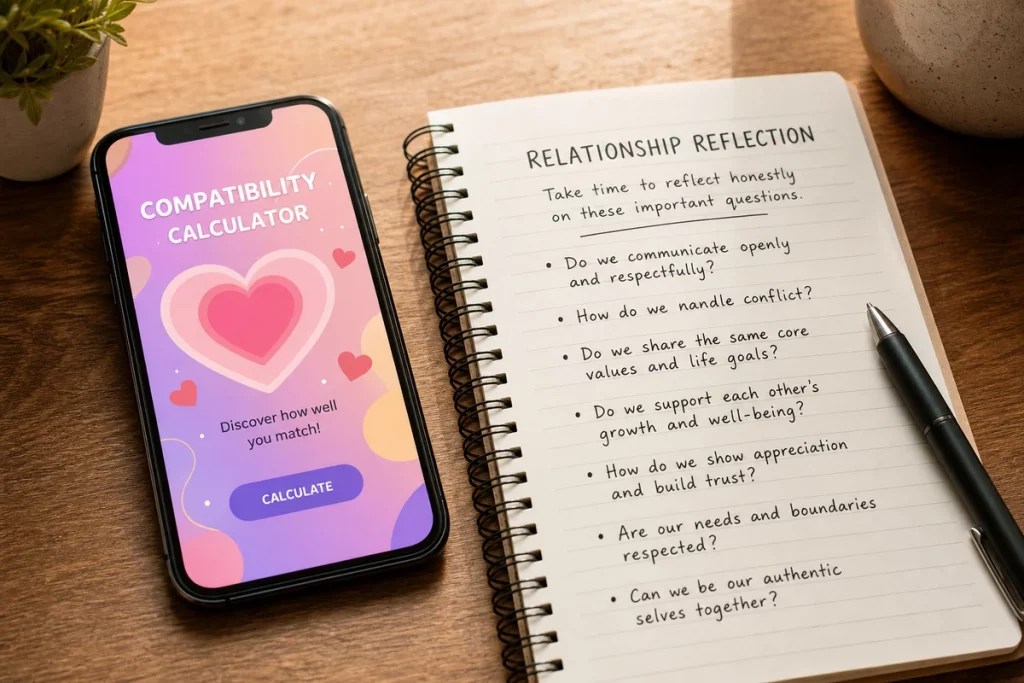
You typed two names into a online love calculator and got a “compatibility score” — and now you’re wondering if a website that generates percentages from letters actually knows something about your relationship. Online love compatibility tests have been a staple of internet entertainment since the early 2000s, and platforms like love test io continue to attract millions of users who enter their name alongside a crush’s name and receive an algorithmically generated “compatibility percentage.” This guide explains what these platforms and similar calculators actually calculate (spoiler: nothing meaningful), why they’re psychologically compelling despite being meaningless, and what genuine compatibility assessment tools exist for people who want real answers rather than entertainment dressed as insight.
NavigateTable of Contents14 sections
What Love Test IO Actually Calculates
Love test io and similar name-based compatibility calculators work through simple algorithms that convert letters to numbers and produce a percentage through mathematical operations that have zero relationship to actual human compatibility. Some platforms add randomization to prevent the same name pair from always producing the same result — which immediately reveals the mechanism: if the “compatibility” changes on refresh, it was never measuring compatibility in the first place.
According to the American Psychological Association’s research on numerological thinking and cognitive biases, name-based compatibility calculations have no scientific foundation whatsoever — they’re the digital equivalent of the “MASH” games played in school notebooks, entertaining because they provide answers to questions we’re anxious about rather than because those answers contain information. The compatibility score your names produce would be identical for any two people who happen to share the same first names — meaning the “compatibility” between you and your crush is actually the “compatibility” between your NAMES, which obviously tells you nothing about your actual relational potential.
This isn’t a controversial assessment — it’s the unanimous conclusion of every relationship researcher who has evaluated name-based compatibility tools. The platforms themselves typically include disclaimers acknowledging the entertainment-only nature of their results, though these disclaimers appear in small text that most users skip. Research from the National Library of Medicine on digital relationship assessment tools confirms that no name-based, astrology-based, or numerology-based compatibility test has demonstrated predictive validity for relationship outcomes in any peer-reviewed study — not because the research hasn’t been done, but because every study that has evaluated these tools has found zero correlation between their outputs and actual relationship satisfaction or longevity.
The evolution of love test io platforms. Name-based love calculators have existed since the early internet era — evolving from simple HTML pages in the late 1990s through Flash-based calculators in the 2000s to the mobile-optimized platforms like love test io that exist today. Despite two decades of interface evolution, the underlying mechanism hasn’t changed: letter arithmetic producing random percentages wrapped in romantic language. What HAS changed is the sophistication of the presentation — modern platforms include personality-style descriptions, “compatibility reports,” and social sharing features that make the results feel more authoritative than the simple percentage their predecessors displayed. This presentation sophistication creates the illusion of depth without adding any actual analytical substance — the same random number now arrives in a more convincing package, making it harder (not easier) for users to recognize that the underlying mechanism is unchanged from the notebook games their parents played in middle school.
How love test io differs from dating app algorithms. An important distinction: the matching algorithms used by dating apps like Tinder, Hinge, and Hinge are fundamentally different from love test io’s name arithmetic — though neither achieves the compatibility prediction their marketing implies. Dating app algorithms use behavioral data (swipe patterns, messaging behavior, profile engagement) and self-reported preferences (age range, distance, interests) to surface matches that are LIKELY to produce mutual interest based on statistical patterns. This approach has modest predictive value for initial attraction — but even sophisticated behavioral algorithms can’t evaluate the deeper compatibility factors (conflict style, attachment patterns, value alignment) that determine long-term relationship success. The gap between “likely to swipe right on each other” and “likely to build a satisfying long-term relationship” is enormous — and no algorithm, from the platform’s name calculator to Hinge’s machine learning model, has bridged it. The dating app safety guide covers what platform algorithms actually do versus what their marketing claims they do.
Why We Want to Believe the Love Test IO Numbers
If compatibility scores are meaningless, why do millions of people use them — and why does a high score feel reassuring while a low score produces genuine unease? The answer lies in several well-documented cognitive biases that love compatibility tests exploit (unintentionally in most cases):
If the score is low, you dismiss it as “just a game.” This asymmetric processing means the test can only REINFORCE existing feelings, never genuinely challenge them — which makes it feel accurate (because it keeps agreeing with you) while providing zero actual information.
The Barnum effect. Named after P.T. Barnum’s observation that “there’s a sucker born every minute,” the Barnum effect describes our tendency to accept vague, general statements as personally accurate. Love test io platforms that include text descriptions alongside their percentages (“You two share a deep emotional connection that others can sense”) use language general enough to apply to literally any couple — but specific enough to feel personally meaningful when you’re reading it about YOUR relationship. The love language quiz provides an example of a compatibility assessment that DOES use validated psychological frameworks rather than the Barnum-effect generalities that entertainment calculators rely on.
Anxiety reduction. Relationship uncertainty is psychologically uncomfortable — and any tool that provides a definitive answer (even a meaningless one) reduces the discomfort of not knowing. The National Domestic Violence Hotline’s resources on healthy relationship assessment emphasize that genuine compatibility evaluation requires behavioral observation over time rather than algorithmic shortcuts — because the qualities that determine whether a relationship is healthy (respect, equality, communication, trust) can only be assessed through lived experience, not through any calculator. This anxiety-reduction function explains why compatibility test usage spikes during the early stages of connections (when uncertainty is highest) and after conflicts (when reassurance is most needed). The dating anxiety guide covers healthier strategies for managing the relationship uncertainty that love tests attempt to resolve through numerological shortcut.
The desire for external validation. When you like someone but aren’t sure if the feeling is reciprocated or whether the connection has potential, you naturally seek external signals — and a name-test percentage FEELS like an external signal even though it’s algorithmically random. The desire for someone or something OUTSIDE your own subjective experience to confirm your feelings is a normal human impulse — but satisfying it with random number generation rather than genuine compatibility assessment (or, better, direct communication with the actual person) is like scratching an itch with a placebo: it provides momentary relief without addressing the underlying need.
What ACTUALLY Predicts Relationship Compatibility
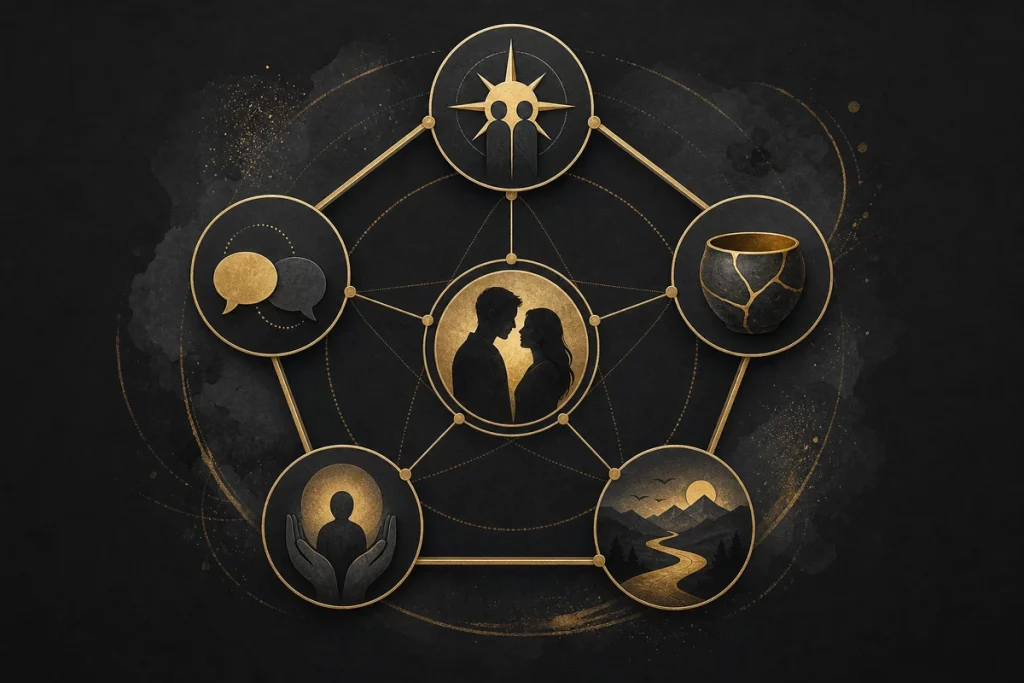
If love test io can’t tell you whether your relationship will work, what CAN? Decades of relationship research — spanning thousands of couples studied longitudinally over years and decades — have identified specific factors that actually predict long-term compatibility with scientific reliability. None involve names, birth dates, or algorithmically generated percentages. All require the three inputs that entertainment calculators are specifically designed to bypass: observation of real behavior, honest communication between real people, and time for patterns to emerge that no snapshot assessment can capture:
Couples who approach conflict with curiosity rather than contempt, who repair after arguments rather than stonewalling, and who express complaints about specific behaviors rather than character attacks survive long-term — while couples who respond to conflict with criticism, contempt, defensiveness, and stonewalling (Gottman’s “Four Horsemen”) divorce at predictable rates that no compatibility score could prevent. The practical implication: your first significant disagreement with a new partner provides more genuine compatibility information than any online test — because it reveals whether the relationship has the conflict infrastructure to survive inevitable challenges. The green flags guide covers the behavioral indicators of healthy conflict resolution visible from the first months of a relationship.
Attachment compatibility. Your attachment style interacts with your partner’s attachment style to produce predictable relationship dynamics. Secure-secure pairings produce the most stable relationships. Anxious-avoidant pairings produce the most volatile. Secure-anxious and secure-avoidant pairings can work when the secure partner provides the stability the insecure partner needs for gradual healing. This attachment interaction predicts relationship quality with scientific validity that the calculator’s name arithmetic cannot approach — and the attachment style quiz provides the specific assessment.
Value alignment on core issues. Agreement on children (whether to have them, how to raise them), finances (spending philosophy, saving priorities, debt tolerance), lifestyle (urban vs. rural, social vs. quiet, ambitious vs. content), and relationship structure (monogamy vs. other arrangements) predicts long-term compatibility more reliably than any other factor. Couples who align on core values but differ on surface preferences (she likes Thai food, he prefers Italian) thrive — while couples who share surface preferences but conflict on core values (both love hiking but disagree about children) eventually face the unresolvable tensions that shared hobbies can’t bridge. No love test io calculation evaluates any of these dimensions because they require honest conversation between two specific people rather than mathematical operations on two names — and the conversations themselves (when to have kids, how to handle money, where to live, how to structure the relationship) are uncomfortable enough that many couples avoid them for months or years, preferring the ambiguity that avoidance provides over the clarity that direct discussion would reveal.
Communication quality. The ability to express needs clearly, listen without defensiveness, and navigate difficult conversations without deflection or gaslighting predicts relationship satisfaction more powerfully than any demographic, personality, or interest-based matching algorithm — including the algorithms used by major dating platforms, which (while more sophisticated than love test io) still can’t evaluate the communication dynamics that emerge only through actual interaction. Communication quality can’t be assessed by any calculator because it’s an emergent property of two specific people interacting — the same person may communicate beautifully with one partner and terribly with another depending on the specific dynamic between them. The boundary-setting guide provides the communication framework that healthy partnerships require.
Behavioral consistency. The most underrated compatibility predictor: does this person’s behavior match their words? Do they follow through on commitments consistently or intermittently? Do they treat you the same way in month six as they did in month one, or has the initial intensity faded into something less attentive? Behavioral consistency is the one compatibility factor that ONLY time can evaluate — it can’t be self-reported (people overestimate their own consistency), it can’t be algorithmically predicted (no data set captures it), and it can’t be assessed through any quiz or calculator (because consistency is definitionally a long-term pattern rather than a snapshot). The genuine interest signs guide and red flags guide evaluate this behavioral consistency — providing the real-world compatibility assessment that no online test (love test io or otherwise) can replicate because consistency can only be observed over time through actual interaction, not predicted through algorithms regardless of their sophistication.
Better Relationship Assessment Tools Than Love Test IO
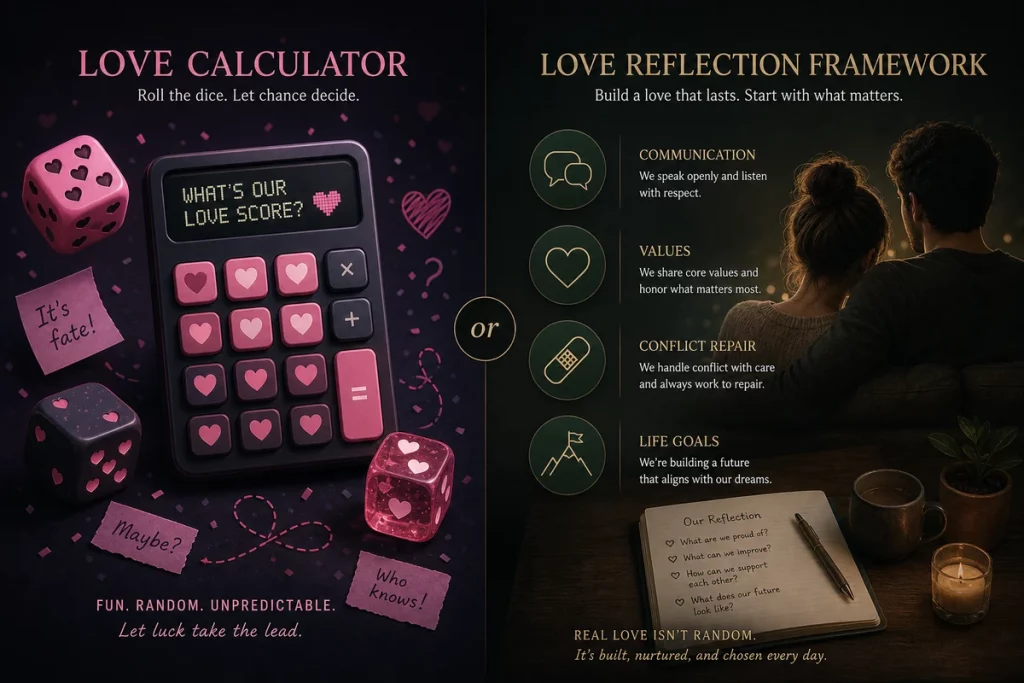
If you’re genuinely interested in understanding your compatibility with a specific person — rather than being entertained by a random number — these evidence-based tools provide actually useful information. Each uses validated psychological frameworks rather than the name arithmetic that entertainment calculators rely on, and each provides actionable insight that can improve your relationship rather than a percentage that simply confirms or challenges what you already feel:
Attachment Style Quiz
Identifies your attachment pattern (secure, anxious, avoidant, or disorganized) and explains how it interacts with your partner’s style. Unlike love test io, the attachment framework is validated by decades of empirical research and predicts actual relationship dynamics with scientific reliability. Take the quiz individually, compare results, and use the comparison to understand the specific challenges and strengths your attachment combination produces.
Love Language Assessment
Identifies how you and your partner give and receive love — addressing the specific communication gap that produces the “I show love through acts of service but they need words of affirmation” friction that the calculator’s percentage can’t evaluate. The love language framework provides immediately actionable information: once you know each other’s primary language, you can deliberately speak it rather than defaulting to your own.
Green Flags Assessment
Evaluates the behavioral indicators that predict healthy, sustainable partnership: consistency, communication quality, conflict resolution style, boundary respect, emotional availability, and accountability. Unlike the static snapshot that love test io provides, the green flags framework evaluates the DYNAMIC qualities that determine whether a relationship will thrive over time — because compatibility isn’t a number; it’s a pattern of behavior that either supports or undermines the connection across months and years.
Relationship Health Assessment
For relationships where the question isn’t “are we compatible?” but “is this relationship healthy?” — the emotionally abusive test and abusive relationship quiz provide the structured evaluation that identifies harmful patterns name calculators can.t detect.
For new connections: The most meaningful “compatibility test” for a new dating connection isn’t any quiz — it’s verified identity and observed behavior over time. Use GuyID’s free screening tools to confirm that the person you’re evaluating compatibility with is actually who they claim to be — because compatibility with a fabricated identity is meaningless regardless of what any calculator produces. Share your Date Mode link through GuyID because compatibility with a verified real person is the only compatibility worth measuring.
Then invest the time to observe the behavioral patterns that genuine compatibility assessment requires: how they handle conflict when it inevitably arrives, how they treat your boundaries when you set them, whether their actions match their words across weeks and months of interaction, and whether the connection makes you feel more like yourself or less. Watch for the early signs of toxicity that no love test io could detect because they require behavioral observation rather than name calculation. These observations take weeks and months — not the seconds that name calculators require — but they produce information that actually predicts your future together rather than generating a random number that pretends to predict it while providing nothing more than a momentary reduction in the uncertainty that genuine compatibility assessment requires you to sit with patiently. The patience is the point: rushing past uncertainty through algorithmic shortcut is exactly how people end up in relationships that feel “destined” at month one and disastrous by month twelve — because the early intensity was mistaken for compatibility when it was actually the absence of evaluation that genuine compatibility requires.
How GuyID Helps
GuyID should appear when it is useful, not as a banner ad. A GuyID Trust Profile gives someone a portable way to share trust signals before a date, while identity verification and social vouching help turn vague profile claims into clearer next steps.
Useful next steps:
- Create a GuyID Trust Profile when you want a cleaner way to share verified trust signals.
- Use GuyID free tools and related guides when you need a checklist before meeting someone.
- Treat identity verification as confidence-building, not a guarantee.
- Use social vouching when you want context from people who already know the person.
- Sign up only when the extra trust layer helps the decision you are already trying to make.
Frequently Asked Questions
Is love test io accurate?
No — name-based love calculators and similar compatibility calculators use letter-to-number conversion algorithms that have zero scientific relationship to actual human compatibility. No peer-reviewed research has ever demonstrated predictive validity for any name-based compatibility test. They’re entertainment — enjoyable as such but not sources of relationship information.
What actually predicts relationship compatibility?
Research identifies five primary predictors: conflict resolution style (how you handle disagreements), attachment compatibility (how your attachment patterns interact), core value alignment (children, finances, lifestyle, relationship structure). Communication quality (expressing needs and listening without defensiveness), and behavioral consistency (words matching actions over time). These factors predict relationship longevity and satisfaction with scientific reliability — unlike name-based calculators that predict nothing.
Are there any online compatibility tests that actually work?
Evidence-based assessments that provide genuinely useful relationship information include: the attachment style quiz (identifies your relational pattern), the love language assessment (identifies how you give and receive love), and the green flags evaluation (assesses behavioral health indicators). These tools use validated psychological frameworks rather than name arithmetic — and they provide actionable information rather than entertainment percentages.
Why do love tests feel accurate even though they’re not?
Three cognitive biases: confirmation bias (you accept high scores for people you already like and dismiss low scores), the Barnum effect (vague descriptions feel personally specific), and anxiety reduction (any definitive answer feels better than uncertainty, even a meaningless one). These biases make name-test results FEEL accurate while providing zero actual compatibility information — the same mechanism that makes horoscopes feel personally relevant despite applying to millions of people simultaneously.