

Reader Briefing
Reader Briefing
Start here if you need a practical read on what is a monogamy relationship?: who should use verification, what signals to check, and what to do before moving from online interest to an in-person plan.
Who this is for
- People meeting someone from a dating app or social platform.
- Readers preparing for a first in-person date.
- Anyone checking identity, profile consistency, and trust signals.
- People trying to avoid romance scams, fake profiles, or pressure tactics.
You’ll learn
- How to evaluate identity signals without treating any single check as certainty.
- Which trust signals matter and how to weigh them together.
- How to spot inconsistencies, pressure, or behavior patterns that deserve caution.
- How to move from online conversation to a safer first meeting.
- Where GuyID tools fit into a quick pre-date screening workflow.
- How to compare options using practical safety and trust criteria.
Bottom line
Verification reduces uncertainty; it does not guarantee future behavior. Use a layered approach: confirm identity signals, compare profile consistency, ask for a short video call, keep early plans public, and slow down when someone pressures you to skip normal safety steps.
Key takeaways
- Identity verification improves confidence, not certainty.
- Patterns matter more than isolated incidents.
- Verify before meeting privately or sharing sensitive details.
- A short video call can reveal many inconsistencies.
- Pressure to skip reasonable safety steps is useful information.
Free Tools
Catfish Probability Detector
Check whether a dating profile has suspicious identity or photo signals.
Dating Bio Red Flag Detector
Review a bio for scam, pressure, or trust-warning language.
Dating Safety Checklist
Use free GuyID tools before moving from chat to a real date.
Next step
Create your GuyID trust profile
Share consent-based trust signals before a date without turning the conversation into an interrogation.
It seems like it should be obvious — but in 2026, the question “what is a monogamy relationship?” has become genuinely complicated. The rise of ethical non-monogamy, polyamory, open relationships, and relationship anarchy has created a landscape where monogamy is no longer the unquestioned default — it’s one option among many, and understanding what it actually means (beyond “dating one person”) helps you choose it deliberately rather than defaulting into it unconsciously. A monogamy relationship is an exclusive romantic and sexual partnership between two people — but that simple definition conceals layers of complexity about what exclusivity actually requires, why monogamy works for some people and not others, and how to build a monogamous relationship that thrives because both people actively chose it rather than merely accepted it.
NavigateTable of Contents17 sections
What Is a Monogamy Relationship? The Complete Definition
A monogamy relationship is an exclusive romantic and sexual partnership between two people, where both partners agree to direct their romantic and sexual energy exclusively toward each other. The American Psychological Association defines monogamy as “the practice or condition of having a single mate during a period of time” — though modern usage typically implies the additional components of emotional exclusivity, mutual commitment to the partnership’s longevity, and the expectation that both people will work through difficulties rather than seeking connection elsewhere when challenges arise.
Understanding what is a monogamy relationship in its full complexity means recognizing that monogamy isn’t just a behavior (seeing one person) — it’s a relationship philosophy that encompasses exclusivity across multiple dimensions: sexual exclusivity (physical intimacy only with each other), romantic exclusivity (romantic attention, energy, and pursuit directed only toward each other), emotional exclusivity (primary emotional intimacy shared between the two partners rather than distributed across multiple romantic connections), and future exclusivity (planning and building toward a shared future that assumes the continuation of the partnership).
The definition also carries cultural and historical weight. Monogamy has been a dominant relationship structure in many Western institutions, reinforced by religious traditions, marriage law, and social norms. That cultural position does not establish biological inevitability or universal superiority. Relationship structure is only one part of the experience; communication, trust, mutual respect, shared values, and freely chosen agreements still shape how the partnership functions.
Types of Monogamy
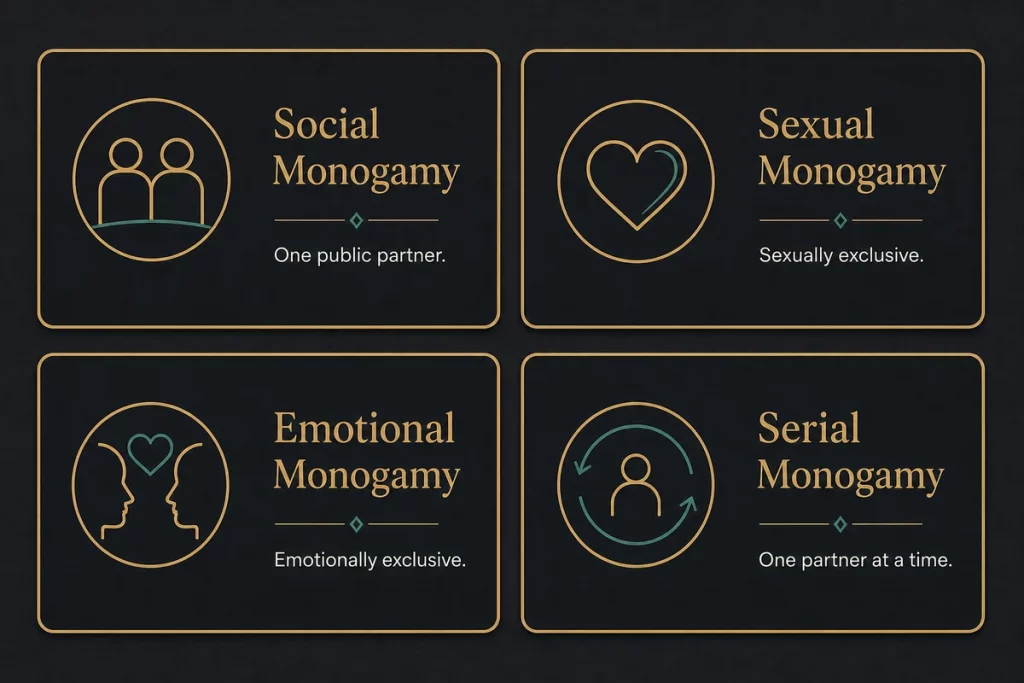
Social Monogamy
Two people present as an exclusive couple socially — living together, attending events together, being recognized by their community as a partnership — while the sexual exclusivity dimension may or may not be explicitly maintained. Social monogamy is the most visible form: it’s what the outside world sees. Understanding what is a monogamy relationship at the social level matters because many relationships that appear monogamous externally may operate differently in private — which is why communication about what exclusivity actually means to both people is essential rather than assumed.
Sexual Monogamy
Exclusive sexual involvement with one partner — no physical intimacy outside the partnership. This is the dimension most people mean when they reference monogamy, and it’s the dimension where violations (infidelity) produce the most acute betrayal. Sexual monogamy requires ongoing choice: the commitment isn’t made once and maintained automatically; it’s reaffirmed through daily decisions to direct sexual energy exclusively toward the partner. Understanding what is a monogamy relationship at the sexual level means acknowledging that attraction to others doesn’t violate monogamy — acting on that attraction does.
Emotional Monogamy
Directing primary emotional intimacy, vulnerability, and romantic energy toward one partner. Emotional monogamy is the dimension that’s most difficult to define and most commonly violated without recognition — because emotional affairs (deep emotional intimacy with someone outside the partnership that replaces rather than supplements the primary connection) often develop gradually and without the clear boundary-crossing moment that physical infidelity involves. The red flags guide identifies emotional unavailability as a warning sign partly because it can indicate that someone’s emotional monogamy is already directed elsewhere.
Serial Monogamy
The pattern of having exclusive, committed relationships one at a time — but moving through multiple such relationships over a lifetime rather than maintaining one permanent partnership. Serial monogamy is the most common modern practice: people commit fully to one partner, the relationship ends, and they commit fully to the next. Understanding what is a monogamy relationship in the serial context acknowledges that monogamy doesn’t require “one partner forever” — it requires “one partner at a time,” with full exclusivity maintained within each partnership regardless of how many partnerships occur across a lifetime.
Why Monogamy Works: The Psychological Benefits
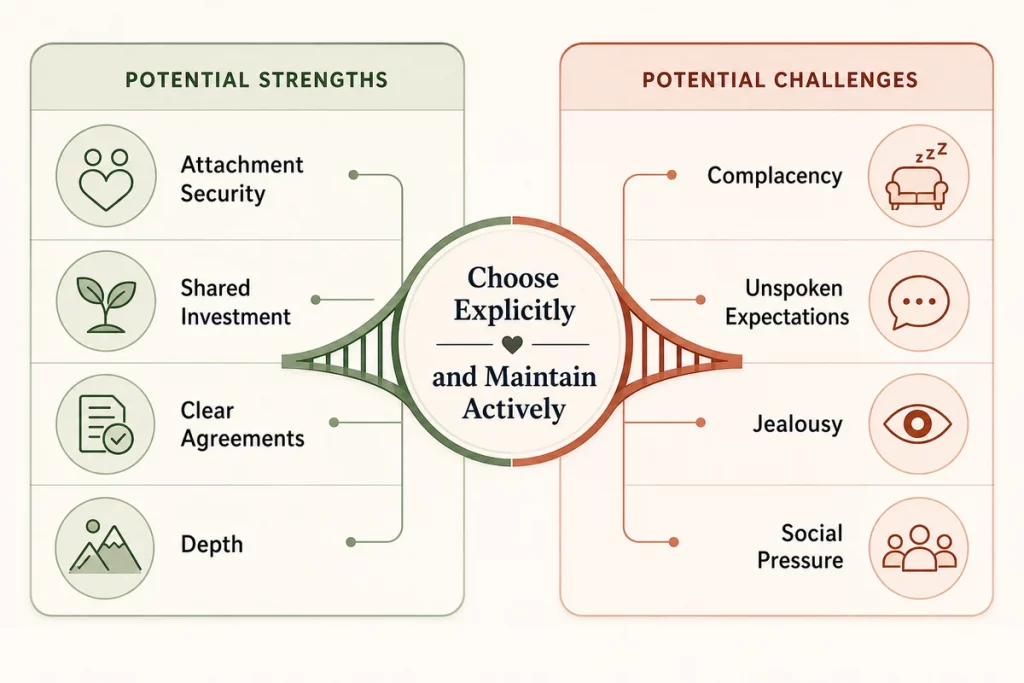
Attachment security. Monogamy’s exclusive structure provides the certainty that anxious attachment styles need to feel safe and that secure attachment styles need to maintain their security. Knowing that your partner’s romantic and sexual energy is directed exclusively toward you reduces the hypervigilance, comparison anxiety, and jealousy that non-exclusive structures can intensify in attachment-sensitive individuals. For many people, the security of monogamy isn’t a limitation — it’s the foundation on which genuine vulnerability becomes possible, because vulnerability requires trust, and trust requires the confidence that your partner isn’t simultaneously investing in alternatives.
Depth over breadth. Directing all romantic energy toward one person produces depth of connection that distributed energy can’t replicate — the same way that mastering one instrument produces expertise that dabbling in five instruments can’t. Monogamous partners develop the fine-grained understanding of each other’s emotional patterns, communication styles, needs, and triggers that only comes from sustained, exclusive attention. This depth is monogamy’s primary advantage: the relationship becomes a specialist skill that both people refine over years rather than a generalist activity spread across multiple connections.
Simplified logistics and reduced emotional complexity. Practical reality: managing one relationship is significantly less logistically and emotionally complex than managing multiple. The time, energy, and emotional bandwidth available for relationship maintenance is finite — and concentrating it on one partnership allows deeper investment than distributing it across several. This isn’t a moral argument against non-monogamy; it’s a practical observation about cognitive and emotional resource allocation that explains why monogamy appeals to people who prefer depth and simplicity over variety and complexity.
Social and institutional support. Monogamous relationships receive more cultural validation, legal protection, and institutional support than any other relationship structure. Marriage laws, tax benefits, inheritance rights, medical decision-making authority, and social recognition all favor monogamous partnerships — creating practical advantages that non-monogamous relationships currently don’t receive. While these institutional advantages don’t make monogamy morally superior, they do make monogamous relationships easier to maintain within existing social structures. The National Domestic Violence Hotline and other support organizations are structured primarily around monogamous relationship models, providing resources and frameworks specifically calibrated to the dynamics of exclusive partnerships.
The Challenges of Monogamy
The desire-security paradox. Monogamy provides security — but security can reduce desire. The novelty and uncertainty that produce romantic excitement diminish as familiarity increases, creating the “passion decline” that long-term monogamous relationships commonly experience after 1-3 years. Understanding what is a monogamy relationship means understanding this paradox and actively working against it: introducing novelty, maintaining individual identities, and continuing to pursue each other rather than taking the relationship’s permanence for granted.
The infidelity vulnerability. Monogamy’s exclusivity requirement creates the conditions for its most devastating violation: infidelity. When the agreement is “only you” and the reality becomes “also someone else,” the betrayal is profound because it violates the specific promise that defines the relationship structure. This statistic doesn’t argue against monogamy; it argues for honest self-assessment about whether you can genuinely commit to exclusivity before promising it.
The “default” problem. Many people enter monogamous relationships not because they’ve deliberately chosen monogamy over alternatives but because monogamy is the cultural default — the “normal” option that requires no justification. Unchosen monogamy is weaker than chosen monogamy because the person hasn’t examined whether the structure actually serves their needs, values, and relationship goals. If you’re monogamous because “that’s just what people do” rather than because you’ve considered the alternatives and determined that exclusivity best serves your partnership — the foundation is assumption rather than intention, and assumptions are more fragile than choices when tested. Our boundary-setting guide covers the explicit communication that transforms assumed monogamy into chosen monogamy.
Communication gaps about what “exclusive” means. “We’re exclusive” doesn’t mean the same thing to both people unless they’ve defined it explicitly. Does exclusive mean no flirting? No close friendships with potential romantic interests? No platonic intimacy that feels threatening? No social media interaction with exes? These questions sound nitpicky — but they’re exactly the undefined boundaries that produce the conflicts, gaslighting, and deflection that erode monogamous partnerships from the inside. The explicit conversation about what exclusivity MEANS in your specific relationship prevents the assumed-but-undefined expectations that produce betrayal feelings over behaviors neither person agreed were off-limits.
The comparison trap in the social media age. Monogamy in 2026 operates against the backdrop of constant exposure to alternatives — attractive people on Instagram, flirtatious interactions on social media, and the ever-present awareness that dating apps offer unlimited options one download away. This exposure doesn’t cause infidelity, but it creates a comparison environment that previous generations of monogamous couples didn’t face. Managing the comparison trap requires both partners to acknowledge its existence (pretending it doesn’t exist produces shame when comparison thoughts arise) and to redirect comparison energy toward investment in the existing partnership rather than fantasy about alternatives. The couples who navigate social media most successfully within monogamy are those who discuss its impact openly rather than pretending that neither person ever notices anyone else — because the pretense creates the secrecy that actual problems grow inside.
Evolving needs over time. What both people needed at year one of the monogamy relationship may differ significantly from what they need at year ten. Individual growth, career changes, parenthood, aging, and shifting priorities all reshape what each person requires from the partnership — and monogamy’s longevity depends on the partnership’s ability to evolve alongside the individuals within it. Relationships that treat the initial agreement as permanent and unchangeable become rigid structures that can’t accommodate the natural growth of two human beings over decades. The most resilient monogamous relationships include regular “relationship check-ins” — honest conversations about what’s working, what isn’t, and what needs to change — that allow the partnership to evolve deliberately rather than calcifying around outdated agreements.
Monogamy vs. Other Relationship Structures
| Structure | Definition | Key Difference from Monogamy |
|---|---|---|
| Monogamy | Exclusive partnership — one romantic/sexual partner at a time | N/A — baseline comparison |
| Open Relationship | Primary partnership with agreed-upon freedom for sexual connections with others | Sexual exclusivity removed; emotional primary maintained |
| Polyamory | Multiple simultaneous romantic relationships with knowledge and consent of all involved | Both sexual AND emotional exclusivity removed |
| Relationship Anarchy | No hierarchy or predefined rules — all connections are defined individually | No structure is assumed; everything is negotiated |
No structure is inherently superior — each serves different psychological needs, attachment styles, and life philosophies. What is a monogamy relationship’s unique value? Its exclusivity provides the attachment security, depth of connection, and simplified emotional landscape that many people require for genuine vulnerability. What’s its limitation? The exclusivity can feel constraining to people whose needs, desires, or relationship philosophies are better served by more flexible structures. The answer isn’t “monogamy is best” or “monogamy is outdated” — it’s “monogamy is RIGHT for people who choose it deliberately, practice it skillfully, and communicate about it honestly.”
Choosing Monogamy Intentionally
Have the explicit conversation. “I want to be exclusive with you — and here’s what that means to me” can transform assumed monogamy into a chosen agreement. Define boundaries together: what counts as a violation, what communication is expected when attraction to someone else arises, and how either person can raise changing feelings honestly. These conversations may feel awkward, but they can expose undefined expectations before those differences become conflict.
Choose it for the right reasons. Monogamy chosen because you genuinely value exclusivity, depth, and focused partnership is strong. Monogamy chosen because you’re afraid of your partner being with others, because you want to control their behavior, or because you assume it’s the only “normal” option is fragile. The strength of any relationship structure comes from the intention behind it — and monogamy chosen from security is fundamentally different from monogamy chosen from fear. Ask yourself honestly: do I want monogamy because I thrive in exclusive connection, or because the thought of my partner with someone else is intolerable? The first answer reflects genuine preference; the second reflects insecurity that will produce controlling behavior regardless of the relationship structure it operates within.
Maintain it actively. Monogamy isn’t a one-time agreement — it’s an ongoing practice that requires daily investment to remain vital and satisfying for both people. Continue dating each other long after the “official” dating phase ends. Maintain physical and emotional intimacy through deliberate attention rather than assuming proximity will sustain it. Address conflicts through direct communication rather than stonewalling or manipulation. Introduce novelty — new experiences, new conversations, new ways of connecting — that prevent the staleness that long-term familiarity can produce. Support each other’s individual growth rather than resisting changes that feel threatening. The monogamous relationships that last decades aren’t the ones where both people simply avoid other romantic connections — they’re the ones where both people actively invest in the connection they chose, making it rich enough that the question of alternatives never becomes compelling.
Verify trust from the beginning. Whether you’re entering monogamy with someone new or recommitting to monogamy after a relationship transition, verified trust is the foundation. Use GuyID’s free screening tools to verify identity before committing emotionally. Share your Date Mode link through GuyID to establish transparency from the start. Watch for the green flags that predict monogamous commitment capacity: consistency between words and actions, respect for boundaries, emotional availability, and the willingness to have explicit conversations about exclusivity rather than assuming it. The genuine interest signs guide helps you identify partners whose behavior demonstrates real commitment capacity versus those whose words promise what their actions can’t deliver.
How GuyID Helps
GuyID should appear when it is useful, not as a banner ad. A GuyID Trust Profile gives someone a portable way to share trust signals before a date, while identity verification and social vouching help turn vague profile claims into clearer next steps.
Useful next steps:
- Create a GuyID Trust Profile when you want a cleaner way to share verified trust signals.
- Use GuyID free tools and related guides when you need a checklist before meeting someone.
- Treat identity verification as confidence-building, not a guarantee.
- Use social vouching when you want context from people who already know the person.
- Sign up only when the extra trust layer helps the decision you are already trying to make.
Frequently Asked Questions
What is a monogamy relationship?
A monogamy relationship is an exclusive romantic and sexual partnership between two people, where both agree to direct their romantic and sexual energy exclusively toward each other. It encompasses sexual exclusivity, emotional exclusivity, and the shared expectation that both people will work through challenges rather than seeking connection elsewhere. Monogamy is one relationship structure among several — and its strength comes from being chosen deliberately rather than assumed by default.
Is monogamy natural for humans?
Humans form relationships in varied ways, so the word natural does not determine which structure is right for an individual. Monogamy is one consensual relationship agreement. Its success depends on shared expectations, communication, and continuing consent rather than biology alone.
How do I know if monogamy is right for me?
Monogamy may fit when exclusivity aligns with your values and you can agree to it freely and honestly. Consider your needs, jealousy, boundaries, communication style, and long-term expectations. Discuss the agreement explicitly rather than relying on assumptions or social pressure.
What’s the difference between monogamy and being faithful?
Monogamy is the relationship structure — the agreement to be exclusive. Faithfulness is the behavior — actually maintaining that exclusivity in practice. You can be in a monogamous relationship without being faithful (infidelity), and you can be faithful within various relationship structures (monogamous faithfulness means exclusivity with one partner; polyamorous faithfulness means honoring the agreements of your multiple-partner arrangement). Understanding what is a monogamy relationship means recognizing that the structure and the behavior are separate — and the structure means nothing without the behavior to support it.
Can a monogamous relationship survive infidelity?
Some can — with significant therapeutic work, genuine accountability from the unfaithful partner, and the willingness of the betrayed partner to process the trust damage.