
Reader Briefing
Reader Briefing
Start here if you need a practical read on first date: the complete guide to getting it right: who should use verification, what signals to check, and what to do before moving from online interest to an in-person plan.
Who this is for
- People meeting someone from a dating app or social platform.
- Readers preparing for a first in-person date.
- Anyone checking identity, profile consistency, and trust signals.
- People trying to avoid romance scams, fake profiles, or pressure tactics.
You’ll learn
- How to evaluate identity signals without treating any single check as certainty.
- Which trust signals matter and how to weigh them together.
- How to spot inconsistencies, pressure, or behavior patterns that deserve caution.
- How to move from online conversation to a safer first meeting.
- Where GuyID tools fit into a quick pre-date screening workflow.
- How to compare options using practical safety and trust criteria.
Bottom line
Verification reduces uncertainty; it does not guarantee future behavior. Use a layered approach: confirm identity signals, compare profile consistency, ask for a short video call, keep early plans public, and slow down when someone pressures you to skip normal safety steps.
Key takeaways
- Identity verification improves confidence, not certainty.
- Patterns matter more than isolated incidents.
- Verify before meeting privately or sharing sensitive details.
- A short video call can reveal many inconsistencies.
- Pressure to skip reasonable safety steps is useful information.
Free Tools
Catfish Probability Detector
Check whether a dating profile has suspicious identity or photo signals.
Dating Bio Red Flag Detector
Review a bio for scam, pressure, or trust-warning language.
Dating Safety Checklist
Use free GuyID tools before moving from chat to a real date.
Next step
Create your GuyID trust profile
Share consent-based trust signals before a date without turning the conversation into an interrogation.
The initial date is the most overanalyzed, overthought, and unnecessarily stressful 90 minutes in all of human connection — and it doesn’t have to be. A initial meeting has exactly one job: determine whether both people want a second one. Everything else — the perfect outfit, the flawless conversation, the impressive restaurant — is noise that distracts from the only question that matters: do we enjoy each other’s company enough to do this again? This guide strips the first date back to fundamentals: what to plan, what to watch for, how to be genuinely yourself rather than performing a curated version of yourself, and the safety framework that protects you from the rare-but-real risks that meeting a stranger for romantic evaluation involves. Because your initial meeting should feel like the beginning of something, not a high-stakes audition.
NavigateTable of Contents15 sections
Planning the Perfect First Date
The best dating environments share three qualities: they’re public (safety), they allow conversation (connection), and they have a natural end point (no awkward “how do we end this?” dynamics). Here’s what works and what doesn’t:
Choose a low-pressure public setting. A coffee shop or casual bar can keep cost and time commitments manageable while supporting conversation and a natural exit. A quiet public venue is not universally ideal — accessibility, alcohol preferences, noise, transit, and personal safety all matter. Choose a place where both people can arrive independently, hear each other, and leave comfortably.
Activity dates for people who hate sitting and talking. Not everyone thrives in face-to-face conversation with a stranger. If that’s you, activity-based first dates — a walk through a neighborhood market, a casual hike, a museum visit, mini golf, a cooking class — provide shared experience that generates natural conversation without the intensity of staring across a table for an hour. Activity dates also reveal personality in ways that conversation alone doesn’t: how does this person handle a challenge? Are they competitive or collaborative? Do they laugh at small mishaps or get frustrated? These behavioral observations are dating gold because they bypass the curated self-presentation that pure conversation allows.
Dinner — only if you’re both comfortable with it. Dinner as dinner carries higher stakes: longer time commitment, higher cost, more formal atmosphere, and the pressure of sustaining conversation across multiple courses. If both people are enthusiastic about dinner, it works fine — but avoid suggesting dinner when a shorter, lower-commitment option would serve the evaluation purpose better. Many successful couples report that their best early dates were coffee or drinks, not elaborate dinners — because the relaxed setting allowed them to be themselves rather than performing for the occasion.
What to absolutely avoid for a first date. Movies (you can’t talk), concerts (you can’t talk), group activities with your friends (the person is meeting YOU, not your social circle), your apartment (safety concern and pressure), long road trips (no escape route), and any activity that costs more than both people are comfortable with. The date should be geographically convenient, time-bounded, and low-stakes enough that ending it early doesn’t feel dramatic and extending it feels organic rather than obligatory.
Choosing the right venue matters more than you think. The venue sets the emotional tone for the entire encounter. A loud, crowded bar produces surface-level shouted conversation. A quiet, intimate restaurant produces pressure and formality. A casual coffee shop with comfortable seating and ambient noise produces the Goldilocks conditions: private enough for genuine conversation, public enough for safety, and relaxed enough for both people to let their guard down. Choose a venue you’re familiar with (you’ll feel more comfortable on home turf), that’s easy for both people to reach (reducing logistical friction), and that has seating arrangements conducive to conversation (side-by-side at a bar counter often produces better flow than face-to-face across a table because the reduced eye-contact intensity lowers social pressure). If you’re choosing the venue, pick somewhere that reflects your actual lifestyle — not somewhere you’d never normally go — because the venue is part of the self-presentation, and a mismatch between venue and personality is detectable.
First Date Conversation: What to Talk About and What to Avoid
The biggest dating conversation mistake is treating it as an interview — rapid-fire questions without genuine engagement with the answers. The goal isn’t to collect data points about the person; it’s to create a shared experience of conversational flow that tells both of you whether you enjoy spending time together. Research from the American Psychological Association on conversational chemistry confirms that feeling “heard” during a first meeting is a stronger predictor of second-date interest than the specific content discussed — which means HOW you talk matters more than WHAT you talk about.
Ask, listen, build. Ask a genuine question. Listen to the actual answer (not just waiting for your turn to talk). Build on what they shared before introducing a new topic. “You mentioned you lived in Barcelona — what was that like?” → listen → “The food scene sounds incredible — do you cook much yourself?” → listen → share your own cooking story. This pattern creates conversational depth (multiple layers on one topic) rather than conversational breadth (one shallow pass across twenty topics) — and depth creates connection while breadth creates interview energy.
Share proportionally. If they share a personal story, reciprocate with one of similar depth. If they keep things light, match that energy. Asymmetrical sharing — one person disclosing deeply while the other stays surface-level — creates imbalance that both people sense even if neither can articulate it. The first date isn’t the time for your deepest trauma or your entire life history — but it IS the time for genuine self-disclosure that shows the real you rather than the polished version.
Topics that work well on date one. Travel experiences and future trip plans (reveals priorities and adventure appetite). What they do outside of work (reveals genuine interests versus work-defined identity). Funny stories that show personality (humor builds rapport faster than earnestness). Current interests and recent discoveries (reveals intellectual curiosity). Family dynamics at a surface level (reveals emotional context without going too deep too fast). These topics work because they invite storytelling rather than factual reporting — and stories build connection while facts build profiles.
Topics to avoid on date one. Exes in detail (save for date 3-4). Salary, debt, or financial specifics (appropriate later). Political debates (risk high conflict on first impression). “Where is this going?” conversations (premature on date one). Anything you’d be uncomfortable hearing from a stranger (which is what you still are). The avoidance isn’t dishonesty — it’s pacing. These topics deserve the comfort and trust that develop over multiple meetings, not the brittle trust of a first encounter.
Green Flags and Red Flags on a First Date
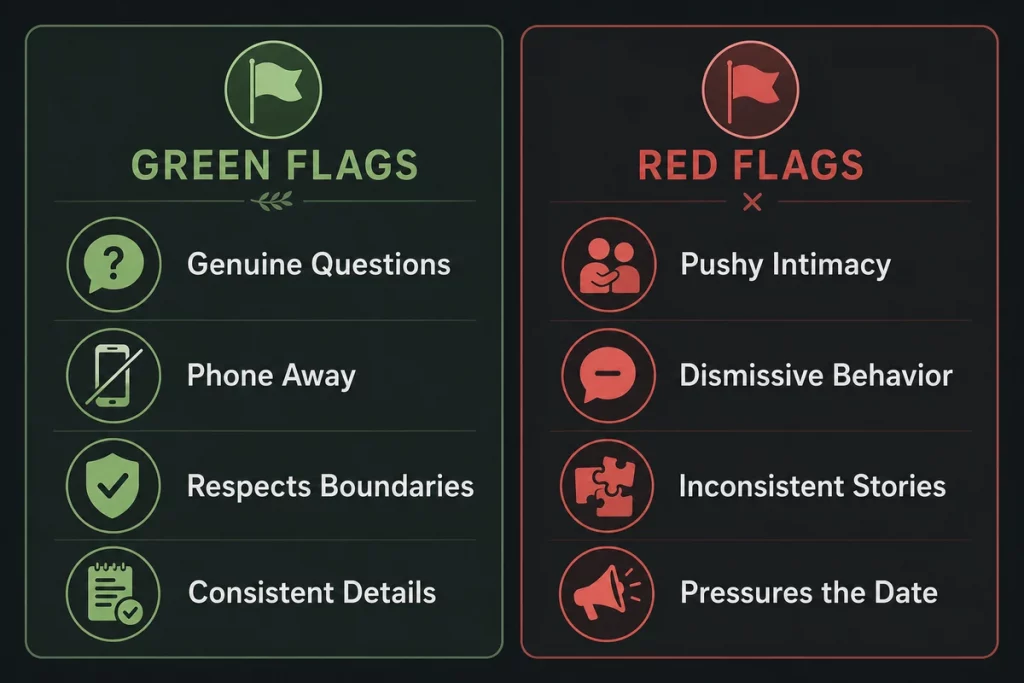
Green flags to watch for. They ask genuine questions and listen to answers (curiosity about YOU, not just performing interest). They make eye contact without staring (comfortable engagement). Their stories are consistent (authentic self-presentation). They treat service staff respectfully (character indicator). They reference future activities naturally — “we should try that place sometime” (forward orientation). They respect the date’s natural pace — not rushing to extend it or abruptly cutting it short. They’re present: phone away, attention on you, engaged with the conversation. These green flags indicate the emotional availability, respect, and genuine interest that predict healthy connection — our genuine interest signs guide provides the complete behavioral indicator framework.
Red flags to watch for. They dominate the conversation without asking about you (self-absorption). They check their phone repeatedly (disengagement). They make negative comments about exes extensively (unprocessed baggage). They push physical boundaries before you’ve signaled comfort (boundary disrespect). They make comments about your appearance that feel evaluative rather than complimentary (“you’re prettier than your photos” implies your photos were evaluated and found wanting). They pressure you to extend the date when you’ve indicated readiness to leave. They mention how different you are from “everyone else on dating apps” — classic love bombing language that sounds flattering but signals performative interest. Our red flags guide and player detection guide provide the comprehensive warning-sign frameworks.
The single most reliable dating indicator. How do you feel AFTER the date — not during it? During the date, chemistry, nervousness, and performance energy distort your assessment. After the date, once the adrenaline subsides, your honest emotional state reveals more: do you feel energized and curious? (green) Do you feel drained and relieved it’s over? (red) Do you feel like you were performing rather than being yourself? (yellow — the environment or the person didn’t create safety for authenticity). Trust the post-date feeling more than the in-date chemistry because chemistry can be manufactured by charismatic individuals whose charm serves purposes beyond genuine connection.
Managing First Date Anxiety
First date nervousness is universal — and a small amount actually helps (it signals that you care about the outcome, which produces better engagement). But when anxiety crosses from helpful alertness into paralyzing dread, it undermines the experience for both people. Practical strategies for managing pre-date anxiety:
Reframe the purpose. You’re not auditioning for the role of someone’s partner. You’re meeting a person to see if you enjoy each other’s company. That’s it. The reframe matters because audition framing produces performance behavior (trying to be what you think they want) while meeting framing produces authentic behavior (being who you actually are). Counterintuitively, authentic behavior produces better outcomes than performance — because the person who likes the REAL you after a genuine first date has a foundation for something sustainable, while the person who likes your performance version has a foundation for disappointment when the performance inevitably drops.
Arrive early. Being already settled when your date arrives eliminates the anxiety of walking in and scanning the room. Order your drink. Claim a comfortable seat. Breathe. The person walking into YOUR established space feels different from two anxious people arriving simultaneously and navigating the awkward “is that you?” moment together. Small environmental control reduces overall dating anxiety significantly.
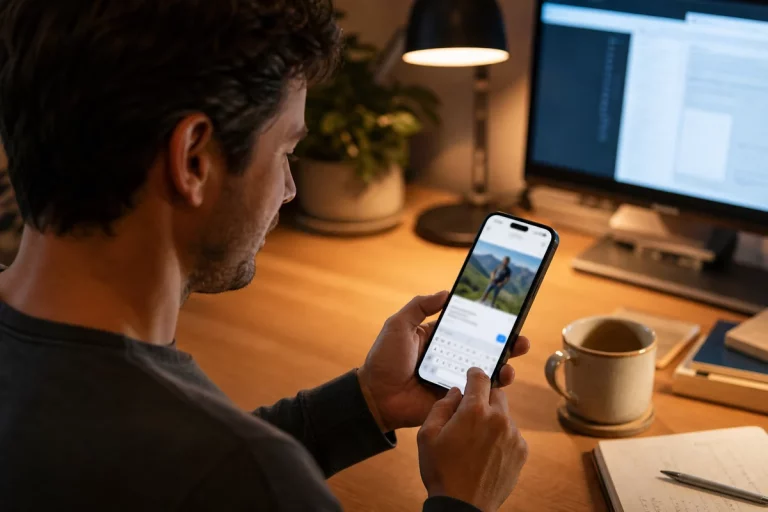
Keep pre-date texting proportionate. Extensive messaging can create expectations that differ from in-person chemistry, while too little communication may leave basic safety and logistics unresolved. Exchange enough to confirm identity, intent, venue, timing, and comfort without treating a fixed message count as a rule. Our icebreaker guide covers ways to keep the conversation relevant.
Accept that some first dates will be bad — and that’s fine. Not every first date produces chemistry. Not every match translates from digital to in-person. A bad date isn’t evidence that you’re undatable — it’s evidence that this specific pairing wasn’t compatible, which is information worth having. The people who date most successfully are those who can experience a mediocre date, process it without catastrophizing, and show up to the next one with undiminished openness.
First Date Safety: The Non-Negotiable Framework
Many first dates end without a safety incident, but meeting a new person is never risk-free. Practical precautions are reasonable, not paranoid or “too much.” The National Domestic Violence Hotline recommends these baseline protections for any meeting with a new romantic interest:
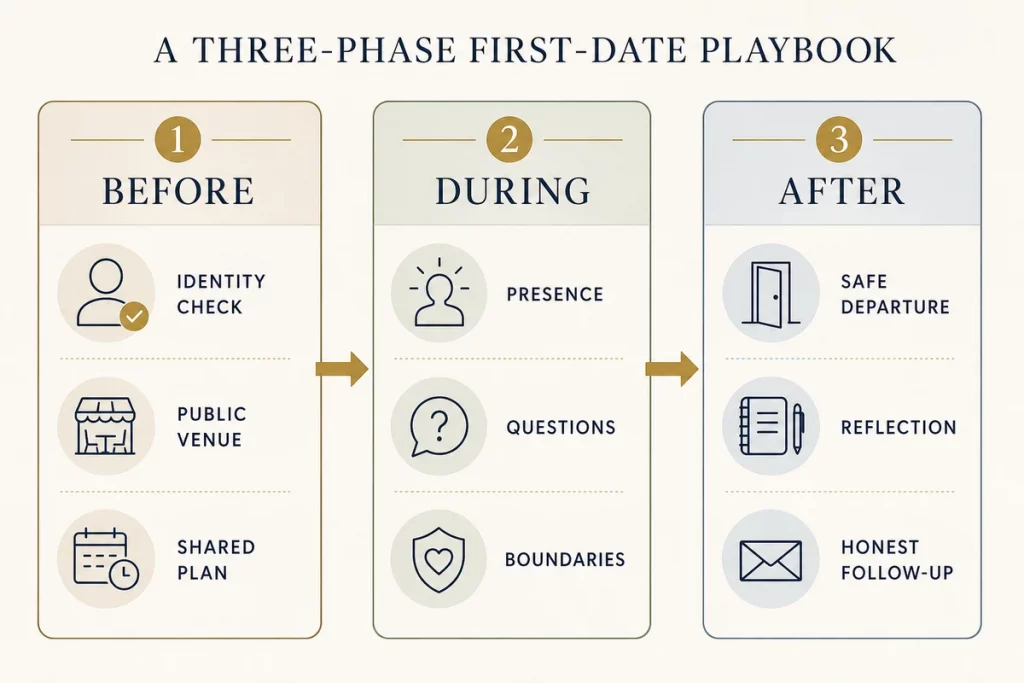
Meet in public. Always. No exceptions on the first date. Not their apartment, not your apartment, not a secluded location. Public venues provide natural safety through the presence of other people, staff who can intervene if needed, and the social accountability that prevents most dangerous behavior.
Tell someone where you’re going. Share the venue, your date’s first name, and your expected return time with a trusted friend. Arrange a check-in text: “I’ll text you by 9 PM — if you don’t hear from me, call.” This takes 30 seconds and provides a safety net that operates independently of your own judgment (which may be compromised by chemistry, alcohol, or social pressure).
Drive yourself or use rideshare. Maintain transportation independence so you can leave whenever you choose. Accepting a ride from someone you’ve known for 90 minutes removes your ability to exit on your own terms — which is a boundary worth maintaining regardless of how well the date went.
Verify before you meet. Use GuyID’s free screening tools for identity verification. Reverse image search their profile photos. Google their name. Share your Date Mode link through GuyID and ask them to share theirs. Government ID verification transforms a stranger from an app into a confirmed real person — the single most impactful safety step you can take before a first date. Our romance scammer guide provides the complete pre-date verification checklist.
Monitor your drinks. Never leave a drink unattended. Accept drinks only from bartenders. Limit alcohol to maintain judgment. These precautions aren’t specific to dating — they apply to any social situation where you’re with people you don’t know well — but the dating context adds motivation to be particularly attentive.
After the First Date: What Happens Next
If you want a second date — say so. “I had a great time — I’d love to do this again” is direct, warm, and eliminates the ambiguity that produces the ghosting and slow fading that plagues modern dating. Text within 24 hours to express interest and suggest a specific plan for date two. Waiting three days to seem “not too eager” is an outdated strategy that communicates disinterest rather than coolness. Promptness signals genuine interest — which is attractive, not desperate.
If you don’t want a second date — be honest. “I enjoyed meeting you, but I didn’t feel the romantic connection I’m looking for. I wish you the best.” This text takes 15 seconds to write and provides the closure that ghosting denies. Yes, sending it is slightly uncomfortable. But the discomfort of honest communication is vastly preferable — for both people — to the confusion and rejection of unexplained silence. Being someone who communicates honestly after first dates builds the integrity that makes you a better partner when the right connection arrives.
If you’re unsure — go on a second date. First date chemistry isn’t always instant. Nervousness, environment, and the evaluation pressure of first meetings can suppress the natural chemistry that emerges once both people relax. If the first date was pleasant (not great, not terrible) and nothing was actively wrong, a second date in a different setting often provides the clearer signal that the first date’s pressure obscured. Many successful long-term couples report mediocre first dates that became excellent connections once the initial awkwardness dissipated.
Don’t over-analyze. The post-first-date analysis spiral — parsing every word they said, every text response time, every micro-expression — consumes cognitive energy without producing useful information. They either want to see you again or they don’t, and no amount of analysis will change the outcome. If they text suggesting a second date, they’re interested. If they don’t, they’re not. The simplicity is uncomfortable but accurate — and accepting it saves the emotional energy that over-analysis wastes. The anxious attachment guide addresses the specific rumination patterns that first dates trigger in anxiously attached individuals.
Don’t broadcast the date on social media prematurely. Posting about a date before the connection has established any foundation creates external pressure (friends asking “how’s it going?”), violates your date’s privacy (they didn’t consent to being featured in your story), and signals that you’re more invested in the social media narrative than the actual connection. Keep the experience between the two of you until there’s something genuinely worth sharing — which typically means waiting until exclusivity before the relationship becomes public content.
Reflect on what YOU brought to the encounter. Post-date processing shouldn’t focus exclusively on evaluating the other person — it should include honest self-assessment. Were you present and engaged, or distracted and performing? Did you ask genuine questions, or default to interview mode? Did you share authentically, or present a curated version? The people who improve at dating over time are those who evaluate their own contribution as honestly as they evaluate their date’s — because the quality of connection you experience is partially determined by what you bring to it, not just what the other person offers.
Give yourself grace regardless of outcome. Whether the date was wonderful, terrible, or somewhere in the unremarkable middle — you showed up. You put yourself in a vulnerable position, met a stranger, and attempted genuine human connection in a world that makes that increasingly difficult. That deserves acknowledgment regardless of whether it produces a second date. The courage to keep showing up after disappointing encounters, after ghosting, after the accumulation of near-misses that dating inevitably produces — that courage is what eventually connects you with the person who makes the entire process worthwhile. Every date that doesn’t work out isn’t a failure — it’s refinement of your understanding of what you want, what you offer, and what genuine chemistry actually feels like when it’s present.
How GuyID Helps
GuyID should appear when it is useful, not as a banner ad. A GuyID Trust Profile gives someone a portable way to share trust signals before a date, while identity verification and social vouching help turn vague profile claims into clearer next steps.
Useful next steps:
- Create a GuyID Trust Profile when you want a cleaner way to share verified trust signals.
- Use GuyID free tools and related guides when you need a checklist before meeting someone.
- Treat identity verification as confidence-building, not a guarantee.
- Use social vouching when you want context from people who already know the person.
- Sign up only when the extra trust layer helps the decision you are already trying to make.
Frequently Asked Questions
What is the best date idea?
Coffee or casual drinks at a venue convenient for both people. The setting is low-pressure, conversational, flexible in duration, and has a natural end point. Activity dates (walks, markets, museums) work well for people who prefer shared experience over face-to-face conversation. The best first date environment is one where both people can be themselves — which typically means casual, public, and low-stakes.
How long should a first date last?
There is no ideal duration for every first date. Planning an activity with a natural endpoint can reduce pressure and make it easier for either person to leave. If both people want to continue, discuss an extension rather than assuming it; consent and comfort still apply when the date is going well.
Who should pay on a first date?
There’s no universal rule — cultural expectations, personal values, and individual circumstances all play a role. A practical approach: the person who suggested the venue offers to pay, and the other person genuinely offers to split. If both people are comfortable splitting, that works. If one person insists on paying and the other accepts graciously, that works too. What matters isn’t who pays — it’s whether the exchange is handled with generosity and grace rather than entitlement or awkwardness. Choosing a low-cost first date venue (coffee, one drink) eliminates most payment anxiety.
What should I wear on a first date?
Something that makes you feel confident, matches the venue’s formality level, and reflects who you actually are. “Slightly better than daily” is the right calibration for most first dates — demonstrating effort without costume-level transformation. Comfort matters: if you’re fidgeting with uncomfortable clothes, the physical discomfort translates to social discomfort. Wear what makes you feel like the best version of your everyday self rather than a special-occasion version you can’t maintain.
How do I know if the date went well?
The most reliable indicator: how do you feel AFTER — not during — the date? If you feel energized, curious, and genuinely interested in seeing them again, the date went well. If you feel drained, relieved, or like you were performing, it didn’t. Other positive signals: the date ran longer than planned (both people lost track of time), conversation flowed naturally without forced effort, and one or both people mentioned future plans (“we should try that place”). The definitive signal: they text within 24 hours expressing interest in a second date.
Should I kiss on the first date?
Only if both people are clearly signaling interest and comfort. There’s no rule that a date must end with a kiss — and no rule that it can’t. Read the body language: are they leaning in? Making sustained eye contact? Lingering at the goodbye rather than moving toward their car? If the signals are ambiguous, defaulting to no kiss and following up with a text expressing interest is the safest approach — because a great text after a date without a kiss builds anticipation, while an unwanted kiss after an otherwise good date can permanently damage the connection.