

Reader Briefing
Reader Briefing
Start here if you need a practical read on how long after divorce to date: who should use verification, what signals to check, and what to do before moving from online interest to an in-person plan.
Who this is for
- People meeting someone from a dating app or social platform.
- Readers preparing for a first in-person date.
- Anyone checking identity, profile consistency, and trust signals.
- People trying to avoid romance scams, fake profiles, or pressure tactics.
You’ll learn
- How to evaluate identity signals without treating any single check as certainty.
- Which trust signals matter and how to weigh them together.
- How to spot inconsistencies, pressure, or behavior patterns that deserve caution.
- How to move from online conversation to a safer first meeting.
- Where GuyID tools fit into a quick pre-date screening workflow.
- How to compare options using practical safety and trust criteria.
Bottom line
Verification reduces uncertainty; it does not guarantee future behavior. Use a layered approach: confirm identity signals, compare profile consistency, ask for a short video call, keep early plans public, and slow down when someone pressures you to skip normal safety steps.
Key takeaways
- Identity verification improves confidence, not certainty.
- Patterns matter more than isolated incidents.
- Verify before meeting privately or sharing sensitive details.
- A short video call can reveal many inconsistencies.
- Pressure to skip reasonable safety steps is useful information.
Free Tools
Catfish Probability Detector
Check whether a dating profile has suspicious identity or photo signals.
Dating Bio Red Flag Detector
Review a bio for scam, pressure, or trust-warning language.
Dating Safety Checklist
Use free GuyID tools before moving from chat to a real date.
Next step
Create your GuyID trust profile
Share consent-based trust signals before a date without turning the conversation into an interrogation.
Your well-meaning friends are split: half say “get back out there” and half say “give it time.” Your therapist says “you’ll know when you’re ready.” And you’re wondering if there’s an actual answer. How long after divorce to date isn’t a calendar question — it’s a readiness question disguised as a timeline question. But the research DOES provide benchmarks, the psychology DOES identify specific readiness indicators, and your specific circumstances DO influence the optimal timeline. This guide replaces vague “when you’re ready” advice with the concrete framework for determining YOUR answer to how long after divorce to date — one that respects both the need to heal and the desire to connect.
NavigateTable of Contents19 sections
What Research Says About How Long After Divorce to Date
The most commonly cited guideline — one year minimum — comes from multiple sources in the therapeutic community, but the evidence base is more nuanced than a single number suggests. Research from the American Psychological Association on post-divorce adjustment indicates that emotional recovery from divorce takes 1-3 years on average, with significant individual variation based on marriage length, divorce circumstances, and individual processing capacity.
A longitudinal study published in the Journal of Family Psychology (indexed in the National Library of Medicine) tracked post-divorce wellbeing and found that individuals who began dating within the first year showed higher rates of rebound relationships that replicated the dynamics of the failed marriage — suggesting that the waiting period should be at least 12 months for most people to allow adequate emotional processing and identity rebuilding. However, the same research found that individuals who waited more than 3 years showed elevated rates of social isolation and dating anxiety — suggesting that excessive waiting produces its own complications.
There is no research-backed waiting period that fits most divorcees. Someone who began grieving during a long marital decline may feel ready sooner than someone blindsided by the split, while abuse, trauma, legal conflict, or severe identity enmeshment may require more time and support. Time alone does not establish readiness. The more useful question is whether your processing has produced enough self-awareness, emotional regulation, and independent identity to approach new connections without asking them to resolve unfinished grief.
6 Factors That Determine How Long After Divorce to Date
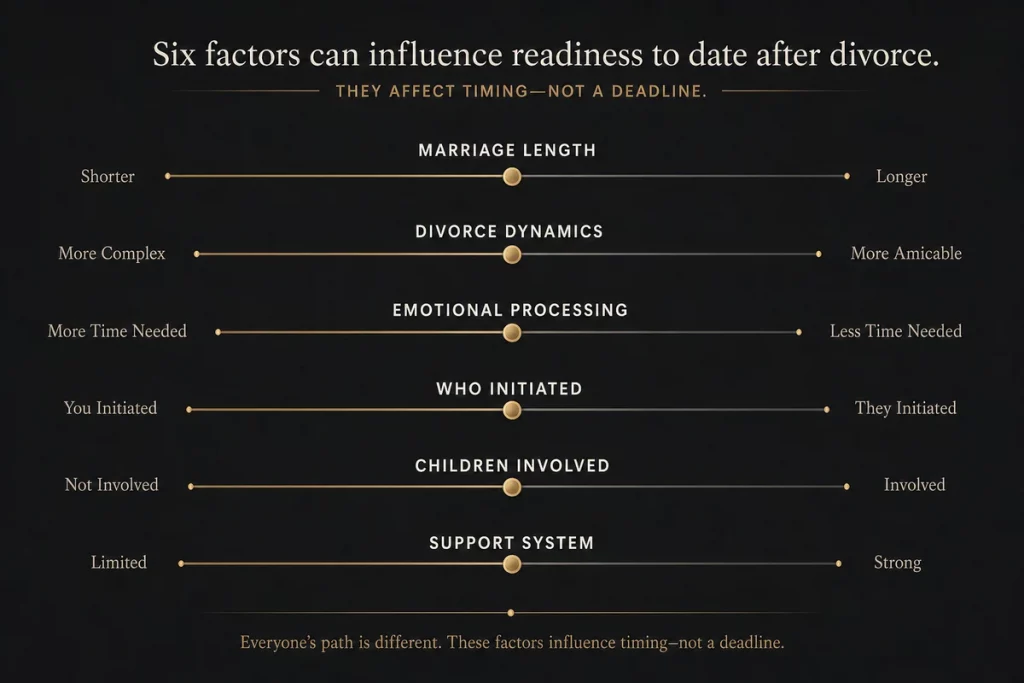
1. Marriage Length
A 3-year marriage and a 25-year marriage produce different recovery timelines — not just because of time invested but because of identity integration depth. Longer marriages create deeper “we” identities, more intertwined routines, and more extensive shared social networks, all of which require more time to disentangle and rebuild independently. A rough guideline: expect 1 month of active recovery for every year of marriage as a minimum baseline, with additional time based on the other factors below.
2. How the Marriage Ended
Mutual, amicable divorces allow faster dating re-entry because both partners acknowledged the ending and processed some grief during the decision-making period. Betrayal divorces (infidelity, financial deception) require additional trust-rebuilding time before dating is healthy — because trust in others AND trust in your own judgment both need repair. Abusive marriage endings require the longest processing period because recovery involves not just grief but trauma bond dissolution, identity reconstruction, and the rebuilding of safety foundations that the abuse dismantled. Our bad breakup recovery guide applies directly to traumatic divorce recovery.
3. Who Initiated the Divorce
The initiator typically processes more grief BEFORE the divorce (during the decision-making period) and may be ready to date sooner. The person who was left experiences the full grief cycle post-divorce, starting from shock rather than prepared acceptance. If you were blindsided by the divorce, add 6-12 additional months to whatever timeline feels right — because the processing that the initiator completed over months or years is compressed into your post-divorce period.
4. Children Involved
What about the timeline when children are involved? Add time and deliberation. Children navigating parental divorce are already managing attachment disruption — introducing a new partner prematurely can compound that disruption. Most child psychologists recommend that the parent be emotionally stable and well-established in their post-divorce identity before introducing dating, and that any specific partner be consistent for 6+ months before meeting the children. The children’s wellbeing adds a legitimate reason to extend the timeline beyond your own readiness.
5. Emotional Processing Depth
Active emotional processing (therapy, journaling, honest self-reflection, grief work) accelerates readiness. Passive waiting (just letting time pass without doing the internal work) doesn’t. Two people divorced on the same day may be ready at wildly different points if one engaged in active processing and the other simply waited for the pain to fade. How long after divorce to date depends more on the quality of your processing than the quantity of your time.
6. Support System Quality
Strong support networks (close friends, family, community, therapy) accelerate recovery by providing emotional processing outlets, reality-checking, and the social connection that prevents the isolation-driven desperation that produces premature dating. Weak support networks extend the timeline because the person lacks both the processing resources and the social connection that healthy recovery requires — making the desire for a romantic partner partly about filling the support gap rather than genuine romantic interest.
The Readiness Assessment: When to Start Dating After Divorce
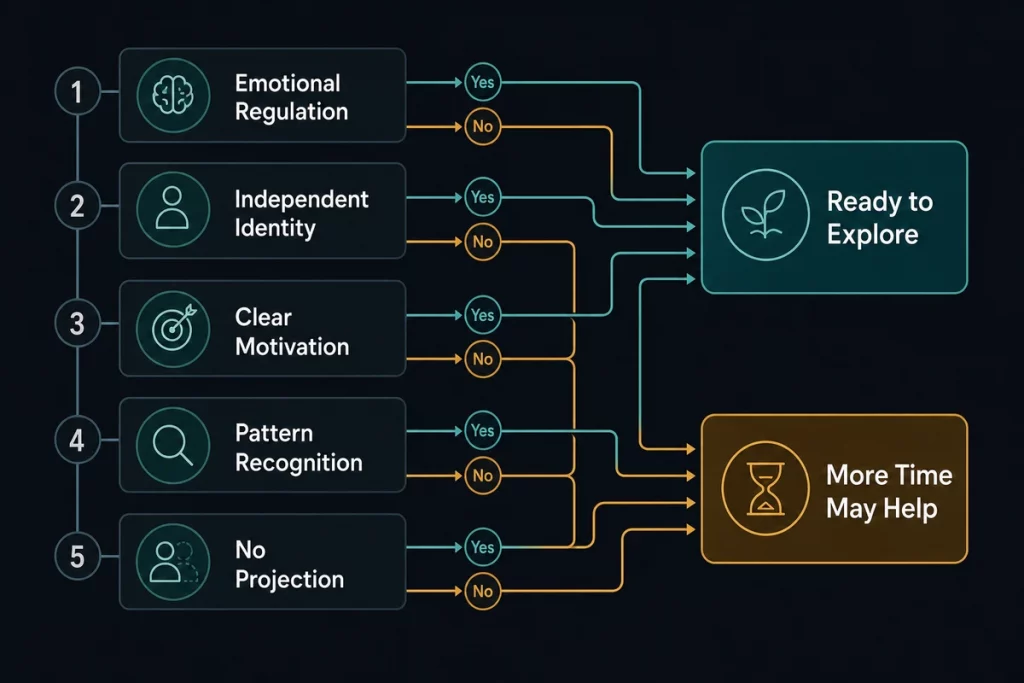
Rather than asking how long after divorce to date, ask whether these readiness indicators are present — because meeting these criteria matters more than any calendar benchmark:
Emotional regulation around the divorce. Can you discuss what happened — including your ex’s role AND your own — without being overwhelmed by anger, grief, bitterness, or the urge to defend or attack? If mentioning your ex produces a flood of unprocessed emotion, more processing is needed before dating. If you can narrate the story with appropriate feeling but without emotional hijacking, your processing has reached the point where new connections won’t be dominated by old pain.
Independent identity. Do you know who you are outside the marriage? Have you rebuilt individual preferences, routines, friendships, and goals that don’t depend on a partner? Can you describe what you want in your life — not just what you want in a relationship? If your identity still feels like “ex-spouse of [name]” rather than “[your own name] who happens to be divorced,” identity reconstruction isn’t complete.
Motivation clarity. Are you dating because you’d enjoy sharing your already-full life with someone — or because you need someone to make your life feel bearable? The distinction matters enormously: desire-based dating produces genuine connection; need-based dating produces dependency, anxious attachment, and tolerance of red flags because being alone feels worse than being in a bad relationship.
Pattern recognition. Have you identified the patterns that contributed to the marriage’s failure — both your ex’s patterns AND your own? Can you articulate what you’d do differently? If you haven’t examined the marriage’s dynamics honestly, you’re at high risk of replicating them — choosing a partner who triggers the same cycles or contributing the same problematic patterns to a new relationship. Our dating after divorce tips guide covers the full framework for post-divorce pattern analysis.
No projection. Can you meet a new person as a new person — rather than as a canvas for projecting your ex’s qualities? If every man reminds you of your ex-husband or every woman triggers comparisons to your ex-wife, the psychological separation isn’t complete enough for fair evaluation of new connections.
Emotional self-sufficiency. Can you regulate your own emotions — manage anxiety, tolerate sadness, process frustration — without requiring another person to do it for you? Marriage often creates co-regulatory patterns where each partner partially depends on the other for emotional management. Post-divorce, rebuilding independent emotional regulation capacity is essential before dating because entering a new relationship while still emotionally dependent on the function your ex-spouse served produces either frantic attachment (clinging to anyone who provides temporary regulation) or avoidant detachment (refusing connection because vulnerability feels too dangerous without the familiar co-regulatory partner). Neither produces healthy partnership. Therapy specifically builds the emotional regulation toolkit that makes post-divorce dating sustainable rather than desperate.
Signs You’re Dating Too Soon After Divorce
Even with the best intentions, some people re-enter dating before they’re ready. The National Domestic Violence Hotline notes that individuals leaving abusive marriages are particularly vulnerable to premature dating because the trauma bond creates an intense need for attachment that can override readiness signals. Watch for these indicators that you may need more time:
You talk about your ex on every date — not in the normal “I was previously married” disclosure, but in extended processing that uses dates as therapy sessions. New connections aren’t equipped to serve as your divorce processing outlet, and the extended ex-talk communicates that you’re still oriented toward the past rather than the present. If a friend told you they spent an entire dinner date talking about their ex, you’d recognize it immediately — apply the same standard to yourself.
You feel desperate rather than curious about new people. Curiosity says “I wonder what this person is like.” Desperation says “Please be the one who ends this loneliness.” Desperation overrides discernment, making you more likely to ignore red flags, tolerate poor treatment, and commit prematurely because any connection feels better than no connection.
You’re comparing every new person to your ex — either favorably (“they’re so much better than my ex!”) or unfavorably (“my ex never would have done that”). Both directions indicate that your ex is still your reference point rather than your own values and needs. When you’re ready, you evaluate people against your standards — not against your ex’s specific qualities or deficiencies.
You’re dating to prove something — to your ex (“look how well I’m doing”), to your social circle (“I’m not damaged goods”), or to yourself (“I’m still desirable”). Externally motivated dating produces performance-oriented connections rather than genuine ones, because the relationship serves an audience rather than the people in it.
Signs You’re Waiting Too Long
The opposite extreme — waiting indefinitely — produces its own complications. The timeline becomes problematic when waiting transforms from healing into avoidance:
You’ve been single for 3+ years and haven’t attempted a single date. At some point, extended singleness transitions from “still processing” to “avoiding vulnerability” — and the avoidance becomes self-reinforcing because the longer you wait, the more intimidating re-entry feels, which increases avoidance, which extends the wait further.
Fear — not wisdom — is driving the delay. “I’m not ready” is healthy when it reflects genuine self-assessment. “I’m not ready” is avoidance when it reflects fear of getting hurt again, fear of repeating patterns, or fear of discovering that the dating world has changed beyond your comfort zone. The difference: wisdom produces specific criteria you’re working toward; fear produces indefinite postponement without clear benchmarks for readiness.
Your social world has contracted to a point where loneliness is your primary emotional state. Sustained loneliness produces depression, cognitive decline, and physical health deterioration — and waiting for “readiness” while these consequences accumulate doesn’t serve your wellbeing. If loneliness has become chronic, re-engaging with social connection (which may include dating) is a health decision as much as an emotional one.
You’ve done the work but keep moving the goalposts. “I’ll date when I finish therapy” becomes “I’ll date when I feel completely healed” becomes “I’ll date when I’m a better version of myself” — and the benchmarks keep receding because perfectionism has replaced genuine readiness assessment. Complete healing isn’t the prerequisite for dating — sufficient healing is. And sufficient means you can engage with new people without being dominated by old pain, not that the old pain has disappeared entirely. Some residual tenderness around divorce is normal and doesn’t disqualify you from connection — it makes you human.
You define yourself by the divorce rather than by who you’ve become since. If “divorced person” is still your primary identity after 3+ years, the divorce has calcified into an identity rather than remaining an experience you’ve integrated. Therapy specifically focused on post-divorce identity can help dissolve this calcification and reconnect you with the parts of yourself that exist beyond the marriage and its ending.
How to Re-Enter Dating When You’re Ready
Once the readiness indicators are present, these practical steps smooth the transition:
Start with one platform and low stakes. Choose a single dating app appropriate for your demographic, set manageable expectations (meeting interesting people rather than finding your soulmate immediately), and pace yourself at 1-2 dates per week maximum. Use GuyID’s free screening tools for identity verification — starting with verified trust eliminates the most common dating fraud and gives your rebuilt trust capacity a solid foundation. Share your Date Mode link through GuyID to demonstrate your own transparency from date one.
Maintain your support system throughout. Don’t abandon the friendships, therapy, and independent activities that supported your recovery in favor of a new relationship. These elements aren’t a substitute for romance — they’re the infrastructure that makes romance sustainable. A new relationship built on the foundation of a full independent life is resilient; a new relationship built as a replacement for your recovery infrastructure is fragile. The moment a new connection makes you want to cancel therapy sessions, skip friend meetups, or drop independent hobbies, recognize that pattern as the enmeshment dynamic that likely contributed to the problems in your marriage.
Be honest about your divorce from the appropriate point. You don’t need to lead with divorce details on date one, but by the second or third date, transparency about your recent history is both ethical and strategic. Ethical because your date deserves to know they’re connecting with someone in post-divorce transition. Strategic because their response to your disclosure provides valuable data: a partner who responds with curiosity and empathy demonstrates emotional maturity; a partner who judges, minimizes, or uses the disclosure against you demonstrates the kind of pattern you’re specifically trying to avoid in this chapter.
Watch for green flags and red flags with your upgraded pattern recognition. Your divorce gave you experiential knowledge about what doesn’t work — use it. But balance vigilance with openness: not every cancellation is the beginning of ghosting, not every compliment is love bombing, and not every disagreement predicts the patterns that ended your marriage. Set boundaries early and clearly, and evaluate new connections based on how they respond to those boundaries — because boundary response is the single most reliable predictor of relationship health. A partner who hears your boundary and adjusts their behavior demonstrates the respect that predicts partnership longevity.
How GuyID Helps
GuyID should appear when it is useful, not as a banner ad. A GuyID Trust Profile gives someone a portable way to share trust signals before a date, while identity verification and social vouching help turn vague profile claims into clearer next steps.
Useful next steps:
- Create a GuyID Trust Profile when you want a cleaner way to share verified trust signals.
- Use GuyID free tools and related guides when you need a checklist before meeting someone.
- Treat identity verification as confidence-building, not a guarantee.
- Use social vouching when you want context from people who already know the person.
- Sign up only when the extra trust layer helps the decision you are already trying to make.
Frequently Asked Questions
How long after divorce to date — what’s the minimum?
Research suggests 1 year as the minimum for most people, with exceptions for those who processed significant grief during the marriage’s decline. The one-year guideline provides time for acute emotional recovery, identity rebuilding, and pattern recognition. Shorter timelines increase the risk of rebound relationships that replicate marriage dynamics. The readiness indicators matter more than the calendar — but the one-year minimum provides a useful minimum benchmark.
Is it bad to date right after divorce?
Not inherently — but dating immediately after divorce usually produces rebounds rather than genuine connections because the emotional processing hasn’t occurred. Immediate dating often serves as pain avoidance (using new relationship chemistry to mask grief) rather than genuine partnership-seeking. If you feel an urgent NEED to date immediately, that urgency itself suggests unprocessed emotional material that a relationship won’t resolve.
How do I know I’m ready to date after divorce?
Five readiness indicators: you can discuss the divorce without emotional flooding; your identity exists independently of being someone’s spouse; you’re motivated by desire rather than need; you’ve identified. The patterns that contributed to the marriage’s failure; and you can meet new people without projecting your ex’s qualities onto them. When all five are present, you’re ready regardless of the calendar date. Our dating after divorce tips guide covers the complete re-entry framework.
Should I date casually first or look for something serious?
Casual dating as a re-entry strategy has merit: it rebuilds social confidence, provides practice with post-divorce dating mechanics, and reduces the pressure that serious-relationship-seeking creates. However, be honest with yourself AND your dates about your intentions. Using people for casual re-entry practice without disclosing that you’re not looking for something serious produces harm. Start wherever feels authentic — casual or serious — as long as you’re transparent about what you’re offering.
How long after divorce to date when kids are involved?
Add deliberation, not necessarily more calendar time. You can date when you’re personally ready, but introducing a new partner to children should wait until the relationship has been consistent for 6+ months and your own post-divorce stability is well-established. Children need to see their parent as stable and whole before processing the addition of a new partner to the family dynamic. The dating with kids section of our divorce tips guide covers the complete framework.