Reader Briefing
Reader Briefing
Start here if you need a practical read on boost bumble: is it worth it?: who should use verification, what signals to check, and what to do before moving from online interest to an in-person plan.
Who this is for
- People meeting someone from a dating app or social platform.
- Readers preparing for a first in-person date.
- Anyone checking identity, profile consistency, and trust signals.
- People trying to avoid romance scams, fake profiles, or pressure tactics.
You’ll learn
- How to evaluate identity signals without treating any single check as certainty.
- Which trust signals matter and how to weigh them together.
- How to spot inconsistencies, pressure, or behavior patterns that deserve caution.
- How to move from online conversation to a safer first meeting.
- Where GuyID tools fit into a quick pre-date screening workflow.
- When to slow down, ask for more context, or walk away.
Bottom line
Verification reduces uncertainty; it does not guarantee future behavior. Use a layered approach: confirm identity signals, compare profile consistency, ask for a short video call, keep early plans public, and slow down when someone pressures you to skip normal safety steps.
Key takeaways
- Identity verification improves confidence, not certainty.
- Patterns matter more than isolated incidents.
- Verify before meeting privately or sharing sensitive details.
- A short video call can reveal many inconsistencies.
- Pressure to skip reasonable safety steps is useful information.
Free Tools
Catfish Probability Detector
Check whether a dating profile has suspicious identity or photo signals.
Dating Bio Red Flag Detector
Review a bio for scam, pressure, or trust-warning language.
Dating Safety Checklist
Use free GuyID tools before moving from chat to a real date.
Next step
Create your GuyID trust profile
Share consent-based trust signals before a date without turning the conversation into an interrogation.
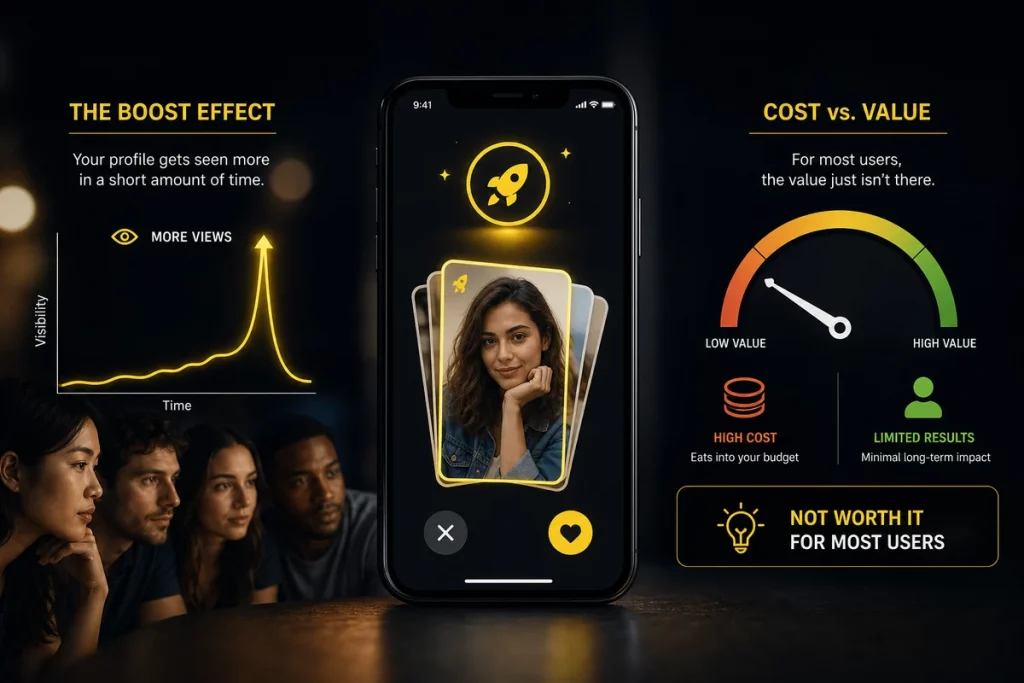
Bumble wants you to pay to be seen — but is a Bumble Boost actually worth your hard-earned money in 2026? The boost bumble feature promises to put your profile at the top of the stack, increasing your visibility and theoretically your matches. But the math, the user reviews, the algorithm mechanics, and the actual match data tell a more complicated story than the marketing suggests.
NavigateTable of Contents16 sections
How the Boost Bumble Feature Works
When you activate a boost bumble feature, your profile is moved to the top of the swipe deck for other users in your area for 30 minutes. During this window, significantly more people see your profile than would during a normal 30-minute period. Bumble claims boosted profiles receive up to 10x more views than unboosted ones — though the actual multiplier varies by location, time of day, and local user density.
What happens during the 30-minute window: Your profile is prioritized in the swipe queue for users who match your settings (age range, distance, gender preference). You appear higher in the stack — not at the absolute top for every user, but significantly higher than your natural algorithmic position. The boost doesn’t change WHO sees your profile (it still follows the same matching criteria) — it changes WHEN they see it during their browsing session (sooner rather than later, or potentially never during normal rotation).
What the boost doesn’t do: It doesn’t guarantee matches — visibility is not the same as attraction. It doesn’t change your profile’s quality or how people respond to what they see. It doesn’t override compatibility filters or expand your reach to users outside your settings. And critically, it doesn’t affect the behavior of people who do match with you — the boost bumble feature gets your profile seen; everything that happens after that initial impression depends entirely on your photos, bio quality, and communication skills.
Bumble’s algorithm and boosts. Bumble’s matching algorithm considers multiple factors: your desirability score (based on how often you’re swiped right), activity level, photo quality (assessed by machine learning), and engagement patterns. A boost temporarily overrides the natural algorithmic position — but once the 30 minutes end, your profile returns to its algorithmic baseline. According to analysis by dating app researchers at the National Library of Medicine, paid visibility features on dating apps produce a temporary but measurable spike in impressions but don’t typically alter the user’s long-term algorithmic positioning.
What a Boost Bumble Purchase Costs
Bumble boost pricing varies by market and purchase volume:
| Package | Approximate Price | Per-Boost Cost |
|---|
Prices vary by region, age demographic, and whether you have Bumble Premium or Bumble Boost (the subscription, confusingly named similarly to the feature). Premium subscribers get periodic free boosts — typically 1 per week — included in their subscription.
The cost-per-match calculation. This is where the boost bumble value proposition gets questionable. Of those, maybe 3-5 are mutual matches (you also swiped right on them). Of those, maybe 1-2 lead to conversations. Of those, maybe 1 leads to a date.
Is Boost Bumble Worth the Money?
The honest assessment depends on your specific situation:
When boost bumble IS worth considering:
You’re in a small market. In rural areas or smaller cities where the user pool is limited, your profile may have already been shown to most local users during normal rotation. A boost in a small market has diminishing returns because the same people see your profile again rather than new people seeing it for the first time. Paradoxically, boosts are most valuable in large, dense markets (NYC, London, Toronto, Ottawa) where the user pool is large enough that many eligible users haven’t seen your profile yet during normal rotation. Analysis from the FTC’s digital marketplace research suggests that location-based visibility features on dating apps provide significantly different value propositions depending on local user density — a factor the marketing for these features typically doesn’t disclose.
You’ve recently optimized your profile. If you’ve just updated your photos, rewrote your bio, or made significant profile improvements, a boost puts the improved version in front of more people quickly — essentially “re-launching” your profile. This is the highest-value boost bumble use case: testing an improved profile against a wider audience to confirm the improvements work before the algorithm naturally increases your visibility based on better engagement metrics.
You’re visiting a new city. If you’re traveling and want to maximize matches during a limited timeframe, a boost compresses the visibility window that normally spreads across days into 30 concentrated minutes. The limited time makes the boost’s temporary nature less of a drawback because your time in the city is equally temporary.
When boost bumble is NOT worth it:
Your profile isn’t optimized. Boosting a bad profile amplifies its exposure to people who will swipe left — and may actually harm your algorithmic position because a high volume of left-swipes signals low desirability to the algorithm. Fix the profile first, then consider boosting the improved version. Poor photos, empty bios, and generic prompts don’t become more attractive simply because they’re shown at higher volume — they become expensive wastes of boost money.
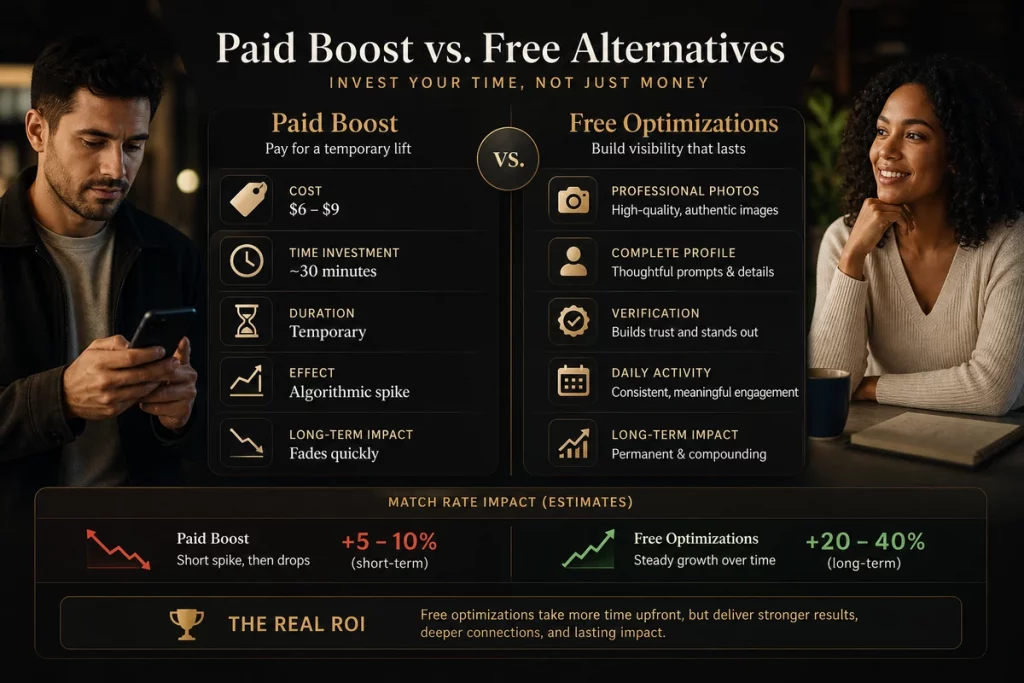
You’re using boosts regularly as a substitute for profile quality. If you find yourself buying boosts weekly because your natural match rate is low, the money is better spent on professional photos, profile review services, or honest feedback from friends about what isn’t working. A permanent improvement to your match rate through profile optimization produces more matches per dollar than repeated temporary visibility spikes through purchased boosts.
You’re in an area you’ll stay in long-term. The algorithm will naturally show your profile to most eligible users in your area over time. A boost accelerates this process but doesn’t change the ultimate outcome — you’ll eventually be seen by the same people. The boost is paying for speed, not for access to a hidden audience.
When to Use a Boost (If You Decide To)
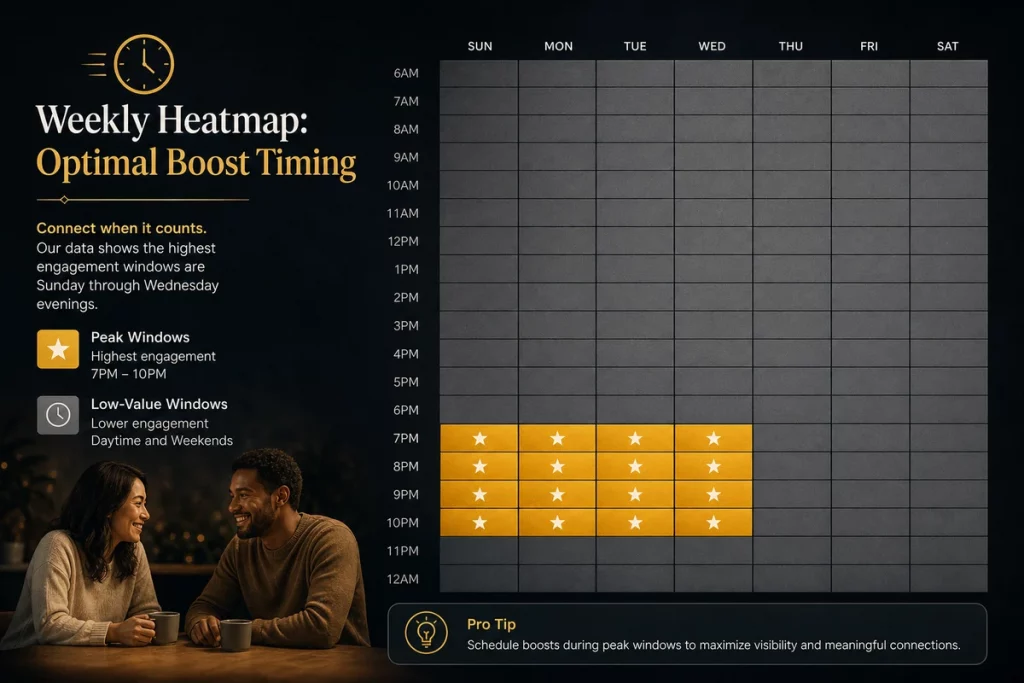
Timing matters enormously. A boost bumble activation at 3 PM on a Tuesday exposes your profile to far fewer active users than the same boost at 8 PM on a Sunday. Research on dating app usage patterns from the American Psychological Association’s digital behavior studies shows peak dating app activity occurs Sunday through Wednesday evenings between 7-10 PM local time — with Sunday evening being the single highest-activity period. Boosting during peak hours maximizes the number of active users who see your boosted profile.
Don’t boost the same day you create your profile. New profiles already receive an algorithmic “newness” boost from Bumble — your profile is naturally prioritized during your first 24-48 hours on the platform. Purchasing a paid boost during this window wastes money on visibility you’re already getting for free. Wait until the newness boost subsides (typically after 3-5 days) before considering a paid boost, if at all.
Boost after profile improvements, not before. Updated photos, a rewritten bio, or new prompt responses all create a “new version” of your profile. Boost this improved version to test it against a wider audience. If the boosted version produces better engagement metrics, the algorithm incorporates that data into your ongoing positioning — creating a lasting benefit from the temporary boost investment.
Free Alternatives That Work Better Than Boost Bumble
Before paying for visibility, maximize these free strategies that produce permanent rather than temporary results:
Optimize your first photo. Your first photo is responsible for the vast majority of swipe decisions — users spend an average of 1-2 seconds before swiping. Professional-quality, well-lit, solo photos where you’re smiling and making eye contact consistently outperform group photos, sunglasses photos, and gym selfies. This single change often produces a larger match rate improvement than multiple paid boosts.
Complete every profile section. Bumble’s algorithm rewards complete profiles with higher visibility — photos in all slots, prompts answered thoughtfully, bio filled in, and verification completed. A fully optimized profile receives algorithmic visibility that a boost bumble purchase provides temporarily but a complete profile provides permanently.
Verify your profile. Bumble’s photo verification (the blue checkmark) increases trust and match rates. For even stronger verification, link your GuyID Trust Profile in your bio — providing government ID verification that Bumble’s selfie verification doesn’t offer. Verified profiles receive more right-swipes because trust reduces the hesitation that causes left-swipes on otherwise attractive profiles. Use GuyID’s free tools to screen your own matches while you’re at it.
Use activity-based visibility. Bumble’s algorithm rewards active users with higher visibility. Regular app activity — daily swiping, prompt response to matches, completing your profile — signals to the algorithm that you’re an engaged user worth showing to others. This “free boost” operates continuously rather than for 30 minutes, and costs nothing except consistent use of the app. Share your Date Mode link in conversations to demonstrate verified accountability — a more meaningful differentiator than algorithmic positioning.
Update your profile regularly. Profile changes — new photos, new prompts, updated bio — signal freshness to the algorithm and may trigger re-exposure to users who previously passed on your profile. This “soft boost” is free and can be repeated as often as you want. Some users report that rotating their photo order weekly produces visibility improvements comparable to paid boosts — at zero cost.
Safety Considerations for Popular Profiles
Higher visibility means more people see your profile — which includes potential scammers, catfish, and people with harmful intentions. When you boost bumble and your matches increase, apply the same verification protocols to every new match:
Verify before investing. Reverse image search photos of new matches. Cross-reference on social media. Video call before meeting. The influx of matches from a boost may include profiles that wouldn’t survive basic verification — and the excitement of increased match volume can reduce the scrutiny you’d normally apply.
Watch for scam patterns. Dating app red flags don’t disappear because you paid for visibility. Matches who immediately push to move off-app, request money, send suspicious links, or exhibit love bombing intensity should be screened through GuyID’s free screening tools regardless of how flattering their attention feels. Report suspicious profiles to Bumble using the in-app reporting system — you’re protecting other users alongside yourself.
Pace your conversations. A boost that produces 10 new matches simultaneously can feel overwhelming — and the temptation to engage superficially with all of them reduces the quality of each individual connection. Prioritize 2-3 promising matches for deeper engagement rather than spreading your attention across every new match. Quality conversations with verified matches produce better outcomes than quantity conversations with unverified ones.
The Psychology of Paid Visibility
Understanding why boost bumble feels tempting even when the math doesn’t support it helps you make more rational decisions about dating app spending:
The scarcity-urgency mechanism. Bumble presents boosts as time-limited opportunities — “Boost now for maximum visibility!” — triggering the scarcity response that makes people act impulsively. The 30-minute window creates urgency within the boost itself, and the suggestion that “other users are boosting right now” creates competitive pressure. These are standard e-commerce persuasion techniques applied to dating — and recognizing them for what they are helps you evaluate the purchase on its merits rather than its emotional urgency.
The illusion of control. Dating apps produce significant anxiety because the outcomes feel random and uncontrollable — you can’t force someone to like your profile. Purchasing a boost feels like taking action, exercising control, doing something active rather than passively waiting. This “illusion of control” effect is well-documented in behavioral psychology: the perception of doing something feels better than the reality of doing nothing, even when the “something” doesn’t meaningfully change the outcome. Before purchasing a boost, ask yourself: “Am I buying this because the math supports it, or because the waiting feels intolerable and buying feels like action?”
The solution isn’t more boosts; it’s a better profile.
A free GuyID verification linked in your bio makes your profile stand out permanently — because in a sea of unverified profiles, a government-ID-verified match is genuinely distinctive. The boost is a temporary algorithmic hack. Verification is a permanent trust signal that affects every person who sees your profile, not just those who see it during a 30-minute window. The most effective “boost” isn’t the one you buy — it’s the trust differential you create through verifiable accountability that no other profile in the stack can match.
How GuyID Helps
GuyID should appear when it is useful, not as a banner ad. A GuyID Trust Profile gives someone a portable way to share trust signals before a date, while identity verification and social vouching help turn vague profile claims into clearer next steps.
Useful next steps:
- Create a GuyID Trust Profile when you want a cleaner way to share verified trust signals.
- Use GuyID free tools and related guides when you need a checklist before meeting someone.
- Treat identity verification as confidence-building, not a guarantee.
- Use social vouching when you want context from people who already know the person.
- Sign up only when the extra trust layer helps the decision you are already trying to make.
Frequently Asked Questions
How much does a boost on Bumble cost?
Bumble Premium subscribers receive periodic free boosts (typically 1 per week) bundled into their subscription. Prices vary by region, age demographic, and subscription status.
How long does a Bumble Boost last?
Each boost bumble activation lasts 30 minutes. During this window, your profile receives up to 10x more visibility in other users’ swipe decks. After the 30 minutes expire, your profile returns to its normal algorithmic position. There’s no way to pause or extend a boost once activated — which is why timing your activation for peak usage hours (Sunday-Wednesday, 7-10 PM) is critical for maximizing value.
Is Bumble Boost worth it?
For most users, no — free profile optimization (better photos, complete profile, verification, regular activity) produces more lasting results per dollar invested. The boost bumble feature is worth considering in specific scenarios: large markets where many users haven’t seen your profile, immediately after significant profile improvements, or during travel when time is limited. If your profile isn’t optimized, boosting amplifies a weak profile rather than solving the underlying problem.
When is the best time to use a Bumble Boost?
Sunday through Wednesday evenings between 7-10 PM local time — when dating app activity peaks. Sunday evening is typically the single highest-activity period. Avoid boosting during work hours, early mornings, or late nights when fewer users are active. Also avoid boosting during your first 48 hours on the platform — new profiles already receive a natural algorithmic visibility boost.
Does boosting hurt your Bumble algorithm?
It can — if your profile isn’t optimized. Boosting exposes your profile to more users, which means more left-swipes if the profile isn’t attractive. A high left-swipe rate signals low desirability to the algorithm, potentially reducing your natural visibility after the boost ends. Only boost a profile you’re confident in — one with strong photos, a complete bio, and verification. Boosting a weak profile is worse than not boosting at all.
Are there free ways to get more Bumble matches?
Yes — and they’re more effective long-term than paid boosts. Professional-quality first photo, all photo slots filled, thoughtful prompt responses, complete bio, Bumble photo verification, daily app activity, regular profile updates, and linking your GuyID verification in your bio. These free optimizations improve your base match rate permanently rather than providing a 30-minute temporary spike. The dating app safety fundamentals also make you a more attractive match — verified, transparent, accountable.
Should I verify my matches after boosting?
Higher visibility attracts more matches, including potentially fake profiles and scammers. Use reverse image search on match photos. Check for red flags. Video call before meeting. Screen through GuyID’s free tools. The excitement of increased match volume shouldn’t reduce the verification standards you’d apply to any new connection.