
Reader Briefing
Reader Briefing
Start here if you need a practical read on trauma bonding worksheet pdf: 6 free exercises: who should use verification, what signals to check, and what to do before moving from online interest to an in-person plan.
Who this is for
- Readers preparing for a first in-person date.
- Anyone checking identity, profile consistency, and trust signals.
- People trying to avoid romance scams, fake profiles, or pressure tactics.
- Online daters improving conversations, profiles, or match screening.
You’ll learn
- How to evaluate identity signals without treating any single check as certainty.
- Which trust signals matter and how to weigh them together.
- How to spot inconsistencies, pressure, or behavior patterns that deserve caution.
- How to move from online conversation to a safer first meeting.
- Where GuyID tools fit into a quick pre-date screening workflow.
- How to compare options using practical safety and trust criteria.
Bottom line
Verification reduces uncertainty; it does not guarantee future behavior. Use a layered approach: confirm identity signals, compare profile consistency, ask for a short video call, keep early plans public, and slow down when someone pressures you to skip normal safety steps.
Key takeaways
- Identity verification improves confidence, not certainty.
- Patterns matter more than isolated incidents.
- Verify before meeting privately or sharing sensitive details.
- A short video call can reveal many inconsistencies.
- Pressure to skip reasonable safety steps is useful information.
Free Tools
Catfish Probability Detector
Check whether a dating profile has suspicious identity or photo signals.
Dating Bio Red Flag Detector
Review a bio for scam, pressure, or trust-warning language.
Dating Safety Checklist
Use free GuyID tools before moving from chat to a real date.
Next step
Create your GuyID trust profile
Share consent-based trust signals before a date without turning the conversation into an interrogation.
A trauma bonding worksheet pdf puts recovery exercises in your hands — literally — providing the structured self-reflection, pattern tracking, and coping strategies that bridge the gap between recognizing a trauma bond and actively dissolving it. Worksheets don’t replace professional therapy, but they make each therapy session significantly more productive by giving you frameworks to process your experience between sessions. They also provide immediate, accessible support during crisis moments when therapy isn’t available — the 2 AM urge to break no-contact is better addressed with a structured worksheet than with the chaotic spiral of unprocessed thoughts. This guide provides 6 evidence-based exercises that you can use immediately, explains how each worksheet targets a specific and critical component of the trauma bonding cycle, and gives you the structured, evidence-based self-help foundation that complements and accelerates professional intervention.
NavigateTable of Contents16 sections
Why Trauma Bonding Worksheets Work
The American Psychological Association identifies structured self-reflection as a key component of trauma recovery — and a trauma bonding worksheet pdf delivers this structure in a portable, repeatable format. Here’s why the worksheet approach is specifically effective for trauma bonding:
They externalize the internal. Trauma bonds operate partly through internal confusion — the cognitive dissonance between “I know this is harmful” and “I can’t leave.” Writing forces you to externalize this internal battle onto paper, where it becomes observable, analyzable, and challengeable. The thought “maybe they’ll change” feels compelling inside your head. Written on paper as a documented pattern alongside the evidence — “they’ve promised to change 7 times, and each time the cycle resumed within 3 weeks” — the thought becomes clearly identifiable as the bond’s predictable cognitive distortion operating exactly as documented rather than a reasonable evidence-based assessment.
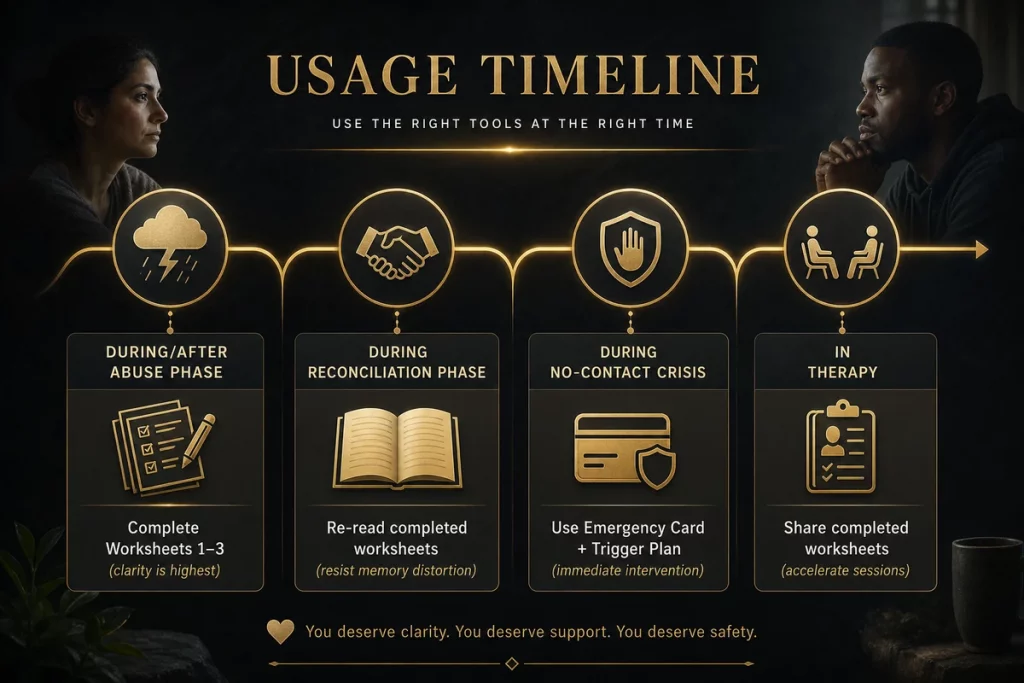
They create evidence you can reference. During reconciliation phases, the trauma bond distorts your memory — the abuse fades while the reconciliation’s warmth sharpens. A completed trauma bonding worksheet pdf provides a factual record you can revisit: “Here’s what I wrote during the last abuse phase. Here are the promises that were made and broken. Here’s the cycle I documented.” This external written evidence actively resists the memory distortion and revisionist history that the bond’s neurochemistry produces during the “good” periods.
They build therapeutic momentum between sessions. Research from the National Library of Medicine on therapeutic homework demonstrates that clients who complete structured exercises between therapy sessions show significantly faster recovery rates than those who rely on sessions alone. Each completed worksheet provides material for the next therapy session — making sessions more productive, targeted, and efficient. Your therapist doesn’t have to spend 15 minutes gathering information because you’ve already organized it into a framework they can work with immediately.
They provide crisis-moment structure. When the urge to break no-contact hits at 2 AM, your prefrontal cortex is offline while your limbic system floods with distress. In that state, you can’t reason your way out of the urge — but you CAN follow a pre-written protocol. The No-Contact Emergency Card (Worksheet 4) and Trigger Response Plan (Worksheet 3) provide exactly this: structured responses created during moments of clarity that guide your behavior during moments of crisis when independent rational thought is neurochemically compromised. This is the same principle behind fire escape plans — you don’t design the exit route during the fire; you follow the one you mapped when you were calm.
They make the invisible visible. Trauma bonds thrive on ambiguity, confusion, and the inability to hold contradictory experiences in clear view simultaneously. A trauma bonding worksheet pdf forces clarity by requiring specific, written answers to specific questions. “How bad is it really?” is an unanswerable question floating inside your head. “Document three specific incidents from the last month with dates, what happened, and how it made you feel” is a structured exercise that produces a concrete, reviewable answer. The act of writing transforms the amorphous emotional experience into specific, observable data points that resist the distortion the bond needs to survive.
Worksheet 1: Cycle Mapping
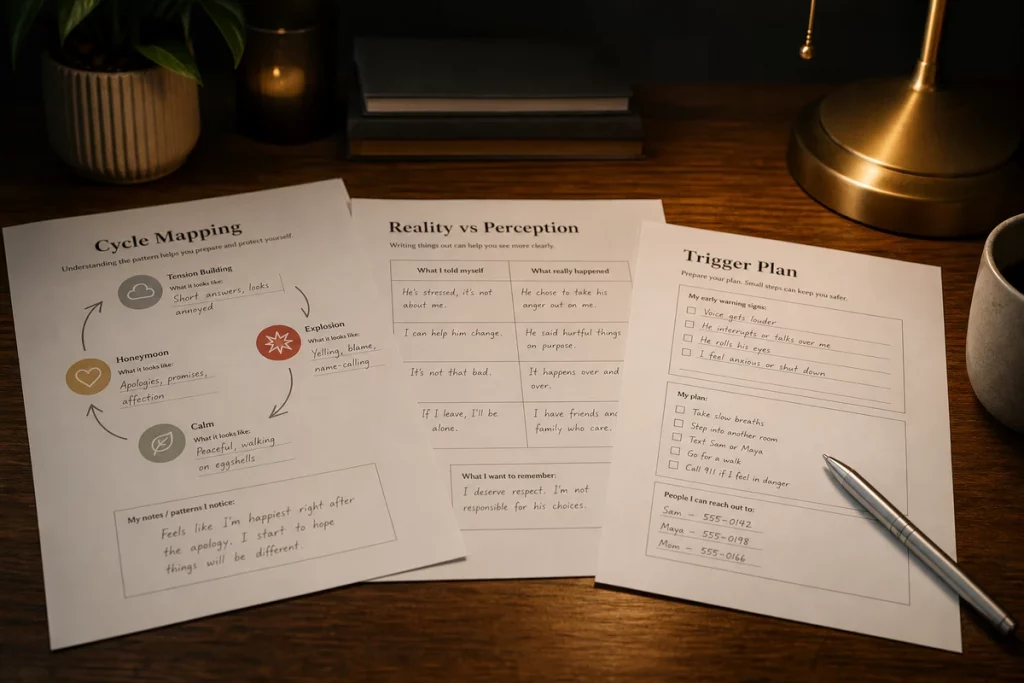
Purpose: Document the specific, recurring pattern of your relationship’s abuse-reconciliation cycle so it becomes visible as a pattern rather than experienced as unpredictable episodes.
How to complete this trauma bonding worksheet:
Draw four columns on a page. Label them: Tension Building (What does the buildup look like? What triggers it? How long does it last?), Incident (What specifically happens? What is said? What behaviors occur?), Reconciliation (What promises are made? How is the apology delivered? What changes are offered?), Calm (How long does it last? What’s the quality of the calm — genuine peace or walking-on-eggshells avoidance?). Fill in each column with specific examples from your most recent 3 cycles.
What this reveals: When you see 3 cycles documented side by side, the repetition becomes undeniable. The promises in the Reconciliation column repeat almost verbatim. The triggers in the Tension column follow recognizable patterns. The Calm periods typically shorten over time while the Incident severity increases. This powerful visual evidence of undeniable cyclical repetition directly counters the reconciliation phase’s distortion that “this time is different.” The emotional abuse cycle wheel provides the framework; this worksheet makes it personal to YOUR cycle.
Worksheet 2: Reality vs. Bond Perception
Purpose: Identify how the trauma bond distorts your perception of the relationship by comparing what the bond tells you with what the evidence actually shows.
How to complete this trauma bonding worksheet:
Create two columns: What the Bond Says and What the Evidence Shows. For each distortion the bond produces, document the counter-evidence.
Example entries:
| What the Bond Says | What the Evidence Shows |
|---|---|
| “They love me — the good times prove it” | “The good times follow the abuse and serve to prevent me from leaving. A person who loved me wouldn’t need a reconciliation phase because there would be no abuse phase to reconcile” |
| “No one else will love me like this” | “The ‘love’ I’m referring to is actually relief from pain they caused. Genuine love doesn’t require pain to feel meaningful” |
| “I can’t survive without them” | “I survived before this relationship. The belief that I can’t survive is the trauma bond’s neurochemistry, not a factual assessment of my capabilities” |
| “They’ll change — they promised” | “They’ve promised [X] times. Change has never lasted beyond [X] weeks. The pattern IS the prediction” |
| “Leaving will hurt worse than staying” | “Leaving produces temporary withdrawal. Staying produces permanent damage. Short-term pain vs. long-term harm” |
What this reveals: The bond operates through cognitive distortions that feel like truths. When each distortion is placed next to its corresponding evidence, the gap between trauma-bond-distorted perception and documented reality becomes starkly visible. This worksheet is most powerful when completed during or immediately after an abuse phase — when clarity is highest — and then re-read during reconciliation phases when the bond is actively distorting your memory and judgment.
Worksheet 3: Trigger Identification & Response Plan
Purpose: Identify the specific situations, emotions, and stimuli that trigger the urge to contact the abuser or return to the relationship — then pre-plan your response.
How to complete this trauma bonding worksheet pdf exercise:
List your top 5-10 triggers (e.g., “Loneliness on Friday nights,” “Seeing their social media,” “A song that reminds me of the good times,” “A bad day at work when I want emotional support,” “Their birthday approaching”). For each trigger, write: (1) What the trigger makes me want to do (e.g., “Text them”), (2) What the bond tells me about this urge (“They’re the only one who understands”), (3) The reality counter (“They understand how to manipulate me, not how to support me”), (4) My planned alternative action (“Call my friend [name] instead” or “Open this worksheet and read Worksheet 2”).
What this reveals: Triggers aren’t random or unpredictable — they follow identifiable, recurring patterns related to specific emotional states, times of day, social situations, and sensory stimuli. Identifying them in advance removes the surprise that makes them effective. A trigger you’ve anticipated, named, and specifically planned for loses much of its disruptive power compared to a trigger that ambushes you. This worksheet transforms reactive moments into pre-planned choice points.
Worksheet 4: No-Contact Emergency Card
Purpose: A pocket-sized reference for the specific moments when the urge to break no-contact is overwhelming — designed to be read in 60 seconds during a crisis moment when your cognitive capacity is reduced by emotional flooding.
How to create this card:
On a card-sized paper or phone note, write: (1) Three specific things they did that caused harm (not vague — specific incidents, specific words, specific impacts). (2) How many times the cycle has repeated (exact count if possible). (3) One sentence from the reality column of Worksheet 2 that resonates most strongly. (4) One person to call instead (name and number). (5) One physical action to take instead (walk around the block, take a cold shower, do 20 pushups — anything that interrupts the phone-reaching impulse).
Why this works: During a no-contact crisis, your prefrontal cortex (rational thinking) is offline while your limbic system (emotional responding) is fully activated. You can’t process a complex trauma bonding worksheet pdf in that state — but you can read 5 short lines on a card. The card provides the minimal-dose intervention that keeps you from acting on the urge during the 5-10 minutes of peak intensity, after which the urge typically begins to subside on its own.
Worksheet 5: Identity Reclamation Inventory
Purpose: Rebuild awareness of who you are beyond the relationship — because trauma bonds erode independent identity until the relationship becomes your entire self-concept.
How to complete this exercise:
Answer the following prompts in writing: (1) Before this relationship, what did I enjoy? (Activities, hobbies, media, foods, places — anything that brought genuine, non-relationship-dependent pleasure.) (2) What opinions or values do I hold that my partner discouraged, mocked, or punished? (3) What friendships or family connections did I lose during this relationship? (Names, specifics, what happened.) (4) What goals or aspirations did I abandon to accommodate the relationship? (5) If I were introducing myself to a stranger without mentioning the relationship, what would I say? (6) What three qualities do people who genuinely care about me say they value in me?
What this reveals: You existed before this relationship — with interests, relationships, goals, and a personality that were sufficient to attract attention, form bonds, and navigate life independently. The trauma bond contracted that identity into a single dimension: “person in this relationship.” This worksheet expands it back out again, providing the foundation of independent selfhood that makes leaving psychologically survivable rather than feeling like self-annihilation.

Worksheet 6: Future Self Letter
Purpose: Write a letter from your future self — the version of you who has successfully dissolved the trauma bond — to your current self. This exercise leverages a therapeutic technique called “future-oriented processing” that research associates with improved motivation and reduced hopelessness.
How to complete this:
Write a letter from yourself one year from now. Your future self has left the relationship, processed the grief, rebuilt their identity, and is living the life the trauma bond told you was impossible. Address: What does your daily life look like? What relationships have you rebuilt? How does it feel to wake up without fear or hypervigilance? What would you tell your current self about the withdrawal period? What was harder than expected? What was easier? What are you grateful for about the decision to leave?
Why this works: Trauma bonds collapse the future into the present — “I can’t imagine life without them” feels like a factual impossibility rather than a failure of imagination produced by the bond’s neurochemistry. Writing from a future perspective forces your brain to construct a post-bond life in concrete detail — which makes the possibility real rather than theoretical. Neuroscience research on prospective imagery shows that vividly imagined future scenarios activate the same brain regions as actual experiences, meaning that writing a detailed future-self letter doesn’t just create a nice idea — it begins building the neural architecture for a life your current bond-state brain tells you is impossible. Read this letter during withdrawal moments alongside the No-Contact Emergency Card. Together, they provide both the immediate crisis intervention (the card) and the motivational vision (the letter) that sustain no-contact through the hardest moments of the first weeks and months.
How to Use Your Trauma Bonding Worksheet PDF Effectively
Complete them during clarity moments. After an abuse phase, during the brief window before reconciliation fully reactivates the bond, your thinking is clearest about the relationship’s reality. Use these moments to complete or update the worksheets. The completed worksheets then serve as evidence during the reconciliation phase when the bond distorts your clarity in the opposite direction.
Share them with your therapist. These worksheets produce organized, specific material that your therapist can use as session starting points. Cycle Mapping provides concrete examples to process. Reality vs. Bond Perception identifies specific cognitive distortions to address. Trigger Response Plans can be refined with professional guidance. A therapist experienced in narcissistic abuse or trauma bonding will recognize these frameworks and integrate them into your treatment plan.
Keep them physically accessible but emotionally safe. Print your trauma bonding worksheet pdf exercises and keep them where you can access them during crisis moments — but stored securely if your abusive partner might find them. Digital versions on a password-protected phone note or a private Google Drive folder provide accessibility without physical evidence. The National Domestic Violence Hotline (1-800-799-7233) provides additional guidance on maintaining private documentation safely within an abusive household.
Combine with professional assessment. Take the trauma bonding test for a scored evaluation of your bond’s severity. Complete the emotional abuse checklist alongside Worksheet 1 to see how your cycle maps onto documented abuse patterns. Use the toxic relationship quiz for a broader relationship health assessment. These evidence-based tools provide the framework; the worksheets provide the personalized application.
When ready to date again. The worksheets prepare you to recognize the same patterns in future connections — and to choose differently. Use GuyID’s free screening tools to verify new matches. Watch for love bombing and early red flags. Set boundaries early. Share your Date Mode link through GuyID to build mutual transparency from the first interaction. The worksheets helped you see the pattern; verification tools help you avoid repeating it.
How GuyID Helps
GuyID should appear when it is useful, not as a banner ad. A GuyID Trust Profile gives someone a portable way to share trust signals before a date, while identity verification and social vouching help turn vague profile claims into clearer next steps.
Useful next steps:
- Create a GuyID Trust Profile when you want a cleaner way to share verified trust signals.
- Use GuyID free tools and related guides when you need a checklist before meeting someone.
- Treat identity verification as confidence-building, not a guarantee.
- Use social vouching when you want context from people who already know the person.
- Sign up only when the extra trust layer helps the decision you are already trying to make.
Frequently Asked Questions
Can a trauma bonding worksheet pdf replace therapy?
No — worksheets complement therapy but don’t replace it. Trauma bonds operate at the neurochemical level, requiring professional intervention (EMDR, somatic therapy, attachment-focused therapy) to restructure the neural pathways maintaining the bond. Worksheets provide the cognitive framework and crisis-moment support that makes therapy more productive. The combination of professional treatment plus structured self-help produces better outcomes than either alone.
Which worksheet should I start with?
Start with Worksheet 1 (Cycle Mapping) — documenting the pattern is the foundation everything else builds on. Then complete Worksheet 2 (Reality vs. Bond Perception) to challenge the cognitive distortions the bond creates. Worksheets 3-6 can be completed in any order based on which feels most immediately needed. If you’re currently maintaining no-contact, the No-Contact Emergency Card (Worksheet 4) is the most time-sensitive priority.
Is it safe to keep these worksheets at home?
If your abusive partner has access to your physical or digital spaces, keep worksheets in a secure location they cannot access — a trusted friend’s home, a locked work drawer, a password-protected cloud folder. The National Domestic Violence Hotline (1-800-799-7233) provides specific guidance on safe documentation within abusive households. If physical worksheets aren’t safe, use a private email draft, password-protected notes app, or a separate device your partner doesn’t access.
How often should I update these worksheets?
Update a worksheet when a meaningful event, boundary change, or new observation affects the pattern you are documenting. There is no required schedule. Use it only when it supports clarity rather than compulsive monitoring or repeated distress.
What if completing the worksheets is too painful?
Stop the worksheet if it causes overwhelming distress or makes you feel unsafe. Use a grounding activity, contact a trusted support person, or continue with a qualified professional. Completing every page is less important than protecting your immediate wellbeing.
Are there other trauma bonding resources I should use alongside worksheets?
Yes. Take the trauma bonding test for scored assessment. Review the trauma bonding signs guide for comprehensive identification. Understand the trauma bonding cycle for stage-by-stage analysis. Use the emotional abuse checklist for broader pattern recognition. The toxic relationship quiz provides overall relationship health assessment. These tools plus your completed worksheets create a comprehensive self-assessment portfolio that makes therapy sessions maximally productive.