

Reader Briefing
Reader Briefing
Start here if you need a practical read on emotional manipulation: 15 tactics: who should use verification, what signals to check, and what to do before moving from online interest to an in-person plan.
Who this is for
- People meeting someone from a dating app or social platform.
- Readers preparing for a first in-person date.
- Anyone checking identity, profile consistency, and trust signals.
- People trying to avoid romance scams, fake profiles, or pressure tactics.
You’ll learn
- How to evaluate identity signals without treating any single check as certainty.
- Which trust signals matter and how to weigh them together.
- How to spot inconsistencies, pressure, or behavior patterns that deserve caution.
- How to move from online conversation to a safer first meeting.
- Where GuyID tools fit into a quick pre-date screening workflow.
- How to compare options using practical safety and trust criteria.
Bottom line
Verification reduces uncertainty; it does not guarantee future behavior. Use a layered approach: confirm identity signals, compare profile consistency, ask for a short video call, keep early plans public, and slow down when someone pressures you to skip normal safety steps.
Key takeaways
- Identity verification improves confidence, not certainty.
- Patterns matter more than isolated incidents.
- Verify before meeting privately or sharing sensitive details.
- A short video call can reveal many inconsistencies.
- Pressure to skip reasonable safety steps is useful information.
Free Tools
Catfish Probability Detector
Check whether a dating profile has suspicious identity or photo signals.
Dating Bio Red Flag Detector
Review a bio for scam, pressure, or trust-warning language.
Dating Safety Checklist
Use free GuyID tools before moving from chat to a real date.
Next step
Create your GuyID trust profile
Share consent-based trust signals before a date without turning the conversation into an interrogation.
This pillar guide identifies the 15 most common emotional manipulation tactics used in dating and relationships, explains the psychology behind each one, and gives you concrete tools to recognize, resist, and recover from manipulative behavior.
NavigateTable of Contents35 sections
Quick Answer: What Emotional Manipulation Is
Emotional manipulation is a pattern of behavior where one person exploits another person’s emotions, vulnerabilities, or trust to gain control, influence decisions, or serve their own interests at the victim’s expense. Understanding emotional manipulation tactics is essential because they operate beneath the surface of normal relationship dynamics — disguised as love, concern, or even self-deprecation.
Key characteristics that distinguish manipulation from normal relationship conflict:
Intent to control. Normal disagreements aim to resolve issues. Emotional manipulation tactics aim to gain power. The manipulator’s goal isn’t understanding — it’s compliance.
Pattern, not incident. Everyone occasionally says something regrettable. Manipulation is systematic — the same tactics deployed repeatedly to achieve the same outcomes. Look for patterns across situations, not isolated events.
Undermining autonomy. Healthy relationships support independent thinking. Emotional manipulation tactics progressively erode the victim’s confidence in their own perceptions, judgment, and decision-making until they become dependent on the manipulator’s version of reality.
Exploiting vulnerabilities. Manipulators learn your insecurities, fears, and emotional needs — not to support you, but to leverage them. Information you share in vulnerability becomes ammunition used against you later.
The American Psychological Association classifies emotional manipulation as a form of psychological abuse when it occurs in a sustained pattern within intimate relationships. Research published in the Journal of Interpersonal Violence found that victims of psychological manipulation report comparable levels of PTSD, depression, and anxiety to victims of physical abuse — dispelling the myth that “it’s not that serious because it’s not physical.”
Why Manipulation Is Hard to Recognize
If emotional manipulation tactics are so damaging, why do millions of intelligent, capable people fail to recognize them? The answer lies in how manipulation exploits normal human psychology:
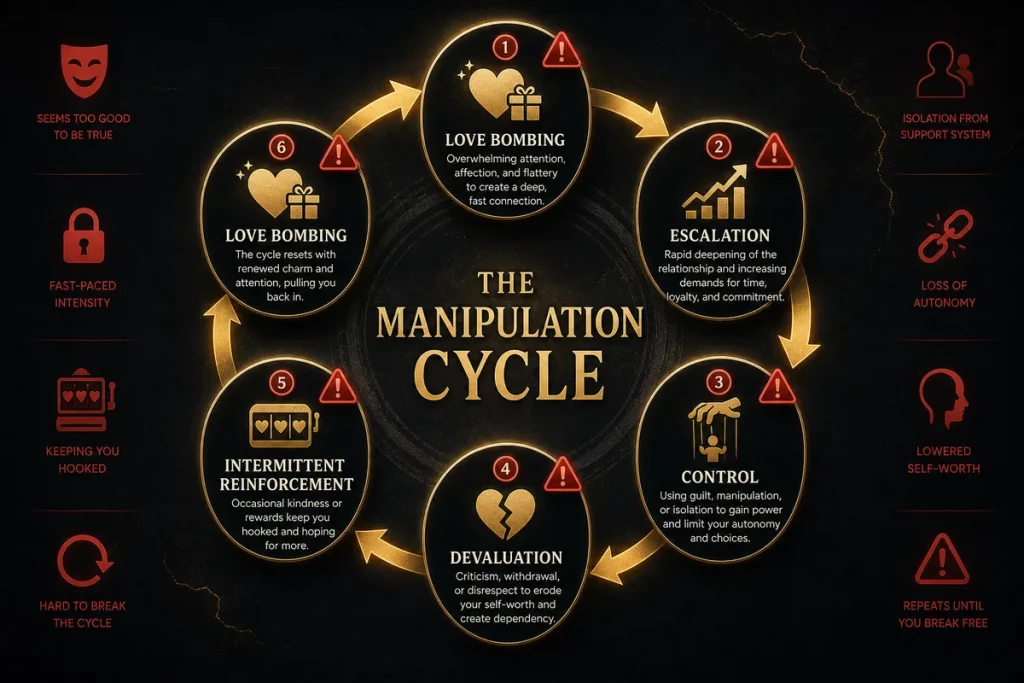
Manipulation mimics love in the early stages. Many emotional manipulation tactics — like love bombing, excessive attention, and making you feel special — initially look and feel exactly like genuine affection. The victim falls in love with the manipulator’s persona before the controlling behaviors begin. By the time manipulation emerges, emotional bonds are already deep.
Escalation is gradual. Manipulators rarely start with extreme behavior. They test boundaries incrementally — a small guilt trip here, a subtle put-down there — and calibrate based on what the victim tolerates. Each individual instance seems minor. It’s only when you step back and see the full pattern that the manipulation becomes visible.
Manipulators rewrite reality. Through gaslighting and other emotional manipulation tactics, the manipulator convinces the victim that their perceptions are wrong. “That didn’t happen.” “You’re being too sensitive.” “I was joking.” When someone systematically challenges your version of events, you begin to doubt your own memory and judgment — which is exactly the goal.
Isolation reduces external perspective. Manipulators gradually distance victims from friends, family, and support systems — often by creating conflict, making the victim feel guilty for spending time with others, or positioning themselves as the only person who “truly understands.” Without external reality checks, the victim’s world shrinks to the manipulator’s version of it.
Intermittent reinforcement creates addiction. The cycle of affection → manipulation → affection creates a dopamine pattern similar to gambling addiction. The unpredictability of when the “good” version of the partner will appear keeps the victim emotionally hooked, constantly hoping the good times will return and the bad times will stop. This is the same mechanism behind trauma bonding.
15 Emotional Manipulation Tactics
These are the specific emotional manipulation tactics you’re most likely to encounter in dating and relationships. Each includes the behavior pattern, an example of how it sounds, and the underlying intent.
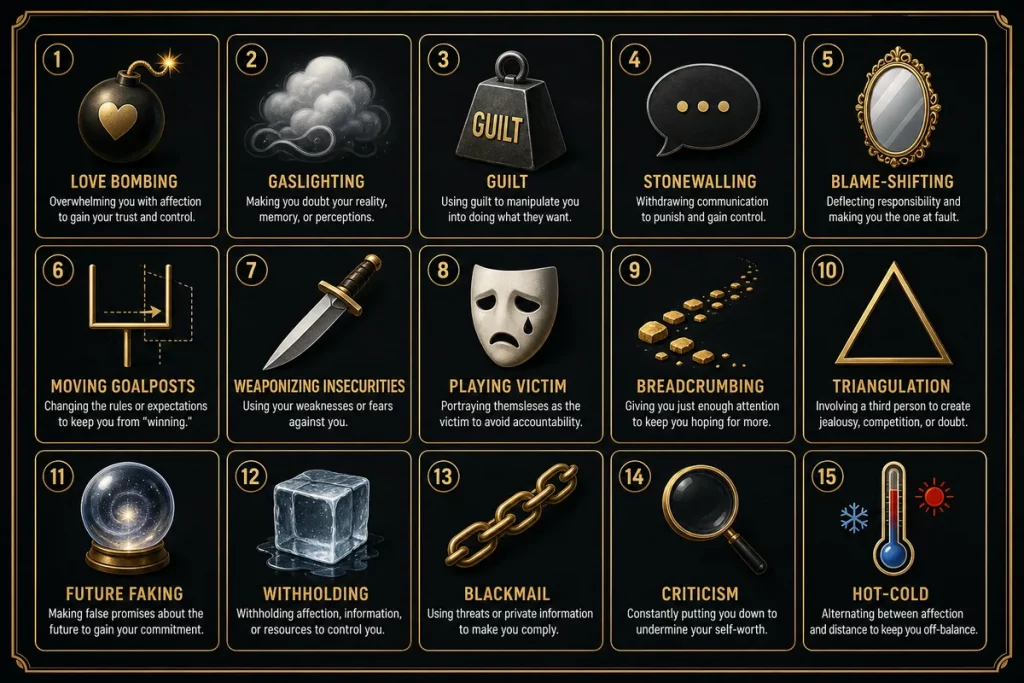
1. Love Bombing
What it looks like: Overwhelming you with affection, attention, compliments, gifts, and declarations of love — especially in the early stages of the relationship before genuine intimacy has developed.
What it sounds like: “I’ve never felt this way about anyone.” “You’re my soulmate — I knew it from the moment we matched.” “I want to spend every minute with you.”
What it really is: A strategy to create emotional dependency quickly, bypassing the natural pace of trust-building. Once you’re hooked, the manipulator gains leverage. For a deep dive, see our guide on love bombing examples and patterns.
High Risk — Gateway Tactic
2. Gaslighting
What it looks like: Denying things that happened, rewriting shared history, and making you question your own perceptions, memory, and sanity.
What it sounds like: “That never happened.” “You’re imagining things.” “I never said that — you’re making things up.” “Everyone thinks you’re overreacting.”
What it really is: The most psychologically destructive of all emotional manipulation tactics. By undermining your trust in your own mind, the manipulator becomes the sole authority on reality. Victims of sustained gaslighting often develop anxiety, depression, and cognitive disorientation.
Critical Risk — Most Destructive
3. Guilt-Tripping
What it looks like: Making you feel responsible for the manipulator’s emotions, problems, or unhappiness to coerce you into compliance.
What it sounds like: “After everything I’ve done for you…” “I guess I’m just not important to you.” “Fine, go out with your friends — I’ll just sit here alone.” “If you really loved me, you wouldn’t do that.”
What it really is: A control mechanism that weaponizes your empathy. The manipulator reframes your independent choices as acts of cruelty, training you to prioritize their needs over your own to avoid the discomfort of manufactured guilt.
High Risk — Most Common
4. Silent Treatment / Stonewalling
What it looks like: Withdrawing all communication — refusing to speak, respond to messages, or acknowledge your presence — as punishment for perceived offenses.
What it sounds like: [Nothing. That’s the point.] Or eventually: “Maybe if you think about what you did, you’ll understand why I’m not talking to you.”
What it really is: Emotional withdrawal used as a control mechanism. The silent treatment creates anxiety and desperation in the victim, who begins to self-censor and comply to avoid triggering another episode. It’s a form of emotional abandonment that research links to measurable stress responses. For more on this pattern, see our guide on what stonewalling means.
High Risk
5. Blame-Shifting
What it looks like: Deflecting responsibility for their behavior onto you. Every conflict becomes your fault, every problem traces back to something you did or failed to do.
What it sounds like: “I wouldn’t have yelled if you hadn’t provoked me.” “You made me do this.” “If you were a better partner, I wouldn’t need to act this way.”
What it really is: A refusal to accept accountability combined with an attempt to make you carry the emotional weight of their actions. Over time, victims internalize the blame and begin to genuinely believe they’re the problem.
High Risk
6. Moving the Goalposts
What it looks like: No matter what you do, it’s never enough. They set expectations, you meet them, and they change the criteria.
What it sounds like: “I said I’d be happy if you did X, but now I realize what I actually need is Y.” “That’s good, but it would have meant more if you’d done it without me asking.” “Close, but not quite what I meant.”
Medium Risk
7. Weaponizing Insecurities
What it looks like: Using personal information you shared in vulnerability — fears, past traumas, insecurities — as ammunition during arguments or to control your behavior.
What it sounds like: “No wonder your ex left you.” “With your trust issues, no one else would put up with you.” “You told me your biggest fear was being alone — maybe you should think about that before you argue with me.”
What it really is: Among the most cruel emotional manipulation tactics because it weaponizes intimacy itself. The victim learns that vulnerability is dangerous, which damages their ability to form healthy attachments in future relationships.
Critical Risk
8. Playing the Victim
What it looks like: Reframing every situation so they’re the wronged party — even when their behavior is clearly the problem. They elicit sympathy to deflect accountability.
What it really is: A deflection strategy that redirects the conversation away from their behavior and toward your alleged insensitivity. It forces you to comfort and reassure them instead of addressing the original issue.
Medium Risk
9. Breadcrumbing
What it looks like: Giving just enough attention, affection, or commitment to keep you interested — without any intention of deepening the relationship. Sporadic texts, occasional dates, vague promises of a future together.
What it sounds like: “I really like you — I’m just not ready for anything serious right now.” [Disappears for a week] “Hey, I’ve been thinking about you.” [Disappears again]
What it really is: A strategy to keep you emotionally available as a backup option without investing real commitment. It exploits hope — each crumb of attention reactivates your attachment. See our guide on narcissist breadcrumbing patterns.
Medium Risk
10. Triangulation
What it looks like: Involving a third person — an ex, a friend, a coworker — to create jealousy, insecurity, or competition. The manipulator positions themselves as the prize that multiple people want.
What it really is: A strategy to destabilize your sense of security in the relationship, keeping you anxious and competitive. It’s also a way to avoid direct communication — the manipulator uses third parties to send messages they won’t say directly.
Medium Risk
11. Future Faking
What it looks like: Making elaborate promises about the future — moving in together, marriage, travel plans, shared goals — with no intention of following through. The promises keep you invested in the relationship.
What it sounds like: “Next year we should go to Paris.” “I can see us getting married someday.” “When we move in together, everything will be better.” [None of these ever materialize.]
What it really is: A commitment illusion designed to keep you emotionally invested by painting a picture of a future that the manipulator never plans to deliver. It exploits your hope and imagination to maintain control in the present.
Medium Risk
12. Withholding Affection
What it looks like: Deliberately withdrawing physical affection, emotional warmth, or sexual intimacy as punishment, leverage, or control. Affection becomes a reward that must be earned through compliance.
What it sounds like: “I don’t feel like being close to you right now.” “Maybe if you were more supportive, I’d want to be intimate.” [Cold, distant behavior without explanation.]
What it really is: A conditioning tool that trains you to associate compliance with warmth and independence with coldness. Over time, you learn to suppress your own needs and preferences to maintain the relationship’s emotional temperature.
High Risk
13. Emotional Blackmail
What it looks like: Using threats — of self-harm, relationship termination, public embarrassment, or revealing secrets — to coerce you into specific behaviors. The threat creates fear that overrides your own judgment.
What it sounds like: “If you leave me, I’ll hurt myself.” “I’ll tell everyone what you told me in confidence.” “If you don’t do this, we’re done.”
What it really is: The most overt form of emotional manipulation. It directly translates emotional threats into behavioral compliance. Threats of self-harm are particularly effective because they weaponize your compassion — making you responsible for someone else’s wellbeing at the expense of your own.
Critical Risk
14. Constant Criticism Disguised as “Help”
What it looks like: Persistent negative commentary on your appearance, abilities, decisions, and character — framed as constructive feedback, concern, or “I’m just trying to help you.”
What it sounds like: “I’m only saying this because I care — you’d look so much better if you lost weight.” “I’m not criticizing, I’m helping you grow.” “Don’t you want to be better? I’m just being honest.”
What it really is: A strategy to erode self-esteem gradually while maintaining plausible deniability. The “I’m just trying to help” frame makes it difficult to push back without seeming ungrateful. Over time, the victim internalizes the criticism and becomes dependent on the manipulator’s approval. See our emotional abuse checklist for more patterns.
High Risk
15. Love Withdrawal (Hot-Cold Cycling)
What it looks like: Alternating between intense affection and cold distance on an unpredictable schedule. The cycle creates an emotional rollercoaster that keeps you addicted to the “highs.”
What it sounds like: [Monday: “You’re the most important person in my world.”] [Wednesday: distant, unresponsive, dismissive] [Friday: “I’m sorry, I just had a rough week — I love you so much.”]
What it really is: The intermittent reinforcement pattern that creates trauma bonds. Like a slot machine, the unpredictability of when affection will appear creates a neurochemical addiction that keeps the victim emotionally locked in. This is one of the most powerful emotional manipulation tactics because it hijacks your brain’s reward system.
Critical Risk — Most Addictive
Emotional Manipulation on Dating Apps
Emotional manipulation tactics don’t begin after a relationship forms — they often start in the matching and messaging phase. Here’s how manipulation shows up in online dating specifically:
Love bombing through messaging. Excessive compliments, “I feel such a connection,” and rapid emotional escalation before a first date. On dating apps, love bombing is amplified because the text-only medium makes grand declarations feel more intimate and personal than they would in person.
Creating urgency and scarcity. “I’m about to delete my profile — you’re the only reason I’m still here.” “I don’t usually match with people, but something about you is different.” These create pressure to move faster than you’re comfortable with, bypassing your natural evaluation process.
Guilt-tripping about boundaries. “You won’t give me your number? I guess you’re not serious about this.” “You want to wait before meeting? Most people would see that as a red flag.” Manipulators frame your safety boundaries as personal rejection.
Triangulation through other matches. “I have so many matches but I’m only interested in you” or mentioning other people they’re talking to, designed to create competition and insecurity. This drives you to “prove” your interest by escalating commitment.
The best defense against these emotional manipulation tactics in dating is verification and time. Verified profiles through GuyID filter out some manipulators by requiring accountability, and taking your time before emotional investment allows manipulation patterns to reveal themselves before you’re hooked. Use GuyID’s free screening tools to check matches, and share your Date Mode link to establish a safety-first dynamic from the start.
The Psychology Behind Manipulation
Understanding why people use emotional manipulation tactics helps you recognize the patterns and protect yourself:
Narcissistic personality traits. Research published in the National Library of Medicine shows strong correlations between narcissistic personality traits and the use of emotional manipulation in relationships. Narcissists view relationships as power dynamics rather than partnerships, and manipulation is their primary tool for maintaining dominance. See our guide on narcissistic abuse signs.
Learned behavior from childhood. Many manipulators learned these tactics from parents or caregivers who modeled manipulation as a relationship strategy. They may not even recognize their behavior as problematic because it’s the only relationship template they know. This doesn’t excuse the behavior — but it explains why some manipulators genuinely believe they’re acting normally.
Attachment insecurity. People with anxious or avoidant attachment styles may use emotional manipulation tactics unconsciously — the anxious partner guilt-trips to prevent abandonment, the avoidant partner stonewalls to maintain emotional distance. Understanding anxious attachment patterns helps distinguish between intentional manipulation and attachment-driven behavior.
Need for control rooted in fear. At the core of most manipulation is fear — fear of abandonment, fear of inadequacy, fear of vulnerability, or fear of losing control. The manipulator uses emotional manipulation tactics to manage their own anxiety, treating the relationship as a system to be controlled rather than a connection to be nurtured.
Am I Being Manipulated? Self-Assessment
If you’re unsure whether you’re experiencing emotional manipulation tactics, consider these questions honestly:
Do you frequently feel confused about what happened during disagreements? If you often leave conversations unsure whether you were right to raise a concern — or doubting whether the event you’re upset about actually occurred — this is a hallmark of gaslighting.
Do you feel like you’re “walking on eggshells”? If you monitor your words, actions, and decisions to avoid triggering a negative reaction from your partner, you’re experiencing the anxiety that manipulation creates. Healthy relationships don’t require constant self-censorship.
Do you apologize more than you should? If you find yourself apologizing for things that aren’t your fault — or apologizing just to restore peace — you may be responding to guilt-tripping and blame-shifting.
Do you feel more anxious, less confident, or less like yourself than before the relationship? Emotional manipulation tactics erode self-worth gradually. If you’ve changed in ways that feel diminishing rather than growth-oriented, the relationship may be the cause.
For a more comprehensive assessment, take our emotional abuse quiz or review the emotional abuse checklist. These tools help you evaluate your experience objectively.
How to Respond to Emotional Manipulation
If you’ve recognized emotional manipulation tactics in your relationship, here’s how to respond:
Name the behavior, not the person. Instead of “You’re manipulating me” (which triggers defensiveness), try “When you refuse to speak to me for days after a disagreement, it makes it impossible to resolve anything.” Specific, behavior-focused language is harder to deflect.
Set boundaries and hold them. “I’m willing to discuss this when we’re both calm, but I won’t engage when you’re yelling or giving me the silent treatment.” A boundary isn’t an ultimatum — it’s a clear statement of what you will and won’t accept. The manipulator’s response to a reasonable boundary reveals everything about their character.
Maintain your external support system. Reconnect with friends and family. Join a support group. Speak with a therapist. External perspectives counteract the reality-distortion that emotional manipulation tactics create. A manipulator’s power diminishes the moment you have other voices affirming your reality.
Document patterns. Keep a private journal of incidents — what happened, what was said, and how you felt. When a manipulator is gaslighting you, written records provide an anchor to reality that memory alone cannot. Date-stamped notes counteract the “that never happened” narrative.
Trust your perception. If your gut tells you something is wrong, it probably is. Emotional manipulation tactics work by making you doubt yourself. Reclaiming trust in your own perception is both the hardest and most important step.
Consider whether the relationship is worth saving. Some manipulators can change with professional help and genuine motivation. Many cannot — or won’t. If emotional manipulation tactics are persistent, escalating, or accompanied by other forms of abuse, leaving may be the healthiest choice. A therapist or the National Domestic Violence Hotline (1-800-799-7233) can help you evaluate your situation safely.
Recovery After Manipulation
Recovering from a relationship characterized by emotional manipulation tactics takes time and intentional effort. Here’s what the recovery process typically involves:
Rebuilding self-trust. Manipulation erodes your confidence in your own judgment. Recovery means gradually learning to trust your perceptions again — that what you saw really happened, that your feelings are valid, and that your needs matter. Therapy, particularly cognitive behavioral therapy (CBT), accelerates this process significantly.
Processing grief. You may grieve the relationship — not for the manipulator, but for the person you thought they were and the future you imagined. This grief is real and valid. Allow yourself to feel it without rushing to “get over it.”
Recognizing patterns to break cycles. Many victims of manipulation unknowingly seek out similar dynamics in future relationships because the patterns feel familiar. Working with a therapist to identify your relationship patterns, attachment style, and vulnerability factors helps you break the cycle. Take our relationship readiness quiz when considering re-entering dating.
Rebuilding boundaries. Manipulation succeeds when boundaries are weak or absent. Recovery involves learning to set clear boundaries, communicate them without guilt, and enforce them without apology. This skill protects you in all future relationships — romantic, professional, and familial.
Re-entering dating safely. When you’re ready to date again, approach it with the awareness you’ve gained. Use verification tools like GuyID to filter for accountability, take your time with emotional investment, and watch for the early signs of emotional manipulation tactics — especially love bombing, which is often the first move in a manipulator’s playbook. Your experience isn’t a weakness — it’s wisdom.
How GuyID Helps
GuyID should appear when it is useful, not as a banner ad. A GuyID Trust Profile gives someone a portable way to share trust signals before a date, while identity verification and social vouching help turn vague profile claims into clearer next steps.
Useful next steps:
- Create a GuyID Trust Profile when you want a cleaner way to share verified trust signals.
- Use GuyID free tools and related guides when you need a checklist before meeting someone.
- Treat identity verification as confidence-building, not a guarantee.
- Use social vouching when you want context from people who already know the person.
- Sign up only when the extra trust layer helps the decision you are already trying to make.
Frequently Asked Questions
What are the most common emotional manipulation tactics?
The most common emotional manipulation tactics are guilt-tripping, gaslighting, love bombing, silent treatment / stonewalling, blame-shifting, and weaponizing insecurities. Guilt-tripping is the most frequently used because it exploits empathy — a quality most people have — and is difficult to identify as manipulation because it masquerades as emotional expression.
How do I know if I’m being emotionally manipulated?
Key indicators include: frequently feeling confused after conversations, walking on eggshells around your partner, apologizing for things that aren’t your fault, feeling more anxious and less confident than before the relationship, and a shrinking social circle. If you recognize these patterns, take our emotional abuse quiz for a structured self-assessment.
Is emotional manipulation the same as emotional abuse?
They’re closely related but not identical. Emotional manipulation becomes emotional abuse when it’s sustained, systematic, and causes measurable harm to the victim’s psychological wellbeing. Isolated manipulative incidents (which most people engage in occasionally) don’t constitute abuse. A pattern of emotional manipulation tactics deployed consistently over time, especially when combined with isolation, control, and escalation, crosses the line into abuse.
Can emotional manipulators change?
Some can — with genuine self-awareness, professional therapy, and sustained effort. However, change requires the manipulator to acknowledge their behavior, take responsibility, and commit to long-term work. Many manipulators lack this self-awareness or motivation. If your partner uses emotional manipulation tactics and refuses to acknowledge the behavior or seek help, the prognosis for change is poor. Focus on protecting yourself rather than waiting for someone else to change.
How do emotional manipulation tactics show up on dating apps?
On dating apps, manipulation typically starts with love bombing (excessive flattery and rapid emotional escalation), creating urgency (“I’m about to delete my profile”), guilt-tripping boundaries (“You won’t share your number? Guess you’re not serious”), and triangulation (mentioning other matches to create jealousy). Verified profiles through GuyID and taking time before emotional investment are the best defenses.
What’s the difference between manipulation and normal conflict?
Normal conflict aims to resolve an issue — both parties express needs, listen, and work toward a solution. Emotional manipulation tactics aim to gain control — one party uses psychological pressure to coerce the other into compliance. The key difference is intent: resolution versus domination. In healthy conflict, both people feel heard. In manipulation, one person feels confused, guilty, or diminished.
Where can I get help if I’m being emotionally manipulated?
The National Domestic Violence Hotline (1-800-799-7233) provides free, confidential support for anyone experiencing emotional abuse or manipulation. A licensed therapist — particularly one specializing in abusive relationships or trauma — can help you evaluate your situation, develop a safety plan, and begin recovery. Support groups (in-person and online) connect you with others who understand the experience.
Am I being manipulated or am I too sensitive?
The fact that you’re asking this question is itself informative — manipulators deliberately make their victims question whether they’re “too sensitive” as a way to invalidate legitimate concerns. If multiple people in your life have expressed concern about your relationship, if you feel worse about yourself than before the relationship, or if you’re constantly monitoring your behavior to avoid your partner’s reactions, these are signs of manipulation, not sensitivity.
Related Reading
- Emotionally Abusive Test: 25 Questions That Reveal the Truth
- Is Stonewalling Abuse? The Line Between Overwhelm and Control