Reader Briefing
Reader Briefing
Start here if you need a practical read on catfish phone lookup: 5 free tools: who should use verification, what signals to check, and what to do before moving from online interest to an in-person plan.
Who this is for
- People meeting someone from a dating app or social platform.
- Readers preparing for a first in-person date.
- Anyone checking identity, profile consistency, and trust signals.
- People trying to avoid romance scams, fake profiles, or pressure tactics.
You’ll learn
- How to evaluate identity signals without treating any single check as certainty.
- Which trust signals matter and how to weigh them together.
- How to spot inconsistencies, pressure, or behavior patterns that deserve caution.
- How to move from online conversation to a safer first meeting.
- Where GuyID tools fit into a quick pre-date screening workflow.
- How to compare options using practical safety and trust criteria.
Bottom line
Verification reduces uncertainty; it does not guarantee future behavior. Use a layered approach: confirm identity signals, compare profile consistency, ask for a short video call, keep early plans public, and slow down when someone pressures you to skip normal safety steps.
Key takeaways
- Identity verification improves confidence, not certainty.
- Patterns matter more than isolated incidents.
- Verify before meeting privately or sharing sensitive details.
- A short video call can reveal many inconsistencies.
- Pressure to skip reasonable safety steps is useful information.
Free Tools
Catfish Probability Detector
Check whether a dating profile has suspicious identity or photo signals.
Dating Bio Red Flag Detector
Review a bio for scam, pressure, or trust-warning language.
Dating Safety Checklist
Use free GuyID tools before moving from chat to a real date.
Next step
Create your GuyID trust profile
Share consent-based trust signals before a date without turning the conversation into an interrogation.
Phone numbers are among the hardest identity elements for scammers to fake because they’re tied to real carriers, real billing addresses, and real digital footprints. This guide covers the 5 best free tools for a catfish phone number lookup, what each reveals, and exactly how to use the results to protect yourself.
NavigateTable of Contents23 sections
Why a Phone Number Is the Best Catfish Check
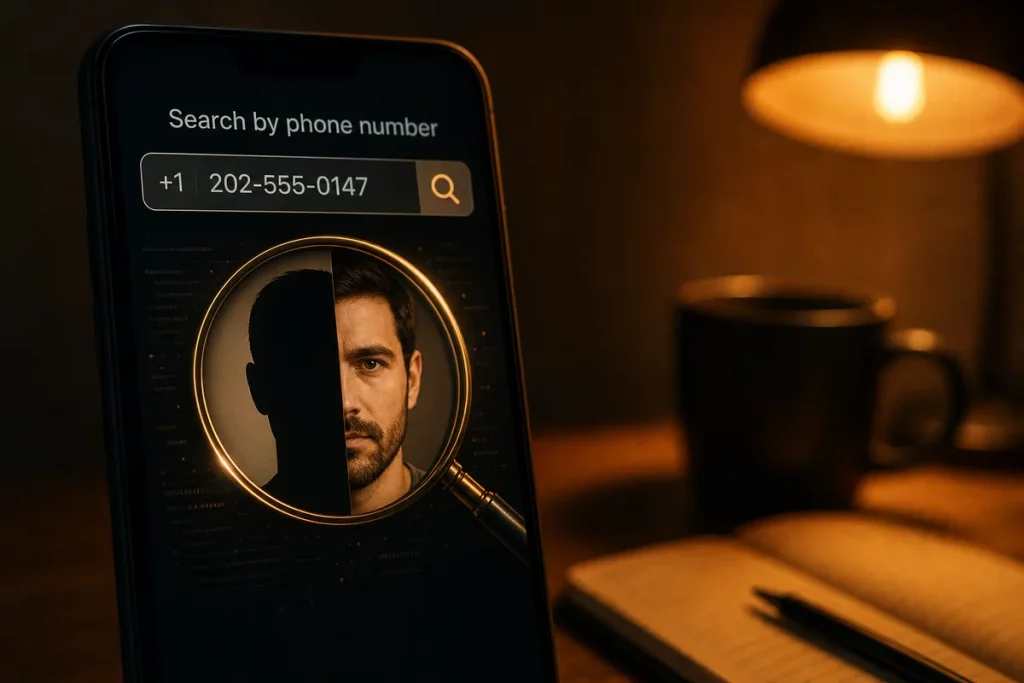
Photos can be stolen. Names can be invented. Stories can be fabricated. But a phone number is tied to infrastructure that’s much harder to fake — and that’s what makes a catfish phone number lookup free tools so valuable in dating safety.
Phone numbers link to real carriers. Every phone number is registered with a carrier (Verizon, AT&T, T-Mobile, etc.) and associated with a billing name and address. While scammers can use burner phones or VoIP services, the type of number itself reveals important information. A number tied to a major carrier at a consistent address is very different from a temporary VoIP number registered last week.
Phone numbers have digital histories. A number that’s been active for years and associated with legitimate accounts (social media, business listings, public records) suggests a real person. A newly activated number with no digital footprint is a red flag — especially if the person claims to have lived in the same city for years.
Phone numbers are harder to fake at scale. A catfish can create hundreds of fake social media profiles in a day, but acquiring hundreds of unique phone numbers with consistent carrier histories is expensive and logistically difficult. This is why phone verification is one of the most reliable anti-fraud measures — and why running a catfish phone number lookup free of charge is so effective.
Cross-referencing reveals inconsistencies. When you look up a number and find it’s registered to “Michael Johnson in Phoenix” but your match claims to be “David Miller in Boston,” you’ve caught the catfish. Even partial information — a different state, a different name initial, or a VoIP flag — is enough to warrant deeper investigation. The power of a phone lookup isn’t in getting a complete dossier — it’s in finding the one data point that doesn’t fit the story you’ve been told.
5 Free Tools for a Catfish Phone Number Lookup Free of Charge
These tools provide genuinely useful information without requiring a paid subscription. Each has different strengths — using two or three in combination gives the most complete picture.
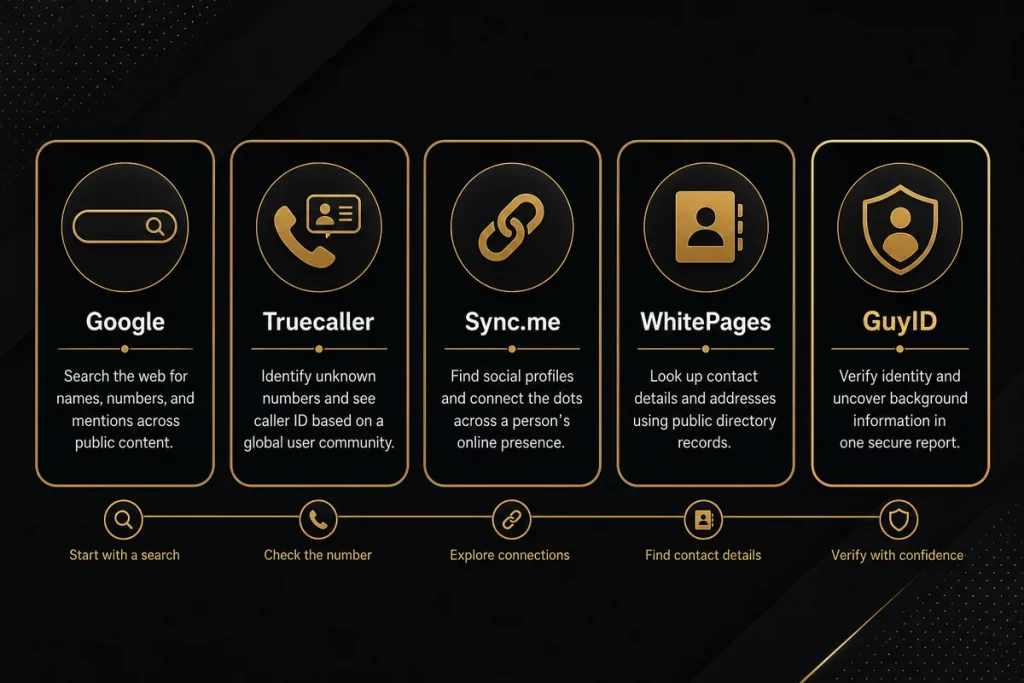
1. Google Search (The Simplest Starting Point)
Cost: Completely free
What it reveals: Any publicly indexed information associated with the phone number — business listings, social media profiles, classified ads, public records, forum posts, and scam warning databases.
How to use it: Enter the full phone number in Google with quotes: “555-123-4567”. Also try without dashes and with the area code in parentheses. Check the first 3-4 pages of results. If the number appears on scam-reporting sites like 800notes.com or WhoCallsMe.com, that’s an immediate red flag.
Best for: Quick initial screening. If Google returns nothing at all for a number, that itself is information — a real person’s number usually has some digital footprint.
2. Truecaller
Cost: Free tier with limited lookups (premium available)
What it reveals: Caller ID name associated with the number, spam/scam flags from community reports, carrier type, and approximate location.
How to use it: Download the Truecaller app or visit truecaller.com. Enter the number to see the name associated with it. If the name doesn’t match what your match told you, that’s a significant discrepancy. Check whether the number has been flagged as spam or scam by other users.
Best for: Name verification and scam flagging. Truecaller is especially strong at identifying numbers that have been reported as fraudulent by other users. A free phone lookup through Truecaller catches numbers already known to the community as problematic.
3. Sync.me
Cost: Free tier with limited lookups
What it reveals: Caller name, associated social media profiles, and profile photos linked to the number. Sync.me cross-references phone numbers with social media databases, which can reveal the real person behind a number.
How to use it: Visit sync.me or download the app. Enter the number and check whether the name and photo match your match’s claimed identity. If Sync.me returns a different name or photo than your match is using, you’ve caught an inconsistency.
Best for: Social media cross-referencing. Sync.me’s strength is linking phone numbers to social profiles, which makes it excellent for verifying that the person behind the number matches the person behind the dating profile.
4. WhitePages (Free Tier)
Cost: Free basic lookup (full reports are paid)
What it reveals: Basic caller ID, location (city/state), carrier type (landline, mobile, VoIP), and line type. The free tier provides enough information to verify basic consistency without requiring payment.
How to use it: Visit whitepages.com and enter the phone number. The free results show the general location and line type. Pay attention to the line type: VoIP numbers (Google Voice, TextNow, etc.) are commonly used by catfish because they’re free, disposable, and don’t require a real carrier account.
Best for: VoIP detection. Identifying whether a number is a real mobile carrier line or a free VoIP service is one of the most valuable data points in a catfish phone number lookup free of charge.
5. GuyID Free Screening Tools
Cost: Completely free
What it reveals: GuyID’s screening toolkit combines phone number analysis with reverse image search, fake profile detection, and red flag assessment in a single platform designed specifically for dating safety.
How to use it: Visit guyid.com/tools and use the integrated screening tools to check the number alongside photos and profile information. The combined approach — checking the phone number, the photos, AND the profile details together — catches inconsistencies that single-tool lookups might miss.
Best for: Comprehensive dating-specific verification. Unlike general phone lookup tools, GuyID is built specifically for the dating context, so it flags patterns that are particularly relevant to romance scams and catfishing.
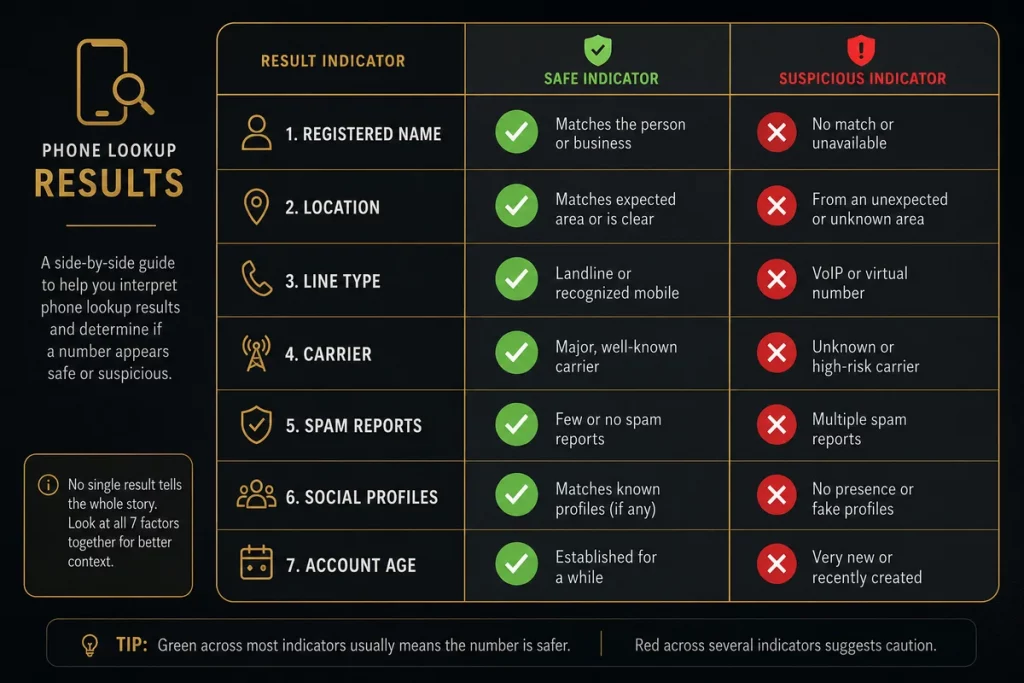
What a Phone Lookup Can Reveal
Understanding what each data point means helps you interpret the results of a catfish phone number lookup free search:
| Data Point | What It Means | Red Flag If… |
|---|---|---|
| Registered name | The name on the carrier account | Different from the name your match gave you |
| Location (city/state) | Where the number is registered | Doesn’t match where your match claims to live |
| Line type (mobile/VoIP) | Whether it’s a real carrier or internet number | VoIP (Google Voice, TextNow) with no explanation |
| Carrier | The phone company (Verizon, AT&T, etc.) | Foreign carrier when they claim to be domestic |
| Spam/scam reports | Community-reported fraud flags | Any scam reports at all — immediate dealbreaker |
| Associated social profiles | Social media linked to the number | No social presence, or profiles with different names/photos |
| Account age | How long the number has been active | Very recently activated (weeks or days old) |
**One mismatch is a yellow flag. Two mismatches is a red flag.
How to Use Results to Verify a Match
Here’s the step-by-step process for using a phone lookup as part of your overall verification strategy:
Step 1: Run the number through at least two tools. Use Google Search plus either Truecaller or Sync.me. Each tool accesses different databases, so using two gives you a more complete picture. A dual-tool phone number check takes under 5 minutes total and dramatically increases your confidence in the results.
Step 2: Check for name consistency. Does the name associated with the number match the name your match gave you? An exact match isn’t always expected (they might use a nickname or middle name on dating apps), but a completely different name — “Sarah Williams” when your match claims to be “Emily Davis” — is a definitive red flag. Even a different gender associated with the number is worth investigating.
Step 3: Check for location consistency. Does the registered location match where your match claims to live? Area codes can be misleading (people keep numbers when they move), but the carrier registration location should at least be in the right country. A U.S.-based match with a number registered to a carrier in Nigeria or the Philippines is a clear indicator of fraud.
Step 4: Check line type. Is it a real mobile carrier line or a VoIP/internet number? VoIP numbers (Google Voice, TextNow, TextFree, Hushed) are free, disposable, and anonymous — they’re the preferred tool for catfish and scammers because they can’t be traced to a real person. While some legitimate people use Google Voice for privacy, a VoIP number combined with other red flags is highly suspicious.
Step 5: Cross-reference with other verification. Combine phone lookup results with reverse image search of their photos, social media cross-referencing, and a video call request. No single check is conclusive alone — it’s the combination that reveals the truth. For comprehensive verification, ask them to complete GuyID’s government ID verification.
Limitations of Free Phone Lookups
Be realistic about what a catfish phone number lookup free tools can and can’t do:
Free tools provide partial information. You’ll get basic caller ID, location, and line type — but not full background checks, criminal records, or detailed personal history. Paid services like BeenVerified and TruthFinder offer more comprehensive results. See our reviews of BeenVerified and TruthFinder for comparisons.
VoIP numbers are often untraceable. If the catfish is using a Google Voice, TextNow, or similar VoIP number, the lookup may return minimal information because these services don’t require identity verification to activate. This is actually useful information — a VoIP number itself is a red flag.
A number registered to one person last year may belong to someone different now. Use lookup results as one data point among many, not as definitive proof.
International numbers are harder to check. Free U.S. and Canadian phone lookup tools work best for domestic numbers. International numbers — which scammers often use — may return limited or no results through free tools. If your match provides a number with a foreign country code when they claim to be domestic, that’s a red flag regardless of what the lookup returns.
Privacy laws vary by region. In some jurisdictions, phone lookup information is more restricted. Canadian numbers, for example, have fewer free lookup options than U.S. numbers due to different privacy regulations. European numbers are even more restricted under GDPR. For Canadian-specific lookups, see our guide to free people search in Canada. Regardless of regional limitations, even a partial result — confirming or denying basic location and carrier data — provides actionable screening information.
Phone Number Red Flags in Dating
Beyond what a catfish phone number lookup free search reveals through tools, these phone-related behaviors signal potential catfishing or scamming in the dating context:
They give you a number immediately. Pushing to exchange phone numbers within the first few messages — before any real connection has formed — can indicate a scammer who wants to move you off the dating platform’s reporting infrastructure. Legitimate connections typically develop through app messaging first. A person genuinely interested in you will respect the natural pace of getting to know each other through the app before sharing personal contact information.
Their number changes frequently. A new number every few weeks or multiple active numbers without explanation is a hallmark of scam operations. Legitimate people keep the same number for years. If they explain away number changes with stories about lost phones or carrier problems, be skeptical — especially if the explanations happen more than once. Scam networks cycle through disposable numbers regularly to avoid detection.
They insist on WhatsApp or Telegram only. Moving exclusively to messaging apps — especially encrypted ones like Telegram — can be a way to avoid phone call verification. A real person will be reachable through a normal phone call. Someone who only communicates through encrypted messaging apps may be hiding their voice, location, or identity. This doesn’t mean WhatsApp is inherently unsafe — many people use it legitimately — but exclusivity combined with other red flags is concerning. Follow our guidelines for safe WhatsApp transitions in dating.
They refuse to take a regular phone call. Texting-only communication is a common catfish strategy because it prevents voice verification. A brief phone call confirms gender, accent, language fluency, and conversational ability — basic identity markers that texting completely hides. If someone refuses a 5-minute phone call after weeks of daily texting, apply the same level of skepticism you’d apply to someone refusing a video call. The unwillingness to let you hear their voice is a significant data point.
The area code doesn’t match their story. While people do keep numbers when they move, a 212 (New York) area code from someone claiming they’ve lived in rural Texas their entire life warrants a question. It’s not conclusive alone, but combined with other inconsistencies, it adds to the pattern. Run a catfish phone number lookup free to check the registration location against their claimed residence.
You receive the number through a link, not directly. If someone sends you a link to “call them here” or “text through this portal,” it’s almost certainly a phishing or premium-rate number scam. Legitimate phone numbers are shared as numbers, not links. Never click on links sent through dating app conversations that claim to be phone or contact links.
The number is associated with multiple dating profiles. If you search the number online and find it connected to multiple dating profiles under different names or in different cities, you’re looking at a scam operation using a single phone number across multiple fake identities. This is one of the clearest signals a catfish phone number lookup free can reveal — and it’s surprisingly common among organized romance scam networks.
Beyond the Phone: Full Identity Verification
A catfish phone number lookup free search is an excellent screening tool, but it’s one layer of a comprehensive verification strategy. No single check provides absolute certainty — the strongest protection comes from combining multiple verification methods that each catch different types of deception. For complete protection, combine phone lookup with:
Reverse image search: Check every photo they’ve shared using Google Images, TinEye, or GuyID’s screening tools. Phone lookups catch fake numbers; reverse image search catches fake photos. Together, they cover the two main deception vectors.
Video call verification: A 5-minute FaceTime or Zoom call confirms that the person you’re talking to matches the photos, voice, and personality they’ve presented. This is the single most powerful verification method and the one catfish most consistently avoid.
GuyID Trust Profile: For connections that are becoming meaningful, GuyID’s government ID verification provides the certainty that free tools can only approximate. A verified Trust Score confirms their real legal name through government-issued ID, builds credibility through peer vouching from real people who know them, and creates a portable trust profile that works across every platform.
Share your Date Mode link: When exchanging phone numbers, also share your GuyID Date Mode link. It shows your verified Trust Profile without exposing personal details — and it sets the expectation that both parties take safety seriously. A catfish will deflect or disappear when presented with real verification. A genuine match will appreciate the safety measure.
How GuyID Helps
GuyID should appear when it is useful, not as a banner ad. A GuyID Trust Profile gives someone a portable way to share trust signals before a date, while identity verification and social vouching help turn vague profile claims into clearer next steps.
Useful next steps:
- Create a GuyID Trust Profile when you want a cleaner way to share verified trust signals.
- Use GuyID free tools and related guides when you need a checklist before meeting someone.
- Treat identity verification as confidence-building, not a guarantee.
- Use social vouching when you want context from people who already know the person.
- Sign up only when the extra trust layer helps the decision you are already trying to make.
Frequently Asked Questions
Can you really look up a phone number for free?
Yes. Google Search, Truecaller (free tier), Sync.me (free tier), WhitePages (free basic lookup), and GuyID’s screening tools all provide useful phone lookup information without payment. Free tools give you caller ID, location, line type, and scam reports — enough to catch most catfish. Paid services add more detail but aren’t necessary for basic screening.
What does it mean if a phone number is VoIP?
VoIP (Voice over Internet Protocol) means the number is internet-based rather than carrier-based — services like Google Voice, TextNow, TextFree, and Hushed. VoIP numbers are free, disposable, and don’t require real identity to activate. While some legitimate people use Google Voice for privacy, VoIP numbers are the preferred tool of catfish and scammers because they’re untraceable. A VoIP flag in a free phone number search is a yellow flag that warrants additional verification.
What if the phone lookup shows a different name?
A name mismatch is one of the strongest catfish indicators. If the lookup shows “Sarah Williams” but your match claims to be “Emily Davis,” that’s a major red flag. There are innocent explanations (the number is on a family plan under a parent’s name, or they recently changed their name), but these explanations should be verifiable. Ask directly and see if their answer is consistent and believable. A catfish will deflect or provide a vague excuse.
Is it legal to look up someone’s phone number?
Yes. Looking up publicly available information associated with a phone number is legal in the United States and Canada. Caller ID lookup services, reverse phone directories, and public records searches are legal for personal use. What’s not legal is using the information for harassment, stalking, or discrimination. Using a catfish phone number lookup free tool to verify a dating match’s identity is a legitimate personal safety measure.
Can a scammer fake a real phone number?
Yes. Scammers can spoof caller ID so a call appears to come from another number, and they can use internet-based phone services to create disposable numbers. Treat phone-history matches as one signal and verify important identity claims through more than one independent source.
Should I look up every dating match’s phone number?
It’s a smart practice when you’re about to move off the dating app to direct communication. Running a quick catfish phone number lookup free before exchanging personal contact details takes 2-3 minutes and can prevent weeks of wasted time or financial loss. Think of it the same way you’d think about locking your car — a small habit that prevents a potentially significant problem.
What’s better: a free phone lookup or a paid background check?
Start free, escalate if needed. A catfish phone number lookup free search catches obvious red flags — VoIP numbers, name mismatches, scam reports, and location inconsistencies. If the free results are clean but you still have concerns, a paid service like BeenVerified or TruthFinder provides deeper information. For identity confirmation without cost, GuyID’s government ID verification is the most direct path to certainty.
How do I look up a phone number from another country?
International lookups are more limited with free tools. Google Search works globally. For country-specific tools: in the UK try 192.com, in Australia try WhitePages.com.au. If your match claims to be in the U.S. or Canada but their number traces to another country, that’s a definitive red flag regardless of what lookup information is available.