Online Dating Safety for LGBTQ+: Complete Protection Guide (2026)
LGBTQ+ daters navigate every risk that straight daters face — fake profiles, romance scams, AI-generated identities, pig butchering — plus additional threats that exist specifically because of sexual orientation and gender identity: extortion based on outing, targeted hate violence, catfishing by people with hostile intent, apps that expose location to potentially dangerous strangers, and scammers who weaponize the emotional vulnerability of seeking acceptance and connection in communities where trust has historically been harder to find. Online dating safety for LGBTQ+ requires the universal safety framework plus specific adaptations for threats that don’t appear in general dating safety guides — because most guides are written for straight, cisgender users and miss the risks that LGBTQ+ daters face uniquely.
This guide provides the complete LGBTQ+ dating safety framework: the unique threats, the platform considerations, the privacy protections, and the verification practices that address both universal dating risks and the specific safety challenges that LGBTQ+ individuals navigate.
The Additional Threat Layer LGBTQ+ Daters Face
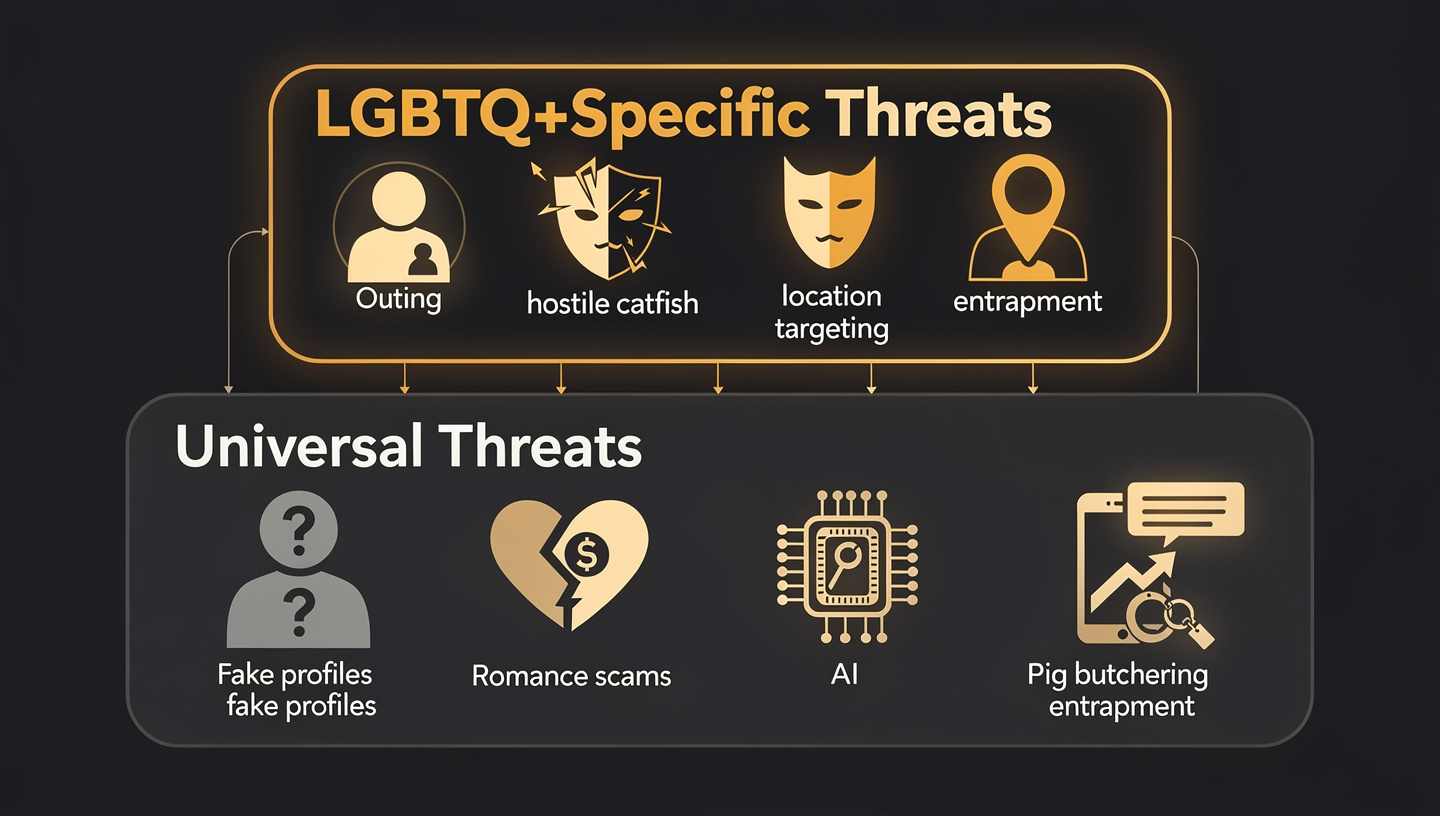
Every dating safety guide covers universal threats: fake profiles, romance scams, financial fraud, and identity deception. LGBTQ+ dating safety includes all of these plus an additional threat layer that exists because of who the dater is — not just what the scammer wants.
Universal Threats (Same as Everyone)
- Fake profiles and catfishing for emotional manipulation
- Romance scams for financial extraction ($1.3B annually)
- Pig butchering and investment fraud through dating connections
- AI-generated identities and deepfake technology
- General physical safety when meeting strangers
LGBTQ+-Specific Threats (Additional Layer)
- Outing-based extortion: Scammers or malicious individuals who discover a person’s LGBTQ+ identity through a dating app and threaten to expose it to family, employers, or communities unless money is paid
- Hate-motivated catfishing: People who create fake profiles on LGBTQ+ apps specifically to lure, humiliate, harass, or physically harm LGBTQ+ individuals
- Location-based targeting: Proximity features revealing exact location to potentially hostile individuals in the user’s geographic area
- Entrapment: In regions where LGBTQ+ identity is criminalized, fake profiles operated by law enforcement or vigilante groups to identify and target LGBTQ+ individuals
- Intimate image exploitation: Sharing of intimate images — sometimes exchanged in dating contexts — as a tool for blackmail, harassment, or outing
The dual threat layer means LGBTQ+ daters must apply both the universal safety framework (screening for scams, verifying identity) AND the LGBTQ+-specific protections (privacy measures, location safety, hostile-intent detection). Neither layer alone is sufficient.
Outing and Extortion: The Weaponization of Identity
For LGBTQ+ individuals who aren’t fully out — or who live in environments where being out carries consequences — the mere presence on a dating app creates vulnerability that straight users don’t face.
How Outing-Based Extortion Works
A person matches with an LGBTQ+ individual on a dating app. Through conversation, they confirm the target’s LGBTQ+ identity and gather identifying information: full name, employer, social connections, family details. They then threaten to expose the person’s sexual orientation or gender identity to their employer, family, religious community, or social network — demanding payment for silence. The extortion works because the information being weaponized is the person’s own identity — something no amount of financial compensation truly resolves.
Who Does This
Organized extortion rings (treating outing threats as a revenue model), individuals with personal animosity toward LGBTQ+ people (motivated by ideology rather than money), and opportunistic scammers who identify vulnerability and exploit it. In regions where LGBTQ+ identity carries legal consequences, the threat escalates to reporting someone to authorities — adding legal danger to social danger.
How to Protect Yourself
- Control identifying information: Don’t share full name, employer, or family details until identity is thoroughly verified. The less an unverified match knows about your offline life, the less leverage any extortion attempt carries. See the complete privacy guide.
- Use apps with privacy controls: Choose platforms that allow you to hide your profile from specific contacts, control who can see your presence, and limit the information visible to matches.
- Verify before vulnerability: Before sharing anything personal that could be used for outing — including intimate conversations or images — verify the person’s identity through GuyID Trust Profile (government ID confirmed + social vouches). An identity-verified person with a real name attached to their verified profile is far less likely to be an extortion operator than an anonymous, unverified match.
- If threatened: Screenshot all threats. Do not pay — payment rarely stops extortion, it escalates demands. Report to the dating platform. Report to local police (extortion is criminal regardless of the information being weaponized). Contact organizations that support LGBTQ+ individuals facing harassment.
Location Safety and Proximity-Based Risks
Several LGBTQ+-focused dating apps use grid-based proximity features that show how far away another user is. While this helps local matching, it creates location-specific risks for LGBTQ+ dating safety.
The Triangulation Risk
Grid-based distance displays — showing “200 meters away” rather than a general area — can be used to triangulate a user’s exact location through multiple readings from different positions. For LGBTQ+ individuals in hostile environments — regions with anti-LGBTQ+ laws, areas with hate crime risk, or conservative communities where being identified on a queer dating app carries consequences — precise location exposure to unknown individuals is a direct safety threat.
Mitigation Strategies
- Disable distance display: Most apps allow hiding your distance from other users — enable this setting. You can still match and message without broadcasting your precise location.
- Use the app from different locations: If distance is visible, using the app only from public locations (not your home) prevents your home address from being triangulated.
- Consider VPN or location-spoofing: In high-risk regions, location-masking tools prevent your real position from being exposed through the app’s proximity features.
- Be cautious with “travel mode”: Some apps notify local users when someone is visiting their area — “new in town” flags that can attract both genuine interest and predatory attention toward a vulnerable, unfamiliar visitor.
Catfishing with Hostile Intent
In LGBTQ+ dating contexts, catfishing sometimes serves a darker purpose than emotional manipulation or financial fraud: it’s used to target LGBTQ+ individuals for humiliation, harassment, or physical violence.
How Hostile Catfishing Works
A person creates a fake profile on an LGBTQ+ dating app — presenting as a potential romantic or sexual partner. They engage a target through conversation, building enough trust to arrange an in-person meeting. At the meeting — or through information gathered digitally — the catfish reveals hostile intent: harassment, assault, robbery, humiliation (sometimes filmed and shared), or outing.
Detection Methods
Hostile catfish on LGBTQ+ platforms often exhibit detectable patterns:
- 🟡 Profile seems too simple or recently created: Minimal effort profile — few photos, sparse bio, recent creation date — on an LGBTQ+ app where genuine users typically invest more in profile quality.
- 🟡 Rushing to meet in private locations: Pushing for first meetings at private residences rather than public venues — eliminating witnesses and exit options.
- 🟡 Vague about their own LGBTQ+ identity or experience: Questions about the community, culture, or experience produce generic or evasive answers — suggesting the person isn’t actually part of the community they’re using the app to access.
- 🟡 New to the app with no community connections: On platforms where community reputation matters, a complete unknown with zero shared connections warrants additional caution.
- 🔴 Requesting your home address before meeting: Any match requesting your home address before you’ve met in person and verified their identity — regardless of framing — is a safety risk.
Protection Through Verification
The strongest protection against hostile catfishing is identity verification before any in-person meeting. A GuyID Trust Profile at TRUSTED tier confirms: government ID verified (the person legally exists as claimed), social vouches present (real people confirm their identity and character). A person planning hostile action is unlikely to verify their real identity through government documents and social vouching — because doing so creates the accountability trail that criminal activity requires anonymity to avoid.
Platform Considerations for LGBTQ+ Safety
Different platforms serve LGBTQ+ communities with different safety profiles. Here’s the assessment for LGBTQ+ dating safety.
LGBTQ+-Specific Platforms (Grindr, HER, Taimi)
- Grindr: The largest platform for gay, bi, and queer men. Proximity-based with grid distance display (triangulation risk). Limited verification. Has implemented safety features including “discreet app icon” and travel alerts for hostile regions. Community familiarity provides some social verification through shared connections — but hostile catfishing and extortion remain documented concerns.
- HER: Platform for queer women and nonbinary individuals. Community-focused with event integration. Smaller user base than mainstream apps — which can mean stronger community recognition but also easier identification in smaller areas.
- Taimi: LGBTQ+-inclusive platform with social networking features. Offers video verification and live streaming — providing more identity confirmation tools than some competitors. Social features create community context that pure matching apps lack.
Mainstream Platforms with LGBTQ+ Inclusivity
- Hinge: Inclusive gender and orientation options. Prompt-based profiles provide depth. Strongest verification among mainstream apps. Relationship-focused culture. For LGBTQ+ users seeking relationships, Hinge’s depth and verification provide the strongest mainstream safety profile.
- Bumble: Inclusive gender options. For same-gender matches, either person can message first (the women-first rule applies only to opposite-gender matches). Broadest safety suite including video calling.
- Tinder: Inclusive orientation options. Largest user base provides the broadest potential match pool. “Orientation” feature can be shown or hidden on profile — providing some privacy control. Safety features are standard but not LGBTQ+-specialized.
- OkCupid: Most extensive gender and orientation options of any mainstream platform (dozens of options). Question system provides the deepest personality matching. Strong choice for LGBTQ+ users who want nuanced identity representation.
Platform Safety Recommendation
For LGBTQ+ users prioritizing safety: use a mainstream platform with strong verification (Hinge or Bumble) for relationship-focused dating, supplemented with LGBTQ+-specific platforms for community connection. Regardless of platform: GuyID’s free screening tools + Trust Profile verification work on every platform and provide the identity confirmation that no dating app offers natively.
The LGBTQ+ Dating Safety Protocol
The universal proactive dating safety protocol applies — with LGBTQ+-specific additions at each stage.
☐ GuyID 60-second screen: reverse image search + catfish detector + bio analyzer
☐ Check for GuyID Trust Profile in their bio
☐ LGBTQ+-specific: Evaluate profile authenticity for community signals — does the person demonstrate genuine familiarity with LGBTQ+ culture and community?
☐ LGBTQ+-specific: Be cautious with very new profiles that have minimal community engagement
☐ Video call within the first week — with active deepfake testing
☐ Request GuyID Trust Profile — gov ID + social vouches
☐ LGBTQ+-specific: Meet ONLY in public venues — never at a private residence for first meetings
☐ LGBTQ+-specific: Choose a venue in an LGBTQ+-friendly area if possible
☐ Inform a trusted friend: where, who (share verified info), and when you’ll check in
☐ Don’t share full name until identity is verified
☐ Don’t share employer until trust is established
☐ Don’t share family details until you’ve met in person multiple times
☐ Disable distance/proximity display on location-based apps
☐ LGBTQ+-specific: Never share information that could be used for outing before thorough verification
☐ LGBTQ+-specific: Be cautious with intimate images — they can be weaponized for extortion
☐ Screenshot ALL threats and communications
☐ Do NOT pay — payment escalates demands, doesn’t stop them
☐ Report to the dating platform with evidence
☐ Report to local police (extortion is criminal)
☐ Contact LGBTQ+ support organizations for guidance
☐ If in a hostile region: contact international LGBTQ+ safety organizations
Privacy as Survival: Protecting Your Identity in Dating
For many LGBTQ+ individuals, privacy in dating isn’t about convenience or preference — it’s about safety that may extend to physical wellbeing, employment security, family relationships, and in some regions, legal survival.
Information Protection Framework for LGBTQ+ Daters
| Information Type | Risk If Exposed | When to Share |
|---|---|---|
| LGBTQ+ identity | On the app: assumed. Outside the app: potential outing risk | Your identity is visible on the platform. Control who connects your dating identity to your offline identity. |
| Full legal name | Enables identification, social media discovery, outing to offline network | After video call + GuyID Trust Profile verified |
| Employer / workplace | Workplace outing, professional consequences in hostile industries | After multiple in-person meetings + verified trust |
| Home address | Physical safety — address of your safe space exposed to unverified person | After months of verified, in-person relationship |
| Family details | Outing to family, family safety if extortion escalates | After deep trust established through extended verified relationship |
| Intimate images | Extortion, non-consensual sharing, outing through visual evidence | Extreme caution — only after deep trust with verified, accountable person |
Technical Privacy Measures
- Secondary phone number: Use Google Voice or TextNow for dating — prevents reverse lookup connecting your dating activity to your real identity
- Separate email: Create a dating-specific email not linked to your real name, employer, or primary accounts
- Location settings: Disable precise location, distance display, and “show me to nearby users” features on all dating apps
- WhatsApp privacy settings: Last Seen, Profile Photo, About, Status → “My Contacts” before sharing your number with any match
- Social media separation: Don’t link Instagram or Facebook to dating profiles if your social media reveals information you’re not ready to share with unverified matches
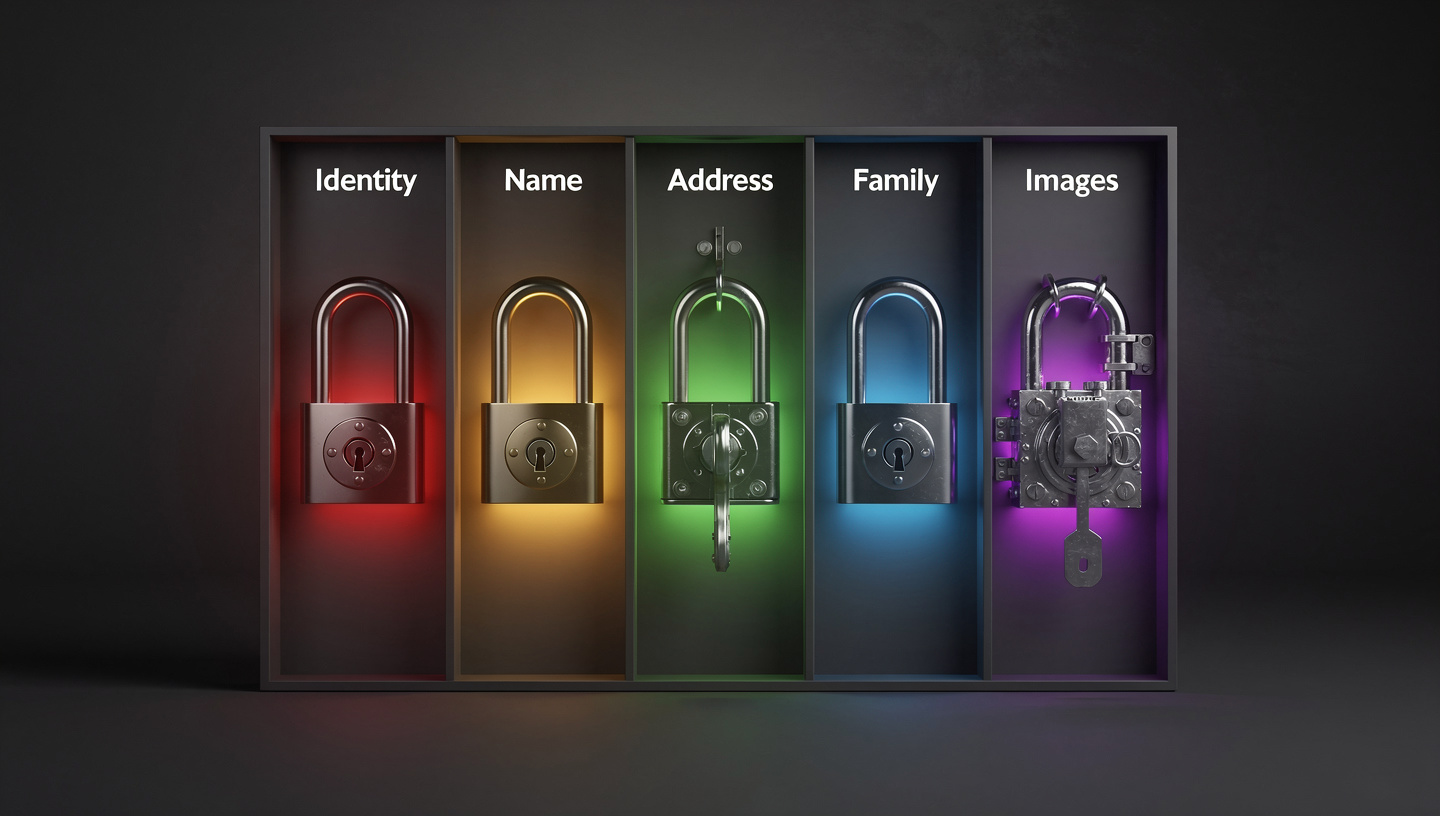
Summary: Universal Safety + LGBTQ+-Specific Protections
Online dating safety for LGBTQ+ requires two layers working together. The universal layer — fake profile screening, romance scam detection, first date safety, and identity verification — protects against the threats every dater faces. The LGBTQ+-specific layer — outing protection, location safety, hostile catfish detection, and identity-as-vulnerability awareness — addresses the threats that exist specifically because of who you are.
The core tools work identically for LGBTQ+ and straight daters: GuyID’s free screening tools catch fake profiles regardless of the platform or community. GuyID Trust Profiles (government ID + social vouches) confirm identity regardless of sexual orientation or gender identity. The Date Mode link works on LGBTQ+-specific apps (Grindr, HER, Taimi) and mainstream platforms (Hinge, Bumble, Tinder) equally — portable verification that follows you across every platform and every conversation.
The LGBTQ+-specific adaptations focus on privacy: controlling what information flows from your dating identity to your offline identity, protecting against outing-based extortion by verifying before vulnerability, using location-masking on proximity-based apps, and recognizing hostile catfishing patterns specific to LGBTQ+ contexts. These adaptations layer on top of the universal framework — they don’t replace it.
LGBTQ+ daters deserve the same safety infrastructure as everyone else — plus the specific protections their community requires. Build your Trust Profile. Screen every match. Verify before meeting. Protect your privacy as actively as you protect your safety. And know that the tools that make dating safer for everyone work for you too — because trust verification doesn’t care about orientation. It cares about identity, character, and trustworthiness.
GuyID’s safety tools work on every platform — Grindr, HER, Taimi, Hinge, Bumble, Tinder, and everywhere else. Government ID verification + social vouching + Trust Tiers + portable Date Mode link. Screen matches in 60 seconds. Women and all gender identities check for free.
Frequently Asked Questions: Online Dating Safety for LGBTQ+
What unique safety risks do LGBTQ+ daters face?
How do I protect myself from outing-based extortion?
Which dating apps are safest for LGBTQ+ users?
How do I stay safe on Grindr and location-based apps?
How do I detect hostile catfishing on LGBTQ+ apps?
Does GuyID work on LGBTQ+-specific dating apps?
Should I share intimate images with dating matches?
What should I do if I’m being harassed or extorted through a dating app?

Founder, GuyID · Dating Safety Researcher · 13+ Years in Data Analytics
Ravishankar Jayasankar is the founder of GuyID, a consent-based dating trust verification platform. With 13+ years in data analytics and a deep focus on consumer trust, Ravi built GuyID to close the safety gap in digital dating. His research found that 92% of women report dating safety concerns — validating GuyID’s mission to make online dating safer through proactive, consent-based verification. GuyID offers government ID verification, social vouching, a Trust Tiers system, and 60+ free interactive safety tools.