
Do Dating Apps Do Background Checks? No — Here’s What to Do Instead (2026)
Do dating apps do background checks? The short answer: no. Not Tinder. Not Bumble. Not Hinge. Not POF. Not Facebook Dating. Not OkCupid. No mainstream dating app in 2026 performs criminal background checks, sex offender registry searches, or any form of background screening on its users. The person you’re swiping right on could have any criminal history, any relationship status, any past — and the dating app has done nothing to find out. With $1.3 billion lost annually to romance scams (FTC, 2026) and 80 million Americans using dating apps (SSRS, 2026), understanding that dating apps do not do background checks is one of the most important safety facts every online dater should know.
This guide explains why dating apps don’t do background checks, what they actually check instead (spoiler: only photos), whether background checks would actually make dating safer, what alternatives exist, and how to protect yourself given the complete absence of screening on every platform you use.
The Definitive Answer: No Dating App Does Background Checks
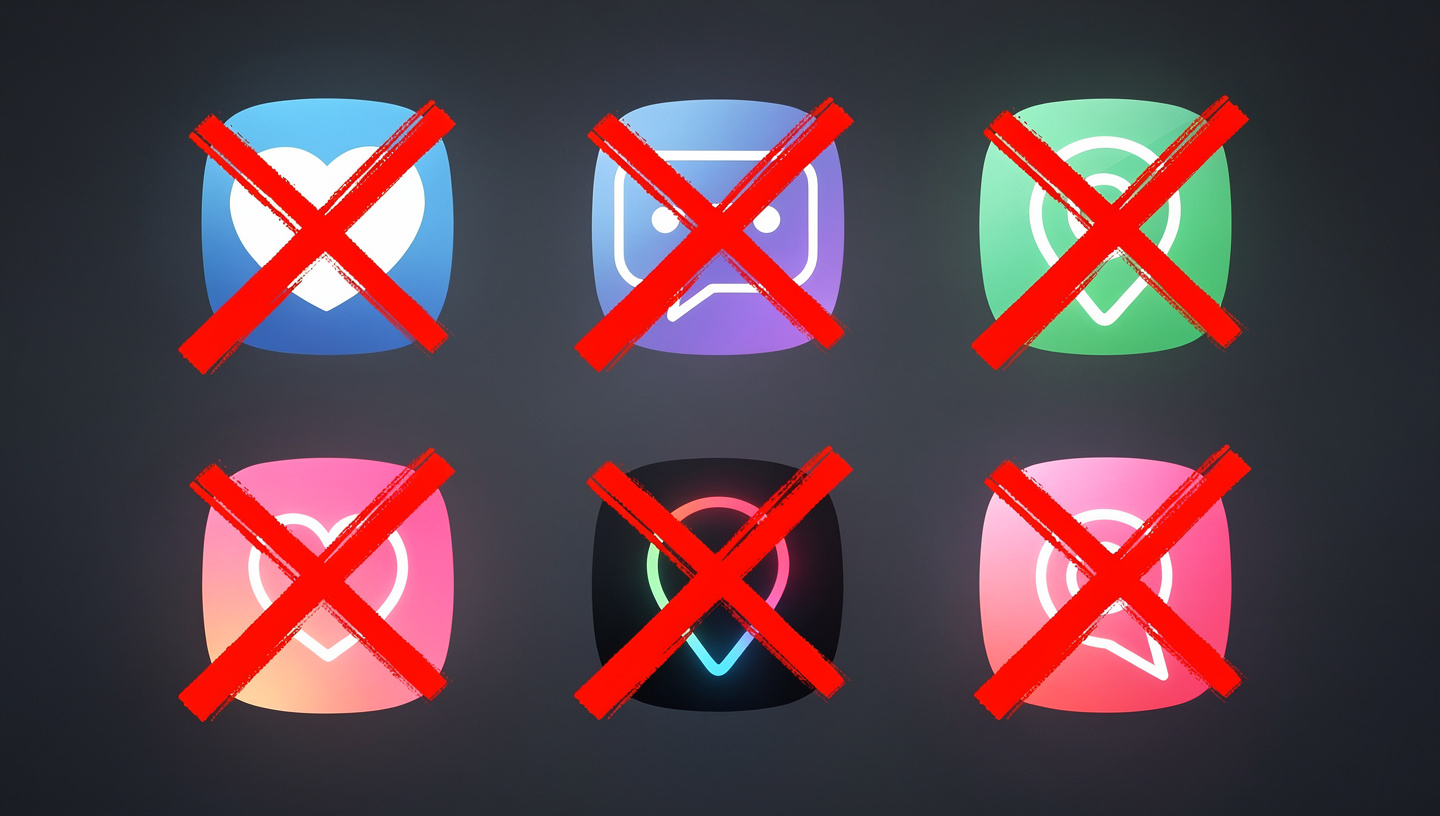
To be absolutely clear about do dating apps do background checks: no mainstream dating app performs any form of background screening on its users. Here is the status for every major platform.
| Dating App | Criminal Background Check | Sex Offender Registry | Identity Verification | What They Actually Check |
|---|---|---|---|---|
| Tinder | ❌ No | ❌ No | ❌ No (photo only) | Pose selfie matches photos |
| Bumble | ❌ No | ❌ No | ❌ No (photo only) | Gesture selfie matches photos |
| Hinge | ❌ No | ❌ No | ❌ No (photo only) | Video selfie matches photos |
| POF | ❌ No | ❌ No | ❌ No (photo only) | Basic photo match (weakest) |
| Facebook Dating | ❌ No | ❌ No | ❌ No | Linked Facebook account |
| OkCupid | ❌ No | ❌ No | ❌ No (photo only) | Optional selfie match |
| Match.com | ❌ No | ❌ No | ❌ No (photo only) | Selfie match |
| The League | ❌ No | ❌ No | Partial (LinkedIn) | LinkedIn + photo match |
| eHarmony | ❌ No | ❌ No | Optional in some regions | Selfie match + optional ID |
The pattern is universal: every column that matters for safety — criminal checks, sex offender screening, identity verification — shows ❌ across every platform. The only column with checkmarks is “What They Actually Check” — and every entry is some variation of “selfie matches photos.” This is the complete reality behind the question do dating apps do background checks.
What Dating Apps Actually Check — and the Massive Gap
Since dating apps don’t do background checks, understanding what they do check — and the gap between what they check and what would actually keep you safe — is essential.
What Dating Apps Check: Photo Matching
Every major dating app’s “verification” system confirms one thing: a live selfie matches uploaded profile photos. This means the person who completed verification has the same face as the profile images. That’s it. As we’ve documented across our Tinder, Bumble, and Hinge verification guides, verified means photos match — nothing more.
What Dating Apps Don’t Check: Everything That Matters for Safety
- Criminal history: No dating app checks whether a user has been convicted of assault, domestic violence, sexual offenses, fraud, stalking, or any other crime. A person with multiple violent felony convictions receives the same “verified” badge as a person with a clean record — because the badge checks faces, not records.
- Sex offender registry: No dating app cross-references users against federal or state sex offender registries. A registered sex offender can create a profile, complete photo verification, earn a badge, and match with targets — without any platform intervention.
- Legal name: No app confirms the name on a profile matches a legal identity document. A person using a completely fake name receives the same badge as someone using their real name.
- Relationship status: No app confirms whether a user is single, separated, divorced, or married. An estimated 15-30% of dating app users may be misrepresenting their relationship status.
- Employment claims: No app verifies career claims despite prominently displaying them (Hinge: “Works at Goldman Sachs”). These are entirely self-reported and unverified — the exact claims that pig butchering scammers exploit.
The gap between what users assume “verified” means and what it actually confirms is the trust gap in online dating — and the answer to do dating apps do background checks reveals just how wide that gap is.
Why Dating Apps Don’t Do Background Checks
The question do dating apps do background checks has a clear answer (no), but the question of why they don’t reveals the structural tensions that prevent dating app safety from improving.
Reason 1: Cost
Background checks cost $10-50+ per person depending on scope and provider. For a platform with 75+ million monthly active users (Tinder) or 80+ million Americans on dating apps collectively, mandatory background checks would cost billions annually. Dating apps are venture-backed businesses optimizing for growth margins — absorbing multi-billion-dollar screening costs contradicts their financial model, and passing costs to users would reduce signups.
Reason 2: Friction and Signup Abandonment
Background checks take days to process. In a market where dating apps compete on ease of signup — swipe, match, message in under 5 minutes — adding a multi-day waiting period for background clearance would devastate signup completion rates. Even government ID verification (which takes minutes, not days) causes 30-50% of users to abandon the signup process. Background check friction would be significantly worse.
Reason 3: Legal Liability
If a dating app performs background checks and then a user with a “clean” check harms someone, the platform faces potential liability — the argument being “you screened this person, gave them a clean signal, and they turned out to be dangerous.” By not screening at all, platforms avoid this liability. The legal paradox: doing nothing is legally safer for the platform than doing something incomplete. Match Group (owner of Tinder, Hinge, OkCupid, Match.com, POF) has explicitly cited legal concerns in discussions about background check implementation.
Reason 4: Accuracy and Fairness Concerns
Background check databases have documented accuracy issues — incorrect records, outdated information, records attributed to the wrong person, and racial and socioeconomic biases in criminal justice data. Implementing background checks based on imperfect data could unfairly exclude innocent people while providing false confidence about people whose records are inaccurate. These fairness concerns are legitimate — though they don’t justify doing nothing.
Reason 5: Competitive Dynamics
The first major dating app to require background checks risks losing users to competitors that don’t — the same competitive dynamic that prevents mandatory government ID verification. In a market where users can switch platforms in seconds, adding friction that competitors don’t require is a growth-killing proposition. This first-mover disadvantage prevents any single platform from leading on safety.
Would Background Checks Actually Make Dating Safer?
Even if dating apps implemented background checks, would they actually prevent the harms users fear? The answer is nuanced — and understanding it helps you calibrate your safety expectations. Do dating apps do background checks is one question; “would background checks solve the problem” is another.
What Background Checks Would Catch
- Registered sex offenders: Cross-referencing against federal and state registries would identify registered offenders. This is the strongest case for background checks — the data exists, the threat is clear, and the protection is direct.
- Convicted violent offenders: People with convictions for assault, domestic violence, stalking, or other violent crimes would be flagged. However, only convicted offenders would be caught — the majority of violence goes unreported and unconvicted.
- Known fraud convicts: People with fraud convictions could be flagged, potentially catching some repeat romance scammers. However, most romance scam operators work from overseas jurisdictions without US criminal records.
What Background Checks Would NOT Catch
- Most romance scammers: 630,000+ scam operators (SpyCloud, Feb 2026) operate primarily from Nigeria, Ghana, Myanmar, Cambodia, and other countries. They have no US criminal records. US background checks would catch zero overseas scammers — which constitute the vast majority of romance scam operations.
- People who haven’t been caught yet: A background check only catches past convictions. A person who will commit their first offense tomorrow passes today’s background check with a clean record. First-time offenders — and people who’ve simply never been caught — are invisible to background screening.
- Emotional manipulation and financial exploitation: Love-bombing, emotional abuse, financial exploitation, and narcissistic manipulation are not criminal offenses that appear in background checks. The behavioral threats that constitute the majority of dating app harms are not addressable through criminal record screening.
- AI-generated identities: Background checks require a real identity to check against. AI-generated fake profiles have no real identity — there’s no person to run a background check on. The fastest-growing scam vector is completely invisible to background screening.
- Married people misrepresenting themselves: Being married and using a dating app isn’t a crime. Background checks wouldn’t flag relationship status misrepresentation.
The Honest Assessment
Background checks would provide meaningful protection against a specific subset of threats (registered sex offenders, convicted violent criminals) while missing the majority of harms dating app users actually face (overseas scammers, first-time offenders, emotional manipulation, AI fraud, relationship status lies). Background checks are a useful component of safety — but they’re not the comprehensive solution the 47% of users who want them imagine.
The Alternatives That Exist Today
Since dating apps don’t do background checks and aren’t likely to start soon, what alternatives actually provide the safety users are seeking? Several approaches address different dimensions of the safety gap.
Government ID Verification (What GuyID Provides)
Consent-based identity verification through GuyID — biometric matching against government-issued documents — confirms legal identity without requiring a background check database. This confirms: the person is who they claim to be (real name, real face matched to government ID), they’re a real person with government-verified existence, and their identity is confirmed at a level that no fake profile, AI-generated identity, or catfish can replicate.
Government ID verification doesn’t replace background checks — it addresses a different dimension. Background checks ask “What has this person done?” Identity verification asks “Who is this person?” In practice, knowing who someone actually is provides substantial protection: a person who has confirmed their real legal identity is accountable in ways an anonymous profile is not. Accountability deters misconduct even without a background check.
Social Vouching (What GuyID Provides)
Social vouching — real friends and colleagues confirming a person’s identity and vouching for their character — provides the character assessment dimension that neither background checks nor identity verification alone can deliver. A background check tells you about past convictions. Social vouching tells you about present character as perceived by people who actually know the person. When real humans stake their reputation on someone’s character, it provides trust information that no database search can match.
Progressive Trust Tiers (What GuyID Provides)
GuyID’s Trust Tiers (GHOST → STARTER → BUILDER → TRUSTED → ELITE → LEGEND) track sustained trustworthiness over time — creating a behavioral trust history that background checks (point-in-time snapshots) can’t provide. A TRUSTED tier means someone has consistently demonstrated trustworthy behavior over weeks or months — a track record that background checks don’t assess and that scammers operating disposable accounts cannot accumulate.
DIY Background Screening
Some users run their own informal background checks through public records searches, court record databases, and social media investigation. While these can surface useful information, they’re limited by data accuracy, incomplete records, and the time investment required. For most users, the combination of identity verification + social vouching + trust tiers through GuyID provides more practical, relevant, and reliable safety information than DIY background screening.
How to Protect Yourself Without Background Checks
Since dating apps don’t do background checks, your safety depends on the verification steps you take yourself. Here’s the complete protocol that provides protection equivalent to — and in many ways exceeding — what background checks would offer.
☐ Registered sex offenders: Search their name on the National Sex Offender Public Website (nsopw.gov) — free, takes 30 seconds
☐ Convicted criminals: Search their name on your state’s court records database (most are free and online)
☐ General background: Google their full name in quotes + city for news articles, court records, or public information
☐ Fake identities: Reverse image search + GuyID Trust Profile (gov ID verification)
☐ AI-generated profiles: Catfish probability detector + visual AI inspection
☐ Overseas scammers: Video call with deepfake testing + identity verification
☐ Character/intentions: Social vouching through GuyID (real people confirm character)
☐ Emotional manipulators: Watch for love-bombing, WhatsApp migration pressure, inconsistencies
☐ GuyID reverse image search (30 sec)
☐ Catfish probability check (10 sec)
☐ Social media cross-reference (LinkedIn, Instagram, Facebook)
☐ Video call with active testing
☐ Request GuyID Trust Profile (gov ID + social vouching)
☐ Optional: Sex offender registry search (nsopw.gov)
☐ Optional: State court records search
This protocol catches MORE threats than background checks alone — and costs $0.
This protocol provides broader protection than background checks would — because it addresses overseas scammers (which background checks miss), AI-generated identities (which background checks can’t screen), character assessment (which background checks don’t measure), and identity confirmation (which background checks don’t provide). The answer to do dating apps do background checks is “no” — but the better answer is that background checks alone would be insufficient anyway, and the alternative protocol described here provides more comprehensive protection.
What Identity Verification Provides That Background Checks Don’t
The most practical response to learning that dating apps don’t do background checks isn’t demanding background checks — it’s adopting identity verification, which addresses a broader set of threats with greater relevance to dating safety.
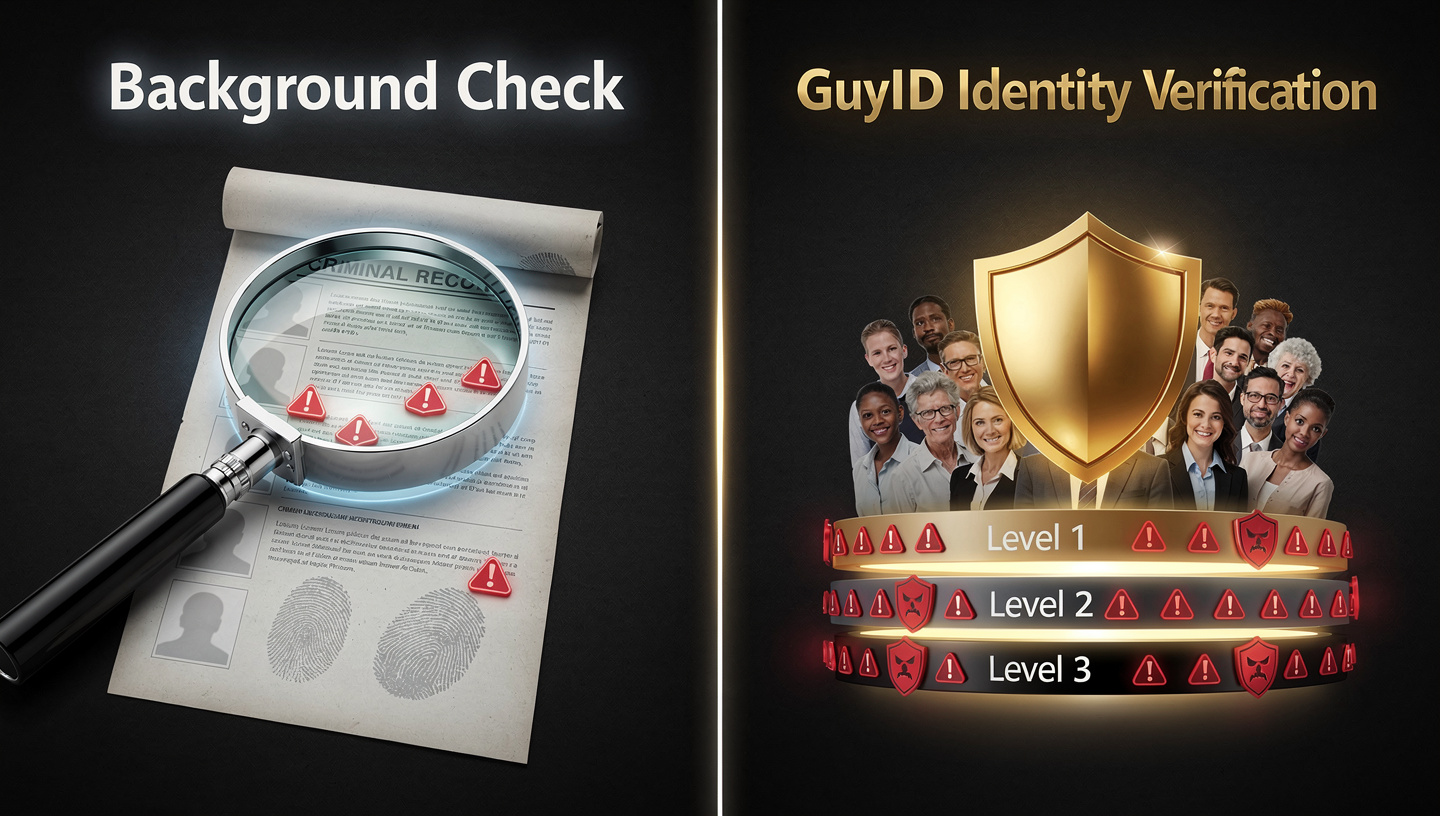
Background Checks vs Identity Verification: What Each Provides
| Dimension | Background Check | Identity Verification (GuyID) |
|---|---|---|
| Confirms legal identity | Requires real identity to run check | ✅ Confirms identity through government ID biometrics |
| Criminal history | ✅ (US records only) | ❌ (Not a background check service) |
| Character assessment | ❌ | ✅ Social vouching from real people |
| Catches overseas scammers | ❌ (No foreign records) | ✅ (Scammers can’t produce gov ID + vouches) |
| Catches AI-generated identities | ❌ (No identity to check) | ✅ (AI can’t generate government documents) |
| Catches catfish | ❌ (Checks records, not photos) | ✅ (Biometric matching confirms real person) |
| Sustained trust measurement | ❌ (Point-in-time snapshot) | ✅ (Trust Tiers track behavior over time) |
| Cross-platform portable | ❌ | ✅ (Date Mode link works everywhere) |
| Cost to check | $10-50+ per check | Free for women to check any profile |
| Processing time | 1-5 business days | 2 minutes to check a Trust Profile |
The comparison reveals that identity verification through GuyID addresses more threat categories, costs less (free to check), processes faster (2 minutes vs days), and provides ongoing trust measurement (Trust Tiers vs point-in-time check). Background checks have one unique advantage — criminal history screening — which can be partially replicated through free public record searches for users who want this specific dimension.
The optimal approach combines both: GuyID identity verification for comprehensive trust assessment + optional public record searches for criminal history screening = coverage that exceeds what dating app-administered background checks would provide.
Summary: The Background Check Gap and How to Close It
Do dating apps do background checks? No. Not one. Every major dating app — Tinder, Bumble, Hinge, POF, Facebook Dating, OkCupid, Match.com, The League, eHarmony — leaves criminal history, sex offender status, and background screening entirely unchecked. The person behind any dating profile could have any history, and the platform has done nothing to find out.
The reasons are structural: cost (billions annually at scale), friction (background checks take days, killing signup completion), legal liability (screening creates accountability the platforms want to avoid), accuracy concerns (database errors could unfairly exclude innocent users), and competitive dynamics (the first platform to require checks loses users to competitors that don’t).
But would background checks solve the problem even if dating apps implemented them? Only partially. Background checks would catch registered sex offenders and convicted criminals — meaningful protection. They would miss overseas scammers (no US records), AI-generated identities (no identity to check), first-time offenders (no record yet), emotional manipulators (not criminal), and relationship status misrepresentation (not illegal). The majority of dating app harms fall outside background check coverage.
The more comprehensive alternative: consent-based identity verification through GuyID — government ID + social vouching + Trust Tiers — addresses a broader threat spectrum than background checks while costing less (free for women to check), processing faster (2 minutes vs days), and providing ongoing trust measurement rather than a point-in-time snapshot. Combined with free public record searches for criminal history, video calls with deepfake testing, and the proactive dating safety protocol, this approach provides protection that exceeds what dating app background checks — even if they existed — would deliver.
The answer to do dating apps do background checks is “no, and they probably won’t.” The answer to “how do I protect myself” is: build your own verification stack using GuyID’s free safety tools, identity verification, and the 5-level verification system that catches more threats than background checks alone ever could.
GuyID provides identity verification (government ID + social vouching + Trust Tiers) that addresses more threats than background checks — for free. 60+ free safety tools. Women check Trust Profiles for free. Because the platform won’t protect you, but you can protect yourself.
Frequently Asked Questions: Do Dating Apps Do Background Checks
Do dating apps do background checks?
Does Bumble do background checks?
Does Tinder do background checks?
Why don’t dating apps do background checks?
Can I run my own background check on a dating match?
Would background checks make dating apps safe?
Is identity verification better than a background check for dating?
How can I protect myself since dating apps don’t screen users?

Founder, GuyID · Dating Safety Researcher · 13+ Years in Data Analytics
Ravishankar Jayasankar is the founder of GuyID, a consent-based dating trust verification platform. With 13+ years in data analytics and a deep focus on consumer trust, Ravi built GuyID to close the safety gap in digital dating. His research found that 92% of women report dating safety concerns — validating GuyID’s mission to make online dating safer through proactive, consent-based verification. GuyID offers government ID verification, social vouching, a Trust Tiers system, and 60+ free interactive safety tools.