Reader Briefing
Reader Briefing
Start here if you need a practical read on how to report a scammer: full guide: who should use verification, what signals to check, and what to do before moving from online interest to an in-person plan.
Who this is for
- People meeting someone from a dating app or social platform.
- Readers preparing for a first in-person date.
- Anyone checking identity, profile consistency, and trust signals.
- People trying to avoid romance scams, fake profiles, or pressure tactics.
You’ll learn
- How to evaluate identity signals without treating any single check as certainty.
- Which trust signals matter and how to weigh them together.
- How to spot inconsistencies, pressure, or behavior patterns that deserve caution.
- How to move from online conversation to a safer first meeting.
- Where GuyID tools fit into a quick pre-date screening workflow.
- When to slow down, ask for more context, or walk away.
Bottom line
Verification reduces uncertainty; it does not guarantee future behavior. Use a layered approach: confirm identity signals, compare profile consistency, ask for a short video call, keep early plans public, and slow down when someone pressures you to skip normal safety steps.
Key takeaways
- Identity verification improves confidence, not certainty.
- Patterns matter more than isolated incidents.
- Verify before meeting privately or sharing sensitive details.
- A short video call can reveal many inconsistencies.
- Pressure to skip reasonable safety steps is useful information.
Free Tools
Catfish Probability Detector
Check whether a dating profile has suspicious identity or photo signals.
Dating Bio Red Flag Detector
Review a bio for scam, pressure, or trust-warning language.
Dating Safety Checklist
Use free GuyID tools before moving from chat to a real date.
Next step
Create your GuyID trust profile
Share consent-based trust signals before a date without turning the conversation into an interrogation.
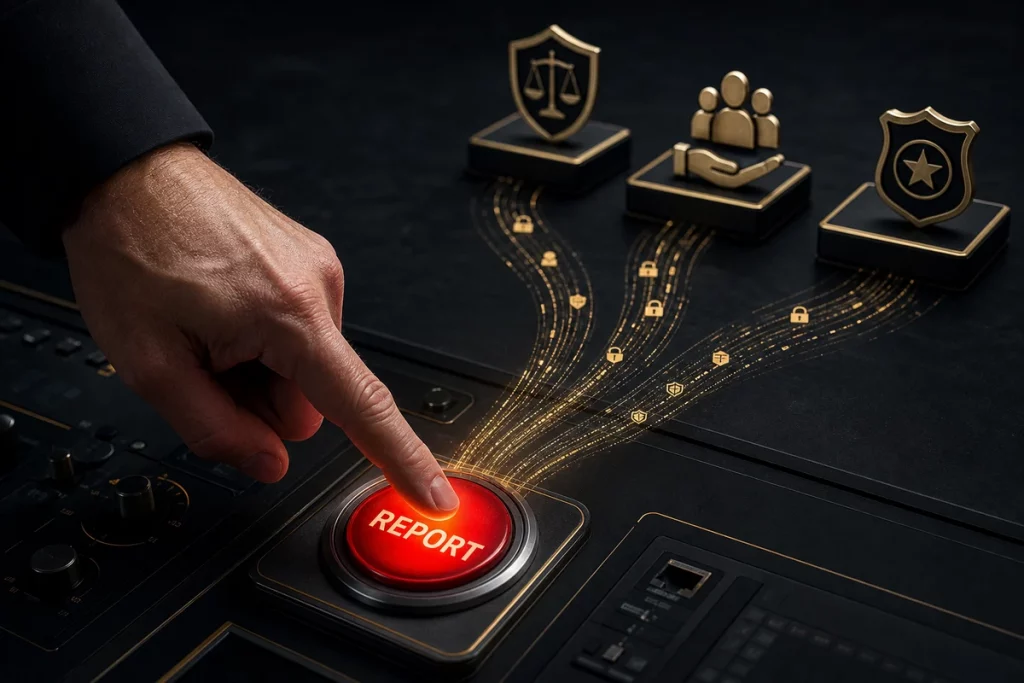
Reporting a scam creates a record that platforms, payment providers, and law-enforcement agencies can use. Whether the incident involved a dating app, phishing message, or investment pitch, this guide explains where to report it, what evidence to preserve, and which recovery steps to attempt without promising a particular outcome.
NavigateTable of Contents28 sections
Why Reporting a Scammer Matters
Learning how to report a scammer isn’t just about your individual case — it’s about dismantling entire fraud networks. Here’s why every report counts:
Law enforcement uses complaint data to identify patterns. The FBI’s Internet Crime Complaint Center collects reports and may share information with appropriate law-enforcement and regulatory partners (IC3). A report does not guarantee an investigation or recovery, but common identifiers can help agencies connect related incidents.
You may recover some or all of your money. Depending on how you paid and how quickly you report, financial recovery is possible. Wire transfers reported within 72 hours have the highest recovery rate. Credit card charges can be disputed. Even cryptocurrency can sometimes be traced and frozen by law enforcement.
You protect future victims. Your report adds the scammer’s phone numbers, email addresses, dating profiles, photos, and bank accounts to law enforcement databases. These databases are shared across agencies and even across countries, making it harder for the scammer to operate. Every report makes the scammer’s world a little smaller.
Reporting helps platform safety. When you report a romance scammer on a dating app, the platform can remove the profile, ban the associated device, and improve their detection algorithms. Your report trains the system to catch the next scammer faster.
Important: There is no shame in being scammed. These are professional criminals who manipulate human psychology for a living. Reporting is an act of courage that helps others. You are not the crime — the scammer is.
Emotional attachment can make reporting feel complicated, especially when you are still asking whether a romance scammer can have genuine feelings. Preserve the evidence and report the conduct regardless of what the scammer claims to feel; affection does not make deception or financial exploitation safe.
What to Gather Before You Report
Before learning how to report a scammer to any agency, compile every piece of evidence you have. Thorough documentation makes your reports more useful and improves the chances of investigation and recovery.
Communication evidence:
Screenshots of all conversations (text messages, dating app chats, emails, WhatsApp messages, social media DMs), including timestamps. Save the entire conversation thread, not just the parts where they asked for money. Earlier messages often contain identifying details the scammer let slip — names, locations, phone numbers, stories about their “life” that can be cross-referenced.
Financial evidence:
Records of every transaction — bank statements, wire transfer confirmations, gift card receipt numbers and photos of the cards, cryptocurrency transaction hashes, Cash App/Venmo/Zelle transaction IDs, and any payment confirmation emails. Calculate your total losses using a tool like the romance scam loss calculator.
Identity evidence:
Every phone number, email address, dating app username, social media profile URL, cryptocurrency wallet address, and bank account number the scammer used. Also save all photos they sent you — these are stolen from real people and can help law enforcement trace the network. Run them through reverse image search and save the results.
Timeline evidence:
Create a written timeline of the relationship: when you first connected, when they first mentioned money, dates and amounts of each payment, and when you realized it was a scam. This narrative helps investigators understand the scammer’s methodology.
| Evidence Type | What to Save | Why It Matters |
|---|---|---|
| Screenshots | All messages with timestamps | Proves the scammer’s tactics and timeline |
| Financial records | Bank statements, receipts, confirmations | Documents total loss and enables recovery attempts |
| Contact details | Phone numbers, emails, usernames, wallet addresses | Helps law enforcement trace and identify the scammer |
| Photos received | Every image they sent, plus reverse search results | Links to stolen identities and other victims |
| Written timeline | Dates of key events in the relationship | Reveals the scammer’s methodology pattern |
Where to Report a Scammer: 8 Agencies
Knowing how to report a scammer means filing with multiple agencies — each serves a different purpose, and casting a wide net maximizes the chance of action. Here’s every agency you should contact when learning how to report a scammer effectively.
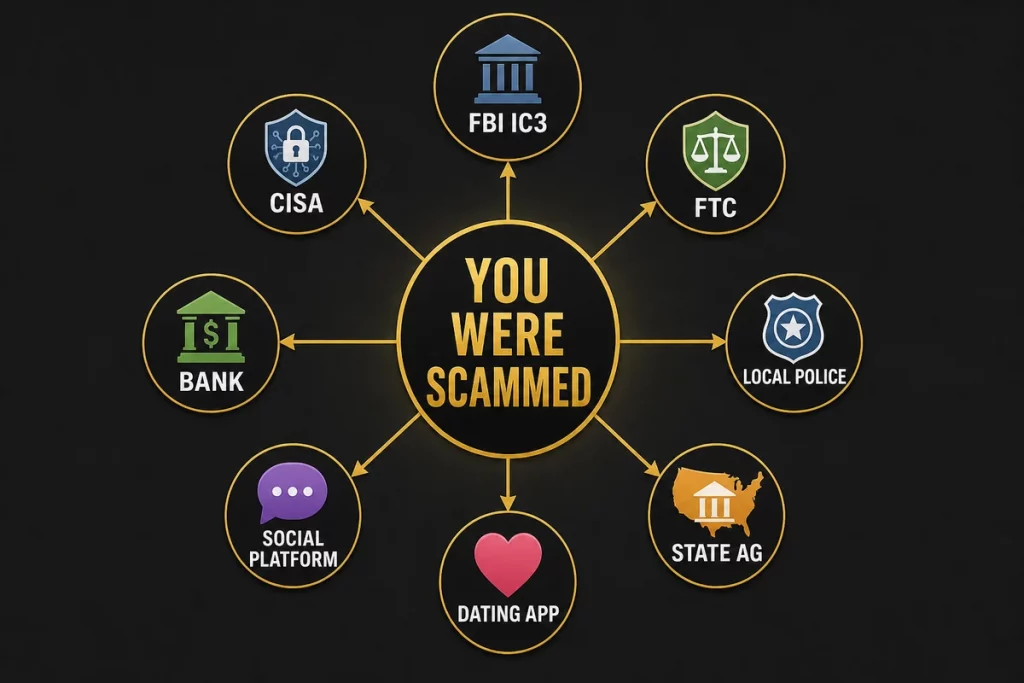
1. FBI Internet Crime Complaint Center (IC3)
Website: ic3.gov
What they handle: All internet-based fraud including romance scams, phishing, investment fraud, business email compromise, and identity theft. IC3 is the #1 place for how to report a scammer online.
Why report here: IC3 is the FBI’s central intake system for internet-crime complaints. Reports may be referred to appropriate law-enforcement or regulatory agencies. For recent financial transactions, provide complete payment details promptly; reporting does not guarantee that funds can be frozen or returned.
How to file: Visit ic3.gov, click “File a Complaint,” and follow the guided form. Include as much detail as possible. You’ll receive a complaint number for tracking.
2. Federal Trade Commission (FTC)
Website: ReportFraud.ftc.gov
What they handle: Consumer fraud, identity theft, deceptive business practices, and scams of all types.
Why report here: FTC reports power the Consumer Sentinel Network, a database used by over 2,800 law enforcement agencies worldwide. While the FTC doesn’t investigate individual cases, their aggregated data drives enforcement actions against major fraud operations. FTC reports also generate the annual fraud statistics that inform public policy.
How to file: Visit ReportFraud.ftc.gov and complete the online form. For identity theft specifically, use IdentityTheft.gov.
3. Your Local Police Department
Why report here: A local police report creates an official record that you may need for insurance claims, bank disputes, credit report corrections, and civil legal proceedings. Some banks require a police report number before processing fraud claims.
How to file: Visit your local police station or call their non-emergency line. Bring all printed evidence. Request the report number and officer’s name. Some departments accept online reports for financial fraud.
4. Your State Attorney General
Website: Search “[your state] attorney general consumer complaint”
Why report here: State AGs have consumer protection divisions that investigate fraud patterns within their jurisdiction. They can also pursue legal action against scammers operating in or targeting residents of their state. Many states have specialized cybercrime units.
5. Internet Crime-Specific Agencies
CISA (Cybersecurity and Infrastructure Security Agency): Report qualifying cyber incidents through CISA’s current reporting channels. Additional law enforcement: For a large or complex financial crime, ask local police, your bank, or IC3 which agency is appropriate rather than relying on a universal dollar threshold. Postal Inspection Service: If the scam involved U.S. mail, report it through the current USPIS reporting channel.
6. Canadian Anti-Fraud Centre (for Canadian victims)
Website: antifraudcentre-centreantifraude.ca
Phone: 1-888-495-8501
Why report here: The CAFC is Canada’s central agency for reporting fraud, identity theft, and cybercrime. They coordinate with the RCMP, local police, and international agencies. Canadian romance scam victims should report here in addition to their local police.
7. The Dating Platform
Why report here: The platform can immediately remove the scammer’s profile, preventing them from targeting new victims. Most major apps have dedicated fraud investigation teams. Report through the app’s built-in reporting feature — see our guide on how to report someone on a dating app for platform-specific instructions for Tinder, Bumble, Hinge, and more.
8. Social Media Platforms
Why report here: If the scammer contacted you on Facebook, Instagram, or other social media, report the profile as “pretending to be someone” or “scam/fraud.” Meta (Facebook/Instagram) has an impersonation reporting form. Twitter/X has a similar process. These reports trigger internal investigations and can lead to network-wide takedowns of related fake accounts.
How to Report a Scammer on Dating Apps
Understanding how to report a scammer on specific dating platforms is critical, because each app has its own process. Here’s a platform-by-platform breakdown:
Tinder: Open the match’s profile → tap the three dots (⋯) → select “Report” → choose “Scam or Spam” → provide details. Tinder’s team reviews reports within 24-48 hours. You can also email Tinder Safety directly through their Help Center.
Bumble: Open the conversation → tap the three dots → select “Report & Block” → choose the reason. Bumble has a dedicated Trust & Safety team that prioritizes scam reports. For romance scam reports specifically, you can email feedback@team.bumble.com with evidence. Learn more about how Bumble handles safety in our Bumble safety review.
Hinge: Open the profile or conversation → tap the three dots → “Report” → select “Other” and describe the scam. Hinge’s moderation team uses both AI and human review. For urgent reports, contact Hinge support directly. Be aware of common Hinge scam patterns.
POF (Plenty of Fish): Visit the profile → click “Report User” → select the appropriate category. POF has been a target-rich environment for scammers due to its large free user base — read our POF safety assessment.
Facebook Dating: Open the profile → tap the shield icon → “Report” → select “Scam or Fake Account.” Facebook Dating reports are reviewed by Meta’s integrity team. See our Facebook Dating safety review for more details.
How to Report Scammers on Social Media
Many scams originate on social media rather than dating apps. Knowing how to report a scammer on these platforms is equally important.
Facebook/Instagram (Meta): Go to the scammer’s profile → tap the three dots (⋯) → “Find support or report” → select “Scam or fraud” or “Pretending to be someone.” Meta also documents how to report a Facebook profile or Page that is impersonating someone. Save screenshots before reporting because you may lose access to the profile afterward.
Twitter/X: Navigate to the profile → tap the three dots → “Report” → “They’re being abusive or harmful” → “Involved in a scam.” Twitter/X has expanded their fraud detection after a surge in crypto romance scams on the platform. You can also report via their help center at help.twitter.com.
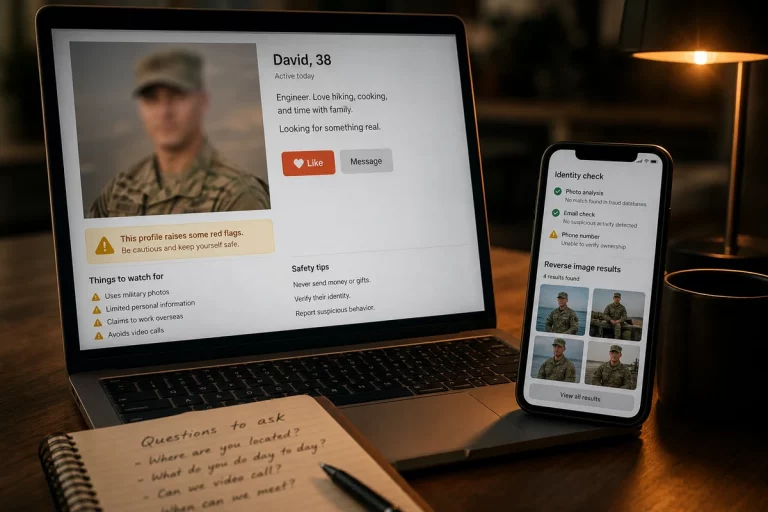
LinkedIn: Military and investment romance scams have migrated to LinkedIn in recent years. Click the “More” button on the profile → “Report/Block” → select “Suspicious, spam, or fake.” LinkedIn’s trust team investigates impersonation reports and removes profiles that violate their terms.
WhatsApp: Open the chat → tap the contact name → scroll to “Report contact.” WhatsApp forwards the last five messages to their moderation team. For romance scam patterns on WhatsApp specifically, see our guide to romance scam signs on WhatsApp.
How to Report Financial Fraud to Your Bank
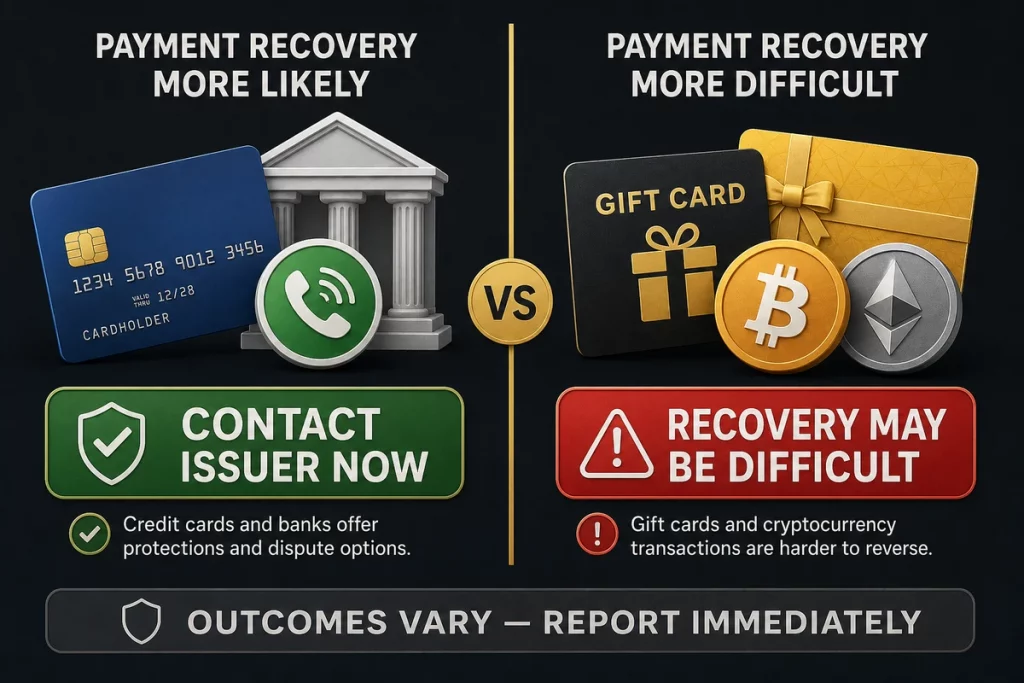
Speed is critical for financial recovery. Contact your bank or payment provider immediately — within hours if possible.
Wire transfers: Call your bank’s fraud department immediately. If the wire was sent within the last 72 hours, your bank can initiate a recall through the receiving bank. For international wires, the window is even shorter. The FBI’s IC3 Financial Fraud Kill Chain can also intervene — this is why filing an IC3 report quickly is essential.
Credit/debit cards: Call the number on the back of your card to dispute the charges. Under federal law (Regulation E for debit, Fair Credit Billing Act for credit), you’re generally protected if you report unauthorized charges within 60 days. Credit cards typically offer stronger protections than debit cards.
Gift cards: Contact the card issuer (Apple, Google, Amazon, etc.) with the card numbers and purchase receipts. While recovery is unlikely once codes are redeemed, reporting helps the issuer flag the scammer’s redemption accounts. The FTC has agreements with major gift card companies to freeze suspicious accounts.
Cryptocurrency: File a report with the exchange platform (Coinbase, Binance, Kraken, etc.) and provide the transaction hash. While crypto recovery is difficult, blockchain analysis firms working with law enforcement have increasingly been able to trace and freeze stolen cryptocurrency. Report to IC3, as they have specialized crypto fraud units.
Payment apps (Cash App, Venmo, Zelle): Report through the app’s fraud/dispute feature. Zelle transactions are particularly difficult to reverse because they’re designed as instant transfers. Cash App and Venmo have dispute processes but recovery isn’t guaranteed. Document everything and escalate through customer service if needed.
Can You Get Your Money Back?
Honest answer: it depends on how you paid and how fast you act.
| Payment Method | Recovery Likelihood | Action Required | Time Window |
|---|
| Bank wire transfer | Medium (if reported fast) | Contact bank + IC3 immediately | 24-72 hours critical |
| Payment apps | Varies by provider and circumstances | Report through the app and bank | Immediately |
| Cryptocurrency | Low but improving | Report to exchange + IC3 | ASAP; blockchain tracing |
| Cash/money order | Almost zero | File police report | N/A |
Beware recovery scams. After filing reports, you may be contacted by companies or individuals claiming they can recover your money for an upfront fee. Treat unsolicited recovery offers as a serious warning sign and verify the provider independently. Government reporting agencies do not charge a filing fee.
Reporting International Scams
Most romance scams and online fraud operations originate outside the victim’s home country. This creates jurisdictional complexity, but there are agencies equipped to handle cross-border cases.
If you’re in the United States targeting an overseas scammer: The FBI’s IC3 coordinates with Interpol and foreign law enforcement through legal mutual assistance treaties. Your IC3 report is the starting point for international cooperation. Additionally, the Department of Justice has international cybercrime liaisons in key regions including West Africa, Southeast Asia, and Eastern Europe — the three primary geographic hubs for romance scam operations.
If you’re in Canada: File with the Canadian Anti-Fraud Centre (CAFC) at 1-888-495-8501. The CAFC coordinates with the RCMP’s National Cybercrime Coordination Unit and shares intelligence with international partners. Canadian victims should also report to their provincial or territorial police. Knowing how to report a scammer in Canada specifically starts with the CAFC.
If you’re in the UK: Report to Action Fraud at actionfraud.police.uk or call 0300 123 2040. Action Fraud is the UK’s national reporting center for fraud and cybercrime, and cases are reviewed by the National Fraud Intelligence Bureau (NFIB).
If you’re in Australia: Report to the Australian Competition and Consumer Commission’s Scamwatch at scamwatch.gov.au and to ReportCyber at cyber.gov.au.
Cross-border coordination is improving. In 2024, Operation Turbo — a joint effort by the FBI, Interpol, and law enforcement from 30+ countries — resulted in the arrest of over 3,500 suspects involved in online romance and investment fraud. International cooperation is no longer theoretical; it produces real arrests and real recoveries. Your report contributes to this global effort regardless of where the scammer is located.
Document the scammer’s digital footprint thoroughly. For international cases, the most useful evidence includes cryptocurrency wallet addresses (which are globally traceable on the blockchain), IP addresses visible in email headers, phone numbers with international country codes, payment platform transaction IDs, and any domain names or website URLs the scammer used. These digital artifacts cross borders more easily than traditional evidence and are increasingly central to international fraud investigations.
What Happens After You File a Report
Setting realistic expectations about the reporting process helps manage frustration:
IC3: You’ll receive a confirmation email with your complaint number. IC3 analysts review complaints, identify patterns, and refer cases to appropriate FBI field offices and law enforcement partners. You may not hear back directly — this doesn’t mean your report was ignored. It means it’s been added to a larger investigation.
FTC: Reports enter the Consumer Sentinel Network and are available to law enforcement nationwide. The FTC does not resolve individual disputes but uses aggregated data to bring enforcement actions against large-scale fraud operations.
Local police: You’ll receive a case number. Follow up periodically. For internet-based crimes, local police often refer cases to federal agencies with more digital investigation capabilities, but your local report remains important for personal legal needs.
Dating platforms: Most platforms will remove reported profiles within 24-72 hours. You typically won’t be notified of the outcome due to privacy policies, but the profile should disappear. If it doesn’t, report again with additional evidence.
Financial institutions: Fraud disputes typically resolve within 10-45 business days for credit cards and up to 90 days for other payment methods. You should receive a provisional credit during the investigation in most cases.
How to Protect Yourself Going Forward
Now that you know how to report a scammer, the next step is making sure you never need to file another report. Once you’ve filed your reports, here’s how to fortify yourself against future scams:
Verify before you trust. Make identity verification a non-negotiable part of your dating process. Ask matches to complete GuyID’s government ID verification — it takes under two minutes and proves they are who they claim to be. A verified Trust Score is worth more than any story.
Use free screening tools. Before investing time in a new match, run their photos through GuyID’s free screening tools. Check for fake profile red flags. Review the dating app red flags checklist. Two minutes of screening prevents two months of heartbreak.
Establish video call as a requirement. Before any relationship progresses beyond initial chatting, insist on a live video call. This single step eliminates the overwhelming majority of romance scams, catfishing attempts, and fake profile schemes.
Never send money to someone you haven’t met in person. This rule has zero exceptions. No emergency is real enough to override this boundary. A person who truly cares about you will never put you in financial jeopardy.
Share the Date Mode link when moving off-app. When transitioning from a dating app to WhatsApp, text, or another platform, share your GuyID Date Mode link. It provides your verified Trust Profile without exposing personal information — and it gives you a clear signal about whether your match values transparency.
Talk to people you trust. Scammers thrive on secrecy. They’ll encourage you to keep the relationship private, often framing it as romantic intimacy. Counter this by sharing new online connections with a trusted friend, family member, or therapist. External perspectives catch red flags that emotions may obscure.
How GuyID Helps
GuyID should appear when it is useful, not as a banner ad. A GuyID Trust Profile gives someone a portable way to share trust signals before a date, while identity verification and social vouching help turn vague profile claims into clearer next steps.
Useful next steps:
- Create a GuyID Trust Profile when you want a cleaner way to share verified trust signals.
- Use GuyID free tools and related guides when you need a checklist before meeting someone.
- Treat identity verification as confidence-building, not a guarantee.
- Use social vouching when you want context from people who already know the person.
- Sign up only when the extra trust layer helps the decision you are already trying to make.
Frequently Asked Questions
Can you report a scammer to the police?
Yes — local police are one of the key agencies in how to report a scammer. File a report with your local police department in addition to federal agencies like the FBI’s IC3 and the FTC. A police report creates an official record you may need for bank disputes, insurance claims, and credit bureau corrections. Some jurisdictions accept online fraud reports, while others require an in-person visit.
What happens when you report a scammer to the FTC?
The FTC stores consumer fraud reports in its Consumer Sentinel system and uses aggregated information to identify patterns and support enforcement work. Filing a report does not guarantee an individual investigation or personal update, but accurate transaction details, contact information, and supporting evidence can help connect related reports.
How long does it take for the FBI to investigate a scam?
FBI investigations can take months or years, depending on the complexity of the fraud network. Individual victims typically don’t receive direct updates. However, for wire transfer fraud reported quickly through IC3, the Financial Fraud Kill Chain can freeze funds within hours. The speed of your initial report directly impacts the potential for recovery.
Should I report a scammer even if I didn’t lose money?
Absolutely. Learning how to report a scammer — and following through even for attempted scams — is just as valuable as reporting successful ones. Your report documents the scammer’s methods, contact information, and fake identity — information that protects their next target. Every report makes the system smarter and the scammer’s operation harder to sustain.
Is there a way to report scammers anonymously?
The FTC’s ReportFraud.ftc.gov accepts reports without requiring personal information. IC3 requires your contact information for follow-up purposes but keeps it confidential. Dating app reports are typically anonymous to the reported user. If you’re concerned about privacy, file with the agencies that allow anonymous reporting first.
What if the scammer threatens me when I try to stop contact?
Threats and intimidation are common tactics scammers use to maintain control, especially if they have compromising photos or personal information. Do not engage with threats. Screenshot everything. Report the threats to local police (this escalates the severity of your case), the FBI’s IC3, and the platform where the threats occur. If you feel in immediate danger, call 911. Scammers making threats are typically operating from overseas and cannot act on them, but document everything regardless.
How do I report a romance scammer on WhatsApp?
Open the chat → tap the contact’s name at the top → scroll down → “Report Contact.” WhatsApp will receive the last five messages for review. You can also email WhatsApp support at support@whatsapp.com with screenshots. Knowing how to report a scammer on WhatsApp is critical because many romance scams migrate to WhatsApp early in the conversation. Additionally, report the phone number to the FTC and IC3, as WhatsApp reports alone may not trigger law enforcement investigation. Read more about romance scam signs on WhatsApp.
Are there organizations that help scam victims?
Yes. AARP’s Fraud Watch Network offers a helpline at 877-908-3360. The Identity Theft Resource Center (idtheftcenter.org) provides free assistance. For emotional support, the Cybercrime Support Network (fightcybercrime.org) connects victims with counseling and recovery resources. Romance scam support groups on Facebook and Reddit also provide peer support from others who understand the experience.