Reader Briefing
Reader Briefing
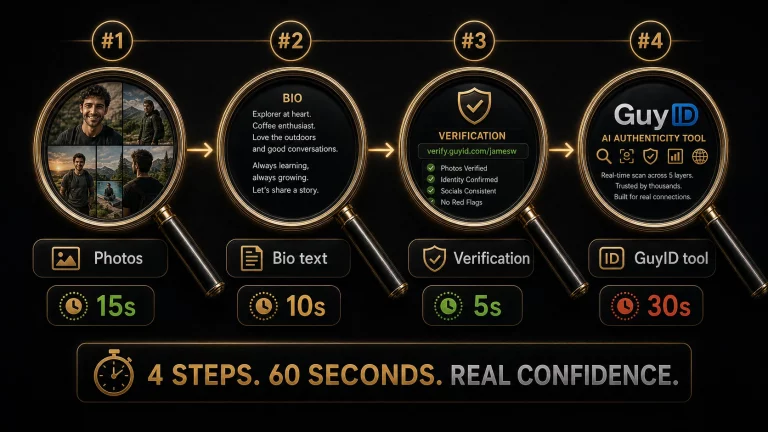
Start here if you need a practical read on two-step verification for dating: why one step isn’t enough: who should use verification, what signals to check, and what to do before moving from online interest to an in-person plan.
Who this is for
- People meeting someone from a dating app or social platform.
- Anyone checking identity, profile consistency, and trust signals.
- People trying to avoid romance scams, fake profiles, or pressure tactics.
- Online daters improving conversations, profiles, or match screening.
You’ll learn
- How to evaluate identity signals without treating any single check as certainty.
- Which trust signals matter and how to weigh them together.
- How to spot inconsistencies, pressure, or behavior patterns that deserve caution.
- How to move from online conversation to a safer first meeting.
- Where GuyID tools fit into a quick pre-date screening workflow.
- How to compare options using practical safety and trust criteria.
Bottom line
Verification reduces uncertainty; it does not guarantee future behavior. Use a layered approach: confirm identity signals, compare profile consistency, ask for a short video call, keep early plans public, and slow down when someone pressures you to skip normal safety steps.
Key takeaways
- Identity verification improves confidence, not certainty.
- Patterns matter more than isolated incidents.
- Verify before meeting privately or sharing sensitive details.
- A short video call can reveal many inconsistencies.
- Pressure to skip reasonable safety steps is useful information.
Free Tools
Catfish Probability Detector
Check whether a dating profile has suspicious identity or photo signals.
Dating Bio Red Flag Detector
Review a bio for scam, pressure, or trust-warning language.
Dating Safety Checklist
Use free GuyID tools before moving from chat to a real date.
Next step
Create your GuyID trust profile
Share consent-based trust signals before a date without turning the conversation into an interrogation.
NavigateTable of Contents19 sections
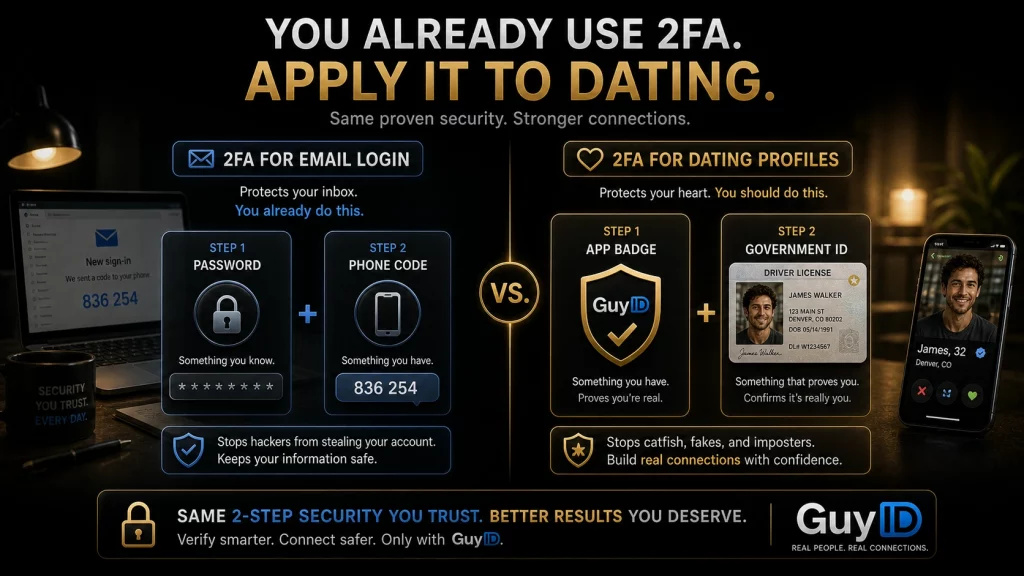
You use two-step verification every day — logging into your email, your bank, your social media. The concept is simple: one verification step (your password) isn’t secure enough, so a second step (a code sent to your phone) confirms it’s really you. The same principle applies to dating — and in a market where deepfakes defeat selfie checks and AI generates convincing fake identities, single-step verification (face matches photos) is the dating equivalent of a password with no second factor. Two-step verification for dating adds the second confirmation layer that transforms “this face looks real” into “this person IS real” — turning a hope-based trust assessment into a fact-based one. This guide explains what two-step dating verification is, why the dating industry needs it, and how you can implement it today through existing tools.
Two-Step Verification: From Tech to Dating
In technology, two-step verification (also called two-factor authentication or 2FA) works by requiring two independent confirmations before granting access. The logic: if a hacker steals your password (Step 1), they still can’t access your account without your phone (Step 2). The two steps are independent — compromising one doesn’t compromise the other. This independence is what makes the system secure.
The Dating Translation
In dating, the same logic applies to identity verification. If a scammer generates a deepfake face that passes a selfie check (Step 1), they still can’t verify their identity without a government document (Step 2). The two steps are independent: defeating the selfie check doesn’t produce a government ID. Producing a stolen government ID doesn’t generate a matching face. Each step is independently difficult to defeat — and defeating both simultaneously is exponentially harder than defeating either alone.
| Concept | In Technology | In Dating |
|---|---|---|
| Step 1 | Something you know (password) | Something you look like (face matches photos — app badge) |
| Step 2 | Something you have (phone receiving a code) | Something you possess (government-issued ID — GuyID verification) |
| What it prevents | Account theft even if password is compromised | Identity fraud even if selfie check is defeated |
| Time to implement | ~2 minutes (enable in settings) | ~25 minutes (app badge + GuyID Trust Profile) |
| Why most people don’t yet | “Too much hassle” (until their account is hacked) | “Not available” (until they discover GuyID) |
Inline visual 2
Why One Step Isn’t Enough in Dating
Every major dating app provides exactly one verification step: face matches photos. Here’s why this single step has become insufficient.
The Single Step Has Been Defeated
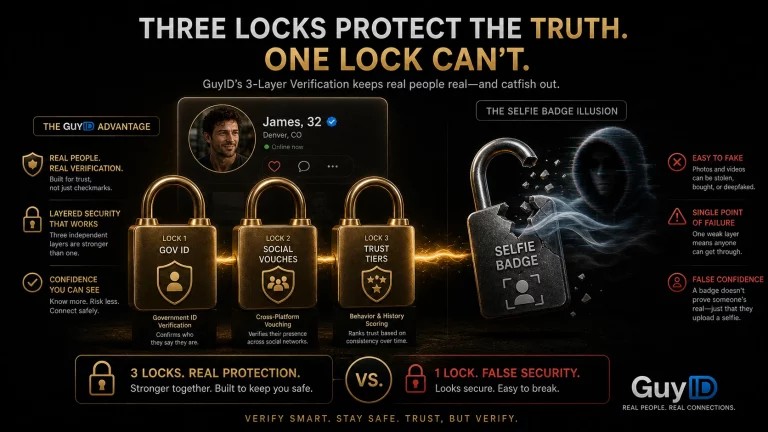
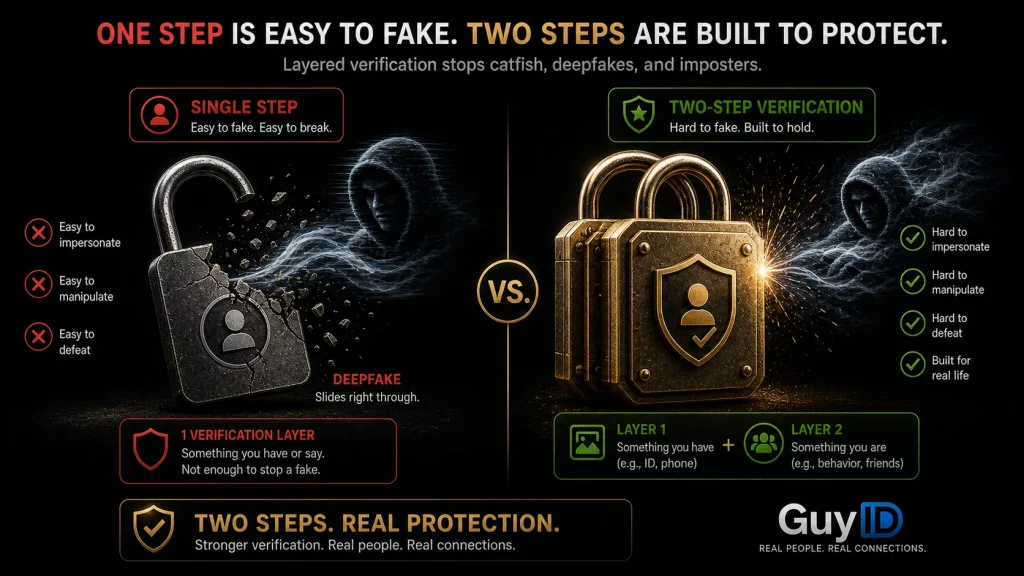
Deepfake technology can overlay synthetic faces during selfie verification — passing the facial matching check with a face that belongs to no real person. AI-generated photos create consistent profile images of fictional people that pass visual inspection. When the single step can be defeated by readily available technology, the verification effectively confirms nothing — it provides a badge that communicates “verified” while the underlying identity remains unconfirmed.
The Analogy
Using single-step verification for dating in 2026 is like using a password without 2FA in 2026. It was adequate when the threats were simpler. It’s not adequate when the attack tools have advanced. The response isn’t to abandon verification — it’s to add the second step that restores security to the level the threats demand.
What the Second Step Catches
- Deepfakes that pass selfie checks: A deepfaked face passes Step 1 (facial match). It cannot produce a government ID at Step 2 — because the fake person doesn’t have one.
- AI-generated identities: An AI creates a convincing profile with photos and bio (passing Step 1). It cannot produce a government document (Step 2) — because no government has issued identity documents for a fictional person.
- Stolen identity using real photos: Someone uses another person’s photos (might pass Step 1 with the stolen person’s face). The government ID check at Step 2 requires the ACTUAL document matching the verified face — which the thief doesn’t possess.
Each threat type defeats Step 1 alone. None defeats Steps 1 AND 2 together. That’s the power of two-step: the threats that bypass one step are caught by the other.
The Two Steps Applied to Dating
Step 1: Facial Verification (What Dating Apps Provide)
The selfie-matching check available on Tinder, Bumble, Hinge, and OkCupid. The user takes a selfie following prompts (pose, gesture, or video). AI compares the selfie to profile photos. If faces match: badge granted. This step confirms facial consistency — the person who completed the check has the same face as the profile. It doesn’t confirm legal name, real age, relationship status, character, or anything beyond facial similarity.
Step 2: Government ID Verification (What GuyID Provides)
GuyID’s identity verification requires biometric matching against a government-issued document — passport, driver’s license, or national ID. This step confirms legal identity through the same standard used in banking, air travel, and financial services. The document is a physical object with institutional backing, security features, and biometric data linked to government databases. This step catches everything Step 1 misses: the legal identity behind the face, confirmed by the most authoritative identity system available (government documentation).
Together: Two-Step Dating Verification
Step 1 confirms: “This face matches these photos.” Step 2 confirms: “This face belongs to a legally identified person confirmed by government documents.” Together: “This is a real person whose legal identity is confirmed” — a fundamentally stronger trust statement than either step alone provides. The combination is visible on your dating profile through two indicators: your app’s verification badge (Step 1) + your GuyID Date Mode link (Step 2). Matches see both. Both are checkable. Together they communicate the two-step trust that single badges can’t.
Inline visual 1
How to Implement Two-Step Dating Verification Today
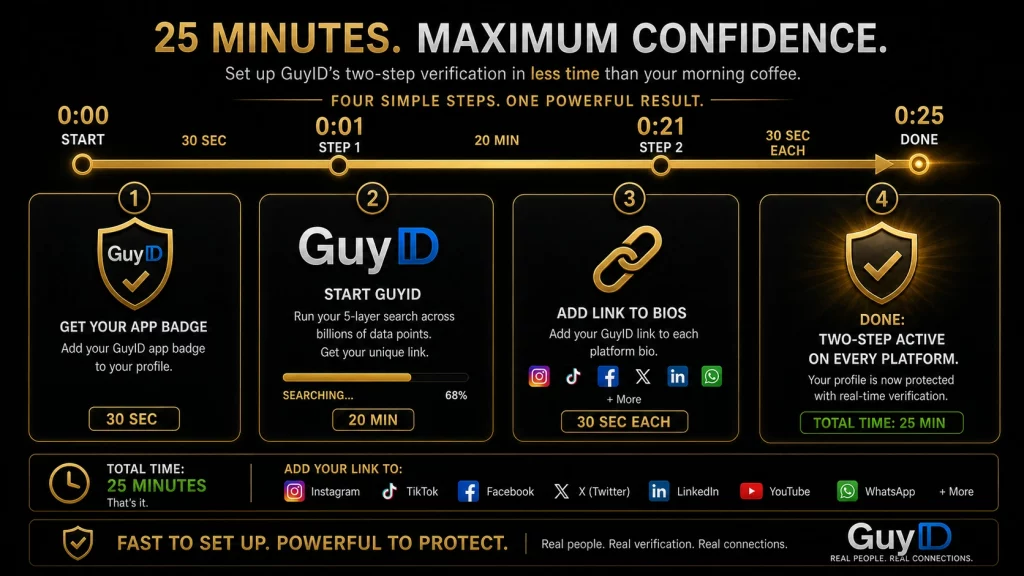
You don’t need to wait for dating apps to upgrade their verification. Two-step verification for dating is implementable today — in under 25 minutes total.
Step 1: Get Your App Badge (30 seconds per app)
☐ Tinder: Profile → Verification → follow selfie prompts → badge granted
☐ Bumble: Profile → Verification → gesture selfie → badge granted
☐ Hinge: Profile → Verification → video selfie → badge granted
☐ OkCupid: Profile → Verification → photo selfie → badge granted
Do this on every app you use. 30 seconds each. Free. No reason not to.
Step 2: Build Your GuyID Trust Profile (20 minutes)
☐ Visit guyid.com and create your account
☐ Complete government ID verification — biometric matching against your official document
☐ Send vouch requests to friends and colleagues (optional for Step 2, adds Steps 3-4)
☐ Copy your Date Mode link
~20 minutes for government ID verification. Vouch responses arrive over hours/days.
Connect Both Steps in Your Bio (30 seconds per app)
☐ Add your Date Mode link to your dating bio on every app
☐ Now your profile shows: app badge (Step 1 visible) + GuyID link (Step 2 checkable)
☐ Every match sees two-step verification without you saying a word
The two steps are now active. Every future match interaction benefits.
**Total time: under 25 minutes.
Two-Step vs Multi-Factor: Understanding the Full Spectrum
Two-step verification is the minimum upgrade from the dating industry’s current single-step system. For maximum security, multi-factor verification adds additional independent factors beyond two.
| Level | Steps | What’s Confirmed | Security |
|---|---|---|---|
| Single-step (current dating industry) | Facial match only | Face matches photos | Weak — deepfake-defeatable |
| Two-step (minimum upgrade) | Facial match + government ID | Face confirmed + legal identity confirmed | Strong — AI-proof |
| Three-factor (recommended) | Face + gov ID + social vouches | Face + identity + character confirmed | Very strong |
| Four-factor (maximum) | Face + gov ID + vouches + Trust Tiers | Face + identity + character + consistency confirmed | Maximum |
Two-step verification is the floor — the minimum meaningful upgrade from the current single-step system. GuyID’s Trust Profile naturally supports all four factors: government ID (identity), social vouches (character), and progressive Trust Tiers (consistency) — building beyond two-step into full multi-factor verification through the same platform. Start with two steps. The system naturally supports growth to three and four.
What Two-Step Verification Looks Like for Each Party
For the Person Building Their Two-Step Profile
Your profile now shows two verification layers: the app’s native badge and your GuyID Date Mode link. Every match who views your profile sees both. The badge says “face confirmed.” The link says “identity confirmed — click to verify.” Together, you’re sending the two-step trust signal that virtually no other profile in their swipe stack provides. This is the verified advantage that competitive profiles need.
For the Person Checking a Two-Step Profile
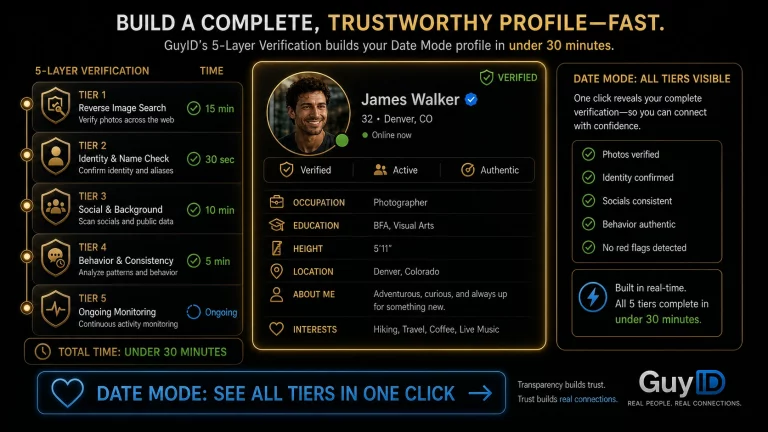
You see a badge (Step 1 — face matches, table stakes). You see a GuyID link (Step 2 — click it). In 10 seconds: government ID verified ✅, Trust Tier visible, social vouches (if present). The safety questions that would otherwise require weeks of conversation — “Is this person real?” “Is their name actually their name?” — are answered before the first message. The two-step verification your match invested 25 minutes building is available to you in 10 seconds at zero cost.
For the Conversation and Beyond
At the WhatsApp transition — when platform safety disappears — the two-step verification persists. “Here’s my number — and here’s my verified identity: [GuyID link].” The app badge is platform-locked (vanishes off-app). The GuyID link is portable (works everywhere). Two-step verification through badge + GuyID covers both the on-platform and off-platform phases of the dating journey.
Summary: Add the Second Step
Two-step verification for dating applies the same security principle that protects your email, bank account, and social media — to the domain where it matters most: meeting strangers from the internet. Step 1 (facial match through app badge) confirms a face. Step 2 (government ID through GuyID) confirms a legal identity. Together: the two independent confirmation layers that are exponentially harder to defeat than either alone.
The implementation takes under 25 minutes: app badges (30 seconds each) + GuyID Trust Profile (20 minutes) + Date Mode link added to bios (30 seconds each). The result: a two-step verified profile on every platform, with portable trust that follows you to WhatsApp and beyond.
You wouldn’t use your bank account without two-step. You wouldn’t log into your email without two-step. The person evaluating whether to meet you in person — potentially at your home, potentially alone — deserves the same security standard. Add the second step. It takes 25 minutes. It provides the trust confirmation that protects both of you. And it’s available today.
Frequently Asked Questions
What is two-step verification for dating?
Why isn’t a dating app badge enough?
How long does it take to set up two-step dating verification?
What’s the difference between two-step and multi-factor verification?
Can someone fake both steps?
Does two-step verification work on all dating apps?
How do I check if someone I’m talking to has two-step verification?
Evidence note
NIST Digital Identity Guidelines distinguish identity proofing, authentication, and federation as separate parts of digital identity risk management (NIST, 2025).