Reader Briefing
Reader Briefing
Start here if you need a practical read on how to get more matches on dating apps: fix the funnel: who should use verification, what signals to check, and what to do before moving from online interest to an in-person plan.
Who this is for
- People meeting someone from a dating app or social platform.
- Readers preparing for a first in-person date.
- Anyone checking identity, profile consistency, and trust signals.
- Online daters improving conversations, profiles, or match screening.
You’ll learn
- How to evaluate identity signals without treating any single check as certainty.
- Which trust signals matter and how to weigh them together.
- How to move from online conversation to a safer first meeting.
- Where GuyID tools fit into a quick pre-date screening workflow.
- When to slow down, ask for more context, or walk away.
- How to turn the article’s advice into a concrete next step.
Bottom line
Verification reduces uncertainty; it does not guarantee future behavior. Use a layered approach: confirm identity signals, compare profile consistency, ask for a short video call, keep early plans public, and slow down when someone pressures you to skip normal safety steps.
Key takeaways
- Identity verification improves confidence, not certainty.
- Verify before meeting privately or sharing sensitive details.
- A short video call can reveal many inconsistencies.
- Pressure to skip reasonable safety steps is useful information.
- Use GuyID tools to turn vague concerns into specific checks.
Free Tools
Catfish Probability Detector
Check whether a dating profile has suspicious identity or photo signals.
Dating Bio Red Flag Detector
Review a bio for scam, pressure, or trust-warning language.
Dating Safety Checklist
Use free GuyID tools before moving from chat to a real date.
Next step
Create your GuyID trust profile
Share consent-based trust signals before a date without turning the conversation into an interrogation.
NavigateTable of Contents25 sections
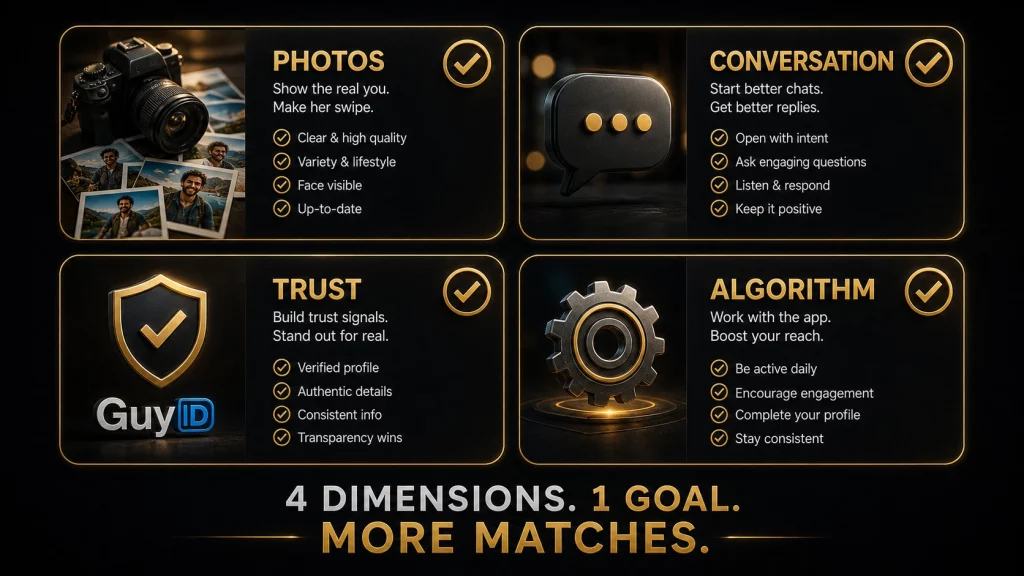
More matches isn’t the goal. Better matches — people who are genuinely interested in you, who read your profile before swiping, who send thoughtful first messages, and who actually show up for dates — that’s the goal. But getting there requires understanding what drives match rates in the first place: the algorithm mechanics, the profile elements that earn swipes, the trust signals that convert swipes into conversations, and the verification layer that converts conversations into actual meetings. This guide is the complete playbook for how to get more matches on dating apps — synthesizing photo strategy, bio optimization, algorithmic behavior, verification advantage, and the counterintuitive truth that optimizing for fewer but better matches produces better outcomes than chasing volume.
Whether you’re getting zero matches and need a complete overhaul, getting matches that never turn into conversations, or getting conversations that never become dates — this guide identifies where your funnel is breaking and provides the specific fix for each stage.
The Dating App Funnel: Where Your Matches Are Dying
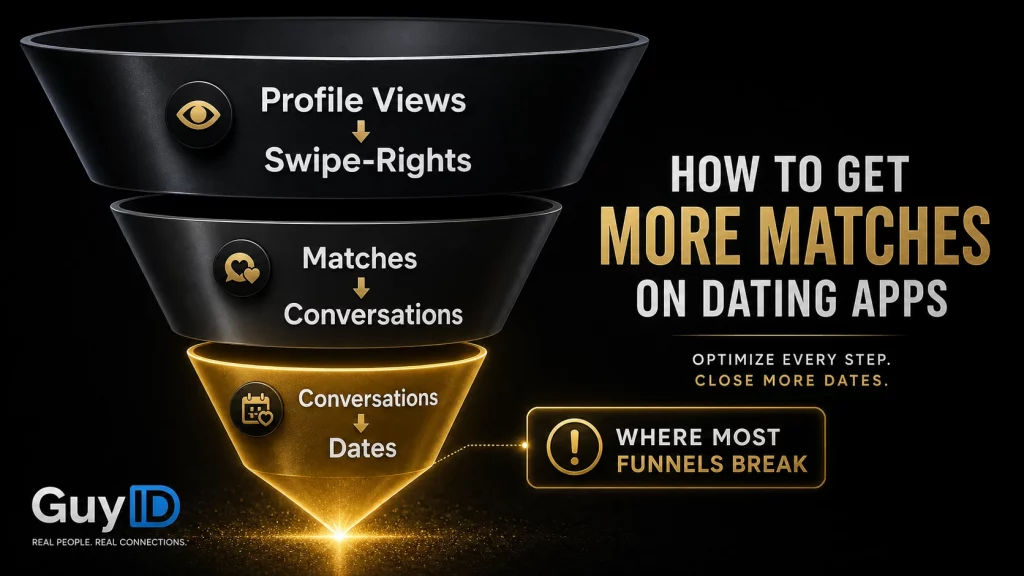
Before optimizing for more matches on dating apps, diagnose where your current funnel is breaking. The funnel has three stages — and the fix is different for each.
| Stage | The Conversion | What Drives It | Symptom When It’s Broken |
|---|---|---|---|
| Stage 1 | Profile views → swipe-rights | Photo quality, bio hook, first impression | Very few matches. Feels like nobody sees your profile. |
| Stage 2 | Matches → conversations | Conversation hooks, messaging quality, engagement timing | Matches but no messages. Or messages that go nowhere. |
| Stage 3 | Conversations → dates | Trust, verification, off-app transition, meeting confidence | Good conversations that never become real-life meetings. |
Most “get more matches” advice focuses exclusively on Stage 1 — better photos, better bio. That’s necessary but incomplete. If your Stage 1 is fine (you’re getting matches) but Stage 2 is broken (no conversations), photo optimization won’t help. If Stages 1 and 2 are fine (matches + conversations) but Stage 3 is broken (no dates), you need trust conversion — not a better bio. Diagnose first, then fix the right stage.
Inline visual 1
Stage 1 Fix: Getting More Swipe-Rights
If your match rate is near zero — very few matches despite active swiping — the issue is profile quality. Here’s the Stage 1 fix, distilled from the complete guides (bio, photos, examples).
-
Photo #1 overhaul: Clear solo face, natural lighting, genuine expression, no sunglasses. If only one thing changes, this is it. Have a friend take 30-50 shots during golden hour, choose the best 2-3.
-
6-photo framework: Hero (face) → Activity (personality) → Social (friends) → Dressed-up (range) → Interest (depth) → Wild card (memorability). Each serves a purpose. See the complete photo strategy.
-
Eliminate the killers: No group-only leads. No sunglasses in every shot. No photos from 3+ years ago. No bathroom mirrors. No all-same-setting monotony.
-
Three-line formula: Hook (specific first line visible in preview) → Substance (1-2 details with conversation hooks) → Trust signal (GuyID link or CTA). See templates.
-
Specificity upgrade: Replace every generic statement with a specific one using interest amplifiers. “Love cooking” → “Currently on attempt #5 of homemade croissants — apartment smells incredible, results questionable.”
-
Kill the negatives: Remove “no drama,” “don’t bother if,” “tired of games.” State what you want positively.
The Verification Fix (Stage 1 boost + Stage 3 foundation)
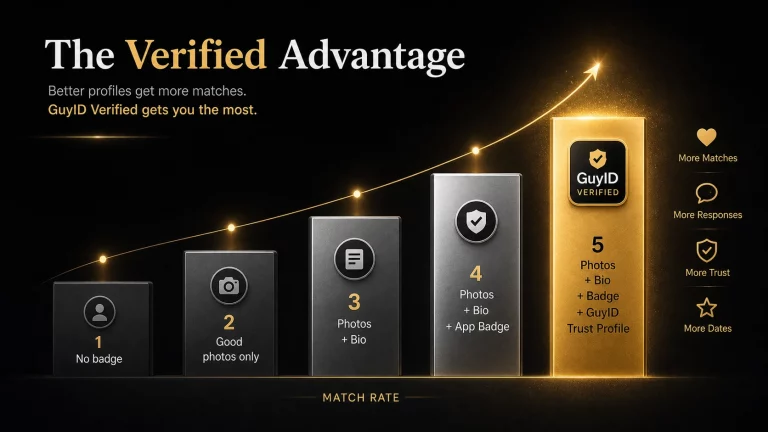
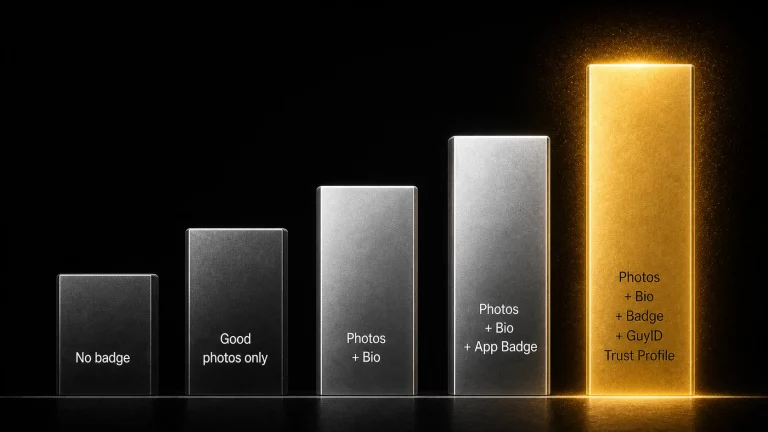
- App badge: Complete native verification on every app (30 sec each). It’s free. Do it now.
- GuyID Trust Profile: Build in 20 minutes. Add Date Mode link to bio. The verified advantage improves Stage 1 (verified profiles get more swipe-rights) AND Stage 3 (verified profiles convert conversations to dates).
Stage 2 Fix: Getting Matches to Actually Message
If you’re getting matches but conversations don’t start — or start and die immediately — the issue is conversation infrastructure and messaging quality.
Build Conversation Hooks Into Your Profile
Every element of your profile should be messageable. Apply the conversation hook test: “Could a stranger send me a specific message about this?” If yes, keep it. If the only possible response is “cool” — replace it. A profile full of conversation hooks gives every match multiple entry points for a first message. A profile without hooks forces the match to generate a conversation topic from nothing — which most people won’t do.
Message First (Especially on Apps Where You Can)
On Tinder, Hinge, and OkCupid, you can message first. Do it. Reference something specific from their profile — a prompt answer, a photo detail, a bio line. “Your ramen ranking spreadsheet — what’s #1 currently?” beats “Hey, how’s your day?” by an order of magnitude. On Bumble, women message first — but your profile must give them something specific to reference.
Response Timing
Respond within a few hours during active hours — not instantly (signals desperation) and not days later (signals disinterest). The window between “engaged” and “eager” is a few hours. Consistent response timing over days builds the conversational rhythm that sustains engagement.
The Dual-Purpose Question Strategy
Ask questions that assess chemistry AND screen for authenticity simultaneously. “What does a typical weekday look like?” reveals lifestyle compatibility AND tests specificity (a real person has a specific answer). “Tell me about your friend group” reveals social style AND tests whether they have real social connections. Every question earns its place by serving both purposes.
Stage 3 Fix: Getting Conversations to Become Actual Dates
This is where most match optimization guides stop — and where most dating experience actually breaks down. You’ve matched. You’ve conversed. She seems interested. But the date never happens.
The Trust Bottleneck
A great conversation reduces but doesn’t eliminate these concerns. The gap between “I enjoy talking to this person” and “I feel safe meeting this person in real life” is the trust gap — and it’s where most promising connections stall. She’s interested but cautious. She likes the conversation but isn’t sure about the person behind it. The stall isn’t rejection. It’s unresolved trust.
How Verification Fixes Stage 3
A GuyID Trust Profile in your bio — or shared during the WhatsApp transition — resolves the trust gap that stalls Stage 3. The match clicks your Date Mode link. In 10 seconds she sees: government ID verified (he’s real), social vouches present (real people confirm his character), Trust Tier visible (sustained trustworthiness). The safety questions that would otherwise take weeks of conversation to resolve are answered before she’s decided about the date. The stall dissolves. The date happens.
The Video Call Bridge
Before the date itself, a video call further bridges Stage 3: “Want to do a quick video call before we meet? Just want to make sure we vibe as well in person.” This normalizes the safety step, provides visual identity confirmation, and — if you’ve already shared your GuyID link — creates a multi-layered trust stack: verified identity (GuyID) + confirmed face (video) + conversational chemistry (ongoing chat). The date becomes the natural next step rather than a trust leap.
Proposing the Date Confidently
After trust is established: propose a specific date. Not “We should meet sometime.” Instead: “There’s a great coffee place on [street] — want to grab a coffee Saturday afternoon, maybe 2pm?” Specific proposal = easy to say yes to. Vague suggestion = easy to defer indefinitely. Specificity in date proposals mirrors the specificity that makes bios work — it demonstrates initiative and reduces the decision load for the other person.
Algorithm Mechanics: What Dating Apps Reward and Punish
Dating app algorithms determine who sees your profile and how often. Understanding what they reward changes how you use the app — and directly impacts how many matches you get.
What Algorithms Reward
The app shows your profile to more people because your selectivity suggests your matches will be genuine — which improves the platform’s overall match quality metrics.
- Complete profiles: Filled bio, all photo slots used, verification badge present. Complete profiles are promoted over incomplete ones — they provide better user experience for the people who see them.
- Regular activity: Using the app 1-2 times daily for 10-15 minutes each keeps your profile active in stacks. Recently active profiles are shown more prominently than dormant ones.
- Response to matches: Replying to matches promptly signals active engagement. Letting matches sit unresponded signals inactive use — which may deprioritize your profile in the stack.
- Profile updates: Refreshing photos or bio signals continued investment. Some apps boost recently updated profiles for a brief period — making regular refreshes a free visibility boost.
What Algorithms Punish
Algorithms deprioritize mass-swipers — showing their profile less frequently and to lower-priority stacks.
- Inactive periods: Not opening the app for days → profile deprioritized → fewer views → fewer matches → less reason to open the app → cycle deepens. Regular brief sessions prevent this spiral.
- Incomplete profiles: Missing photos, no bio, no verification → lower placement. The algorithm has less content to match and less reason to promote an incomplete profile over a complete one.
- Being reported: Reports for inappropriate behavior, spam, or policy violations directly reduce profile visibility and can result in shadow-banning (your profile shown to almost nobody without notification).
The Counterintuitive Truth: Quality Over Volume
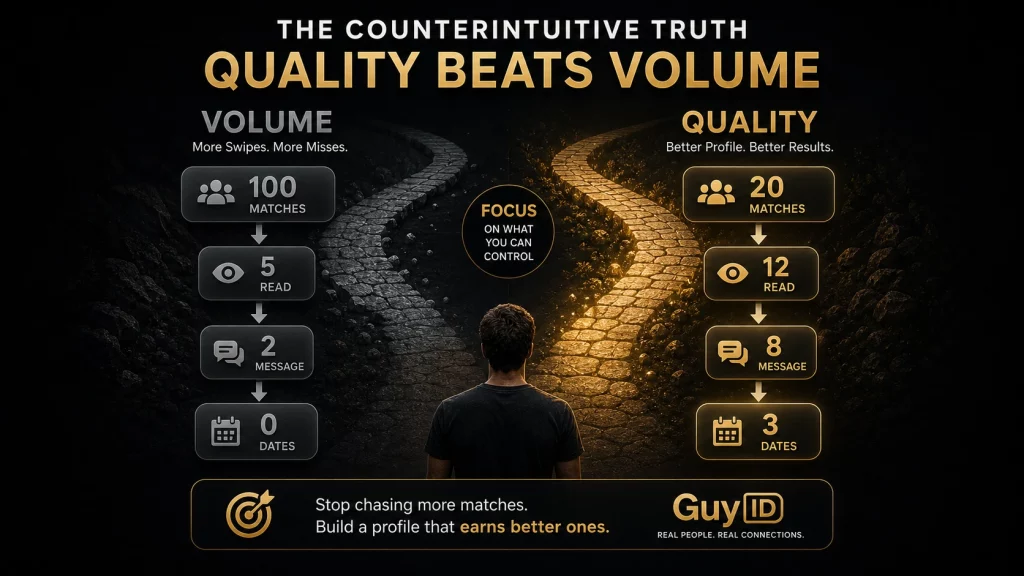
The most effective way to get more matches on dating apps is to stop optimizing for more matches — and start optimizing for better ones.
Why Volume Fails
100 matches from mass-swiping → 5 who read your profile → 2 who message → 0.5 who agree to a date → an experience that feels like dating apps don’t work. The high-volume approach generates numbers that feel productive but produce minimal real-world results — because the matches were never quality-filtered by a good profile.
Why Quality Wins
20 matches from a specific, personality-rich, verified profile → 12 who read your profile before swiping → 8 who have something to message about → 4 who feel safe engaging → 2-3 actual dates with people genuinely interested in who you are. The quality approach generates fewer numbers but dramatically better outcomes — because every match is someone who chose you specifically, not someone who swiped right on everything.
The Quality Stack
- Specific profile → attracts specific people (the personality filter)
- Conversation hooks → generates quality messages (the engagement filter)
- Verification → converts cautious matches (the trust filter)
- Selective swiping → signals quality to algorithms (the algorithmic filter)
Each filter reduces volume and increases quality. The end result: fewer matches, more dates, better experiences. The quality stack works because it aligns what algorithms reward (selectivity), what viewers want (specific, trustworthy profiles), and what produces real outcomes (dates with people who are genuinely interested).
The Complete Match Optimization Checklist
📸 Stage 1: Profile (Earns Swipe-Rights)
☐ Photo #1: clear solo face, natural light, genuine expression, no sunglasses
☐ 6 photos following the framework: hero → activity → social → dressed-up → interest → wild card
☐ Bio hook: specific first line visible in preview
☐ Bio substance: 1-2 specific details with conversation hooks
☐ Bio closer: GuyID Date Mode link or CTA
☐ App verification badge completed (30 sec, free)
☐ No generic statements, no negativity, no empty bio
💬 Stage 2: Conversation (Turns Matches Into Engagement)
☐ Message first on platforms that allow it — reference their profile specifically
☐ Every profile element passes the conversation hook test
☐ Ask dual-purpose questions (chemistry + screening)
☐ Respond within a few hours during active hours
☐ Move conversations forward — don’t let them stagnate in small talk
🤝 Stage 3: Trust (Converts Conversations to Dates)
☐ GuyID Trust Profile built: gov ID + vouches + Trust Tier
☐ Date Mode link shared at WhatsApp transition
☐ Video call proposed before meeting
☐ Date proposed specifically: place, day, time
☐ First date safety plan (public venue — demonstrates you respect her safety)
⚙️ Algorithm Optimization
☐ Regular activity: 1-2 sessions daily, 10-15 min each
☐ Profile completeness: all slots filled, bio written, verification present
☐ Prompt responses to matches
☐ Profile refresh every 2-3 months (swap 1-2 photos, update bio details)
Inline visual 2
Summary: Fix the Funnel, Not the Face
How to get more matches on dating apps isn’t about being more attractive. It’s about fixing the specific stage of the dating funnel that’s broken: profile quality for more swipe-rights (Stage 1), conversation hooks for more engagement (Stage 2), and trust conversion for more actual dates (Stage 3). Most people only optimize Stage 1 — and wonder why matches don’t become dates.
The complete optimization: specific photos that show personality (not just appearance), a bio that gives readers something to message about (not just something to read), verification that resolves trust before conversation starts (GuyID Trust Profile — 20 minutes), algorithmic behavior that signals quality (selective swiping, regular activity, complete profile), and the quality-over-volume mindset that produces fewer matches but dramatically better outcomes.
The checklist above covers every element. The implementation time for a complete overhaul: 30-60 minutes including Trust Profile build. The result: a profile that performs at every stage of the funnel — earning attention through optimization and converting attention through trust. Fix the funnel. The dates follow.
Frequently Asked Questions
Why am I not getting matches on dating apps?
I get matches but no one messages — what’s wrong?
I have good conversations but they never become dates — why?
What’s the fastest way to improve my dating app results?
Should I focus on more matches or better matches?
Evidence note
Pew Research Center found that 48% of Americans considered online dating at least somewhat safe while 49% considered it not too safe or not at all safe (Pew Research Center, 2023).