

Reader Briefing
Reader Briefing
Start here if you need a practical read on what is nsa in dating? no strings attached explained: who should use verification, what signals to check, and what to do before moving from online interest to an in-person plan.
Who this is for
- People meeting someone from a dating app or social platform.
- Readers preparing for a first in-person date.
- Anyone checking identity, profile consistency, and trust signals.
- People trying to avoid romance scams, fake profiles, or pressure tactics.
You’ll learn
- How to evaluate identity signals without treating any single check as certainty.
- Which trust signals matter and how to weigh them together.
- How to spot inconsistencies, pressure, or behavior patterns that deserve caution.
- How to move from online conversation to a safer first meeting.
- Where GuyID tools fit into a quick pre-date screening workflow.
- How to compare options using practical safety and trust criteria.
Bottom line
Verification reduces uncertainty; it does not guarantee future behavior. Use a layered approach: confirm identity signals, compare profile consistency, ask for a short video call, keep early plans public, and slow down when someone pressures you to skip normal safety steps.
Key takeaways
- Identity verification improves confidence, not certainty.
- Patterns matter more than isolated incidents.
- Verify before meeting privately or sharing sensitive details.
- A short video call can reveal many inconsistencies.
- Pressure to skip reasonable safety steps is useful information.
Free Tools
Catfish Probability Detector
Check whether a dating profile has suspicious identity or photo signals.
Dating Bio Red Flag Detector
Review a bio for scam, pressure, or trust-warning language.
Dating Safety Checklist
Use free GuyID tools before moving from chat to a real date.
Next step
Create your GuyID trust profile
Share consent-based trust signals before a date without turning the conversation into an interrogation.
You see “NSA” on a dating profile and you’re not sure if they’re referencing the National Security Agency or something entirely different. In the dating world, what is NSA in dating means “No Strings Attached” — a relationship arrangement where two people engage physically or socially without the expectations, obligations, or commitments that traditional relationships carry. Understanding what is NSA in dating goes beyond the acronym: it means understanding the psychology of casual arrangements, the ethical requirements for making them work, the risks they carry, and the honest self-assessment required to determine whether NSA is genuinely what you want or a compromise you’re accepting because it’s what’s available.
NavigateTable of Contents13 sections
What Is NSA in Dating? The Complete Definition
What is NSA in dating? NSA stands for “No Strings Attached” — a relationship dynamic where both people agree that the connection carries no obligations beyond the interaction itself. No exclusivity requirements, no progression expectations (moving in, meeting family, building a future), no emotional debt, and no assumption that the arrangement will evolve into something more traditional. The “strings” that are explicitly absent are the commitments, expectations, and obligations that define conventional romantic relationships.
The term appears frequently on dating apps, in profile bios, and in early conversations as a shorthand for communicating intentions: “I’m not looking for a relationship — I’m looking for connection without commitment.” According to the American Psychological Association’s research on non-traditional relationship structures, NSA arrangements have become increasingly common since the rise of dating apps, which facilitate the matching of people with aligned casual intentions more efficiently than traditional social contexts ever could.
Understanding what is NSA in dating requires separating the concept from its cultural stereotypes. NSA isn’t inherently unhealthy, exploitative, or emotionally shallow — when both people genuinely want the arrangement, communicate honestly, and maintain the boundaries they’ve agreed upon, NSA can be a legitimate relationship choice that serves specific life stages, circumstances, and preferences. The problems arise when NSA is used dishonestly (one person says NSA while secretly hoping for more), coercively (one person pressures the other into accepting NSA because it’s “all they’re offering”), or as avoidance (using NSA to dodge the vulnerability that genuine connection requires).
How NSA Arrangements Actually Work
Functional NSA arrangements — the ones that don’t produce the emotional wreckage that gives casual dating its bad reputation — operate on explicit agreements rather than assumptions:
Clear communication about what NSA means FOR BOTH PEOPLE. “No strings” means different things to different people: for some, it means physical connection with zero emotional engagement; for others, it means genuine friendship with physical benefits but no progression toward partnership; for others, it means dating without exclusivity while remaining open to multiple connections simultaneously. What is NSA in dating for YOU specifically? And does your definition match your partner’s? The conversation that aligns these definitions — awkward as it may be — is the foundation that prevents the misunderstandings that make NSA arrangements painful.
Agreed-upon boundaries. Functional NSA arrangements establish boundaries explicitly: frequency of contact (are we texting between meetups or only coordinating logistics?), exclusivity expectations (are we both seeing other people, and do we disclose this?), emotional boundaries (how much personal sharing is appropriate?), and public presentation (are we seen together socially, or is this private?). Research from the National Library of Medicine on casual relationship satisfaction confirms that arrangements with explicitly discussed boundaries produce higher satisfaction and lower distress than those where boundaries are assumed rather than stated. Our boundary-setting guide provides the communication framework that applies to every relationship type — including NSA.
Regular check-ins about whether the arrangement still works. Feelings change. What felt right at month one may feel insufficient at month four. A person who genuinely wanted NSA initially may develop feelings that make the arrangement painful. Regular honest conversations — “Is this still working for both of us?” — prevent the slow accumulation of misalignment that produces the hurt feelings, resentment, and betrayal sensations that badly managed NSA arrangements are known for. Schedule these check-ins deliberately rather than waiting for a crisis to force them — monthly is a reasonable cadence for any ongoing NSA arrangement, and the conversation itself builds the communication muscle that every relationship type benefits from.
An agreed exit protocol. How does the arrangement end? Can either person end it at any time without owing an explanation? Is there a conversation requirement, or is simply stopping contact acceptable? What is NSA in dating contexts if there’s no agreement about how it ends? It’s a recipe for ghosting — which produces the same pain in NSA contexts that it produces in committed ones, because the attachment system doesn’t check relationship labels before activating. Agreeing in advance that either person can end the arrangement with a simple, honest conversation (“this isn’t working for me anymore”) prevents the ambiguous disappearances that make NSA endings unnecessarily painful.
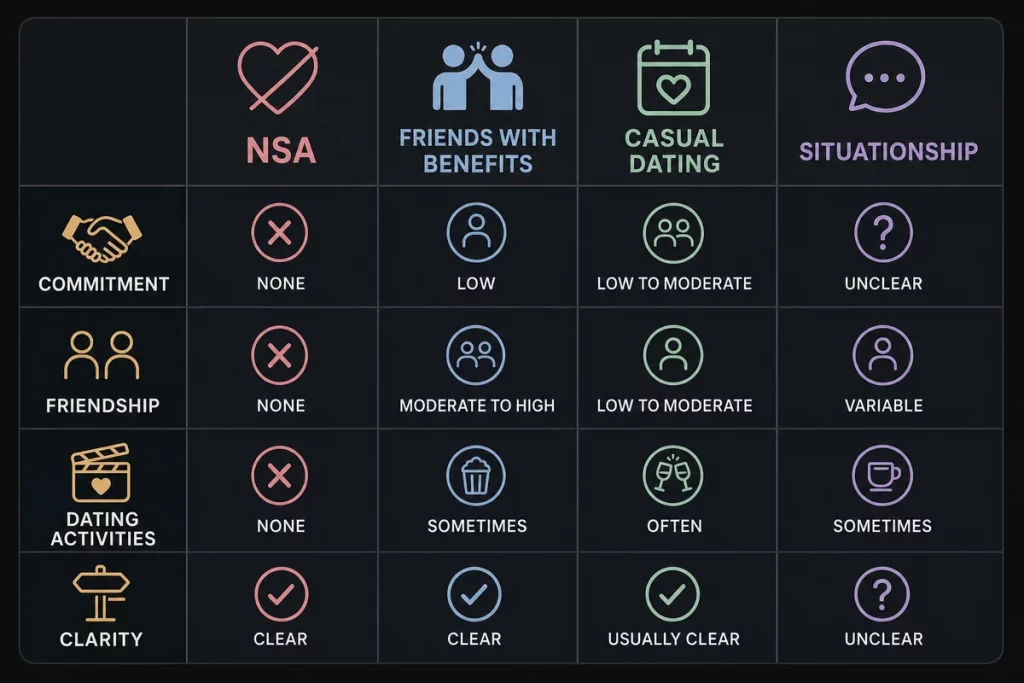
NSA vs. FWB vs. Casual Dating vs. Situationship: The Differences
| Term | What It Means | Key Distinction |
|---|---|---|
| NSA (No Strings Attached) | Physical/social connection with zero commitment obligations | Explicitly no progression expectation |
| FWB (Friends With Benefits) | Genuine friendship that includes physical intimacy | The friendship is real and valued independently |
| Casual Dating | Going on dates without exclusivity or defined commitment | May or may not include physical intimacy; may evolve |
| Situationship | Undefined relationship that behaves like a partnership without the label | Ambiguity is the defining feature — nobody knows what it is |
The critical difference: NSA and FWB are explicitly defined by agreement. Situationships are explicitly UNdefined — which produces the anxiety, confusion, and attachment distress that breadcrumbing and slow fading thrive on. Casual dating occupies middle ground — more defined than a situationship but less structured than NSA. Understanding what is NSA in dating versus these adjacent terms helps you communicate your actual intentions rather than defaulting to ambiguity because you don’t have the vocabulary to name what you want.
The overlap between these categories is significant — a connection can shift from casual dating to NSA to FWB to situationship depending on how both people communicate as the dynamic evolves. Name what you want using the term that best matches your intention, check that your partner’s definition aligns with yours, and revisit the definition when circumstances or feelings change. Clear check-ins can reduce ambiguity, while avoiding difficult conversations may allow mismatched expectations to grow. Our casual dating rules guide covers a broader framework for non-committed connections.
The Ethics of NSA Relationships
NSA arrangements are ethically neutral — they’re not inherently right or wrong. But the BEHAVIOR within them can be ethical or unethical depending on how both people conduct themselves:
Honesty is non-negotiable. If you’re presenting NSA to someone who clearly wants a committed relationship — hoping they’ll “come around” or accepting their participation knowing their actual desire doesn’t match the arrangement — that’s manipulation regardless of what label you’ve attached. What is NSA in dating when one person is lying about wanting it? It’s exploitation with a consent veneer. Genuine ethical NSA requires that BOTH people authentically want the arrangement — not that one person wants it and the other accepts it as the price of access to the first person.
Consent extends beyond the physical. Consent in NSA contexts means ongoing agreement to the terms — not just initial agreement that becomes binding regardless of how feelings evolve. If one person develops feelings and communicates that NSA no longer works for them, the ethical response is to either renegotiate or end the arrangement — not to say “you agreed to NSA, so your feelings are your problem.” The emotional manipulation guide identifies consent withdrawal dismissal as a control tactic that applies in both committed and casual relationship contexts.
Safety obligations persist regardless of commitment level. NSA doesn’t exempt either person from basic dating safety obligations: honesty about health status, respect for physical boundaries, and the baseline human decency that every person deserves regardless of relationship category. Treating someone as disposable because the arrangement is “casual” reveals character — and that character will manifest in committed relationships as well. Our red flags guide applies to NSA connections just as directly as it applies to partnership-track dating. Someone who treats casual connections with disrespect, dishonesty, or carelessness will treat committed connections the same way when the novelty fades.
Disclosure obligations about other connections. If your NSA arrangement is non-exclusive (which most are by definition), the ethical question of disclosure arises: do you need to tell your NSA partner about other people you’re seeing? The answer depends on what you’ve agreed — but at minimum, honesty about the existence of other connections (without requiring detailed disclosure) is ethically baseline because it allows your partner to make informed decisions about their own health and emotional investment. Concealing other connections in an NSA context is just as dishonest as concealing them in a committed one — the label doesn’t change the ethics of deception. The signs of a player guide identifies compartmentalization and selective honesty as warning signs that apply across all relationship types.
The Risks of NSA That Nobody Talks About
Asymmetric feelings are almost inevitable. The National Domestic Violence Hotline’s research on relationship dynamics confirms what experience teaches: physical intimacy produces emotional attachment regardless of the labels applied to the relationship. Oxytocin doesn’t check whether the relationship is “official” before bonding two people — it bonds them anyway. The result: asymmetric feelings develop in the vast majority of NSA arrangements, with one person developing deeper attachment while the other maintains the casual distance they agreed upon. What is NSA in dating when one person has fallen in love and the other hasn’t? It’s pain — and the pain is genuine regardless of what was “agreed to” at the start.
Anxious attachment makes NSA dangerous. Anxiously attached individuals are the worst candidates for NSA arrangements — because their attachment system interprets the inherent uncertainty of NSA as threat, producing the consuming preoccupation, reassurance-seeking, and protest behaviors that the NSA framework explicitly doesn’t accommodate. If you experience significant anxiety when your NSA partner doesn’t text back quickly, if you monitor their social media for signs of other connections, or if you find yourself trying to “earn” commitment through increasingly generous behavior — NSA is working against your psychological architecture, not with it.
NSA can become a commitment-avoidance habit. For some people, serial NSA arrangements become a pattern that prevents them from ever developing the vulnerability tolerance that committed relationships require. Each casual connection provides enough connection to prevent loneliness without requiring enough vulnerability to risk genuine heartbreak — producing a comfortable but ultimately shallow emotional life where deep partnership remains permanently deferred. If you’ve had NSA arrangements for years and the thought of commitment produces genuine panic rather than healthy caution, the NSA pattern may be serving an avoidance function worth examining in therapy.
The “cool girl/guy” trap. Cultural pressure to appear unbothered by casual dynamics produces a specific trap: performing comfort with NSA while internally experiencing distress. “I’m totally fine with this” becomes a performance that masks genuine feelings because expressing those feelings would make you seem “clingy” or “needy” in a culture that valorizes emotional detachment. This performance is exhausting and corrosive — it trains you to suppress authentic emotional responses, which degrades self-trust and emotional intelligence over time. If maintaining the appearance of being okay with NSA requires constant emotional suppression, the arrangement isn’t serving you — it’s costing you the self-honesty that every healthy relationship (casual or committed) requires. The green flags guide identifies emotional authenticity as a key indicator of healthy relating — and that standard applies to your relationship with yourself as much as your relationship with others.
Self-worth erosion for the person who wanted more. Accepting NSA when you actually want commitment — because it’s “better than nothing” or because you’re hoping the other person will change their mind — produces progressive self-worth erosion. Every meetup that doesn’t lead to deeper connection reinforces the message “I’m not worth committing to.” This erosion is particularly damaging because it’s self-inflicted: you chose to accept terms that contradict your actual needs, and the resulting pain feels like evidence of your inadequacy rather than evidence of a mismatched arrangement. The genuine interest signs guide helps distinguish between someone who genuinely wants NSA and someone who wants YOU — the difference determines whether NSA serves both people or exploits one of them.
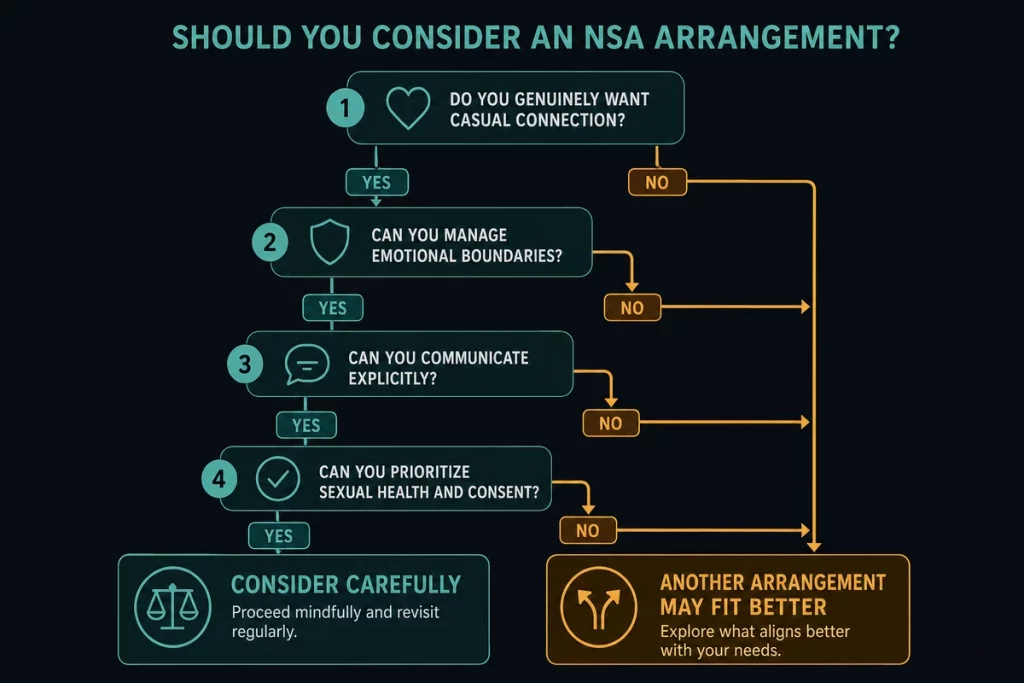
Is NSA Right for You? The Honest Assessment
NSA may be right for you if: You genuinely don’t want a committed relationship right now (not as a compromise, but as an authentic preference). You can maintain emotional boundaries without suppressing genuine feelings. You’re able to enjoy connection without needing it to “mean something” or “go somewhere.” You’re in a life stage (post-divorce recovery, career-focused period, recent breakup healing) where casual connection serves your wellbeing better than the demands of partnership. And critically: you can communicate honestly with your NSA partner about boundaries, feelings, and changes as they arise. The self-awareness required to honestly assess these criteria is the same self-awareness that makes every relationship type healthier — which is why understanding what is NSA in dating at the self-knowledge level matters more than understanding it at the definitional level.
NSA is NOT right for you if: You’re accepting it as a compromise because the person you want won’t offer commitment. You experience significant anxiety between meetups. You find yourself trying to “earn” their deeper interest through increased investment. You secretly hope the arrangement will evolve into a relationship despite the explicit agreement that it won’t. Or you’re using NSA to avoid the vulnerability that genuine connection requires because past relationships made vulnerability feel unsafe — in which case the appropriate intervention isn’t more casual connections; it’s the therapeutic work that rebuilds vulnerability tolerance. The trauma bonding test can help assess whether your attraction to emotionally unavailable partners reflects a pattern worth examining professionally.
Regardless of your choice: Verify identity before any intimate encounter. Use GuyID’s free screening tools for government ID verification — because NSA doesn’t exempt anyone from the basic safety precautions that all dating requires. Share your Date Mode link through GuyID to demonstrate that your transparency applies regardless of the relationship’s commitment level. Our romance scammer guide and reverse image search guide provide the verification framework that applies to every dating context — casual and committed alike.
How GuyID Helps
GuyID should appear when it is useful, not as a banner ad. A GuyID Trust Profile gives someone a portable way to share trust signals before a date, while identity verification and social vouching help turn vague profile claims into clearer next steps.
Useful next steps:
- Create a GuyID Trust Profile when you want a cleaner way to share verified trust signals.
- Use GuyID free tools and related guides when you need a checklist before meeting someone.
- Treat identity verification as confidence-building, not a guarantee.
- Use social vouching when you want context from people who already know the person.
- Sign up only when the extra trust layer helps the decision you are already trying to make.
Frequently Asked Questions
What does NSA mean in dating?
NSA stands for “No Strings Attached” — a relationship arrangement where both people agree to connection without the commitment obligations of traditional relationships. No exclusivity, no progression expectations, no emotional debt. The term is common on dating apps and in early conversations as shorthand for casual intentions. Understanding what is NSA in dating means recognizing it as a legitimate relationship choice when both people genuinely want it — and a harmful arrangement when one person accepts it while actually wanting commitment.
Can an NSA relationship turn into a real relationship?
It CAN — but banking on it is a recipe for disappointment. If both people develop feelings and mutually agree to redefine the relationship, the transition is possible and sometimes produces strong partnerships built on genuine compatibility rather than projection. But entering NSA with the secret expectation that it will evolve into commitment is dishonest (to both yourself and your partner) and produces the exact pain that honest NSA communication is designed to prevent.
Is NSA dating unhealthy?
Not inherently — it depends on the people and the context. NSA is healthy when both people genuinely want it, communicate honestly, and maintain agreed-upon boundaries. NSA is unhealthy when one person accepts it as a compromise, when it serves as a commitment-avoidance pattern, or when the arrangement exploits someone who actually wants more. The determining factor isn’t the arrangement type — it’s the honesty and self-awareness both people bring to it.
How do I end an NSA arrangement?
Honestly and directly: “This arrangement isn’t working for me anymore.” You don’t owe a detailed explanation, but basic honesty is the genuine ethical minimum — even in explicitly casual contexts. Ghosting is not an acceptable exit strategy for NSA any more than it is for committed relationships — the other person deserves the clarity that a simple, direct message provides. If feelings have developed on your side, honesty about that is both brave and fair: “I’ve developed feelings that make NSA painful for me, so I need to step away.”
What’s the difference between NSA and FWB?
The friendship. FWB (Friends With Benefits) includes a genuine, valued friendship that exists independently of the physical component — you’d be friends even without the benefits. NSA may or may not include friendship; the defining feature is the absence of commitment strings rather than the presence of friendship. In practice, many arrangements blur these categories, which is why explicit communication about what both people want and expect matters more than which acronym you apply.