
Reader Briefing
Reader Briefing
Start here if you need a practical read on best widower dating site options in 2026: who should use verification, what signals to check, and what to do before moving from online interest to an in-person plan.
Who this is for
- People meeting someone from a dating app or social platform.
- Readers preparing for a first in-person date.
- Anyone checking identity, profile consistency, and trust signals.
- People trying to avoid romance scams, fake profiles, or pressure tactics.
You’ll learn
- How to evaluate identity signals without treating any single check as certainty.
- Which trust signals matter and how to weigh them together.
- How to spot inconsistencies, pressure, or behavior patterns that deserve caution.
- How to move from online conversation to a safer first meeting.
- Where GuyID tools fit into a quick pre-date screening workflow.
- How to compare options using practical safety and trust criteria.
Bottom line
Verification reduces uncertainty; it does not guarantee future behavior. Use a layered approach: confirm identity signals, compare profile consistency, ask for a short video call, keep early plans public, and slow down when someone pressures you to skip normal safety steps.
Key takeaways
- Identity verification improves confidence, not certainty.
- Patterns matter more than isolated incidents.
- Verify before meeting privately or sharing sensitive details.
- A short video call can reveal many inconsistencies.
- Pressure to skip reasonable safety steps is useful information.
Free Tools
Catfish Probability Detector
Check whether a dating profile has suspicious identity or photo signals.
Dating Bio Red Flag Detector
Review a bio for scam, pressure, or trust-warning language.
Dating Safety Checklist
Use free GuyID tools before moving from chat to a real date.
Next step
Create your GuyID trust profile
Share consent-based trust signals before a date without turning the conversation into an interrogation.
Dating after losing a spouse requires a different kind of platform — one that understands grief timelines, respects the memory of who came before, and attracts people who are genuinely ready for connection rather than just filling a void. Finding the right widower dating site (or widow and widower dating site that serves both) means evaluating platforms not just for their user base and features, but for how well they accommodate the emotional complexity that widowed daters bring. This guide reviews the best widower dating site options available in 2026, compares specialized platforms against mainstream alternatives, provides the safety framework specific to widowed daters, and helps you determine whether you’re ready to date a widow or widower — or whether you ARE one who’s ready to re-enter the dating world.
NavigateTable of Contents18 sections
Why Widowed Daters Need a Specialized Widower Dating Site
The widowed dating experience differs fundamentally from post-breakup or post-divorce dating — and those differences make general-purpose dating platforms a poor fit for many widowed singles. Understanding why a dedicated widower dating site or widow and widower dating site matters helps you choose the platform that serves your specific needs:
Grief doesn’t follow dating timelines. General dating platforms operate on the assumption that users have “moved on” from previous relationships. For widowed daters, the previous relationship didn’t end through choice — it ended through loss. The person you loved didn’t leave; they died. That distinction means grief coexists with new romantic interest in ways that breakup or divorce grief typically doesn’t. A dedicated widower dating site creates space for this complexity rather than treating it as baggage to be minimized. According to the American Psychological Association, grief from spousal loss follows a non-linear trajectory that can include waves of acute sadness years after the loss — and a dating environment that understands this produces healthier connections than one that expects a clean emotional slate.
The late spouse isn’t an “ex.” On mainstream platforms, mentioning a previous partner extensively is a red flag — it signals unresolved feelings about someone who chose to leave. For widowed daters, the late spouse is permanently part of their story: they’re present in photos, in memories shared with children, in the identity the surviving spouse still carries. A widow and widower dating site creates a culture where this ongoing connection to the late spouse is normalized rather than pathologized — allowing widowed daters to honor their history while building new connections without having to constantly explain why they still love someone who’s gone.
Vulnerability to exploitation is elevated. Research from the National Library of Medicine on grief and decision-making confirms that bereaved individuals show altered risk assessment during active grief — making them more susceptible to love bombing, romance scams, and emotional manipulation. The loneliness that follows spousal loss creates a vulnerability that predatory individuals specifically target — which is why the National Domestic Violence Hotline identifies recently widowed individuals as a high-risk demographic for romance-based financial exploitation. A reputable widower dating site with verification features provides protection that unmoderated general platforms don’t.
The Best Widower Dating Site Options in 2026
OurTime
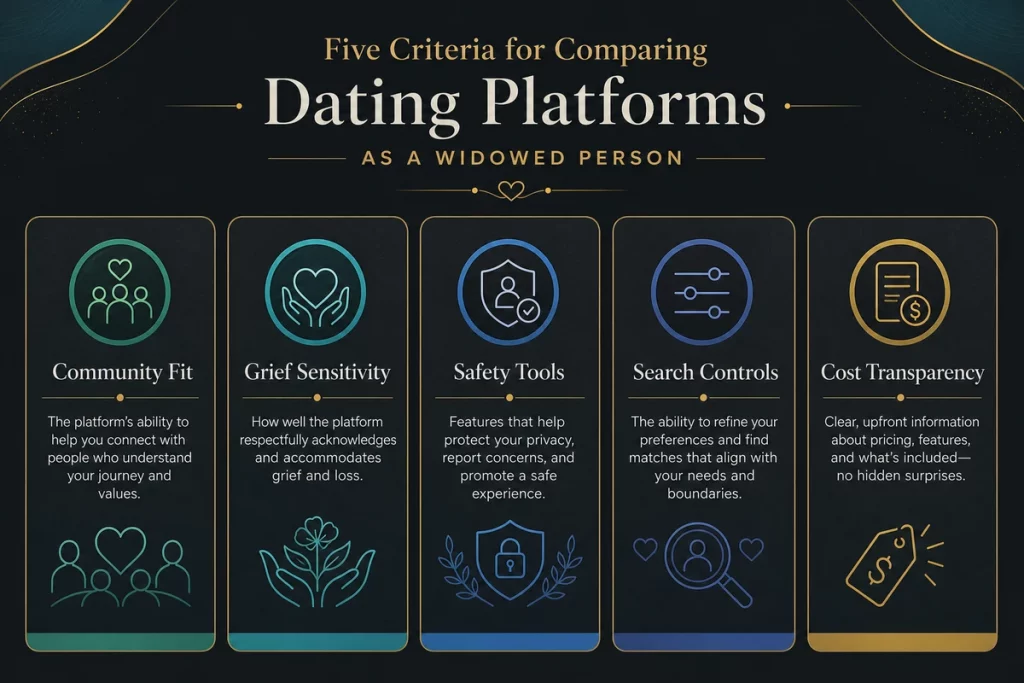
OurTime focuses on daters over 50, an age group that includes many people navigating widowhood and other major life transitions. Review the current profile fields, safety features, subscription terms, and cancellation policy directly on the platform before paying; these details can change. Do not assume that an age-focused community verifies identity or grief readiness. Use GuyID’s free tools and independent checks before meeting.
eHarmony
eHarmony markets itself toward relationship-focused matching and uses an extensive questionnaire. That structure may appeal to widowed daters who want more context before messaging, but it does not verify emotional readiness or guarantee higher-quality connections. Confirm current pricing, widowed-status fields, communication controls, and renewal terms directly with the platform before subscribing.
WidowsorWidowers.com
One of the few dedicated widow and widower dating site platforms — designed exclusively for people who have lost a spouse. The community understands grief intimately, respects late spouses as part of the story rather than baggage, and provides a judgment-free environment for people navigating the complexity of dating after loss. Smaller user base than mainstream platforms (which means fewer options but higher relevance), and the specialized focus means every member shares the widowed experience. Free basic membership with premium features available. Best for widowed daters who want a community that inherently understands their situation without needing to explain it on every date.
SilverSingles
Another over-50 platform that captures significant widowed demographics. SilverSingles uses personality-based matching similar to eHarmony, with a focus on long-term compatibility. The platform verifies profile photos (reducing catfishing risk) and offers a curated match experience (3-7 matches per day rather than unlimited swiping). Monthly pricing: $25-50. Strong option for widowed daters who prefer quality over quantity and want the platform to do initial filtering rather than scrolling through hundreds of profiles. Our widow dating websites guide provides the comprehensive platform comparison.
Match.com
The largest general-purpose dating platform with the broadest user base across all demographics — including a substantial widowed population. Match.com offers detailed profile options that let you identify as widowed and specify what you’re looking for. The breadth of the platform means more potential matches but also more noise — you’ll encounter people who don’t understand widowed dating dynamics alongside those who do. Match is best for widowed daters comfortable navigating a general-audience platform and willing to filter actively. Use reverse image search and GuyID verification for matches on any general platform.
Using Mainstream Apps as a Widower Dating Site Alternative
If dedicated widow and widower dating sites feel too niche or have insufficient users in your area, mainstream apps can work — with modifications to your approach:
Hinge is the strongest mainstream option for widowed daters because its prompt-based profiles encourage the kind of detailed, personality-revealing self-disclosure that surfaces grief-readiness and emotional depth. Use prompts to signal your situation naturally: “The one thing you should know about me is… I lost my spouse and I’ve done the work to be ready for this.” Hinge’s “designed to be deleted” positioning attracts relationship-seekers rather than casual browsers — aligning with what most widowed daters want.
Bumble works well for widowed women because the women-initiate model gives you control over who contacts you — reducing the unwanted messages that can feel overwhelming during the vulnerable re-entry period. The “Bumble Date” mode (distinct from BFF and Bizz) can be set to show only profiles within your age range and distance, and the 24-hour response window prevents conversations from lingering indefinitely.
Tinder is generally NOT recommended as a widower dating site alternative because its swipe-based, volume-oriented culture produces the rapid, casual dynamics that most widowed daters don’t want. The platform’s younger demographic and hookup associations create a mismatch with the intentional, grief-informed dating that widowed individuals typically seek.
Facebook Dating offers a unique advantage for widowed daters: because it’s integrated with your existing Facebook profile, matches can see mutual friends, shared interests, and community connections — providing the kind of social context that builds trust faster than anonymous app profiles. The ability to see that a potential match knows people you know creates natural accountability that anonymous platforms lack. Facebook Dating is free and available to anyone with a Facebook account, making it accessible regardless of budget. The limitation: younger demographics dominate, so widowed daters over 55 may find fewer age-appropriate matches than on OurTime or SilverSingles.
Cross-platform strategy for widowed daters. Rather than committing exclusively to one widower dating site, the most effective approach combines a specialized platform (for the grief-aware community) with one mainstream app (for broader reach). Run both simultaneously: the specialized platform provides emotional safety and understanding, while the mainstream app provides volume and variety. This dual approach ensures you’re not limited by the smaller user base of niche platforms while still having a community that inherently understands your experience. Regardless of which platforms you use, apply the same verification standards to every match — GuyID’s free screening tools work across all dating contexts.
Are You Ready to Date After Losing a Spouse?
Before choosing a widower dating site, assess whether you’re genuinely ready — because dating before grief has been sufficiently processed produces connections that are built on need rather than desire, and those connections rarely survive the transition from grief-driven attachment to genuine partnership:
You can talk about your late spouse without emotional flooding. Not without emotion — that may never fully happen, and it doesn’t need to. But without the overwhelming wave that hijacks the conversation and makes your date feel like a therapy audience rather than a potential partner. If mentioning your spouse still produces uncontrollable crying, extended distress, or the inability to redirect attention to the present conversation, more processing time is warranted.
You want a new partner — not a replacement. If your dating motivation is finding someone who resembles your late spouse, fills the specific void they left, or recreates the dynamic you had together, you’re seeking replacement rather than partnership. A new partner should be valued for who THEY are — not for how well they approximate someone they never met. If you catch yourself comparing every potential match to your late spouse (positively or negatively), the comparison reflex indicates the late spouse is still your primary reference point for partnership rather than your own current values and needs.
Your identity exists beyond “widow” or “widower.” If “widowed person” is your primary identity — if it’s the first thing you mention, the lens through which you interpret every experience, and the framework that structures your daily life — more identity rebuilding is needed before dating. You are a person who experienced loss, not a loss that happens to have a person attached. Our post-loss dating timeline guide provides the readiness framework that applies equally to widowed and divorced individuals.
Your support system endorses the timing. Friends, family, and (if applicable) your therapist who know your grief journey well are the most reliable external assessors of your readiness. If multiple people close to you express concern that you’re moving too soon, their outside perspective deserves serious consideration — because they’re observing your grief trajectory from an angle you can’t see from inside it.
You’ve processed the guilt. Many widowed individuals experience guilt about dating — feeling they’re betraying their late spouse’s memory, being disloyal to the marriage, or “moving on too fast” in the eyes of others. This guilt is normal, but it needs to be processed before dating rather than carried into new connections. Unprocessed guilt produces self-sabotage: you find yourself pulling away from promising connections, refusing to allow yourself to enjoy dates, or unconsciously choosing partners who are wrong for you because choosing someone right feels like a betrayal. Therapy specifically addressing survivor guilt and the permission to love again produces the emotional freedom that healthy post-loss dating requires.
You can envision a future that includes both — your late spouse’s memory AND a new partner. The readiness milestone isn’t erasing the past; it’s expanding the future to include room for both honoring what was and building what will be. If your vision of the future still centers exclusively on what you lost rather than what you might gain, the orientation is backward-facing in a way that new romantic connections can’t resolve — because no new partner can compete with a past that memory has idealized. When you can hold grief and hope simultaneously — genuinely missing your late spouse while genuinely anticipating new connection — you’ve reached the emotional complexity that healthy post-loss dating requires.
Tips for Dating a Widow or Widower
If you’re not widowed yourself but you’re interested in dating someone who is — whether you met them on a widower dating site or elsewhere — these guidelines will help you navigate the unique dynamics:
The late spouse isn’t your competition. This is the single most important mindset shift for someone dating a widowed person. You’re not replacing their late spouse; you’re adding a new chapter to a life that already includes a profound love story. Feeling threatened by a dead person’s memory produces jealousy that damages the connection and causes pain to someone who has already suffered significant loss. If you can’t be comfortable knowing your partner loved someone before you — and still carries that love alongside whatever develops with you — dating a widowed person may not be the right fit.
Don’t rush them past grief milestones. Anniversary of the death. The late spouse’s birthday. The anniversary of their wedding. Holidays they shared. These dates carry emotional weight that may persist for years — and a partner who says “it’s been long enough to move on” is demonstrating the emotional tone-deafness that predicts ongoing insensitivity. Sit WITH them in the grief rather than trying to hurry them through it. Our dating a widower red flags guide covers the specific warning signs that indicate a widowed person isn’t ready — and the green flags that indicate they are.
Patience with the pace is non-negotiable. Widowed daters often move more slowly than divorced or never-married daters — and that pace reflects wisdom, not reluctance. They’ve experienced the deepest form of relationship loss and they’re understandably cautious about investing in a new connection that could also end in pain. Respecting their pace — without taking it personally, without interpreting slowness as disinterest — demonstrates the emotional maturity that widowed daters need in a partner.
Distinguish grief from disinterest through conversation. A widowed partner who seems distant may be processing a grief trigger, experiencing ordinary stress, or reconsidering the relationship. Do not assume which explanation is true. Ask gently, “Is this about grief, something between us, or something else?” and listen to both the answer and the longer pattern of communication.
Don’t compare yourself to the late spouse. You will never “win” a comparison with someone whose flaws have been softened by death and whose virtues have been amplified by memory. Don’t try. Don’t ask “am I as good as they were?” or “do you love me as much as you loved them?” These questions have no satisfying answers and create pressure that damages the connection. Focus on building something NEW — a relationship that has its own identity, its own inside jokes, its own shared experiences — rather than measuring yourself against a ghost. The relationship you’re building doesn’t need to be better than the one that came before; it needs to be genuine, present, and its own thing entirely.
Children (if present) add a layer of complexity. If the widowed person has children, those children lost a parent — and their feelings about a new person entering their surviving parent’s life will be complicated regardless of your wonderfulness. Don’t try to parent, don’t try to replace, and don’t try to rush the relationship between you and the children. Let it develop at the pace the children set, with the surviving parent as gatekeeper. Expect that some children will welcome you and others will resist — and that both responses are legitimate expressions of their own grief process. Our dating with kids framework applies directly to this dynamic.
Safety for Widowed Daters: Protecting Yourself on Any Platform
Whether you’re using a dedicated widower dating site or a mainstream app, widowed daters face elevated safety risks that require specific precautions:
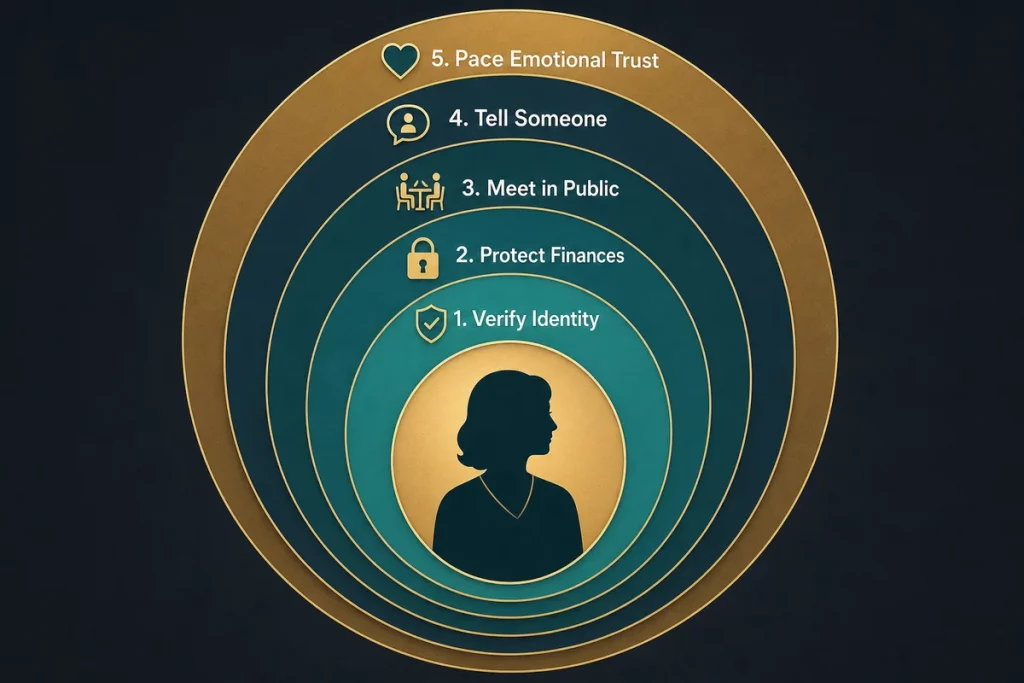
Romance scam awareness. Scammers specifically target widowed individuals because grief creates the emotional vulnerability that scam scripts exploit — rapid emotional escalation, financial “emergencies,” and premature declarations of love are the signature tactics. Our romance scammer detection guide provides the complete warning-sign framework. The dating over 60 red flags guide covers the financial exploitation patterns that disproportionately target widowed women with retirement assets.
Verify every match. Use GuyID’s free screening tools for government ID verification before meeting in person. Reverse image search profile photos. Google their name. Share your Date Mode link through GuyID to establish reciprocal transparency. Verification isn’t paranoia — it’s the absolute minimum due diligence that every widower dating site user should practice before meeting anyone in person.
Maintain financial boundaries absolutely. No financial integration, no lending, no investing in anyone’s “opportunity” for at least the first year — regardless of how genuine the connection feels. Grief distorts financial judgment, and the person you trust at 6 months may look very different at 18 months once acute grief has fully resolved. Consult your financial advisor before any financial decisions involving a new romantic partner. Boundary-setting isn’t cold — it’s the financial self-care that protects both you and the connection from premature entanglement.
Tell your support system you’re dating. Isolation is the friend of exploitation. When your friends, family, and adult children (if applicable) know you’re dating, they provide the natural accountability and outside perspective that protect against manipulation. A partner who encourages you to keep the relationship secret — or who discourages your family’s involvement — is demonstrating the isolation tactics that characterize controlling relationships.
How GuyID Helps
GuyID should appear when it is useful, not as a banner ad. A GuyID Trust Profile gives someone a portable way to share trust signals before a date, while identity verification and social vouching help turn vague profile claims into clearer next steps.
Useful next steps:
- Create a GuyID Trust Profile when you want a cleaner way to share verified trust signals.
- Use GuyID free tools and related guides when you need a checklist before meeting someone.
- Treat identity verification as confidence-building, not a guarantee.
- Use social vouching when you want context from people who already know the person.
- Sign up only when the extra trust layer helps the decision you are already trying to make.
Frequently Asked Questions
What is the best widower dating site?
For dedicated widow and widower platforms: WidowsorWidowers.com offers the most grief-aware community. For mainstream platforms that serve widowed daters well: OurTime (over-50 demographic), eHarmony (compatibility matching), and Hinge (relationship-focused with detailed profiles). The best choice depends on your age, location, and whether you prefer a specialized community or a broader user base. Regardless of platform, use GuyID’s free verification tools to confirm match identities.
How long should I wait after my spouse dies to start dating?
There’s no universal timeline — readiness is emotional, not chronological. Most grief counselors suggest at least 1-2 years, but the readiness indicators matter more: you can discuss your late spouse without emotional flooding, you want a new partner rather than a replacement, your identity extends beyond “widowed person,” and your support system endorses the timing. The widow dating guide covers the complete readiness assessment.
Is it safe to use dating sites after being widowed?
Yes — with appropriate precautions. Widowed individuals face elevated romance scam risk due to grief-related vulnerability, so verification is especially important: use GuyID’s tools for ID verification, reverse image search profile photos, maintain absolute financial boundaries, and keep your support system informed about your dating activity. The platform itself matters less than the verification practices you apply to every match.
Should I date someone who is widowed?
It can be, when both people communicate openly about grief, boundaries, memories, pace, and the future. A late spouse may remain an important part of the person’s story, but every widowed person relates to that history differently. Evaluate the individual relationship rather than treating widowhood itself as proof of unusual depth or unusual difficulty. The dating a widower red flags guide offers additional questions about readiness.
How do I write a dating profile as a widowed person?
Lead with who you are NOW — your interests, personality, and what you’re looking for — not with your loss. Mention widowed status naturally (not as the opening line) when it fits context. Avoid making the profile a memorial to your late spouse. Show that you’re a complete person seeking to share an already-full life, not someone seeking completion. Our bio ideas guide provides templates adaptable to widowed daters, and the honest/direct template works particularly well for this demographic.