Free Tools
Catfish Probability Detector
Check whether a dating profile has suspicious identity or photo signals.
Dating Bio Red Flag Detector
Review a bio for scam, pressure, or trust-warning language.
Dating Safety Checklist
Use free GuyID tools before moving from chat to a real date.
Next step
Create your GuyID trust profile
Share consent-based trust signals before a date without turning the conversation into an interrogation.
The match happened. The cursor blinks in the empty message field. And your brain produces exactly nothing. Good dating app icebreakers solve the blank-screen problem by giving you a framework for starting conversations that go somewhere — not the generic “hey” that dies on arrival, but specific, engaging openers that make the other person want to respond. This guide covers every category of dating app icebreakers that actually work: profile-based, question-based, humor-based, shared-interest, and direct — plus the psychology behind why certain approaches generate responses while others generate silence. Because the gap between matching and meeting is where most connections die, and the icebreaker determines which side of that gap you land on.
NavigateTable of Contents18 sections
Why Dating App Icebreakers Matter More Than You Think
Research on dating app behavior from the National Library of Medicine reveals a stark reality: roughly 50% of matches never exchange a single message. The icebreaker isn’t just the beginning of a conversation — it’s the make-or-break moment that determines whether a mutual attraction becomes anything more than a notification that fades from both people’s screens.
The reason dating app icebreakers carry such disproportionate weight is the attention economy of modern dating. The average active user has multiple matches competing for their attention simultaneously, and the cognitive load of responding to multiple conversations means that low-effort messages get deprioritized in favor of ones that are easier and more rewarding to engage with. Your icebreaker is competing not against silence but against every other message in their inbox — and winning that competition requires standing out through personalization, personality, and conversational momentum.
The stakes are particularly high because dating apps create what behavioral economists call “choice overload” — when too many options are available, people default to choosing the easiest path, which often means responding to the message that requires the least cognitive effort to engage with. Paradoxically, this means the most effective dating app icebreakers are those that make responding EASY while demonstrating HIGH effort from the sender. You invest effort so they don’t have to — and that asymmetry of effort is what separates messages that generate dates from messages that generate silence. The effort you put into crafting a personalized, engaging opener is the clearest signal of genuine interest available in the digital dating environment — because anyone can type “hey” but only someone genuinely interested invests the 60 seconds required to write something specific and thoughtful.
According to the American Psychological Association’s research on digital communication, text-based first impressions are more heavily weighted than in-person first impressions because the reader has no nonverbal cues (smile, tone, eye contact) to supplement the words. The good news: this means a well-crafted icebreaker has outsized positive impact. The challenge: a poorly crafted one has outsized negative impact.
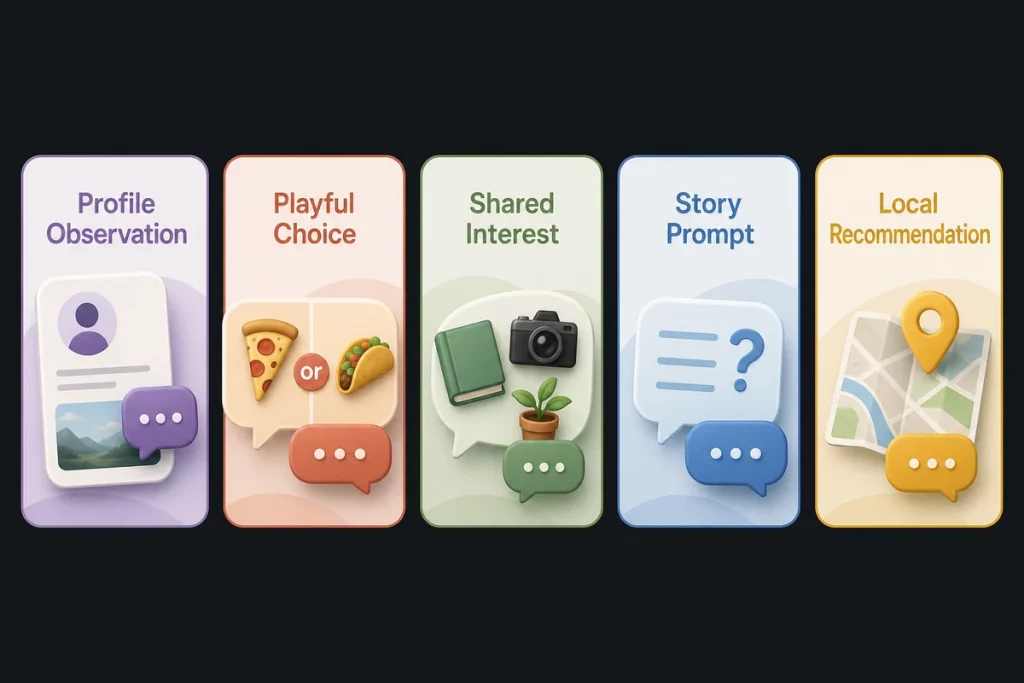
5 Categories of Dating App Icebreakers That Actually Work
1. Profile-Based Icebreakers
The highest-converting category because they demonstrate genuine engagement with the specific person. Reference a photo location (“That rooftop in your third photo looks incredible — where is that?”), a bio detail (“Your bio mentions you’re learning pottery — how long have you been at it?”), or a prompt response (“You said your hot take is that breakfast food is overrated — I need you to explain this immediately because I disagree on every level”). Profile-based openers work because they communicate “I chose you specifically” rather than “I’m messaging everyone.” The personalization signals investment, which triggers reciprocal investment in the response.
2. Question-Based Icebreakers
Questions succeed because they create a clear response path — the person knows exactly how to reply, which eliminates the friction that kills engagement. The best question-based openers are specific and revealing rather than generic and surface-level. “What’s the last thing you cooked that you were actually proud of?” beats “What do you like to cook?” because it invites a story rather than a list. “If you could live in any fictional universe for a week, where would you go?” beats “What shows do you watch?” because it reveals imagination and values rather than just media consumption.
3. Humor-Based Icebreakers
Humor works because laughter creates immediate positive association — the person connects the good feeling to you, even though the interaction is purely text-based. But humor-based openers carry higher risk than other categories because humor is subjective: what’s hilarious to one person is cringey to another. The safest humor approaches: self-deprecation that’s confident rather than pitying (“I spent 20 minutes crafting the perfect opener and this is what I came up with — I’m already apologizing”), observational humor about dating (“I feel like we both swiped right for different reasons and I’m genuinely curious what yours was”), or absurdist questions (“Very important compatibility question: if you could only eat one condiment for the rest of your life, which one?”). Avoid sarcasm in text — it reads as hostile without vocal tone to soften it.
4. Shared-Interest Icebreakers
When profiles reveal a shared interest, that alignment is your strongest icebreaker material. “I see you’re into trail running — I just finished a half marathon trail race and I’m still recovering. What’s your favorite trail?” creates immediate common ground. Shared-interest openers work because they skip the “getting to know you” phase and land directly on “we already have something in common” — which feels like a head start rather than starting from zero. The key: be genuine about the shared interest. Claiming to love hiking because their photos show trails — when you haven’t hiked since high school — sets up an unsustainable pretense that collapses on the first date.
5. Direct Icebreakers
“I’m going to be straightforward — your profile made me genuinely curious, and I’d rather have a real conversation than exchange small talk for a week. What’s something you’re excited about right now?” Direct openers appeal to people who are tired of the typical dating app dance. They communicate confidence, emotional maturity, and the intention to build a genuine connection rather than play games. This category works best on apps where the demographic skews older or more relationship-oriented (Hinge, Match) and less well on casual-swipe apps where the culture rewards playfulness over directness.
Adapting Dating App Icebreakers to Different Platforms
Tinder. Tinder’s casual culture rewards wit, brevity, and playful energy. The best Tinder icebreakers are 1-2 sentences maximum — short enough to read in the preview without opening the conversation. Humor and challenge-based approaches tend to perform best. See our tinder best opener guide for platform-specific strategies.
Hinge. Hinge’s prompt-based structure provides built-in icebreaker material through the “comment on prompt” feature. The best Hinge icebreakers engage directly with the person’s prompt answers — agreeing, challenging, or building on what they shared. The platform’s design encourages longer, more thoughtful interactions than Tinder, so 2-3 sentence icebreakers perform well.
Bumble. On Bumble, women send the first message — so this section applies to women crafting icebreakers and men crafting profiles that invite specific icebreakers. Women on Bumble: the same principles apply — profile-specific comments and questions outperform “hey” by massive margins. Men on Bumble: craft your bio and prompts to include hooks that make sending a thoughtful first message easy for your matches.
Match / OkCupid / Older-demographic apps. These platforms support longer profiles and more detailed conversation, so dating app icebreakers can be more substantive — 3-4 sentences that demonstrate thoughtful engagement with the person’s profile, values, and stated preferences. The older demographic on these platforms generally responds better to sincerity than wit, and to genuine questions rather than clever gimmicks.
Cross-platform principle. Personalization usually makes an icebreaker more relevant than an unchanged template because it shows attention to the individual profile. Adapt the length, tone, and format to the platform and the information the person chose to share. Treat personalization as respectful context, not a technique that entitles you to a response.
Using your GuyID profile as a conversation bridge. Once initial icebreaker exchanges establish mutual interest on any platform, sharing your GuyID Trust Score provides a natural conversation transition: “I’m enjoying this conversation — here’s my verified profile so you know I’m exactly who I say I am.” This gesture transforms a standard dating app exchange into a trust-verified connection, distinguishing you from every other match who relies solely on unverified profile claims. The verification itself becomes a conversation point that demonstrates transparency and emotional maturity — two of the most attractive qualities identified in our genuine interest signs guide.
What to Avoid in Dating App Icebreakers
“Hey” and its variants. “Hey,” “Hi,” “Hello,” “What’s up” — these aren’t icebreakers; they’re conversational placeholders that place the entire burden of starting the actual conversation on the other person. Data from multiple dating platforms confirms that single-word openers receive the lowest response rates across all demographics and all platforms.
Appearance-only compliments. “You’re beautiful” tells someone something they’ve already heard and provides zero conversational path. Compliment something specific and effort-based instead: “Your travel photos are incredible — you clearly have an eye for finding beautiful places” acknowledges beauty while complimenting the person’s choices rather than their genetics. Our green flags guide identifies genuine curiosity about personality as a positive indicator and appearance-fixation as a warning sign.
Copy-paste messages. Mass-messaging the same icebreaker to every match is detectable — the generic quality is obvious, and many people have seen the popular copy-paste lines dozens of times. Even if the template is clever, its lack of personalization communicates “you’re not worth individual effort” — the opposite of what effective icebreakers communicate.
Negativity and negging. “I don’t usually go for [type] but something about you…” or “Most profiles on here are boring but yours caught my eye” are backhanded approaches that undermine the recipient to create insecurity-based engagement. These tactics are recognized as manipulation by anyone with basic awareness, and they attract exactly the wrong dynamic for healthy connections. Our red flags guide classifies negging as an early indicator of player behavior.
Overly sexual openers. Explicit first messages receive near-zero response rates from people seeking genuine connections, generate reports and bans, and contribute to the environment that makes dating apps feel unsafe — particularly for women. The National Domestic Violence Hotline emphasizes that respectful communication is the foundation of healthy connection, and consent-violating sexual overtures in first messages represent the opposite of that foundation.
The autobiography opener. “Hi! I’m 32, work in finance, love hiking and cooking, just got back from Bali, have a golden retriever named Max, and I’m looking for someone who shares my passion for travel and good food!” This isn’t an icebreaker — it’s an unsolicited resume that gives the recipient nothing to respond to except “cool.” The problem: it’s all about YOU without any engagement with THEM. Effective dating app icebreakers create dialogue, not monologue. Lead with curiosity about the other person; save the autobiography for the organic conversation that follows.
GIF-only openers. A GIF without accompanying text is the visual equivalent of “hey” — it requires zero effort, demonstrates zero engagement with the profile, and provides zero conversational direction. GIFs work as supplements to text (adding tone or humor to a written message) but fail as standalone icebreakers because they don’t create a response path. The person sees a funny GIF and thinks “ha” — but has nothing to reply to, so they don’t.
From Icebreaker to Date: The Conversion Path
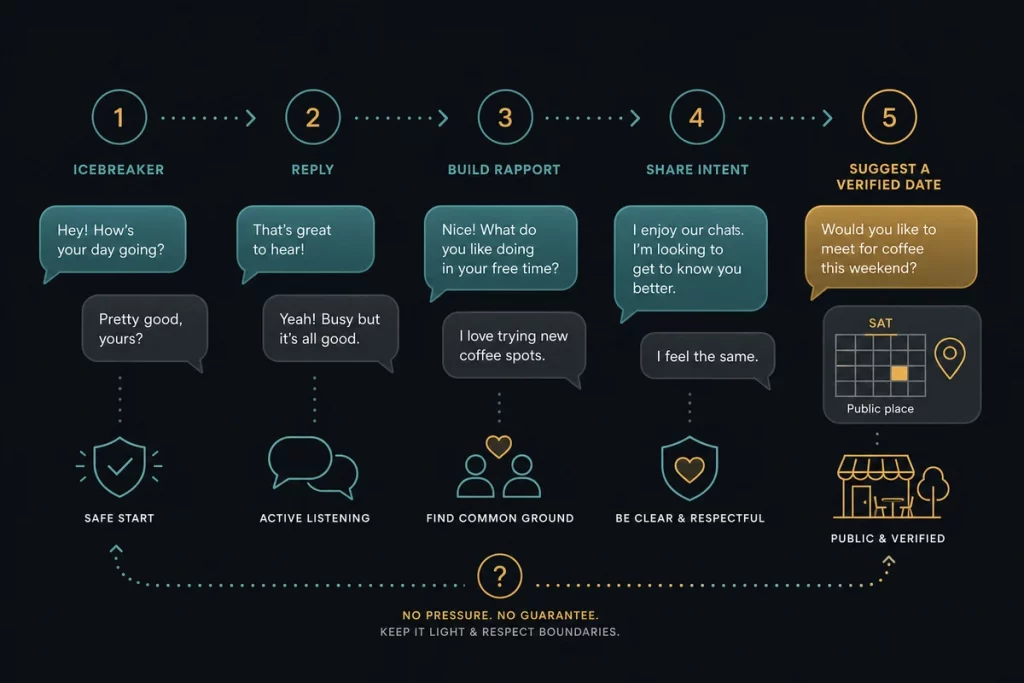
Even the best dating app icebreakers are just the entry point — the conversion from icebreaker to actual date requires sustained conversational quality. Most connections don’t die because of bad icebreakers; they die because good icebreakers lead to conversations that lose momentum, direction, or energy. The path from first message to first meeting follows a predictable progression that you can navigate intentionally:
Build on their response. Whatever they share in response to your icebreaker, go deeper on that topic before introducing new ones. If your icebreaker about their pottery hobby gets a response about the class they’re taking, ask what inspired them to start, what they’ve made that they’re proudest of, or whether it’s as meditative as people claim. Sustained curiosity about a single topic demonstrates genuine interest more effectively than rapid topic-switching demonstrates breadth. The person who asks three follow-up questions about one subject communicates more interest than the person who covers five unrelated topics in the same number of messages.
Reciprocal sharing. Don’t just ask questions — share proportionally. For every question you ask, offer something about yourself on the same topic. “I tried pottery once and produced something my instructor politely called ‘experimental'” shows vulnerability, humor, and willingness to match the disclosure level you’re requesting from them. Conversations where one person only asks and the other only answers feel like interviews — and nobody wants to date their interviewer or feel like a research subject. The best post-icebreaker conversations feel like two people discovering each other simultaneously, with both contributing and both learning.
Read the energy and match it. If they’re sending enthusiastic, detailed responses with questions of their own, match that energy — the connection has momentum and both people are invested. If their responses are short and don’t include return questions, one of two things is happening: they’re interested but busy (give it time, don’t escalate), or they’re not interested enough to invest (which will become clear within 3-4 exchanges). Don’t force conversations that aren’t flowing naturally — the slow fade is a reality of dating app communication, and recognizing it early saves emotional investment in connections that aren’t reciprocal.
Suggest a date when interest is mutual. When the conversation has sustained positive energy and both people are participating, consider a specific, low-pressure invitation: “This conversation is great — are you free for coffee this Saturday?” There is no universal message count or deadline. Move at a pace that allows basic trust and safety checks without using prolonged messaging to avoid a clear decision.
Verify before you meet. Once a date is set, share your Date Mode link through GuyID. Government ID verification transforms a stranger from an app into a confirmed, real person — providing the safety foundation that in-person meetings require. Use GuyID’s free screening tools to verify your match as well. Our reverse image search guide and romance scammer guide provide additional pre-date verification steps that protect both parties. The boundary-setting guide covers the first-date safety framework including location selection, communication with trusted contacts, and maintaining transportation independence.
How GuyID Helps
GuyID should appear when it is useful, not as a banner ad. A GuyID Trust Profile gives someone a portable way to share trust signals before a date, while identity verification and social vouching help turn vague profile claims into clearer next steps.
Useful next steps:
- Create a GuyID Trust Profile when you want a cleaner way to share verified trust signals.
- Use GuyID free tools and related guides when you need a checklist before meeting someone.
- Treat identity verification as confidence-building, not a guarantee.
- Use social vouching when you want context from people who already know the person.
- Sign up only when the extra trust layer helps the decision you are already trying to make.
Frequently Asked Questions
What are the best dating app icebreakers?
Profile-specific icebreakers have the highest response rates because they demonstrate genuine engagement. Reference something specific — a photo, bio detail, or prompt response — add your personality, and end with an easy response path. The best dating app icebreakers feel like the beginning of a real conversation rather than a scripted approach, because they’re customized to the specific person rather than mass-produced for everyone.
How long should a dating app icebreaker be?
One to three sentences (15-50 words) for most apps. Short enough to read without effort; long enough to convey personality and provide a response hook. Tinder and Bumble reward brevity; Hinge and Match accommodate slightly longer messages. If the message can’t be read in the notification preview, it’s probably too long for initial contact.
Do icebreakers actually make a difference?
Significantly. Personalized icebreakers receive 2-3x higher response rates than generic ones, and thoughtful first messages correlate with longer conversations and higher date-conversion rates. The difference between “hey” and a personalized, engaging icebreaker is often the difference between silence and a date.
What do I do if my icebreaker gets no response?
Wait 3-4 days, then send one light follow-up — not a guilt trip, just a second conversational attempt on a different topic. If the second message gets no response, move on. Non-response at the icebreaker stage reflects the volume dynamics of dating apps — not a personal rejection. See our ghosting and dating guide for the framework on handling non-responses with perspective.
Should women use icebreakers differently than men?
The principles are identical: personalization, personality, and easy response paths work regardless of gender. The main difference is that women typically receive more messages than they send, so their icebreakers (particularly on Bumble) face less competition but still benefit from specificity. For women: profile-based comments and genuine questions outperform “hey” just as dramatically as they do for men — and the matches who respond most enthusiastically to thoughtful icebreakers tend to be the most communicative partners.