

Reader Briefing
Reader Briefing
Start here if you need a practical read on how to get over a friend breakup: who should use verification, what signals to check, and what to do before moving from online interest to an in-person plan.
Who this is for
- People meeting someone from a dating app or social platform.
- Readers preparing for a first in-person date.
- Anyone checking identity, profile consistency, and trust signals.
- Online daters improving conversations, profiles, or match screening.
You’ll learn
- How to evaluate identity signals without treating any single check as certainty.
- Which trust signals matter and how to weigh them together.
- How to move from online conversation to a safer first meeting.
- Where GuyID tools fit into a quick pre-date screening workflow.
- How to compare options using practical safety and trust criteria.
- When to slow down, ask for more context, or walk away.
Bottom line
Verification reduces uncertainty; it does not guarantee future behavior. Use a layered approach: confirm identity signals, compare profile consistency, ask for a short video call, keep early plans public, and slow down when someone pressures you to skip normal safety steps.
Key takeaways
- Identity verification improves confidence, not certainty.
- Verify before meeting privately or sharing sensitive details.
- A short video call can reveal many inconsistencies.
- Pressure to skip reasonable safety steps is useful information.
- Use GuyID tools to turn vague concerns into specific checks.
Free Tools
Catfish Probability Detector
Check whether a dating profile has suspicious identity or photo signals.
Dating Bio Red Flag Detector
Review a bio for scam, pressure, or trust-warning language.
Dating Safety Checklist
Use free GuyID tools before moving from chat to a real date.
Next step
Create your GuyID trust profile
Share consent-based trust signals before a date without turning the conversation into an interrogation.
Nobody warns you that losing a best friend can hurt as much as — sometimes more than — losing a romantic partner. There are no breakup songs for friendships, no cultural rituals for processing the loss, and no widely recognized recovery framework. Yet research confirms that friend breakups produce grief responses equivalent to romantic breakups: the same rumination, the same identity disruption, the same aching sense of something essential missing from daily life. If you’re searching for how to get over a friend breakup, you’ve already discovered the hardest part — that everyone acknowledges romantic heartbreak, but friendship loss is treated as something you should simply “move on” from without fanfare or support. This guide provides the recognition and recovery framework that friendship breakups deserve.
NavigateTable of Contents18 sections
Why Friend Breakups Hurt So Much
Understanding how to get over a friend breakup starts with validating WHY it hurts — because the cultural dismissal of friendship grief (“it’s just a friend, not a partner”) compounds the loss with the message that you shouldn’t be this upset:
Friendships carry attachment bonds. The American Psychological Association recognizes that close friendships activate the same attachment systems as romantic relationships — producing the same neurochemical bonding (oxytocin, dopamine), the same identity integration, and the same grief responses when the bond is severed. Your best friend isn’t “just a friend” — they’re an attachment figure whose presence in your life regulates your nervous system, validates your identity, and provides the safety that enables vulnerability. Losing that attachment figure produces genuine neurological withdrawal, regardless of whether the relationship was romantic.
Friendships lack formal closure rituals. Romantic breakups have cultural scripts: the conversation, the “it’s not you it’s me,” the removal of belongings, the social recognition that something significant ended. Friend breakups often have none of this — many friendships end through the slow fade rather than explicit conversation, leaving you grieving a loss that was never formally acknowledged or even confirmed. The ambiguity of a friendship ending — “are we even broken up, or just going through a rough patch?” — prevents the clean processing that explicit endings enable.
Friends carry irreplaceable knowledge. Your best friend knows the version of you that nobody else knows — the 3 AM version, the unfiltered version, the version that existed before your current identity. They carry shared memories, inside jokes, and contextual understanding that took years to build and cannot be transferred to a new friendship. When you lose that friend, you don’t just lose the person — you lose the only witness to specific chapters of your life, creating a loneliness that new friendships (however wonderful) cannot fully address because they weren’t there for the parts that mattered most.
Social networks fragment. Unlike romantic breakups where social circles may remain relatively intact, friend breakups often split the mutual friend group — producing not just the loss of one person but the disruption of an entire social ecosystem. How to get over a friend breakup becomes exponentially harder when the breakup costs you not just the friend but the broader community that surrounded the friendship. Research from the National Library of Medicine on social network disruption confirms that the collateral social damage from friendship endings significantly extends grief timelines compared to losses that leave social networks intact.
Types of Friend Breakups
The Slow Fade
Nobody has the explicit conversation. Texts become less frequent. Plans get cancelled more than kept. The friendship gradually loses energy until it exists only as an occasional social media interaction. The slow fade is the most common form of friendship ending — and often the most painful because the lack of explicit rupture creates ambiguous grief: you’re mourning something that technically still exists but functionally doesn’t. Understanding how to get over a friend breakup caused by slow fade requires accepting that the ending was real even though nobody said the words, and that your grief is valid even without a formal precipitating event.
The Betrayal
Your friend did something that violated the trust foundation — shared your secrets, pursued your partner, lied about something significant, talked about you behind your back, or failed to show up during a crisis. Betrayal friend breakups produce the same trust devastation as romantic betrayal: you lose not just the friend but your confidence in your ability to judge character. This category overlaps with patterns described in our manipulation tactics guide — because friendship manipulation uses many of the same strategies as romantic manipulation.
The Outgrowing
Neither person did anything wrong — you simply grew in different directions. Values diverged. Lifestyles changed. The shared foundation that built the friendship no longer exists, and conversations that once flowed naturally now feel forced. Outgrowing is the gentlest form of friend breakup — but it still hurts, because there’s nobody to blame and nothing to fix. The loss is existential rather than event-based: you’re grieving the reality that human beings change, and that some changes move people apart even when both people are changing for the better.
The Conflict Explosion
A specific disagreement escalates beyond repair. Accumulated resentments surface. Things are said that can’t be unsaid. Unlike the slow fade, the conflict explosion provides clarity — the friendship is over and both parties know it — but the clarity comes with the additional pain of harsh words, exposed grievances, and the possibility that the friendship’s foundation was weaker than either person believed.
The Life Transition
Marriage, parenthood, relocation, career change — major life transitions naturally restructure social networks, and friendships that can’t accommodate the new reality may not survive. This is particularly common when one friend undergoes a transition that the other hasn’t: the new parent whose childless friend can’t understand the schedule constraints, the relocated friend whose local friend can’t sustain the long-distance effort, or the career-changed friend whose old colleagues no longer share professional context. These transitions don’t make either person wrong — but they can make friendship maintenance feel impossible.
The Grief Stages of a Friend Breakup
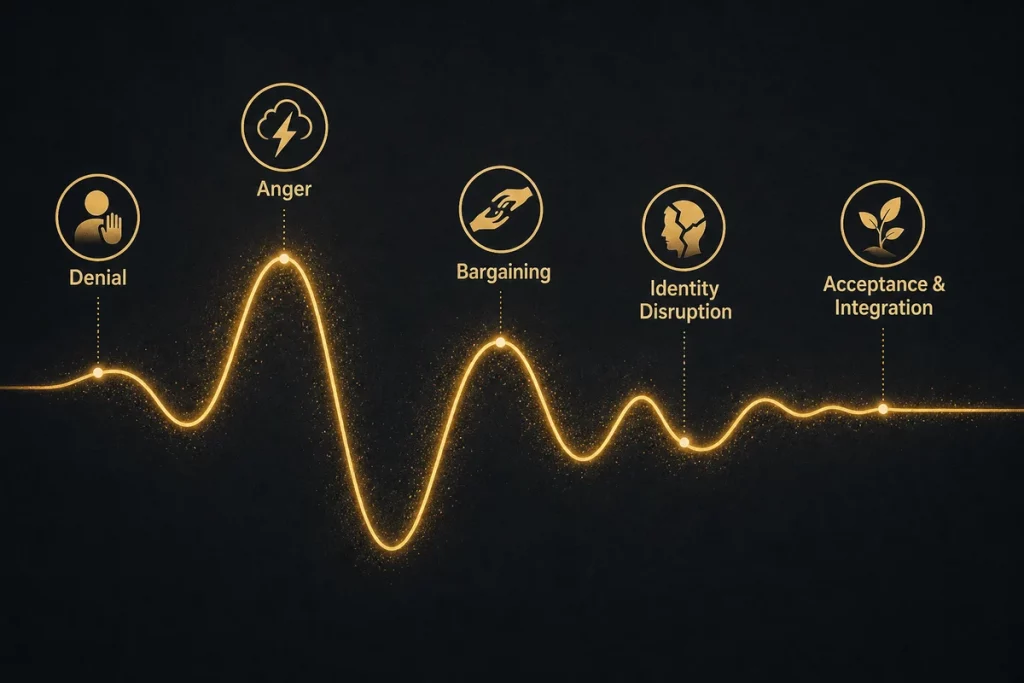
Denial and hope. “Maybe they’re just busy.” “Maybe I’m reading too much into it.” “Maybe if I reach out one more time…” The denial stage is particularly prolonged in friend breakups because the ambiguity of most friendship endings supports the hope that things will return to normal. The denial breaks when a specific moment makes the loss undeniable — they didn’t show up for your birthday, they started a new friendship group without you, or you realize you haven’t had a real conversation in six months.
Anger and injustice. “How could they treat me like this after everything we’ve been through?” Anger is natural and serves a protective function: it reinforces the recognition that you deserved better treatment and that the loss was not acceptable. In friend breakups involving betrayal, the anger may be intense and sustained. In slow-fade breakups, the anger is often directed at the ambiguity itself: “They couldn’t even have the decency to tell me it was over.” Allow the anger without acting on it destructively — the anger is information about what you value, not a mandate for retaliation.
Sadness and missing. The hardest stage because it’s the most purely painful. Missing their laugh. Missing the shorthand communication that took years to develop. Missing having someone who understood your context without explanation. Missing the version of yourself that existed in their presence. This sadness is grief — genuine, valid, legitimate grief that deserves the same respect as any other significant loss. If people in your life dismiss this sadness (“it’s just a friendship”), they’re wrong — and their dismissal reflects cultural blind spots about friendship, not the reality of your experience.
Identity adjustment. Close friendships can shape identity, and losing a best friend may require adjusting the self-concept that included them. “We often…” becomes “I used to…” The adjustment is not just about losing activities or routines; it can also mean losing a familiar mirror for parts of yourself. Their absence may leave an identity gap that changes as you reconnect with your own interests and other relationships.
Acceptance and integration. The friendship becomes a chapter in your story — valued for what it gave you, grieved for what it lost, and integrated into your understanding of who you are and what you need from connection. Acceptance doesn’t mean the loss stops mattering — it means the loss stops dominating. You can remember the good without being consumed by the grief, acknowledge the ending without being defined by it, and carry the lessons forward into new friendships without the weight of unprocessed pain. Some people find that acceptance arrives not as a single moment but as a gradual realization — one day you notice that you haven’t thought about the lost friendship in a week, and the absence of the thought doesn’t produce guilt. That’s integration at work.
How to Get Over a Friend Breakup: Recovery Strategies
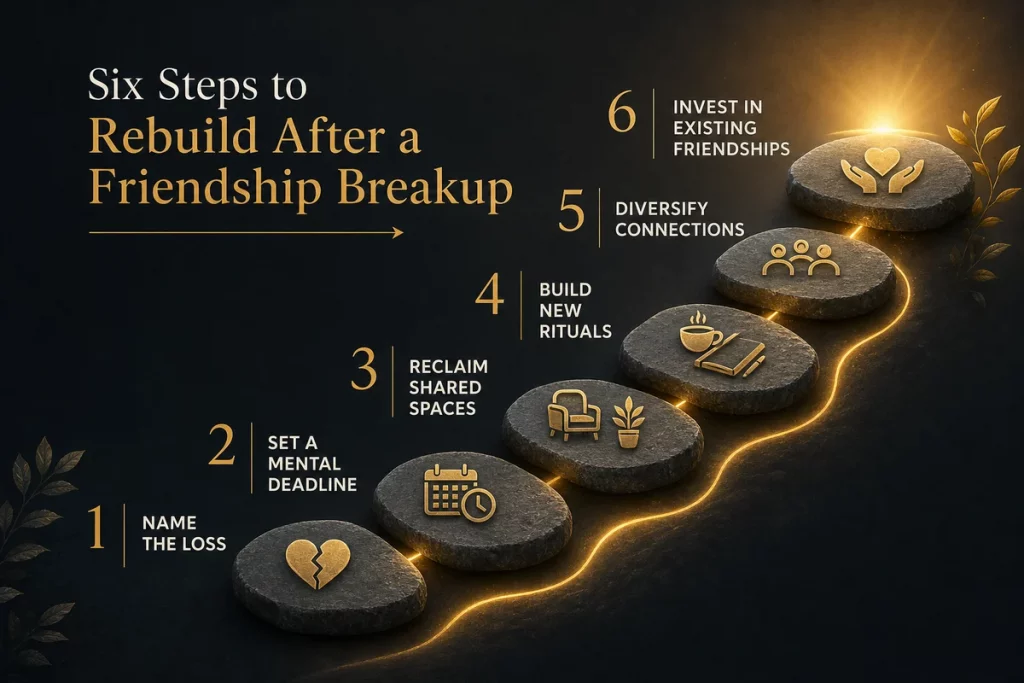
Name the loss as real. The single most important recovery step: acknowledge to yourself and to trusted others that you lost something significant. “My best friend and I aren’t friends anymore, and I’m grieving” is not dramatic — it’s accurate. The naming validates your experience, creates space for processing, and counters the cultural minimization that tells you friendship loss shouldn’t hurt this much. It should, and it does, and naming it is the beginning of recovery.
Process without the ambiguity trap. If the friendship ended through a slow fade, resist the indefinite “maybe they’ll come back” hope that prevents processing. Set a mental boundary: “If they haven’t initiated meaningful contact in [timeframe], I accept that the friendship has ended.” This boundary converts ambiguous grief into processable loss — painful but productive, because you can grieve what you’ve accepted is over in a way you can’t grieve what might still be ongoing.
Journal the full friendship arc. Write the story — from meeting through the good years through the decline through the end. Include what you valued, what you contributed, what they contributed, what went wrong, and what you learned. This narrative exercise produces the narrative coherence that the brain needs to process loss. Without a coherent story, the brain keeps searching for understanding; with one, the brain can begin the integration that constitutes genuine recovery.
Resist the urge to replace immediately. The impulse to find a “new best friend” quickly is the friendship equivalent of a rebound relationship — and it fails for the same reason: the new connection can’t address the specific grief from the lost one, and the pressure of filling a vacancy rather than building an organic connection produces unfair expectations that burden the new friendship before it begins. Allow yourself to be in the gap. The gap is uncomfortable but it’s where the growth happens.
Examine your patterns honestly. What role did you play in the friendship’s ending? This isn’t self-blame — it’s self-awareness. Did you take the friendship for granted? Did you fail to communicate changing needs? Did you avoid the difficult conversation that might have saved the connection? Honest self-assessment produces the lessons that improve your next friendships. The boundary-setting guide applies to friendships as much as romantic relationships — unspoken boundaries that get violated produce resentment in any relationship type.
Therapy if needed. If the friend breakup involved betrayal, love bombing patterns, gaslighting, or narcissistic dynamics, the recovery work mirrors abusive romantic relationship recovery and benefits from professional support. The National Domestic Violence Hotline recognizes that emotional abuse occurs in non-romantic relationships as well. Our trauma bonding in friendship guide addresses the specific dynamics of abusive friendship patterns.
Create intentional rituals for closure. Since friend breakups lack cultural closure rituals, create your own: write a letter you don’t send (expressing everything — gratitude, anger, sadness, understanding). Create a memory box with items from the friendship and put it away. Delete or archive text threads that you find yourself rereading compulsively. These intentional acts of closure provide the formal marking that the culture doesn’t offer, giving your brain the “this chapter is closed” signal that enables processing to progress toward integration rather than cycling indefinitely in the ambiguity loop.
Manage the mutual friend situation proactively. If the friend breakup fragments shared social networks, address the situation directly rather than letting awkwardness accumulate. Communicate with mutual friends: “I want you to know that [friend] and I aren’t close anymore. I don’t expect anyone to choose sides, and I genuinely want you to maintain your own friendship with them. I just wanted to be transparent.” This proactive communication prevents the social anxiety of wondering who knows, who’s chosen sides, and who might be reporting your behavior back to the lost friend. It also demonstrates the emotional maturity that strengthens your remaining friendships while modeling the kind of honest communication that prevents future friendship losses. If navigating the social fallout feels overwhelming, our boundary-setting guide provides frameworks for protecting your emotional space while maintaining important connections.
Rebuilding Your Social World After a Friend Breakup
Diversify your attachment portfolio. If the lost friendship was your primary or sole close connection, the loss exposed a vulnerability: concentrated attachment. Rebuilding should include cultivating multiple close connections rather than placing all attachment needs on a single person. Multiple close friendships provide resilience — the loss of any one friendship is painful but not devastating when other connections remain.
Invest in friendships you value. The breakup may highlight other relationships that received less attention while one friendship absorbed much of your social energy. Reconnecting with people you already trust can feel more manageable than building every connection from scratch, though both approaches can matter. A text saying “I’ve been going through something and I realize I haven’t invested enough in our friendship — can we get together this week?” is honest, vulnerable, and opens the door to a deeper conversation.
When entering new connections, apply what you learned. The friend breakup taught you something about what you need, what you can’t accept, and what patterns to watch for. Apply those lessons without projecting the specific pain onto new people. Not every new friend who cancels plans is beginning a slow fade. Not every disagreement will escalate into an explosion. The lessons are about patterns, not people — and the new people deserve the chance to demonstrate who they are rather than being pre-judged through the lens of who hurt you.
When re-entering the broader social world, the same principles of trust-building that apply to dating apply to friendship. Use GuyID’s free screening tools for identity verification in dating contexts, and apply the behavioral verification principles to friendship: consistency between words and actions, reliability over time, and mutual investment rather than one-sided effort. Share your Date Mode link through GuyID when dating — verified, transparent connections in romance create the stability that supports healthy friendships, and healthy friendships create the security that supports healthy romance. The two relationship domains reinforce each other, and rebuilding one strengthens the other.
How GuyID Helps
GuyID should appear when it is useful, not as a banner ad. A GuyID Trust Profile gives someone a portable way to share trust signals before a date, while identity verification and social vouching help turn vague profile claims into clearer next steps.
Useful next steps:
- Create a GuyID Trust Profile when you want a cleaner way to share verified trust signals.
- Use GuyID free tools and related guides when you need a checklist before meeting someone.
- Treat identity verification as confidence-building, not a guarantee.
- Use social vouching when you want context from people who already know the person.
- Sign up only when the extra trust layer helps the decision you are already trying to make.
Frequently Asked Questions
How long does it take to get over a friend breakup?
Similar to romantic breakup recovery: 3-12 months for most people, depending on friendship length, depth, type of ending, and social network disruption. Close friendships of 5+ years typically require 6-12 months of active processing. The breakup recovery timeline guide covers the factors that influence your specific timeline — the principles apply equally to friendship loss.
Is it normal to grieve a friendship?
Completely normal — and psychologically expected. Close friendships activate the same attachment systems as romantic relationships, producing equivalent grief when severed. The cultural lack of recognition for friendship grief doesn’t reflect psychological reality — it reflects a cultural blind spot. Your grief is valid regardless of whether others understand its intensity.
Should I try to save the friendship before giving up?
If the friendship was meaningful and the ending wasn’t caused by betrayal or abuse — yes, one honest conversation about what’s happening is worth attempting. “I’ve noticed our friendship has changed, and I value you enough to talk about it directly” gives the friendship a chance that the slow fade denies. If the conversation produces mutual commitment to reinvestment, the friendship may survive. If it produces denial, dismissal, or more avoidance — you have your answer, and you can begin processing a confirmed ending rather than an ambiguous one.
Why does losing a friend hurt more than losing a partner?
Several reasons: friendships often span more years than romantic relationships, creating deeper attachment. Friends frequently know versions of you that partners never met. Friendship loss lacks social validation (nobody sends sympathy cards for friend breakups). And friendship loss often fragments entire social networks, producing compound loss beyond the individual relationship. The cultural dismissal adds injury: you’re grieving something significant while being told it shouldn’t be significant, which creates isolation on top of loss.
Can a broken friendship be repaired?
Sometimes — depending on how it ended and whether both people want to rebuild. Friendships that ended through outgrowing or life transitions can sometimes be revived when circumstances change. Friendships that ended through betrayal require the same trust-rebuilding process as romantic betrayals: genuine accountability, behavioral change, and time. Friendships that ended through slow fade can sometimes be reignited with honest conversation about what happened and mutual recommitment. The key variable: BOTH people need to want the repair. One-sided effort produces frustration, not friendship.