

Reader Briefing
Reader Briefing
Start here if you need a practical read on what does stonewalling mean?: who should use verification, what signals to check, and what to do before moving from online interest to an in-person plan.
Who this is for
- Readers preparing for a first in-person date.
- Anyone checking identity, profile consistency, and trust signals.
- Online daters improving conversations, profiles, or match screening.
You’ll learn
- How to evaluate identity signals without treating any single check as certainty.
- Which trust signals matter and how to weigh them together.
- How to move from online conversation to a safer first meeting.
- Where GuyID tools fit into a quick pre-date screening workflow.
- When to slow down, ask for more context, or walk away.
- How to turn the article’s advice into a concrete next step.
Bottom line
Verification reduces uncertainty; it does not guarantee future behavior. Use a layered approach: confirm identity signals, compare profile consistency, ask for a short video call, keep early plans public, and slow down when someone pressures you to skip normal safety steps.
Key takeaways
- Identity verification improves confidence, not certainty.
- Verify before meeting privately or sharing sensitive details.
- A short video call can reveal many inconsistencies.
- Pressure to skip reasonable safety steps is useful information.
- Use GuyID tools to turn vague concerns into specific checks.
Free Tools
Catfish Probability Detector
Check whether a dating profile has suspicious identity or photo signals.
Dating Bio Red Flag Detector
Review a bio for scam, pressure, or trust-warning language.
Dating Safety Checklist
Use free GuyID tools before moving from chat to a real date.
Next step
Create your GuyID trust profile
Share consent-based trust signals before a date without turning the conversation into an interrogation.
You’re trying to have a conversation about something that matters — and they shut down completely. Eyes glaze over. Arms cross. Responses stop. They leave the room, or worse, they stay physically but disappear emotionally. If you’ve experienced this, you need to understand what stonewalling mean in relationship contexts — because stonewalling is one of the four behaviors that relationship researcher John Gottman identifies as the most reliable predictors of relationship failure. Understanding what does stonewalling mean goes beyond the dictionary definition of “refusing to communicate.” It means understanding the neuroscience of why people stonewall, the devastating impact on the partner being stonewalled, when stonewalling crosses from self-protection into abuse, and how to address the pattern before it destroys the connection entirely.
NavigateTable of Contents26 sections
What Does Stonewalling Mean?
What does stonewalling mean in relationships? Stonewalling is the act of completely withdrawing from communication during a conversation — refusing to engage, respond, or acknowledge what the other person is saying. The stonewaller may physically leave, go silent while remaining present, give monosyllabic non-responses (“fine,” “whatever,” “I don’t care”), change the subject, or adopt a blank, disengaged expression that communicates “I am not participating in this conversation” without saying the words.
The term comes from the image of a stone wall — immovable, unresponsive, impenetrable. When someone stonewalls, they become that wall: nothing gets through. Questions go unanswered. Feelings go unacknowledged. Attempts to connect bounce off without impact. For the person being stonewalled, the experience is profoundly isolating — you’re talking to someone who is physically present but emotionally absent, and the absence feels worse than physical distance because you can SEE them choosing not to engage.
Understanding what does stonewalling mean requires distinguishing it from related but different behaviors. Stonewalling is not the same as taking a pause during heated conflict (which is healthy). It’s not the same as being naturally quiet or introverted (which is personality, not strategy). And it’s not the same as being unable to articulate emotions in the moment (which reflects skills deficit, not withdrawal). Stonewalling mean a deliberate or reflexive shutdown of all communicative engagement — verbal and nonverbal — in response to a partner’s attempt to address an issue, express a need, or resolve a conflict.
The American Psychological Association classifies stonewalling as a form of emotional withdrawal that can constitute psychological aggression when used consistently as a response to a partner’s legitimate communication needs. Understanding what does stonewalling mean in clinical terms helps remove the ambiguity: this isn’t “just how some people handle conflict” — it’s a documented relational behavior with measurable negative effects on relationship satisfaction, partner mental health, and relationship longevity.
Stonewalling as a Relationship Predictor
Stonewalling is the fourth horseman, and understanding what stonewalling mean in the Gottman framework explains why it’s so destructive:
By the time stonewalling appears, the relationship has already progressed through escalating dysfunction. Contempt expresses superiority and disgust. Defensiveness deflects responsibility. Stonewalling withdraws entirely — representing the point at which one partner has given up on the possibility that communication will produce resolution. When someone stonewalls, they’ve concluded (consciously or unconsciously) that engaging is pointless, dangerous, or more painful than silence.
The 85% male pattern. Research from the National Library of Medicine on stonewalling patterns confirms Gottman’s finding that approximately 85% of stonewallers in heterosexual relationships are men — not because men are more emotionally withdrawn by nature, but because male physiological responses to relationship conflict are typically more intense (higher heart rate elevation, slower cardiovascular recovery), and stonewalling is often the nervous system’s attempt to regulate overwhelming physiological arousal. This doesn’t excuse the behavior — but it contextualizes what stonewalling mean in terms of nervous system responses rather than purely volitional choices.
These numbers make stonewalling one of the most empirically validated predictors of relationship failure in the psychology literature — which is why understanding what does stonewalling mean isn’t academic; it’s essential for anyone whose relationship includes this pattern.
The Neuroscience Behind Stonewalling
What does stonewalling mean at the neurological level? Understanding the brain’s role explains why stonewalling happens and why “just talk to me” doesn’t work as a solution:
Diffuse Physiological Arousal (DPA). Gottman’s research identifies DPA — a state where heart rate exceeds 100 BPM during conflict, stress hormones flood the system, and the prefrontal cortex (responsible for rational thought and empathy) goes offline — as the physiological precursor to stonewalling. When someone enters DPA, their brain shifts into fight-or-flight mode. Some people fight (yell, criticize, attack). Others flee (stonewall). The stonewaller’s nervous system has determined that the conversation is a threat, and the shutdown is the brain’s attempt at self-preservation — reducing stimulation by refusing to process incoming emotional data.
Emotional flooding. Many stonewallers experience what therapists call “emotional flooding” — a state where the volume of incoming emotional information exceeds the brain’s processing capacity. The result is cognitive shutdown: the person literally cannot formulate responses, cannot access empathy, and cannot engage constructively because their cognitive resources are consumed by managing the overwhelming internal experience. What does stonewalling mean for the stonewaller themselves? Often, it means being trapped inside a body that has locked them out of their own cognitive functions — which feels as helpless to them as the silence feels rejecting to their partner.
Learned helplessness contribution. In relationships with chronic conflict, stonewalling can develop as a learned helplessness response: “Nothing I say makes things better, and engagement makes things worse, so I’ll stop engaging.” This isn’t strategic manipulation — it’s the same psychological shutdown that develops in any environment where the person perceives their actions as having no positive effect on outcomes. Understanding what stonewalling mean through this lens generates more compassion (the person is genuinely stuck) while maintaining the recognition that the behavior is still harmful regardless of its cause.
8 Signs of Stonewalling
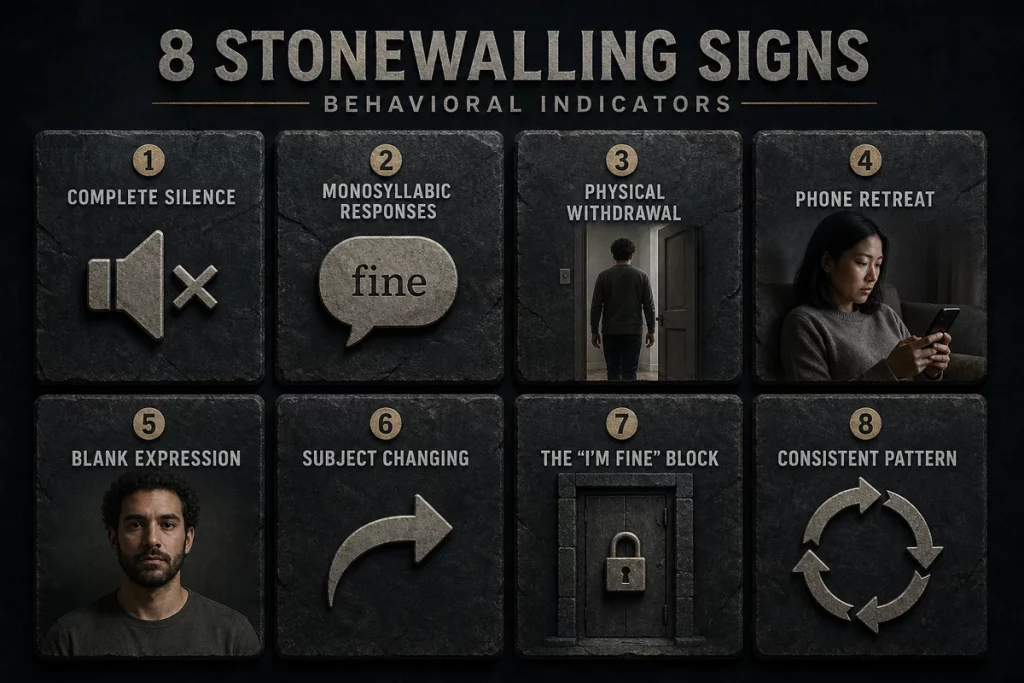
1. Complete Silence During Conflict
You’re talking; they’re not responding. Not processing silently before responding (which includes nonverbal engagement like nodding or eye contact) — genuinely not responding at all. The silence isn’t contemplative; it’s a wall. This is the most recognizable manifestation of what stonewalling mean in practice.
2. Monosyllabic Non-Responses
“Fine.” “Whatever.” “Okay.” “Sure.” “I don’t know.” These aren’t answers — they’re verbal wall-bricks designed to technically respond while providing zero genuine communication. The words say “I heard you”; the delivery says “I refuse to engage with what you said.” Monosyllabic responses during serious conversations are stonewalling with a thin verbal veneer.
3. Physical Withdrawal
Leaving the room mid-conversation. Going to another part of the house. Getting in the car and driving away. Physical withdrawal during an active discussion — without communicating “I need a break and I’ll come back” — is stonewalling expressed through movement rather than silence. The departure communicates: “This conversation is over because I’ve decided it’s over” — regardless of whether the other person’s need for discussion has been met.
4. Phone/Screen Retreat
Picking up the phone during a serious conversation. Turning on the TV. Opening a laptop. Retreating into a screen while your partner is trying to communicate is a modern form of stonewalling that uses technology as the wall. It communicates the same message as silence — “I am not participating” — but with the additional dismissiveness of choosing a device over your partner’s emotional needs.
5. Blank, Disconnected Facial Expression
The “thousand-yard stare” during conflict — eyes unfocused, face expressionless, body language conveying absence rather than presence. This blank expression often indicates that the person has entered DPA and their emotional processing has shut down. For the partner observing it, the blankness is deeply unsettling — you’re watching someone you love become temporarily unreachable, and the disconnect feels personal even when it’s physiological.
6. Changing the Subject
7. The “I’m Fine” Block
“Are you okay?” “I’m fine.” “Can we talk about what happened?” “There’s nothing to talk about. I’m fine.” When “fine” is deployed as a conversation-stopper rather than a genuine status report, it’s a stonewalling tactic that places the burden of proof on the concerned partner while denying the existence of the issue that prompted the concern. This creates a double bind: pushing past “I’m fine” feels like not respecting their stated position, while accepting it means abandoning your own legitimate need for communication.
8. Consistent Pattern Across Multiple Conflicts
One instance of shutdown during an overwhelming moment isn’t necessarily stonewalling — it may be a temporary stress response. What does stonewalling mean as a pattern? When the shutdown occurs consistently across multiple conflicts, multiple topics, and over months or years, the consistency transforms it from “a bad moment” into a relationship dynamic. The pattern — not the individual instance — is what predicts relationship failure.
Stonewalling vs. Needing Space: The Critical Distinction
This distinction matters enormously — because healthy self-regulation during conflict looks similar to stonewalling from the outside but operates completely differently from the inside:
| Stonewalling | Healthy Space-Taking |
|---|---|
| Withdraws without communicating the need for a break | “I need 20 minutes to calm down. I’ll come back and we’ll continue.” |
| No return timeline — the conversation is abandoned | Specific return timeline — the conversation is paused, not ended |
| Used to avoid the conversation permanently | Used to improve the quality of the conversation when it resumes |
| The withdrawing partner doesn’t self-soothe — they stew or avoid | The withdrawing partner actively calms their nervous system |
| Leaves the other partner feeling abandoned and dismissed | Leaves the other partner feeling respected and reassured |
| The issue remains unresolved indefinitely | The issue is addressed once both partners are regulated |
The single most important differentiator: communication about the withdrawal. “I’m overwhelmed and I need a break — can we come back to this in 30 minutes?” transforms stonewalling into healthy self-regulation. The words take 5 seconds. They communicate respect for both the partner’s need for discussion AND the withdrawer’s need for regulation. They provide a concrete return timeline that prevents the abandoned partner from spiraling into rejection anxiety. And they demonstrate that the conversation matters — it’s being paused for quality, not cancelled for avoidance.
The Impact on the Partner Being Stonewalled
Understanding what does stonewalling mean requires understanding its impact on the person being stonewalled — which is often more severe than the stonewaller realizes:
Rejection sensitivity activation. Being stonewalled activates the same neural pathways as social rejection — because functionally, that’s what it is: one person rejecting another person’s attempt to connect. For partners with anxious attachment, stonewalling triggers the core abandonment fear at maximum intensity because the person they depend on for emotional safety has become emotionally inaccessible while remaining physically present.
Pursuit-withdrawal escalation. The stonewalled partner often responds to the withdrawal by pursuing more intensely — raising their voice, following the stonewaller from room to room, escalating emotional expression in an attempt to break through the wall. This pursuit is a protest behavior driven by the attachment system — but it produces the opposite of the desired effect: the stonewaller withdraws further in response to the escalation, creating a destructive feedback loop where more pursuit produces more withdrawal, producing more pursuit, until the conflict has expanded far beyond the original issue. This pursue-withdraw cycle is one of the most thoroughly documented destructive relationship patterns in couples research.
Self-blame and gaslighting-adjacent effects. “Maybe I’m too much.” “Maybe my needs are unreasonable.” “Maybe I should just stop trying to talk about things.” Being repeatedly stonewalled teaches the partner that expressing needs leads to rejection — producing a self-silencing pattern that resembles the effects of gaslighting. The partner learns to suppress their needs to avoid triggering the stonewalling response, gradually eroding their voice within the relationship until they’ve adapted to the stonewaller’s preferred dynamic: silence.
The National Domestic Violence Hotline recognizes chronic stonewalling as a form of emotional abuse that produces physical as well as psychological harm — making the “it’s just their communication style” minimization both clinically inaccurate and potentially dangerous.
When Stonewalling Becomes Abuse
Not all stonewalling is abuse — but understanding what does stonewalling mean in the abuse context helps distinguish between a nervous system response and a control tactic:
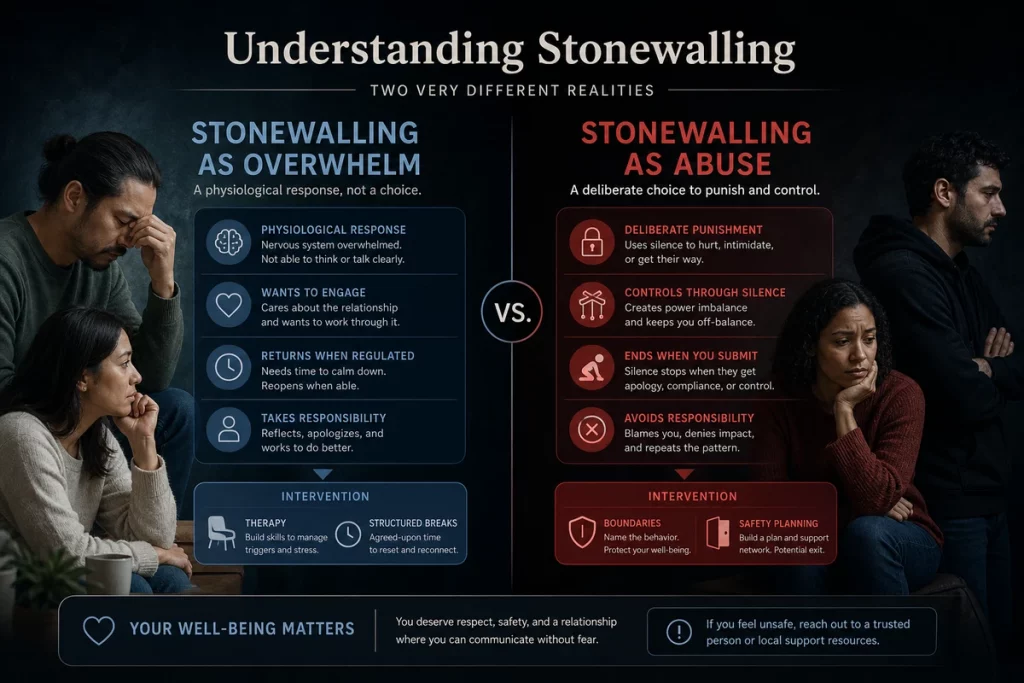
Stonewalling as overwhelm (not abuse): The person genuinely experiences flooding/DPA, wants to engage but can’t in the moment, returns to the conversation once regulated, takes responsibility for the shutdown, and is willing to develop better coping strategies through therapy. This is a skills deficit — problematic and damaging, but not abusive in intent.
Stonewalling as abuse: The person uses silence deliberately as punishment — withdrawing warmth, affection, communication, and responsiveness specifically to punish the partner for expressing needs, setting boundaries, or initiating conversations the stonewaller doesn’t want to have. The silence ends not when regulation occurs but when the partner capitulates — apologizes for raising the issue, withdraws the request, or otherwise communicates “I’ll stop asking.” When stonewalling operates as punishment that persists until the other person submits, it has crossed from communication failure into emotional manipulation. Our emotional abuse checklist and toxic relationship quiz can help you evaluate which category your partner’s stonewalling falls into.
How to Address Stonewalling
If you’re the stonewaller:
Recognize that understanding what stonewalling mean intellectually is the first step — but behavioral change requires practice, not just awareness. Learn to identify the physiological signs that DPA is approaching: elevated heart rate, chest tightness, racing thoughts, the urge to flee. When you feel these signs emerging, communicate: “I’m getting overwhelmed and I need a 20-minute break. I want to finish this conversation — I just need to calm my nervous system first.” Then use the break productively: deep breathing, walking, progressive muscle relaxation — not phone scrolling, not ruminating about the argument, not building your defense. Return at the stated time. Re-engage. This pattern — communicate, pause, regulate, return — replaces stonewalling with a healthy alternative that respects both partners’ needs.
If your partner stonewalls:
Name the pattern without accusation: “When I try to discuss things that are important to me and you go silent, I feel dismissed and alone. I need us to find a way to have these conversations that works for both of us.” Suggest the structured break approach: “If you’re overwhelmed, I completely understand needing a pause — but I need you to tell me you need a break and when you’ll come back, rather than just shutting down.” If stonewalling continues despite direct communication and agreed-upon alternatives, couples therapy with a Gottman-trained therapist provides the structured intervention that addresses the Four Horsemen pattern specifically.
When the relationship is worth working on: Both partners engage in individual therapy (the stonewaller to develop emotional regulation and communication skills; the pursued partner to develop self-soothing capacity during withdrawal episodes) plus couples therapy focused on replacing the pursue-withdraw cycle with a structured conflict management protocol. Emotionally Focused Therapy (EFT) has the strongest evidence base for addressing stonewalling patterns specifically.
When it’s time to leave: If stonewalling is chronic, deliberate, punitive, and resistant to intervention — particularly when combined with gaslighting, manipulation, or narcissistic abuse patterns — the relationship may not be viable regardless of your communication improvements. Understanding what stonewalling mean in the context of broader abuse helps you assess whether you’re dealing with a skills deficit (changeable) or a control strategy (unlikely to change). Take our trauma bonding test if the stonewalling is part of a larger pattern of intermittent cruelty and warmth.
For future relationships. When re-entering dating, watch for communication patterns early. A person who withdraws from even mild disagreements during the dating phase will stonewall during marriage-level conflict. Use GuyID’s free screening tools for identity verification, but also apply behavioral verification: how does this person handle mild conflict, expressed needs, and boundaries? The green flags guide identifies constructive conflict handling as a key positive indicator. Share your Date Mode link through GuyID — verified, transparent connections are the foundation on which healthy communication patterns build.
How GuyID Helps
GuyID should appear when it is useful, not as a banner ad. A GuyID Trust Profile gives someone a portable way to share trust signals before a date, while identity verification and social vouching help turn vague profile claims into clearer next steps.
Useful next steps:
- Create a GuyID Trust Profile when you want a cleaner way to share verified trust signals.
- Use GuyID free tools and related guides when you need a checklist before meeting someone.
- Treat identity verification as confidence-building, not a guarantee.
- Use social vouching when you want context from people who already know the person.
- Sign up only when the extra trust layer helps the decision you are already trying to make.
Frequently Asked Questions
What does stonewalling mean in a relationship?
Stonewalling mean completely withdrawing from communication during conflict — refusing to respond, engage, or acknowledge the other person’s attempts to address an issue. The stonewaller may go silent, give monosyllabic non-responses, physically leave, or retreat into a screen. The key distinction: stonewalling is different from taking a communicated break — it’s withdrawal without communication about the withdrawal.
Is stonewalling a form of emotional abuse?
It depends on context and intent. Stonewalling driven by genuine overwhelm (DPA, emotional flooding) is a skills deficit — harmful but not abusive in intent. Stonewalling used deliberately as punishment — silence that persists until the partner capitulates, apologizes, or withdraws their request — is emotional manipulation. Use the emotional abuse checklist to evaluate whether the stonewalling is part of a broader pattern of control. See our detailed is stonewalling abuse guide for the complete framework.
Why does my partner stonewall me?
The most common reason: their nervous system enters Diffuse Physiological Arousal (DPA) during conflict — heart rate exceeds 100 BPM, stress hormones flood, and the prefrontal cortex goes offline. Stonewalling is the brain’s attempt to reduce stimulation. Less commonly: learned helplessness (“nothing I say helps”), deliberate punishment (using silence to control), or conflict avoidance as a personality pattern. Identifying which applies to your partner determines the appropriate intervention — therapy for overwhelm, boundaries for punishment, and communication training for avoidance.
How do I get my partner to stop stonewalling?
Name the pattern without accusation. Propose the structured break alternative: “Take the time you need, but tell me you need a break and when you’ll return.” Suggest Gottman-based couples therapy. Understand that you cannot force someone to stop stonewalling — you can communicate the impact, offer alternatives, and set boundaries about what you’ll accept. If stonewalling continues despite clear communication and available alternatives, the decision becomes whether the relationship can survive a dynamic that Gottman’s research identifies as one of the strongest predictors of dissolution.
Is the silent treatment the same as stonewalling?
They overlap significantly but aren’t identical. Stonewalling mean withdrawing during active conflict — the shutdown occurs in response to a conversation about an issue. The silent treatment extends beyond conflict — it’s sustained withholding of communication, warmth, and engagement for hours or days as punishment for perceived offenses. Both are harmful; the silent treatment is more reliably abusive because its sustained, punitive nature is harder to attribute to physiological overwhelm.
Can stonewalling be fixed in a relationship?
When the stonewaller genuinely wants to change and is willing to invest in the process, yes — through individual therapy (developing emotional regulation), couples therapy (replacing the pursue-withdraw cycle with structured breaks), and consistent practice of the communicate-pause-regulate-return protocol. When the stonewaller doesn’t see their behavior as a problem, isn’t willing to change, or uses silence deliberately as punishment — the prognosis is poor. The willingness to acknowledge the pattern and invest in alternatives is the critical variable.
How do I protect myself from stonewalling in future relationships?
Watch for communication patterns during early dating: how does the person handle mild disagreement? Do they engage constructively, or do they withdraw? The green flags guide identifies constructive conflict handling as a key positive indicator. Use GuyID’s free tools for identity verification and apply behavioral assessment: a person who handles early-dating disagreements through silence will handle marriage-level conflict through stonewalling. Share your Date Mode link through GuyID to build connections on verified transparency from the start.
Where can I learn more about stonewalling?
Our stonewalling in a relationship guide covers the dynamic in depth. The is stonewalling abuse guide provides the framework for evaluating when the line is crossed. John Gottman’s books “The Seven Principles for Making Marriage Work” and “Why Marriages Succeed or Fail” provide the research foundation. The emotional abuse checklist and toxic relationship quiz help evaluate the broader relationship context.