
Reader Briefing
Reader Briefing
Start here if you need a practical read on phone number lookup for dating safety: free methods & what results mean: who should use verification, what signals to check, and what to do before moving from online interest to an in-person plan.
Who this is for
- People meeting someone from a dating app or social platform.
- Readers preparing for a first in-person date.
- Anyone checking identity, profile consistency, and trust signals.
- People trying to avoid romance scams, fake profiles, or pressure tactics.
You’ll learn
- How to evaluate identity signals without treating any single check as certainty.
- Which trust signals matter and how to weigh them together.
- How to spot inconsistencies, pressure, or behavior patterns that deserve caution.
- How to move from online conversation to a safer first meeting.
- Where GuyID tools fit into a quick pre-date screening workflow.
- How to compare options using practical safety and trust criteria.
Bottom line
Verification reduces uncertainty; it does not guarantee future behavior. Use a layered approach: confirm identity signals, compare profile consistency, ask for a short video call, keep early plans public, and slow down when someone pressures you to skip normal safety steps.
Key takeaways
- Identity verification improves confidence, not certainty.
- Patterns matter more than isolated incidents.
- Verify before meeting privately or sharing sensitive details.
- A short video call can reveal many inconsistencies.
- Pressure to skip reasonable safety steps is useful information.
Free Tools
Catfish Probability Detector
Check whether a dating profile has suspicious identity or photo signals.
Dating Bio Red Flag Detector
Review a bio for scam, pressure, or trust-warning language.
Dating Safety Checklist
Use free GuyID tools before moving from chat to a real date.
Next step
Create your GuyID trust profile
Share consent-based trust signals before a date without turning the conversation into an interrogation.
NavigateTable of Contents23 sections
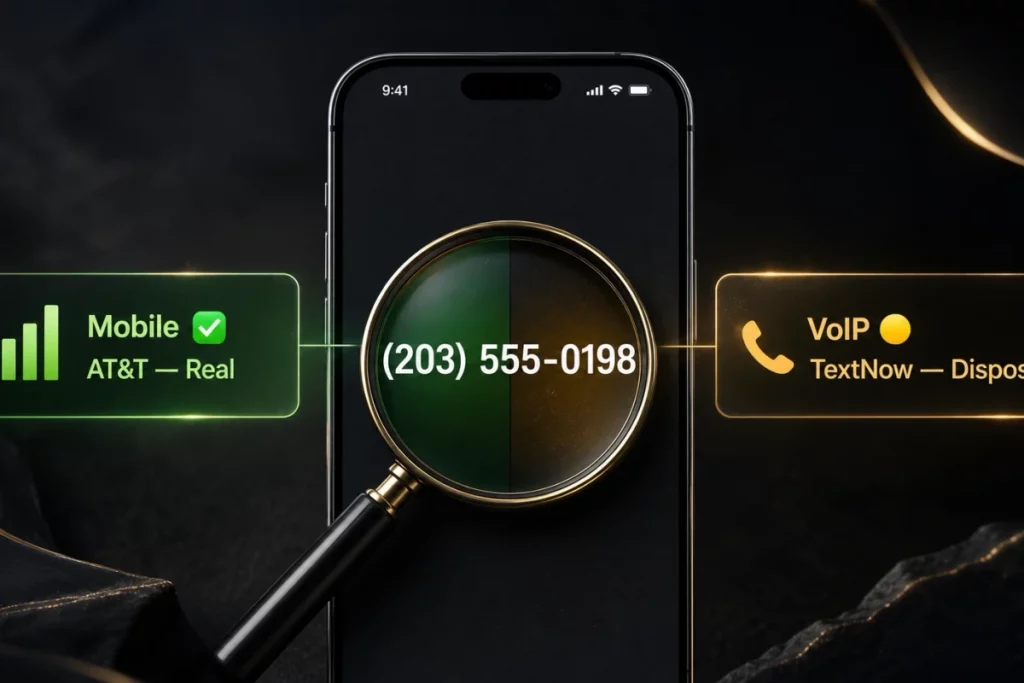
The moment you exchange phone numbers with a dating match is the moment you leave the relative safety of the dating platform and enter unmonitored communication. The dating app can’t protect you on WhatsApp. The platform’s report button doesn’t work in your text messages. And the phone number your match just shared is either a real number tied to a real person — or a disposable VoIP number created five minutes ago by someone running a romance scam from another continent. A phone number lookup for dating safety takes 30-60 seconds and can reveal whether the number is legitimate, disposable, or linked to a different identity than claimed — before you’ve shared personal information through a channel the scammer now controls. This guide covers every method: free tools, paid services, what the results mean, and the verification approach that makes phone investigation supplementary rather than essential.
Why the Phone Number Transition Is a Safety Checkpoint
The move from a dating app to WhatsApp, iMessage, or text is the single most important safety transition in online dating — and most people treat it as a casual logistics step.
What You Lose at the Transition
- Platform protections: Dating apps have report systems, content moderation, and the ability to ban abusive users. WhatsApp and text have none of these in the dating context.
- Identity linkage: On the dating app, the person’s profile (photos, bio, badge) is visible. On WhatsApp, they’re just a phone number with a display name they chose themselves.
- Conversation records: Dating app conversations exist within the platform’s moderation system. Text/WhatsApp conversations are private — only you and the other person can see them.
- Easy blocking/reporting: Reporting someone on a dating app can result in their account being banned. Blocking a phone number doesn’t prevent them from contacting you through other numbers.
What Scammers Gain at the Transition
Romance scammers push to move off-app quickly for exactly these reasons: once communication is on WhatsApp or text, the victim loses platform protections, the scammer gains unmonitored access, and the scammer’s fake dating profile can be deleted (eliminating evidence) while communication continues through the phone number. The urgency to “move to WhatsApp” within hours or days of matching is itself a documented red flag.
This makes the phone number itself worth investigating before you use it — or better, before you share your own.
Free Phone Number Lookup Methods
1. Google Search (10 seconds)
The simplest first check: search the phone number in quotes on Google (“555-123-4567”). Real phone numbers often appear in public records, business directories, social media profiles, or online marketplaces where the owner has used them. Results matching the person’s claimed name and location: positive signal. Results under a different name: red flag. Zero results: ambiguous — could be a private person or a disposable number.
2. Carrier Type Check (30 seconds)
The single most revealing free check — determines whether the number is a mobile phone, landline, or VoIP service.
- How to check: Free services like FreeCarrierLookup.com or CarrierLookup.com accept a phone number and return the carrier type.
- What to look for: “Mobile” or “Wireless” (AT&T, Verizon, T-Mobile, etc.) = expected for a real person. “VoIP” or “Internet” (Google Voice, TextNow, Bandwidth.com, Twilio) = a number that can be created for free, used temporarily, and discarded without a trace.
- Why it matters: VoIP numbers are the tool of choice for scam operations — free to create, impossible to trace to a real identity, and disposable after the scam is complete. A VoIP number isn’t conclusive proof of a scam (some real people use Google Voice for privacy), but it’s a significant yellow flag that warrants further verification.
Inline visual 1
3. WhatsApp Profile Check (10 seconds)
If the number is for WhatsApp communication: save the number, open WhatsApp, check their profile photo, about section, and last-seen status. Cross-reference the WhatsApp profile photo with their dating app photos. Mismatches between WhatsApp and dating app photos: red flag. No WhatsApp profile photo at all: yellow flag. Matching photo + filled profile: positive signal (not conclusive, but consistent).
4. Social Media Search (2 minutes)
Search the phone number on Facebook (Settings → Account → Phone) and Instagram (contact sync). Some platforms allow finding profiles by phone number if the owner has linked it. Finding a profile with matching name and photos: strong positive signal. Finding a profile with a different identity: definitive red flag.
5. Caller ID Apps (30 seconds)
Apps like Truecaller and Hiya maintain crowd-sourced databases linking phone numbers to names. If the number’s owner has been identified by other users, the app returns a name and sometimes a location. Matching name: positive. Different name: red flag. “Spam” or “Scam likely” tag: definitive red flag.
Paid Phone Lookup Services
When free methods are inconclusive and you want deeper information before proceeding.
BeenVerified Phone Lookup (paid service; check current pricing)
Returns: name, address history, associated email addresses, social media profiles, and sometimes criminal records linked to the phone number. The most comprehensive phone-to-identity connection available commercially. Useful when the person’s claimed identity needs cross-referencing against a phone number’s registered owner.
Spokeo Reverse Phone (paid service; check current pricing)
Returns: name, location, carrier, and associated online profiles. More affordable than BeenVerified with slightly less depth. Good for a quick identity check when free methods returned no results.
When Paid Services Are Worth It
If you’re considering meeting someone and: free methods returned ambiguous results, the carrier check showed VoIP, or something about the conversation feels off but isn’t definitive — a paid lookup may provide additional public-record context beyond free tools. The cost is trivial relative to the potential risk of meeting an unverified stranger.
Carrier Type Check: The Most Revealing Free Test
Of all phone number lookup methods, the carrier type check provides the highest information-to-effort ratio.
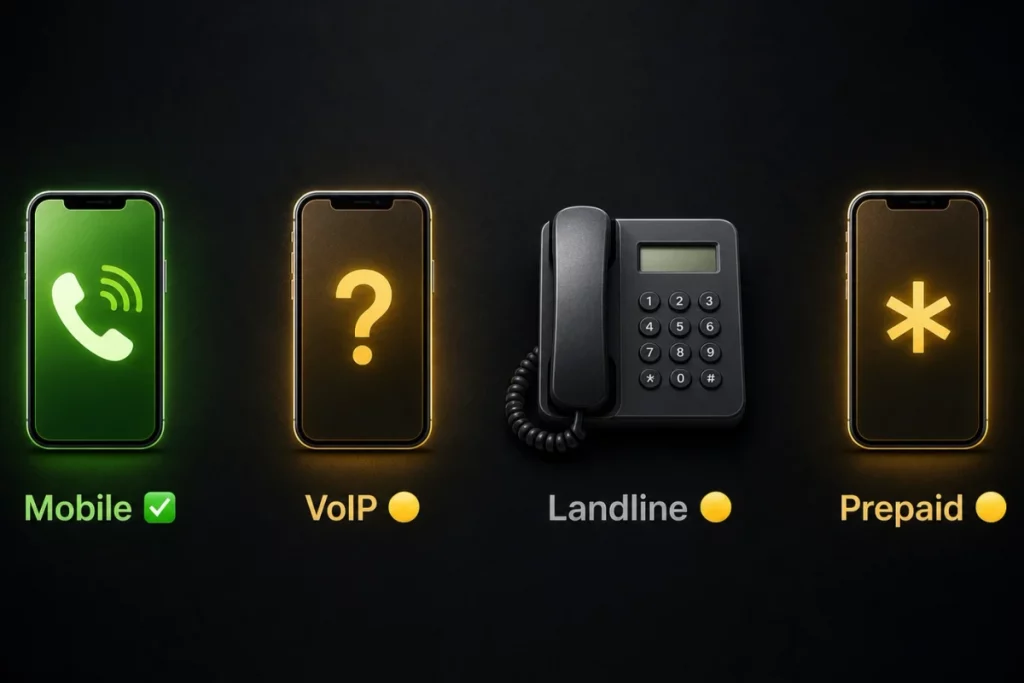
| Carrier Type | What It Means | Trust Signal |
|---|---|---|
| Mobile / Wireless (AT&T, Verizon, T-Mobile, etc.) | Standard mobile phone on a paid carrier account — requires identity to activate, costs money to maintain, tied to billing address | ✅ Expected — consistent with a real person’s phone |
| VoIP (Google Voice, TextNow, Bandwidth, Twilio) | Internet-based number — free to create, no identity required, disposable, can be created from any country | 🟡 Caution — scammer’s tool of choice. Not proof of scam but significant flag |
| Landline | Traditional phone line at a fixed address | 🟡 Unusual for dating — may indicate older user or non-standard setup |
| Prepaid mobile | Prepaid SIM — can be purchased without identity in some regions | 🟡 Common legitimately but also used by people avoiding identity linkage |
💡
The VoIP Context Rule A VoIP number from someone who explained upfront “I use Google Voice for dating privacy — here’s my real number once we’ve met” is reasonable. A VoIP number from someone who presented it as their regular phone number without disclosure is concerning. Context and transparency determine whether VoIP is a privacy practice or a concealment tactic.
How to Interpret Phone Lookup Results
| Finding | Interpretation | Action |
|---|---|---|
| Mobile carrier + name matches + social media confirms | ✅ Strong positive — multiple data points align | Proceed with standard first date safety. Video call before meeting. |
| Mobile carrier + no additional info found | ✅ Neutral-positive — carrier type is right, identity unconfirmed | Proceed cautiously. Request GuyID Trust Profile or video call for identity confirmation. |
| VoIP number + explained by owner + matches other verified info | 🟡 Acceptable with context — privacy measure, not concealment | Request secondary verification: video call + GuyID Trust Profile. If both pass: proceed. |
| VoIP number + not disclosed + other yellow flags present | 🟡 Concerning — disposable number consistent with scam infrastructure | Apply 5-layer investigation. Do not meet without video call + identity verification. |
| Number linked to a different name than claimed | 🔴 Red flag — identity mismatch between claim and registration | Confront discrepancy directly. If no satisfactory explanation: disengage and report. |
| Number flagged as “Spam” or “Scam Likely” in caller ID apps | 🔴 Definitive — known scam number flagged by other users | Stop all contact. Report on dating app. Block number. |
Red Flags in Phone Communication After the Transition
Even after the number checks out, monitor for behavioral red flags once communication moves to phone/WhatsApp.
- 🔴 Immediate financial topics: Investment opportunities, crypto platforms, or “I know a great way to make passive income” — pig butchering initiation
- 🔴 Urgency escalation: “Let’s delete the app since we have each other’s numbers now” — eliminating the platform’s evidence and safety infrastructure
- 🔴 Intimate photo requests: Soliciting intimate images through the private channel — potential sextortion setup
- 🟡 Timezone inconsistency: Messages at 3am from someone claiming to be in your city — possible offshore scam operator
- 🟡 Communication pattern change: Their personality on WhatsApp feels different from the dating app — possible team of operators rather than a single person
- 🟡 Refusal to call or video: Happy to text endlessly but never available for a live voice or video call — the catfish signal
The Better Approach: Verify Identity Before Exchanging Numbers
Phone number investigation is a reactive safety measure — you’ve already shared your number (and possibly your identity) before checking theirs. The proactive approach: verify identity at the transition point, not after it.
The Transition Protocol
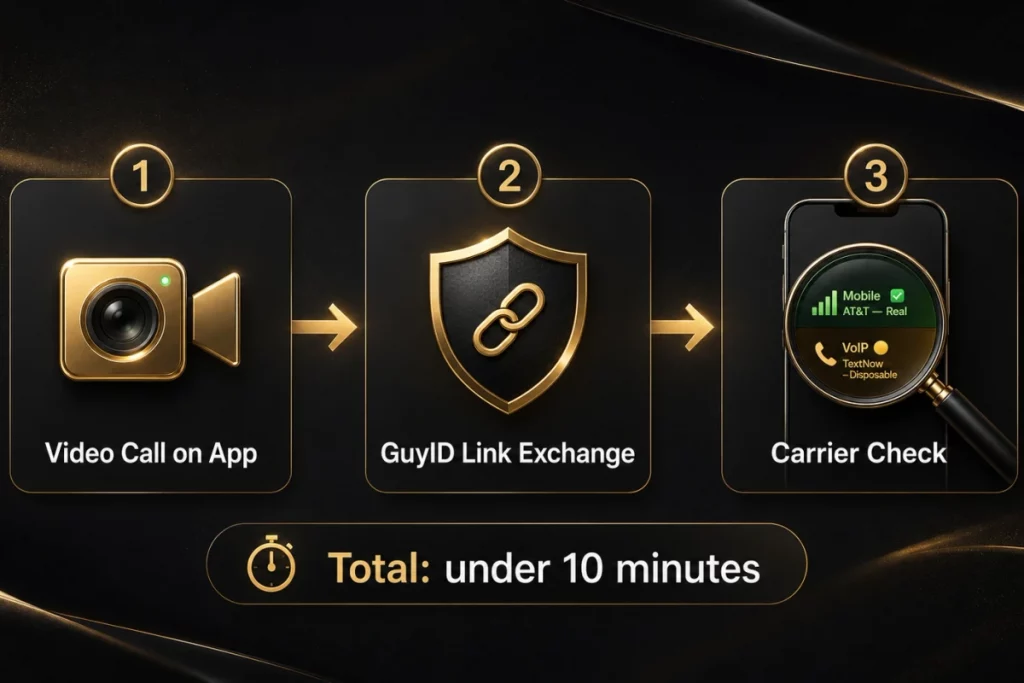
- Before sharing your number, request a video call on the dating app. The video call confirms the person behind the profile is a real human who matches their photos — eliminating the majority of catfish before you share personal contact information.
- At the number exchange, share your GuyID Date Mode link alongside your phone number: “Here’s my number — and here’s my verified identity: [link].” This establishes the verification norm. Then: “Do you have a GuyID? I check before meeting anyone from an app.”
- After the exchange, run the 30-second carrier check on their number. Cross-reference their WhatsApp photo. Apply the interpretation guide above. If everything aligns: proceed with confidence. If flags appear: address them before investing further.
This protocol layers three safety measures at the transition: video call (visual confirmation), GuyID link exchange (identity + character confirmation), and phone lookup (number legitimacy check). Together: the most protected number exchange possible — taking under 10 minutes total and providing trust evidence that persists through every subsequent interaction.
Inline visual 2
Why Verification Supersedes Investigation
Phone lookups tell you about a phone number. GuyID Trust Profiles tell you about a person — government-confirmed identity, character vouched by real people, progressive trust measurement. A phone lookup might reveal “VoIP number, no name found” — which tells you to be cautious but doesn’t confirm OR deny identity. A Trust Profile at TRUSTED tier tells you definitively: this person’s legal identity is confirmed, real people vouch for their character, and their trust has been sustained over time. The investigation is useful. The verification is conclusive.
Summary: 30 Seconds That Can Prevent Weeks of Damage
A phone number lookup for dating safety takes 30-60 seconds and provides meaningful information: carrier type (mobile vs VoIP), name linkage (matches or doesn’t), and flagging status (spam/scam tags from other users). It’s a lightweight checkpoint that every dater should apply at the number exchange — the transition point where platform safety disappears and personal vulnerability begins.
But phone investigation is a supplement, not a solution. The carrier check tells you about a phone number. The identity verification through GuyID tells you about a person. The strongest transition protocol combines both: video call on-app (visual confirmation) + GuyID link exchange (identity + character verification) + phone carrier check (number legitimacy). Three layers in under 10 minutes — protecting the transition that most people treat as a casual logistics step but that scam operators treat as the moment their victim leaves safety.
Check every number. Verify every person. And share your own verification at every transition — because safety at the number exchange protects everything that follows.
Frequently Asked Questions
How do I look up a phone number from a dating match?
What does it mean if their number is VoIP?
Is it legal to look up someone’s phone number?
Should I look up every match’s phone number?
What’s better — phone lookup or GuyID verification?
What should I do if a phone lookup reveals red flags?
Evidence Note
The FTC recommends searching online for a person’s claimed role together with the word “scammer” and checking profile images for conflicting identities. Phone lookup results are supporting context, not proof of identity.