Reader Briefing
Reader Briefing
Start here if you need a practical read on profile authenticity: what makes a real dating profile vs a fake: who should use verification, what signals to check, and what to do before moving from online interest to an in-person plan.
Who this is for
- People meeting someone from a dating app or social platform.
- Anyone checking identity, profile consistency, and trust signals.
- People trying to avoid romance scams, fake profiles, or pressure tactics.
- Online daters improving conversations, profiles, or match screening.
You’ll learn
- How to evaluate identity signals without treating any single check as certainty.
- Which trust signals matter and how to weigh them together.
- How to spot inconsistencies, pressure, or behavior patterns that deserve caution.
- Where GuyID tools fit into a quick pre-date screening workflow.
- How to compare options using practical safety and trust criteria.
- When to slow down, ask for more context, or walk away.
Bottom line
Verification reduces uncertainty; it does not guarantee future behavior. Use a layered approach: confirm identity signals, compare profile consistency, ask for a short video call, keep early plans public, and slow down when someone pressures you to skip normal safety steps.
Key takeaways
- Identity verification improves confidence, not certainty.
- Patterns matter more than isolated incidents.
- A short video call can reveal many inconsistencies.
- Pressure to skip reasonable safety steps is useful information.
- Use GuyID tools to turn vague concerns into specific checks.
Free Tools
Catfish Probability Detector
Check whether a dating profile has suspicious identity or photo signals.
Dating Bio Red Flag Detector
Review a bio for scam, pressure, or trust-warning language.
Dating Safety Checklist
Use free GuyID tools before moving from chat to a real date.
Next step
Create your GuyID trust profile
Share consent-based trust signals before a date without turning the conversation into an interrogation.
NavigateTable of Contents19 sections
Every dating profile claims to be real. No profile announces itself as fake. The question — "Is this profile authentic?" — is the fundamental safety assessment that 80 million dating app users (SSRS, 2026) make dozens of times per session, mostly subconsciously, in the 3-7 seconds they spend evaluating each profile. Profile authenticity isn't a single checkmark or a binary badge. It's a spectrum of signals — visual, textual, behavioral, and verified — that collectively indicate whether the person behind the profile is who they present themselves to be. In a market where 1 in 4 Americans encounter fake profiles and AI-generated identities are increasingly indistinguishable from real ones, understanding what makes a profile authentic — and what makes one fabricated — is the literacy that every online dater needs.
This guide explains profile authenticity from both sides: the signals that indicate a genuine person behind the profile, the signals that indicate fabrication, and the verification tools that confirm authenticity when visual and textual analysis alone can't.
What Profile Authenticity Actually Means
Profile authenticity answers three nested questions, each deeper than the last.
Question 1: Is This a Real Person?
The most basic authenticity check: does a real human being exist behind this profile? Or is it a fake profile — stolen photos, AI-generated identity, bot account, or scam operation? This is the question that reverse image searches, catfish detectors, and verification badges attempt to answer.
Question 2: Is This Person Who They Claim?
A real person can still misrepresent themselves: using old photos, lying about age, fabricating career claims, misrepresenting relationship status. The person behind the profile exists — but their presented identity doesn't match their actual identity. This is the question that photo verification partially addresses and that government ID verification definitively addresses.
Question 3: Is This Person's Character as Presented?
The deepest authenticity question: is the personality, character, and trustworthiness implied by the profile consistent with who this person actually is? A profile that presents someone as kind, honest, and relationship-ready — when the person is manipulative, dishonest, or emotionally unavailable — is inauthentic at the character level. This is the question that social vouching and character references address.
Full profile authenticity means all three levels check out: a real person (identity exists), accurately presented (claims match reality), with genuine character (personality matches behavior).
Inline visual 1
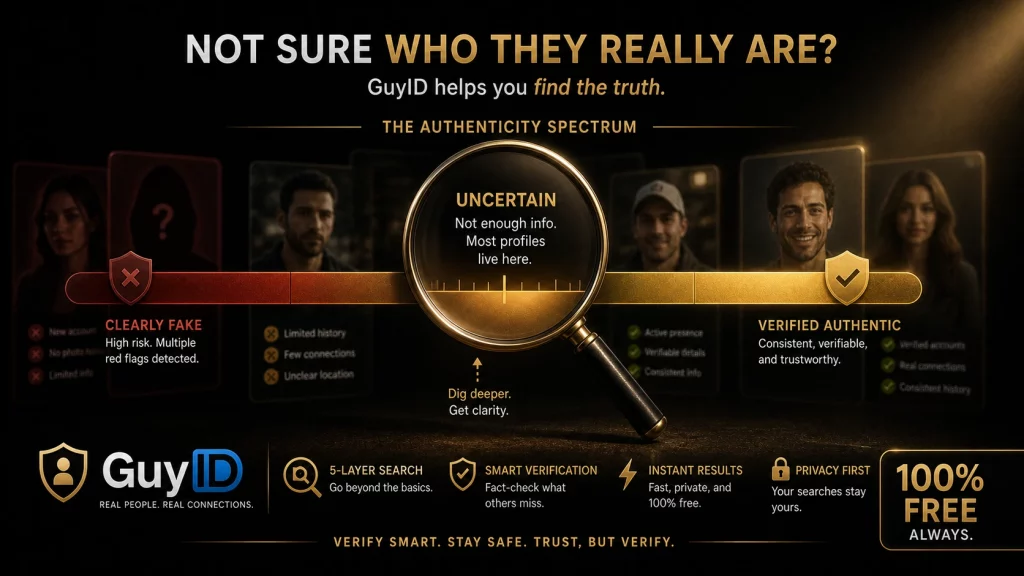
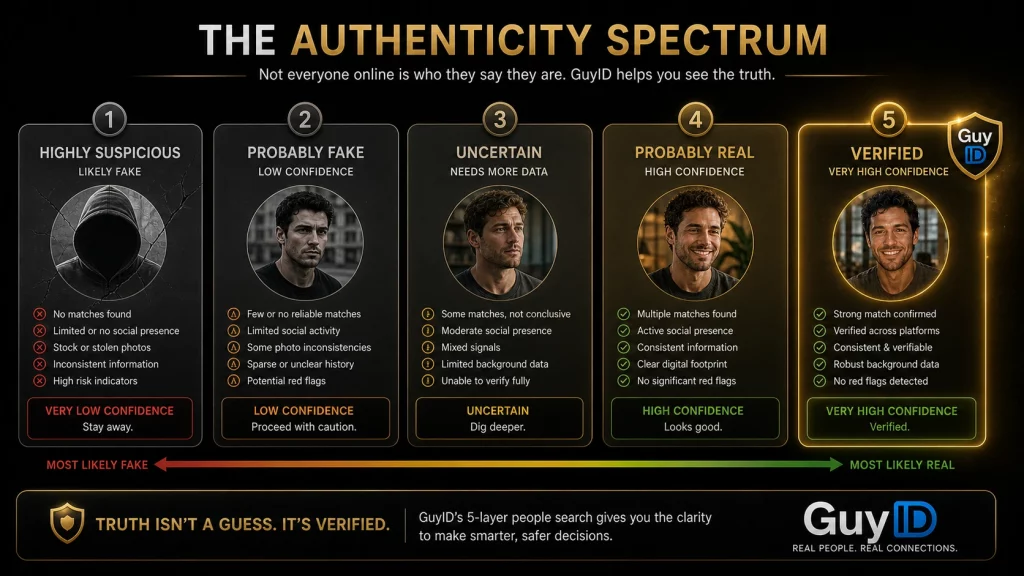
The Authenticity Spectrum
| Authenticity Level | What It Means | Signals Present | Trust Appropriate |
|---|---|---|---|
| 🔴 Clearly Fabricated | Fake profile — stolen/AI photos, scam operation, bot | Stock photos, zero bio, no badge, inconsistent details | Zero — report and block |
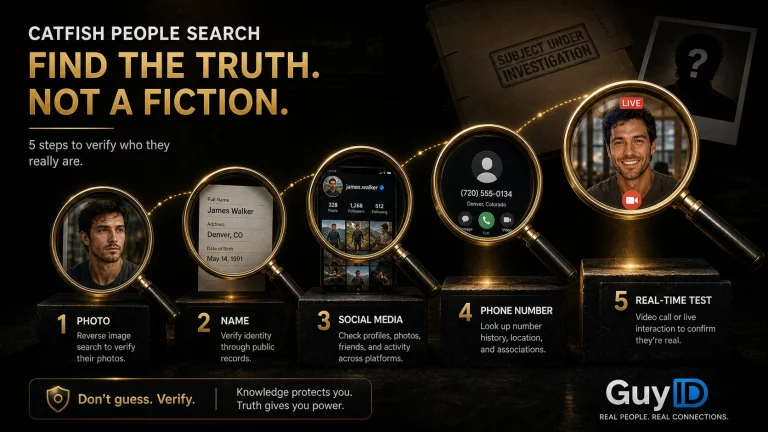
| 🟡 Probably Fake | Strong fabrication indicators but not definitively proven | Professional-only photos, vague bio, thin social media, avoids video | Minimal — investigate through 5-layer method |
| 🟡 Uncertain | Some authenticity signals present but not enough for confidence | Decent photos, some bio, no verification, no social proof | Cautious — apply screening tools and request verification |
| ✅ Probably Authentic | Multiple authenticity signals align — likely a real person | Mixed photo quality, specific bio, app badge, social photos | Moderate — proceed with standard safety practices |
| ✅✅ Verified Authentic | Identity confirmed through documents and human attestation | GuyID Trust Profile: gov ID ✅, social vouches ✅, Trust Tier visible | High — identity and character verified through independent systems |
Visual Authenticity Signals: What Real Photos Look Like
Signals of Authentic Photos
- Mixed quality: One great photo + several decent-but-not-perfect ones. Real people have a range. All-professional galleries suggest stolen or curated collections.
- Multiple environments: Home, outdoors, restaurants, travel, social events. Real people exist in multiple settings.
- Temporal variety: Different hair lengths, seasonal clothing, aging across photos. Real profiles accumulate photos over months and years.
- Other people present: Friends in some photos. Real people have social connections visible in their photo history.
- Imperfections: Slightly unflattering angle, red-eye, casual clothing. Real people include imperfect photos because they capture genuine moments.
- Consistent identity: Same person recognizable across all photos from different angles, lighting, and times.
Signals of Fabricated Photos
- 🟡 All photos are professional quality with studio-grade lighting
- 🟡 No casual, candid, or imperfect photos
- 🟡 Face partially obscured in every photo
- 🟡 No other people appear in any photo
- 🔴 AI-generation artifacts: unnatural skin texture, asymmetric accessories, distorted backgrounds
- 🔴 Reverse image search matches photos to a different identity
Textual Authenticity Signals: What Real Bios Sound Like
Signals of Authentic Writing
- Specificity: Named restaurants, numbered attempts, particular stories. Too specific to fabricate efficiently at scale.
- Voice: Consistent tone that reads like a person talking — individual humor, communication quirks.
- Self-deprecation: Honest admissions of imperfection. Fabricated profiles present idealized versions without vulnerability.
- Opinions: Real people have preferences and takes. Fabricated profiles stay inoffensively generic to maximize appeal breadth.
Signals of Fabricated Writing
- 🟡 Entirely generic — could describe millions of people
- 🟡 No specific details — interests at category level only
- 🟡 Perfect grammar with zero personality — reads like a template
- 🔴 Career claims explaining unavailability (military, oil rig, international business)
- 🔴 Scam language patterns in formulaic combination
Behavioral Authenticity: What Real People Do Differently
Authentic Behavior Patterns
- Consistency: Same biographical facts, same personality tone across conversations. Real people describe their real life consistently.
- Reciprocal curiosity: Genuine interest in YOUR life — specific follow-ups, remembering details.
- Willingness to verify: Video calls accepted. GuyID Trust Profile shared when requested. Spontaneous selfies provided easily.
- Normal pacing: Emotional development proportional to time. Genuine connection builds gradually.
Fabricated Behavior Patterns
- 🟡 Story details shift between conversations
- 🟡 Deflects personal questions back to you
- 🟡 Emotional intensity disproportionate to relationship stage
- 🔴 Refuses video calls despite extended texting
- 🔴 Anger or defensiveness when asked verification questions
- 🔴 Any financial request at any stage
Verified Authenticity: The Only Signal That Can't Be Faked
Visual signals can be fabricated (AI photos). Textual signals can be fabricated (AI bios). Behavioral signals can be performed by skilled manipulators. Verified authenticity — confirmed through external systems — is the one signal fabrication cannot replicate.
- App badge (Level 1): Selfie matches photos. Table stakes. Vulnerable to deepfakes.
- GuyID Trust Profile (Level 2): Government ID verification + social vouches + Trust Tier. Addresses all three authenticity questions: real person ✅, accurate identity ✅, genuine character ✅. AI-proof.
The AI Challenge: When Visual and Textual Analysis Fail
The AI era has degraded visual and textual analysis as standalone evidence. AI generates photorealistic faces and fluent bios indistinguishable from genuine ones at casual inspection. The reliable assessment combines first-pass screening (GuyID free tools — 60 seconds) with verified confirmation (GuyID Trust Profile — 10 seconds). First pass catches obvious fakes. Verified confirmation catches sophisticated ones.
How to Build an Authentic Profile Yourself
- Photos: Mixed quality, multiple environments, friends included, imperfections present. See the photo framework.
- Bio: Specific details, genuine voice, opinions included, self-deprecation present. See the bio guide.
- Verification: App badge (30 sec) + GuyID Trust Profile (20 min) + Date Mode link in bio.
- Behavior: Consistency, responsiveness, video call acceptance, comfort with verification. The ongoing dimension you demonstrate continuously.
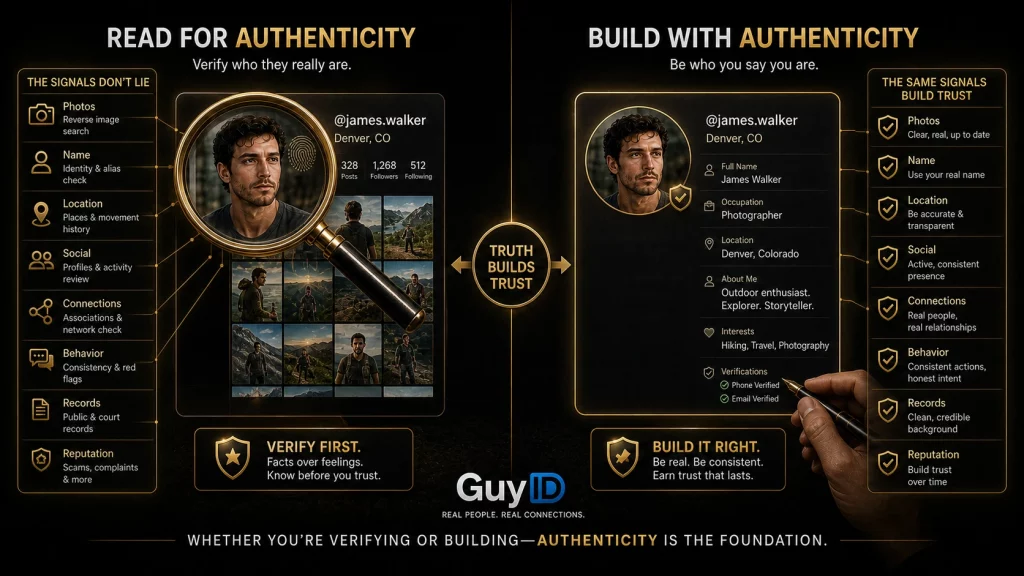
Authenticity is symmetrical: the signals that help you read others help you project yourself. Learn them. Apply them in both directions.
Inline visual 2
Summary: Authenticity Is Readable — If You Know What to Read
Profile authenticity is a four-dimensional signal: visual, textual, behavioral, and verified. Each dimension catches different fabrication types. Together they provide the comprehensive assessment that protects against every fake profile variant. The AI era has degraded visual and textual analysis but not eliminated their first-pass value. The reliable assessment layers free screening tools with verified confirmation with behavioral observation. Authenticity is readable. The tools are free. The verification takes 20 minutes. Read it. Build it.