Reader Briefing
Reader Briefing
Start here if you need a practical read on how to spot a fake dating profile: the 5-layer detection guide: who should use verification, what signals to check, and what to do before moving from online interest to an in-person plan.
Who this is for
- People meeting someone from a dating app or social platform.
- Anyone checking identity, profile consistency, and trust signals.
- People trying to avoid romance scams, fake profiles, or pressure tactics.
- Online daters improving conversations, profiles, or match screening.
You’ll learn
- How to evaluate identity signals without treating any single check as certainty.
- Which trust signals matter and how to weigh them together.
- How to spot inconsistencies, pressure, or behavior patterns that deserve caution.
- How to move from online conversation to a safer first meeting.
- Where GuyID tools fit into a quick pre-date screening workflow.
- How to compare options using practical safety and trust criteria.
Bottom line
Verification reduces uncertainty; it does not guarantee future behavior. Use a layered approach: confirm identity signals, compare profile consistency, ask for a short video call, keep early plans public, and slow down when someone pressures you to skip normal safety steps.
Key takeaways
- Identity verification improves confidence, not certainty.
- Patterns matter more than isolated incidents.
- Verify before meeting privately or sharing sensitive details.
- A short video call can reveal many inconsistencies.
- Pressure to skip reasonable safety steps is useful information.
Free Tools
Catfish Probability Detector
Check whether a dating profile has suspicious identity or photo signals.
Dating Bio Red Flag Detector
Review a bio for scam, pressure, or trust-warning language.
Dating Safety Checklist
Use free GuyID tools before moving from chat to a real date.
Next step
Create your GuyID trust profile
Share consent-based trust signals before a date without turning the conversation into an interrogation.
This guide teaches you every detection technique available in 2026 — from 30-second visual checks to AI-era detection methods that most people don’t know exist.
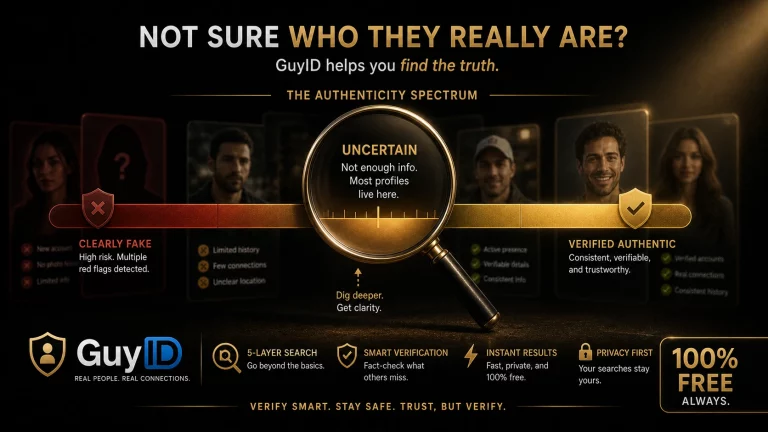
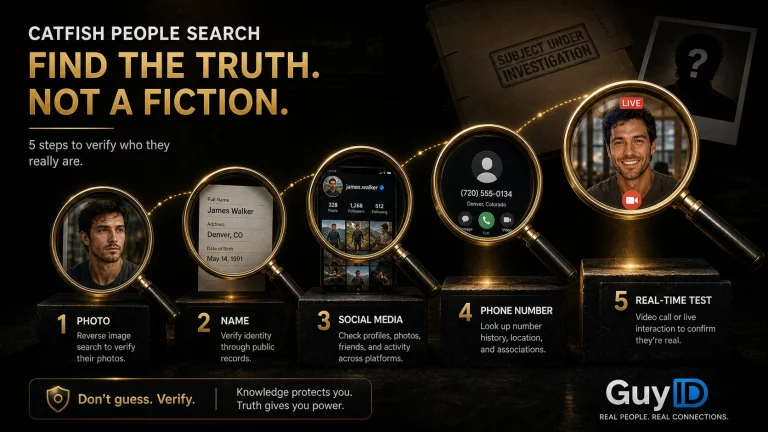
We’ve organized the complete how to spot a fake dating profile methodology into five detection layers: photo analysis, bio analysis, behavioral analysis, technical verification, and AI-era detection. Each layer catches threats the others miss. Together, they provide the most comprehensive fake profile detection framework available — combining manual inspection with GuyID’s free automated tools for maximum coverage in minimum time.
NavigateTable of Contents32 sections
⚡ Key Takeaways
The 60-second check catches the majority of fakes
Reverse image search (30 sec) + catfish probability detector (10 sec) + bio red flag check (10 sec) = 50 seconds total through GuyID’s free tools.
AI-generated profiles require new detection techniques
Traditional fake profile signs (stolen photos, broken English) are being replaced by AI-generated photos and deepfake technology. The 2026 detection framework includes AI-specific checks that didn’t exist two years ago.
No single check is definitive — layers are
Some fakes pass photo analysis. Others pass bio analysis. Very few pass all five layers. The detection framework’s power comes from layered verification — each layer catching what the previous layers missed.
The best fake profiles don’t look fake
The most dangerous fakes are the ones you’d never suspect. That’s why proactive screening — checking every match, not just suspicious ones — catches threats that suspicion-based detection misses entirely.
The 5-Layer Detection Framework: How to Spot a Fake Dating Profile Systematically
Amateur fake profile detection relies on gut feeling: “something seems off.” Professional detection — the kind that catches sophisticated fakes — uses a systematic framework where each layer addresses a different dimension of authenticity. Here’s the complete 5-layer system for how to spot a fake dating profile in 2026.
| Layer | What It Checks | What It Catches | Time |
|---|---|---|---|
| 1. Photo Analysis | Visual authenticity of profile images | Stolen photos, stock images, AI-generated faces, inconsistent photo sets | 30-60 sec |
| 2. Bio Analysis | Language patterns and content signals | Scam-associated language, vague bios, script-like text, inconsistent details | 10-30 sec |
| 3. Behavioral Analysis | Communication patterns and actions | Unusual messaging patterns, refusal of video calls, escalation tactics | Observed over days |
| 4. Technical Verification | Digital footprint and cross-platform presence | Absent social media, inconsistent identities across platforms, reverse lookup results | 2-5 min |
| 5. AI-Era Detection | Signals specific to AI-generated content | AI-generated photos, chatbot conversation patterns, deepfake video artifacts | 30-60 sec |
The layers are ordered by speed — the fastest checks come first, eliminating obvious fakes before you invest time in deeper analysis. Layer 1 and 2 combined take under 60 seconds and catch the majority of fake profiles. Layers 3-5 catch the sophisticated fakes that survive initial screening.

Layer 1: Photo Analysis — What Fake Photos Reveal
Photos are the first thing you see on any dating profile — and the first place fakes reveal themselves. Knowing how to spot a fake dating profile starts with knowing what to look for in the images.
Reverse Image Search (The #1 Detection Tool)
Reverse image search is the single highest-impact fake profile detection technique. Upload the profile photo to GuyID’s free reverse image search — if the same photo appears under a different name on another platform, the profile is definitively fake.
For maximum coverage, also check Google Images, TinEye, and Yandex. The 4-engine method takes 2 minutes total and catches photos that any single engine might miss.
Photo Set Consistency Check
Examine all photos as a set, not individually. Look for:
- Consistent aging and appearance: Do they look the same age across all photos? Scammers sourcing photos from different people or different time periods create sets where the person looks noticeably different between images — different body type, different skin tone, different apparent age.
- Consistent quality and style: Are all photos taken with similar camera quality? A set with five magazine-quality photos and zero casual snapshots suggests the photos came from a professional source — not a personal camera roll.
- Social context: Does at least one photo include other people (friends, family, social settings)? Genuine profiles typically include at least one group shot. Fake profiles avoid group photos because the stolen image set rarely includes the subject’s social context.
- Setting variety: Do photos show different locations, outfits, times of day, and activities? Real camera rolls have variety. Photo sets from a single source (one photoshoot, one social media account, one AI generation session) have uniform quality and limited variety.
Visual Red Flags in Individual Photos
- 🟡 Watermarks or cropping artifacts: Edges that suggest the photo was cropped from a larger image, or faint watermarks from stock photo sites.
- 🟡 Professional lighting and composition in every shot: Real selfies have mixed quality. If every photo looks like it was taken by a professional photographer, they may have been.
- 🟠 No environment variation: All photos in the same room, same lighting, same angle — suggesting a limited source rather than a lived life captured over time.
Layer 2: Bio Analysis — Language Patterns That Betray Fake Profiles
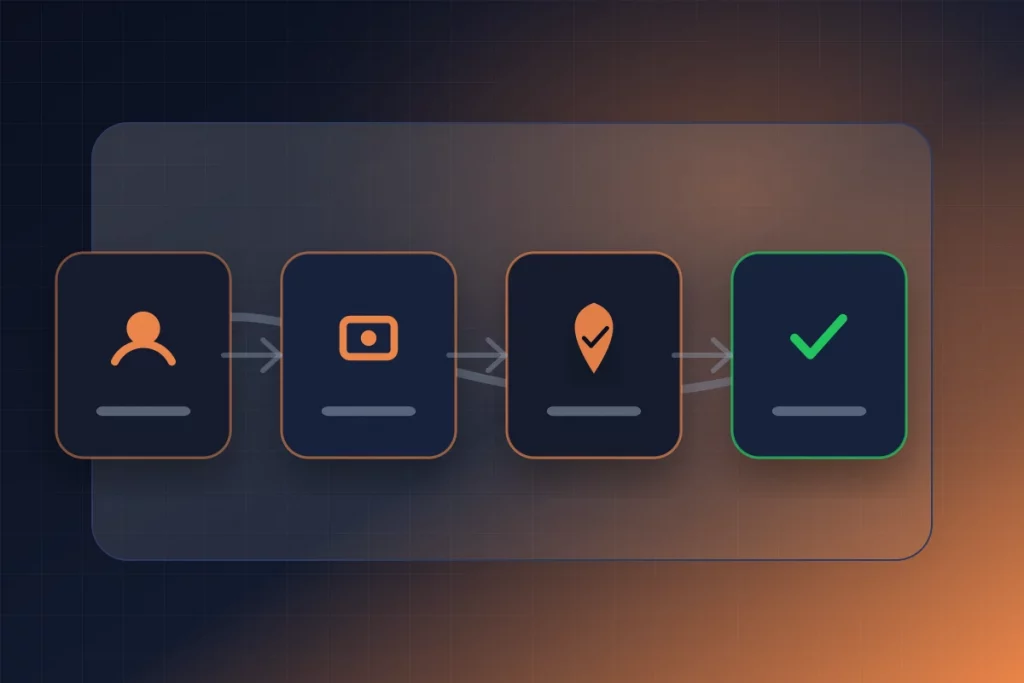
The second layer of how to spot a fake dating profile examines the written content — where scam-associated language patterns, strategic vagueness, and scripted text reveal inauthenticity.
Automated Bio Analysis
Run the bio through GuyID’s bio red flag detector — this automated tool checks for scam-associated language patterns, vagueness indicators, and suspicious claims in 10 seconds. It catches patterns that casual reading misses because it’s trained on thousands of confirmed scam profiles.
Manual Bio Red Flags
- 🟡 Vague platitudes with zero specifics: “Love to travel, laugh, and enjoy life” provides no verifiable information. Real people describe real interests with real details: “Training for the Ottawa marathon, obsessed with Thai street food, learning guitar badly.”
- 🟡 Scam-associated career claims: Military deployment overseas, oil rig engineer, international business consultant, marine engineer, UN humanitarian worker. These careers explain unavailability for meeting while projecting financial stability — the classic romance scam setup.
- 🟡 Emotional hooks without biographical substance: “Tired of games,” “looking for my soulmate,” “ready for something real,” “just want someone honest.” These phrases target emotional desires without revealing anything about the person writing them.
- 🟠 Grammatical patterns inconsistent with claimed background: A claimed American with sentence structures that suggest English as a second language. A claimed professional with spelling and grammar that contradict their education claims. Inconsistency between claimed background and language use is a signal.
- 🟠 Bio that reads like a wish list rather than a self-description: “Family-oriented, financially stable, great communicator, loves cooking, ready to settle down” describes what the reader wants to hear, not who the writer actually is.
Layer 3: Behavioral Analysis — How Fakes Act Differently from Real People
Behavioral patterns emerge over days of interaction — revealing inauthenticity that photos and bios can’t. This layer of how to spot a fake dating profile requires patience and attention to conversational signals.
Messaging Pattern Red Flags
- 🟡 Instant responses at all hours: No real person responds instantly at 3am, 8am, 1pm, and 11pm with consistent quality. AI chatbots send 60+ messages in 12 hours (McAfee Labs, 2026).
- 🟡 Messages that never reference your previous messages specifically: Generic responses that could apply to anyone versus responses that reference specific things you said. “That’s so interesting, tell me more!” after every message is a script. “Wait, so the marathon was in the rain? How did you handle the last 10k?” is engagement with your actual content.
- 🟡 Rapidly escalating emotional intensity: Love-bombing within the first week — “I’ve never felt this connection,” “you might be the one,” “I can’t stop thinking about you.” Real emotional development takes time.
- 🔴 Consistent refusal of video calls: The #1 behavioral indicator across all fake profile types. One declined call is normal. Three+ with changing excuses is definitive — the person cannot appear on camera because they don’t match their profile. See our complete catfish detection guide.
Escalation Pattern Red Flags
- 🟡 Urgent push to leave the dating app: “Let’s move to WhatsApp, I’m rarely on here” within 24-48 hours. Scammers migrate conversations off-platform to escape monitoring.
- 🟡 Story inconsistencies across conversations: Their age, job details, family situation, or hometown shifts between conversations. Scammers managing multiple targets confuse details.
- 🟡 Avoidance of verifiable specifics: “I went to a restaurant” (which one?). “I live downtown” (what neighborhood?). Every answer is plausible but unverifiable.
See dating app red flags for the complete financial detection framework.
Layer 4: Technical Verification — The Tools That Catch What Eyes Miss
Technical verification uses digital tools to cross-reference a profile’s claims against independently available data. This layer of how to spot a fake dating profile catches fakes that pass visual and behavioral inspection.
GuyID’s Free Detection Tools
- Reverse image search: Upload profile photos to check for matches elsewhere online — catches stolen photos, stock images, and recycled scam identities. (30 seconds)
- Catfish probability detector: Holistic risk assessment that evaluates multiple signals simultaneously — providing an objective risk score when your emotional investment might bias your judgment. (10 seconds)
- Bio red flag detector: Automated analysis of bio text for scam-associated language patterns, vagueness indicators, and suspicious claims. (10 seconds)
Social Media Cross-Reference
Search the person’s claimed name on LinkedIn, Instagram, Facebook, and Google. A real person has a consistent digital footprint across platforms — years of posts, real connections, employment history, and organic content. A fake identity has a thin, recently created, or inconsistent online presence. The cross-reference takes 2-5 minutes and catches fabricated identities that photo and bio analysis alone may miss.
Phone Number Verification
If they’ve shared a phone number, Google it. Scam phone numbers often appear in scam-reporting databases (ScamAdviser, WhoCalledMe). A phone number that appears in multiple scam reports across different dating platforms is definitive evidence.
GuyID Trust Profile Check
The most definitive technical verification: ask for their GuyID Trust Profile. A TRUSTED tier or above means government ID is verified and real people vouch for them — confirmation that eliminates every form of fake profile. A refusal to share a Trust Profile, or the absence of one, doesn’t confirm a fake — but it leaves the identity question unanswered. Women check for free.
Layer 5: AI-Era Detection — New Techniques for 2026
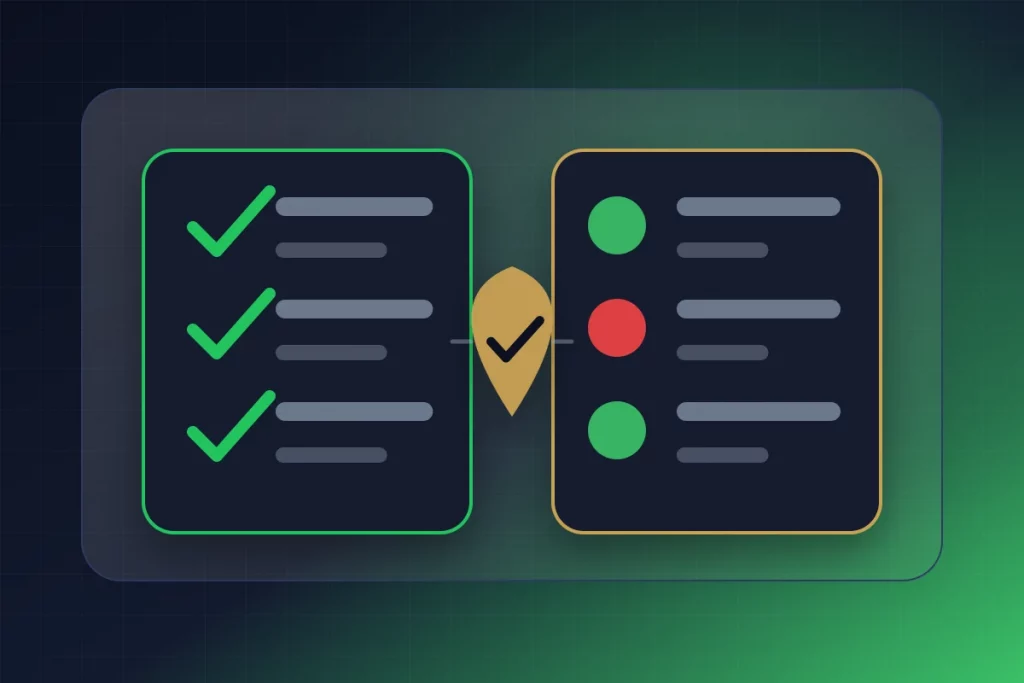
The fifth layer of how to spot a fake dating profile addresses the newest and fastest-growing threat: AI-generated profiles that pass traditional detection methods because their photos are original (not stolen), their conversations are sophisticated (AI-generated), and their behavior is calibrated (trained on human patterns).
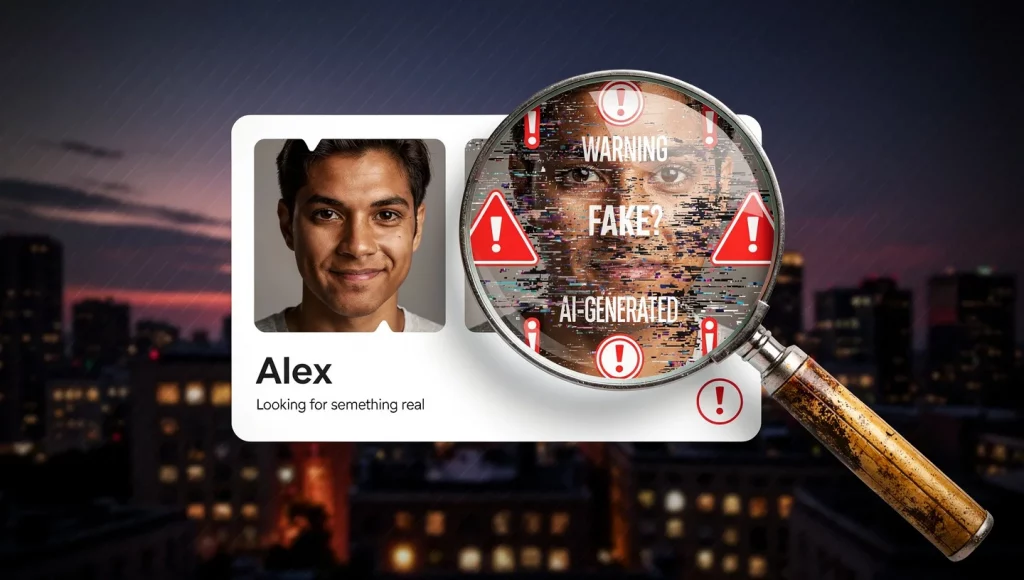
AI-Generated Photo Detection
Look for:
- 🟡 Excessively smooth skin with no texture: AI generates skin as a smooth surface. Real skin has pores, fine lines, texture variation, and imperfections — even in filtered photos.
- 🟡 Background artifacts: Distorted text on signs, impossible architecture, melting objects, inconsistent shadows, and spatial relationships that don’t make physical sense. AI struggles with complex backgrounds.
- 🟡 Hand anomalies: Wrong number of fingers, fingers merging into each other, joints at impossible angles. Hands are AI’s weakest generation area — examine any visible hands carefully.
- 🟡 Accessory inconsistencies: Earrings that don’t match, glasses that merge into skin, hair that clips through shoulders, clothing with impossible folds. Small objects are where AI makes detectable errors.
- 🟡 Uncanny valley effect: The photo looks “too perfect” — like a high-end portrait, but something is subtly wrong. This feeling is your visual cortex detecting inconsistencies your conscious mind can’t articulate. Trust it.
- 🟠 Unnaturally uniform eye reflections: Real eyes reflect the actual environment — windows, light sources, surroundings. AI-generated eyes often have uniform, generic reflections that don’t match the claimed setting.
AI Chatbot Conversation Detection
- 🟡 Unnaturally consistent quality: Real conversations fluctuate — brilliant exchanges, mundane replies, tired responses. If every message is eloquent, thoughtful, and perfectly calibrated, the consistency itself is the tell.
- 🟡 60+ high-quality messages per day indefinitely: No human maintains this volume and quality without fatigue. AI chatbots do.
- 🟡 Perfect emotional attunement without miscalibrations: AI is trained to validate and mirror. A person who always says exactly the right thing, never misreads a moment, and responds with precision-tuned empathy may be executing sentiment analysis rather than feeling empathy.
- 🟡 Inability to engage with spontaneous, specific requests: “Send me a selfie holding up four fingers next to something purple” — a human does this in 10 seconds. An AI system needs processing time or deflects. Spontaneous, specific requests are the best real-time AI detection test.
Deepfake Video Detection
If they agree to a video call — which itself is a positive signal — apply active testing: request full head turns (deepfakes struggle with profile views), ask them to move their hand across their face (disrupts face-swapping), request room or lighting changes (deepfakes are calibrated for specific conditions), and watch for micro-lag between audio and lip movement (real-time deepfakes have processing latency).
The 60-Second Fake Profile Check: The Minimum Viable Detection
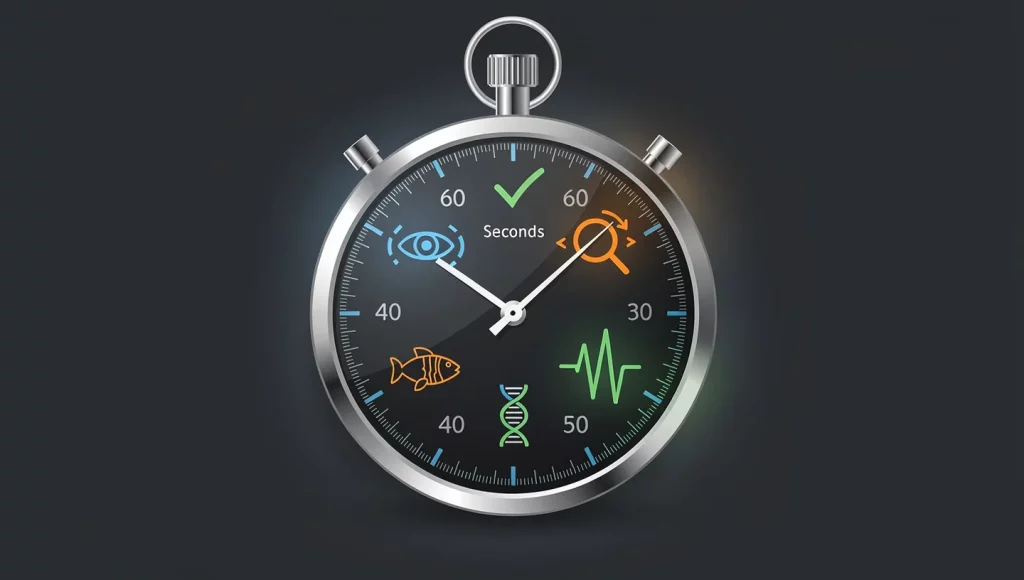
Not every match requires a full 5-layer analysis. The 60-second check provides the minimum viable detection — catching the majority of fake profiles in under a minute. This is the routine you should apply to every single match.
⏱️ The 60-Second Check (Every Match, No Exceptions)
☐ 0-30 sec: GuyID reverse image search — upload their main photo. If matches found under a different name → fake. Stop.
☐ 30-40 sec: Catfish probability detector — holistic risk score. If high risk → proceed to full Layer 1-5 analysis.
☐ 40-50 sec: Bio red flag detector — automated language analysis. If flagged → investigate further.
☐ 50-60 sec: Quick visual scan — friends in photos? Variety in settings? AI-smooth skin? Anything off?
Result: Clean across all four? → Proceed to conversation with normal caution.
Result: Any flag triggered? → Escalate to full 5-layer analysis before investing emotionally.
This 60-second routine costs nothing, requires no expertise, and catches the majority of fake profiles before you send your first message. Making it routine — applied to every match, not just suspicious ones — is the proactive approach that catches the dangerous fakes you’d never think to investigate.
Platform-Specific Fake Profile Patterns
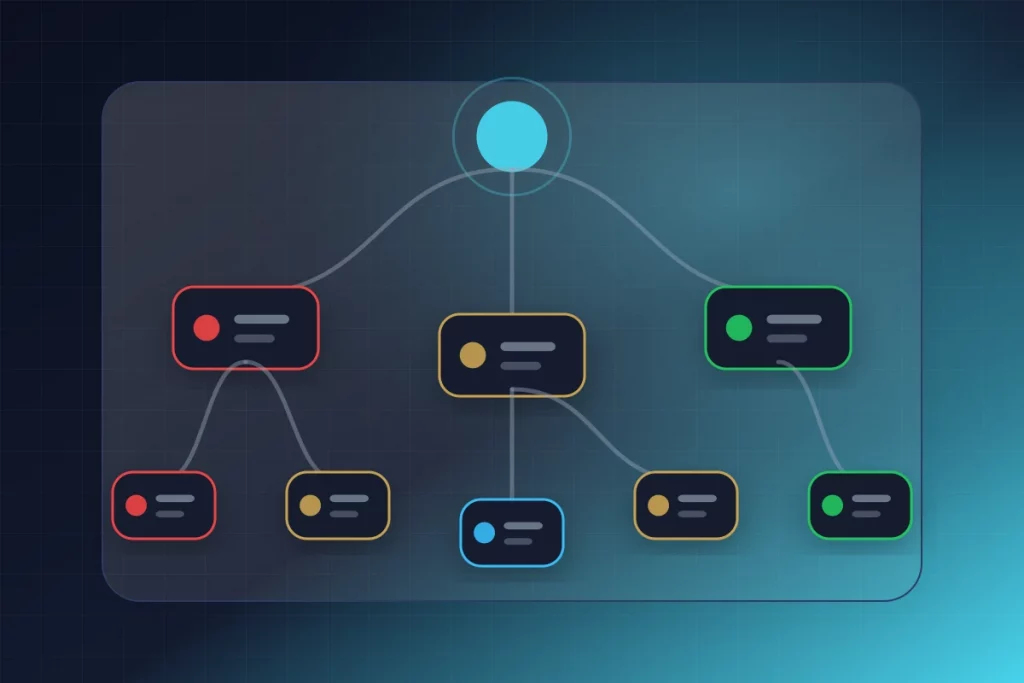
Different platforms attract different types of fake profiles. Knowing the platform-specific patterns helps you calibrate your detection for how to spot a fake dating profile on whichever app you use.
Tinder
Highest volume of fakes. Common patterns: crypto/investment bios, links to external sites in bios, profiles that immediately push to Snapchat or Instagram, and mass-swiped right profiles that match everyone. Tinder’s weak pose verification makes it the easiest top-three platform for fake profile creation.
Bumble
Lower fake density due to women-first messaging. Common patterns: attractive male profiles designed to receive first messages from women (the women self-select as interested targets), profiles with generic bios that pass Bumble’s gesture verification through deepfake technology.
Hinge
Fakes on Hinge tend to be more sophisticated because the prompt system requires more content investment. Watch for: generic prompt answers that could apply to anyone (“A life goal of mine: to be happy”), prompts that mirror common desires without personal specificity, and career claims that don’t survive LinkedIn cross-referencing.
POF
The highest density of fake profiles across any platform. Common patterns: unsolicited messages from highly attractive profiles, immediate push to WhatsApp, military/overseas career claims, and profiles with minimal photos and vague bios. On POF, assume elevated risk for every contact.
Facebook Dating
Unique threat: hacked accounts with years of genuine social proof. Traditional fake profile detection fails because the account history is real — only the current operator is fake. Look for: recent behavioral changes on the linked Facebook account, communication style mismatches, and sudden friend additions from unexpected regions.
What to Do When You Spot a Fake Dating Profile
Detection is step one. Action is step two. When you’ve confirmed (or strongly suspect) a fake profile, follow this sequence:
- Screenshot everything — profile photos, bio, all messages, any phone numbers or links shared. Evidence first.
- Report to the dating platform — select the appropriate category (fake profile, scam, etc.) and include a detailed description with your evidence.
- Block the user — after reporting (report first, block second — blocking may remove evidence access).
- If money was sent or requested: Escalate to FBI IC3 (ic3.gov), FTC (reportfraud.ftc.gov), and your financial institution. See the complete reporting guide.
- Don’t confront the fake. Alerting a scammer that you’ve detected them serves no purpose — they’ll simply note what triggered detection and adjust their technique for the next target.
Summary: The Complete Fake Profile Detection System
Knowing how to spot a fake dating profile in 2026 requires a systematic, multi-layered approach that addresses both traditional fakes (stolen photos, scam bios) and AI-era threats (generated photos, chatbot conversations, deepfake video). The 5-layer detection framework — photo analysis, bio analysis, behavioral analysis, technical verification, and AI-era detection — provides comprehensive coverage where each layer catches what the others miss.
The minimum viable detection — the 60-second check using GuyID’s free tools (reverse image search + catfish probability detector + bio red flag detector + visual scan) — catches the majority of fakes in under a minute. Applied to every match as a routine, this single habit prevents more harm than any other dating safety practice.
But the most powerful approach isn’t better detection — it’s rendering detection unnecessary. The proactive dating safety model verifies identity through GuyID Trust Profiles (government ID + social vouching + Trust Tiers) before emotional investment occurs. When someone’s real identity is confirmed by documents and real people, the question of “is this profile fake?” is definitively answered. Detection catches fakes. Verification eliminates the uncertainty entirely.
Use the 60-second check on every match. Apply the full 5-layer framework when flags are raised. Request GuyID Trust Profiles before meeting anyone in person. And report every fake you find — your report protects the next person who encounters the same profile. Every detection, every report, and every verification moves us closer.
60 Seconds. Free Tools. Most Fakes Caught.
GuyID’s free tools catch fake profiles in under a minute: reverse image search, catfish probability detector, bio red flag analyzer. Plus verified Trust Profiles (government ID + social vouching) that eliminate the question entirely. Women check for free.
Try Free Detection Tools
Check a Trust Profile Free
Frequently Asked Questions
How can I tell if a dating profile is fake?
What is the fastest way to check if a dating profile is real?
Can AI-generated dating profiles be detected?
What should I do if I find a fake dating profile?
Should I check every dating match for fakes or just suspicious ones?
Can a verified profile still be fake?
What are the best free tools for detecting fake dating profiles?
Related Reading
- Online Dating Scams: How to Spot and Avoid Them (2026)
- The End of Dating Apps Is Near: Why GuyID May Be the Trust Layer That Saves Online Dating
Evidence note
The FTC reported 64,003 romance-scam reports in 2023, with $1.14 billion in reported losses and a $2,000 median reported loss (Federal Trade Commission, 2024).