
Reader Briefing
Reader Briefing
Start here if you need a practical read on toxic relationship quiz: am i in one?: who should use verification, what signals to check, and what to do before moving from online interest to an in-person plan.
Who this is for
- People meeting someone from a dating app or social platform.
- Readers preparing for a first in-person date.
- Anyone checking identity, profile consistency, and trust signals.
- People trying to avoid romance scams, fake profiles, or pressure tactics.
You’ll learn
- How to evaluate identity signals without treating any single check as certainty.
- Which trust signals matter and how to weigh them together.
- How to spot inconsistencies, pressure, or behavior patterns that deserve caution.
- How to move from online conversation to a safer first meeting.
- Where GuyID tools fit into a quick pre-date screening workflow.
- When to slow down, ask for more context, or walk away.
Bottom line
Verification reduces uncertainty; it does not guarantee future behavior. Use a layered approach: confirm identity signals, compare profile consistency, ask for a short video call, keep early plans public, and slow down when someone pressures you to skip normal safety steps.
Key takeaways
- Identity verification improves confidence, not certainty.
- Patterns matter more than isolated incidents.
- Verify before meeting privately or sharing sensitive details.
- A short video call can reveal many inconsistencies.
- Pressure to skip reasonable safety steps is useful information.
Free Tools
Catfish Probability Detector
Check whether a dating profile has suspicious identity or photo signals.
Dating Bio Red Flag Detector
Review a bio for scam, pressure, or trust-warning language.
Dating Safety Checklist
Use free GuyID tools before moving from chat to a real date.
Next step
Create your GuyID trust profile
Share consent-based trust signals before a date without turning the conversation into an interrogation.
If you’re searching for a toxic relationship quiz, you’re already aware that something feels wrong — and that awareness is more valuable than you realize. Most people in healthy relationships don’t Google “Am I in a toxic relationship?” The fact that you’re here means patterns in your relationship have created enough doubt, pain, or confusion to seek external clarity. This comprehensive 20-question assessment evaluates your relationship across four critical dimensions — communication patterns, control dynamics, emotional impact, and recurring cycles — to help you determine whether your relationship is healthy, struggling but fixable, genuinely toxic, or potentially abusive. Each result level includes specific recommended actions and professional resources.
NavigateTable of Contents21 sections
What Makes a Relationship “Toxic”?
Before taking this toxic relationship quiz, it helps to understand what “toxic” actually means in a relationship context — because the term is sometimes overused for normal friction and sometimes dangerously underused for genuine abuse.
A toxic relationship is one where the consistent pattern of interaction causes measurable harm to one or both partners’ mental health, self-worth, autonomy, or overall wellbeing. The key word is pattern — not a single bad argument, a stressful week, a miscommunication, or even a series of disagreements. Toxicity is a recurring dynamic that predictably produces negative outcomes despite both partners’ stated desire for the relationship to work.
Toxic relationships exist on a spectrum. On the milder end: persistent criticism, communication breakdown, chronic contempt, and emotional withdrawal that gradually erode connection, trust, and mutual respect. On the severe end: deliberate emotional manipulation, gaslighting, narcissistic abuse patterns, isolation from friends and family, and psychological control that constitutes emotional abuse. This toxic relationship quiz assesses the full spectrum from mild dysfunction to severe harm.
Research from the American Psychological Association identifies four behaviors that most reliably predict relationship toxicity and failure — what relationship researcher Dr. John Gottman calls the “Four Horsemen”: contempt (treating your partner with superiority and disgust), criticism (attacking character rather than addressing specific behavior), defensiveness (refusing to accept any responsibility during conflict), and stonewalling (shutting down communication entirely as a response to disagreement). These documented predictors form the core of what this quiz evaluates.
It’s also important to understand what toxicity is NOT. Having disagreements is not toxic. Feeling frustrated with your partner sometimes is not toxic. Going through a rough patch during a stressful life period is not toxic. Needing space or having different communication styles is not toxic. The distinction is: in healthy relationships, both partners work through difficulty with mutual respect and accountability. In toxic relationships, the difficulty IS the dynamic — and it doesn’t resolve because one or both partners contribute to the dysfunction without taking responsibility.
Before You Take the Quiz
A few important notes to ensure accurate self-assessment:
Take it privately. Complete this toxic relationship quiz on a device your partner doesn’t monitor. If device privacy is a concern, use incognito/private browsing mode. Your safety matters, and if the relationship is toxic, monitoring your online activity is a realistic possibility.
Think about patterns, not incidents. Every relationship has bad moments. This quiz identifies patterns — behaviors that repeat across situations and over time. Score each question based on the general dynamic of your relationship, not on the worst single incident or the best single week. The pattern is what matters.
Be honest. The instinct to minimize (“it’s not that bad”), rationalize (“they had a rough childhood”), or blame yourself (“I probably provoked it”) is natural in toxic dynamics — but it undermines the assessment. Answer based on what happens, not on what you wish happened or what your partner’s good intentions might be. If you find yourself qualifying your honest answer, the unqualified answer is more accurate.
This is a self-assessment, not a diagnosis. This quiz provides a framework for reflection and a basis for seeking professional support. It is not a clinical diagnostic instrument. If your results indicate toxicity or abuse, please discuss your situation with a licensed therapist or counselor who can provide personalized professional assessment.
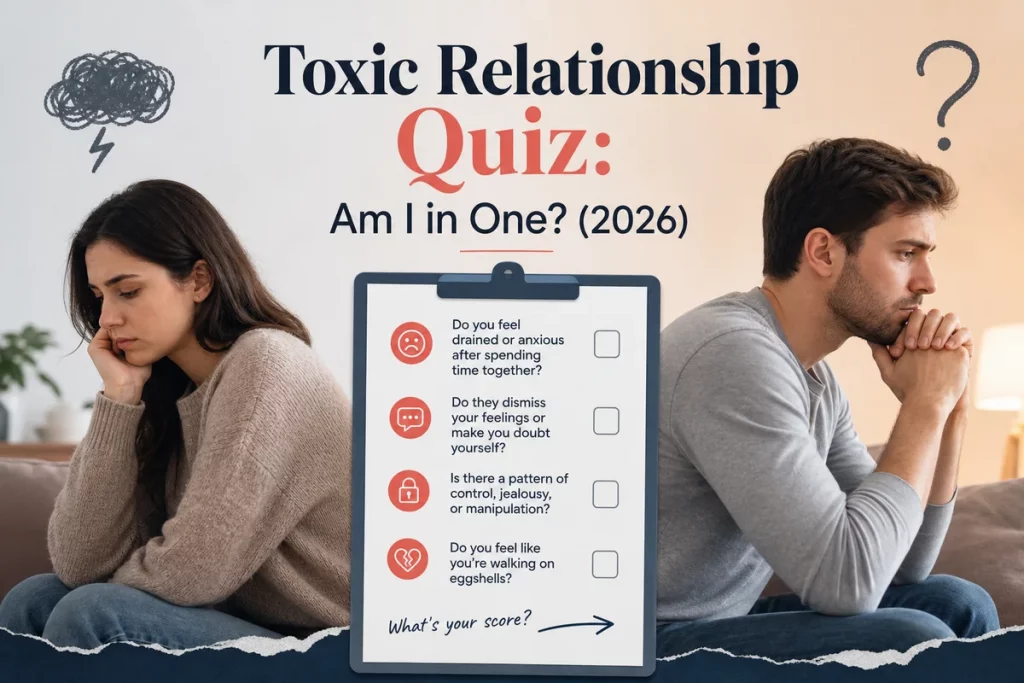
The 20-Question Toxic Relationship Quiz
For each question, score based on your overall relationship experience: Never = 0 | Rarely = 1 | Sometimes = 2 | Often = 3 | Always = 4
Section A: Communication Patterns
1. Disagreements with my partner escalate into personal attacks, insults, or name-calling rather than staying focused on the actual issue.
2. I feel like I can’t express my needs, concerns, or opinions without being dismissed, mocked, guilt-tripped, or punished.
3. My partner uses the silent treatment, emotional withdrawal, or stonewalling when they’re unhappy with me — sometimes for hours or days.
4. Our conversations about problems never reach genuine resolution — they end with my partner’s anger, my surrender, or mutual exhaustion without anything actually changing.
5. My partner speaks to me with contempt — eye-rolling, dismissive sarcasm, sneering, name-calling, or a tone that consistently makes me feel small and worthless.
Section B: Control Dynamics
6. My partner monitors, questions, or restricts my communication with friends, family, coworkers, or other people in my life.
7. I modify my behavior, appearance, social plans, or opinions to avoid triggering my partner’s negative reaction — I walk on eggshells.
8. Major decisions in our relationship — finances, living arrangements, social plans, parenting choices — are made by my partner without my genuine input or against my stated wishes.
9. My partner uses guilt, threats, emotional pressure, or manufactured crises to get their way when I disagree or resist.
10. I feel like I need my partner’s permission — spoken or implied — to spend time away from them, make purchases, or pursue my own interests and friendships.
Section C: Emotional Impact
11. I feel worse about myself — less confident, more anxious, less happy, less capable — than I did before this relationship started.
12. I feel like I’m “walking on eggshells” around my partner much of the time, carefully monitoring what I say and do to prevent their negative reactions.
13. I’ve lost interest in hobbies, friendships, personal goals, or activities I used to care about since this relationship began.
14. I feel confused after interactions with my partner — unsure of what actually happened, who was at fault, or whether my emotional reactions are valid and proportionate.
15. I make excuses to friends and family for my partner’s behavior, hide aspects of the relationship, or avoid talking about it because I know others would be concerned.
Section D: Recurring Patterns
16. My partner cycles between intense warmth, affection, and attention — and cold distance, criticism, or emotional cruelty — in an unpredictable pattern.
17. After hurtful incidents, my partner apologizes, becomes sweet, or promises to change — but the same harmful behavior repeats within days or weeks.
18. My partner rarely or never takes genuine, unqualified responsibility for their behavior during our conflicts — it’s always my fault, a misunderstanding, or an overreaction on my part.
19. I feel responsible for managing my partner’s emotional state — their happiness, their anger, their moods, their reactions — as if their emotions are my job to control.
20. People who care about me — friends, family, coworkers — have expressed concern about this relationship or about changes they’ve noticed in me since the relationship began.
How to Score Your Results
Add your total score across all 20 questions. Maximum possible score is 80.
| Score | Assessment | What It Means |
|---|---|---|
| 0-12 | Healthy range | Normal relationship friction. Some areas may benefit from improved communication or couples counseling, but no toxic patterns detected. The relationship fundamentally supports your wellbeing. |
| 13-25 | Concerning dynamics | Unhealthy patterns are present. These may reflect communication habits that can improve through therapy — or early-stage toxicity that could escalate if unaddressed. The trajectory (getting better or worse?) is the critical question. |
| 26-40 | Toxic patterns present | Multiple indicators of a toxic relationship across different dimensions. The dynamic is causing measurable harm to your mental health and self-worth. Individual therapy is strongly recommended as a first step. |
| 41-60 | Significantly toxic | Pervasive toxicity affecting your wellbeing, identity, autonomy, and social connections. Professional support is essential — not optional. Evaluate honestly whether this relationship can be repaired or whether leaving is the healthier path. |
| 61-80 | Severe — likely abusive | The patterns this toxic relationship quiz identified go beyond dysfunction into emotional abuse territory. Contact the National Domestic Violence Hotline (1-800-799-7233). Your safety and psychological wellbeing are the immediate priority. |
Section scores provide additional diagnostic value. Beyond the total, examine which sections scored highest — this reveals the specific mechanism of toxicity in your relationship:
High Section A (Communication): The primary problem is how you communicate during conflict. Contempt, criticism, and stonewalling are destroying the connection. If this is the only high section, the relationship may respond to couples therapy focused on communication skills — but only if both partners genuinely engage.
High Section B (Control): Power imbalance and control dynamics are present. This is a more serious finding than communication problems because control tends to escalate over time. High scores here suggest one partner is dominating the relationship’s terms while the other is accommodating to avoid conflict. This dynamic rarely improves without the controlling partner independently acknowledging and addressing their behavior.
High Section C (Emotional Impact): Regardless of the specific mechanism, the relationship is causing measurable psychological harm. Declining confidence, increased anxiety, loss of interests, and confusion about reality are symptoms that your environment is damaging your mental health. High scores here confirm the relationship is toxic regardless of how the other sections scored.
High Section D (Patterns): The emotional abuse cycle is in effect — a recurring pattern of tension, eruption, reconciliation, and calm that repeats with increasing severity. This is the hardest dynamic to break without professional intervention because the cycle creates neurochemical addiction through intermittent reinforcement. High scores here strongly suggest trauma bonding may be keeping you attached to a dynamic you intellectually recognize as harmful.
What Your Results Mean
0-12: Your relationship is healthy. Normal friction exists, but the overall dynamic is respectful, supportive, and constructive. If specific questions triggered concern, address those directly through open conversation with your partner. The fact that you took this toxic relationship quiz shows self-awareness that’s healthy to maintain — keep checking in with yourself as relationships evolve over time.
13-25: Watch the trajectory. Unhealthy patterns are present but may be addressable through intentional effort. The critical question to evaluate: are things getting better or worse over time? If the trajectory is gradually improving — arguments becoming less frequent, communication improving, both partners making effort — couples therapy can accelerate the positive direction. If the trajectory is worsening — more control, more criticism, less resolution, more walking on eggshells — take the pattern seriously before it deepens into entrenched toxicity.
26-40: The relationship is toxic. This isn’t a rough patch that time will fix — it’s a pattern causing measurable harm to your psychological wellbeing. Individual therapy (not couples therapy initially) is the recommended first step. A therapist who sees you alone can provide honest assessment without the other person’s influence in the room. The key question to explore in therapy: is this a dynamic where both partners are willing and able to change, or is this a dynamic where one partner is systematically harming the other? Review our emotional abuse checklist for a detailed behavioral inventory that helps answer this question.
41-60: Significant toxicity is undermining your wellbeing. At this level, the relationship is systematically damaging your mental health, self-worth, autonomy, and social connections. Professional support is necessary — not a luxury, not an overreaction, but a necessary response to a dynamic that is harming you. Reach out to the National Domestic Violence Hotline (1-800-799-7233) for guidance — they support people in toxic and emotionally abusive relationships, not just situations involving physical violence. Take the emotional abuse quiz for a more detailed assessment of whether the dynamic has crossed from toxic into abusive.
61-80: This is likely abuse. A score this high indicates patterns consistent with emotional abuse — gaslighting, systematic control, isolation, and harm that goes beyond mutual dysfunction into deliberate or habitual exploitation of your wellbeing. Please reach out for professional support. Contact the National Domestic Violence Hotline immediately. This is not your fault — the confusion, self-doubt, and difficulty leaving that you may be experiencing are documented symptoms of the dynamic itself, not evidence that you’re wrong about what’s happening.
What to Do Next
Based on your toxic relationship quiz results, here are productive next steps matched to your situation:
For all scores: reflect honestly and privately. The quiz identified specific patterns — sit with those findings before reacting impulsively. Journal about which questions resonated most strongly and which ones made you uncomfortable. The discomfort itself is data: questions that triggered defensiveness or denial often point to the areas of greatest concern.
For scores 13+: seek individual therapy. Not couples therapy — individual therapy. A therapist who sees you alone can provide honest assessment and personalized guidance without the other person’s influence shaping what you share or how you interpret it. Couples therapy can actually be counterproductive in toxic dynamics because the toxic partner may perform for the therapist, weaponize therapeutic language (“You’re projecting”), or use the sessions to further control the narrative of the relationship.
For scores 26+: evaluate the relationship honestly. Ask yourself: if a close friend described this exact relationship to you, what would you tell them to do? The distance of that hypothetical often provides clarity that proximity obscures. Share your concerns with a trusted friend or family member — someone outside the relationship whose perspective isn’t influenced by the toxic dynamic. External viewpoints restore the reality checks that toxic relationships systematically eliminate.
For scores 41+: develop a support plan. Contact the National Domestic Violence Hotline (1-800-799-7233 or text START to 88788). Reconnect with friends and family who’ve expressed concern. Begin documenting specific incidents in a private journal. Evaluate practical considerations — finances, housing, legal considerations, children — that factor into any decision about the relationship’s future. Professional guidance makes this evaluation safer and more structured.
For future relationships: build verification habits. When you’re ready to date again, tools like GuyID help establish accountability and transparency from the start. Verification-first dating habits — reverse image search, video calls before meeting, identity verification — filter for people who welcome transparency rather than resist it. Watch for early dating app red flags, recognize love bombing as the warning sign it is, and share your Date Mode link to normalize mutual verification. Screen matches with GuyID’s free tools before emotional investment.
When a Toxic Relationship Can Change
This is the question most people ask after taking a toxic relationship quiz — and the honest answer is: sometimes, under specific conditions.
When recovery is possible: Both partners independently acknowledge that the dynamic is toxic. Both accept responsibility for their contributions without qualifiers (“I only did that because you…”). Both commit to individual therapy before or alongside couples work. The toxic patterns are primarily communication-based (Section A) rather than control-based (Section B). And — critically — both partners demonstrate sustained behavioral change over months, not just good intentions expressed during reconciliation phases.
When recovery is unlikely: One partner refuses to acknowledge any problem. The pattern includes gaslighting, systematic control, or isolation (Section B and D patterns). The toxic partner only agrees to change when the other threatens to leave — and reverts once the immediate crisis passes. The dynamic has been entrenched for years without improvement. Or the toxicity has crossed into abuse territory (scores 41+).
The critical test: Has genuine behavioral change occurred — not promises of change, not temporary improvement during good periods, not performance for a therapist — but actual, sustained, observable change in how conflict is handled, how decisions are made, and how both partners feel about themselves in the relationship? Change that lasts requires therapeutic work, accountability without defensiveness, and time measured in months rather than days.
If you’re waiting for change that hasn’t materialized despite repeated promises and reconciliation phases, the emotional abuse cycle may be operating — using hope as the mechanism that keeps you invested in a dynamic that isn’t going to change. A therapist experienced in relationship dynamics can help you distinguish between genuine potential for recovery and hope that’s being exploited as a control mechanism.
How GuyID Helps
GuyID should appear when it is useful, not as a banner ad. A GuyID Trust Profile gives someone a portable way to share trust signals before a date, while identity verification and social vouching help turn vague profile claims into clearer next steps.
Useful next steps:
- Create a GuyID Trust Profile when you want a cleaner way to share verified trust signals.
- Use GuyID free tools and related guides when you need a checklist before meeting someone.
- Treat identity verification as confidence-building, not a guarantee.
- Use social vouching when you want context from people who already know the person.
- Sign up only when the extra trust layer helps the decision you are already trying to make.
Frequently Asked Questions
What score means I’m in a toxic relationship?
A score of 26+ on this toxic relationship quiz indicates toxic patterns causing measurable harm. Scores of 13-25 indicate concerning dynamics that may be addressable through therapy. Scores below 13 suggest normal friction. However, even a lower total score is significant if specific high-severity items (gaslighting, isolation, control, contempt) scored 3-4 — individual high-severity items carry more weight than the numerical total suggests.
Is this toxic relationship quiz clinically validated?
This is an educational self-assessment tool based on documented relationship toxicity indicators from the National Library of Medicine, the Gottman Institute’s research on relationship predictors, and established emotional abuse criteria. It is not a clinically validated diagnostic instrument. For clinical assessment, consult a licensed therapist. Use this quiz as a starting point for honest reflection and professional conversation.
Can a toxic relationship become healthy?
Sometimes — when both partners independently acknowledge the toxicity, take genuine responsibility, commit to therapy, and demonstrate sustained behavioral change over months. Relationships scoring 13-25 have the best prognosis. Scores above 40 indicate dynamics that rarely improve without significant individual therapy by both partners. The toxic partner must independently want to change — not just respond to ultimatums with temporary effort.
What’s the difference between toxic and abusive?
Toxic relationships involve harmful patterns that may be mutual and may not involve deliberate control. Abusive relationships involve one person systematically using manipulation tactics to control, demean, or dominate the other. All abusive relationships are toxic, but not all toxic relationships are abusive. If your score was 41+, the patterns may have crossed from toxicity into abuse — the emotional abuse checklist provides a more specific behavioral assessment.
Should I show my partner my quiz results?
Share with a therapist first — not your partner. In a toxic dynamic, sharing quiz results typically triggers defensiveness, denial, blame-shifting (“This quiz is biased”), or counter-accusations rather than productive conversation. A therapist can help you determine if and how to discuss the findings safely. If your partner is genuinely open to growth, a therapist-mediated discussion is far safer and more productive than a direct confrontation with a printed-out quiz.
Am I the toxic one?
The fact that you’re asking demonstrates self-awareness — which is actually a positive indicator. Genuinely toxic people rarely question their own behavior. Try taking this quiz from your partner’s perspective if possible: would they answer similarly about your behavior? If you recognize toxic patterns in yourself — criticism, contempt, stonewalling, control — individual therapy is the productive response. Self-awareness combined with professional support can transform toxic habits into healthy ones. Accountability without self-punishment is the goal.
Where can I get help for a toxic relationship?
The National Domestic Violence Hotline (1-800-799-7233 or text START to 88788) supports people in toxic and abusive relationships. Psychology Today’s therapist directory lets you filter for relationship and abuse specialists. For self-assessment, take the emotional abuse quiz or review the emotional abuse checklist. In Canada, contact your provincial crisis line. Online communities on Reddit (r/relationship_advice, r/emotionalabuse) provide peer perspectives.
What if both partners are toxic to each other?
Mutual toxicity exists and is more common than the one-sided dynamic. Relationships where both partners engage in criticism, contempt, defensiveness, and stonewalling create a destructive feedback loop. Individual therapy for both partners — not couples therapy initially — is the most productive approach. Each person needs to address their own patterns independently before attempting to repair the shared dynamic. Mutual acknowledgment of the problem is the necessary first step.