
Reader Briefing
Reader Briefing
Start here if you need a practical read on emotional abuse checklist: 20 signs: who should use verification, what signals to check, and what to do before moving from online interest to an in-person plan.
Who this is for
- People meeting someone from a dating app or social platform.
- Readers preparing for a first in-person date.
- Anyone checking identity, profile consistency, and trust signals.
- People trying to avoid romance scams, fake profiles, or pressure tactics.
You’ll learn
- How to evaluate identity signals without treating any single check as certainty.
- Which trust signals matter and how to weigh them together.
- How to spot inconsistencies, pressure, or behavior patterns that deserve caution.
- How to move from online conversation to a safer first meeting.
- Where GuyID tools fit into a quick pre-date screening workflow.
- When to slow down, ask for more context, or walk away.
Bottom line
Verification reduces uncertainty; it does not guarantee future behavior. Use a layered approach: confirm identity signals, compare profile consistency, ask for a short video call, keep early plans public, and slow down when someone pressures you to skip normal safety steps.
Key takeaways
- Identity verification improves confidence, not certainty.
- Patterns matter more than isolated incidents.
- Verify before meeting privately or sharing sensitive details.
- A short video call can reveal many inconsistencies.
- Pressure to skip reasonable safety steps is useful information.
Free Tools
Catfish Probability Detector
Check whether a dating profile has suspicious identity or photo signals.
Dating Bio Red Flag Detector
Review a bio for scam, pressure, or trust-warning language.
Dating Safety Checklist
Use free GuyID tools before moving from chat to a real date.
Next step
Create your GuyID trust profile
Share consent-based trust signals before a date without turning the conversation into an interrogation.
The National Domestic Violence Hotline reports that emotional abuse is present in nearly every abusive relationship — yet it remains the hardest form of abuse to identify because it leaves no visible marks. This emotional abuse checklist identifies the 20 most common behaviors that constitute emotional abuse in relationships, organized from subtle early-stage patterns to severe late-stage control. If you’re questioning whether your relationship is healthy, this checklist provides the clarity that confusion has been preventing. Check each behavior honestly against your experience — recognition is the first and most important step toward change.
NavigateTable of Contents39 sections
What Is Emotional Abuse?
Emotional abuse is a persistent and damaging pattern of behavior where one person uses non-physical methods — words, actions, withholding, and manipulation — to control, demean, punish, or isolate another person. The American Psychological Association recognizes emotional abuse as a form of intimate partner violence that produces measurable psychological harm including anxiety, depression, PTSD, and long-term damage to self-worth and cognitive function.
What makes emotional abuse uniquely damaging — and why an emotional abuse checklist is so necessary — is that it operates below the threshold of what most people define as “abuse.” There’s no bruise to photograph, no police report to file, no emergency room visit. The damage accumulates invisibly, one dismissive comment, one guilt trip, one reality denial at a time, until the cumulative weight becomes unbearable. Victims often don’t realize what’s happening until they’ve lost years to a relationship that systematically diminished them. By the time they search for help, their self-confidence, social connections, and sense of identity have already sustained significant damage.
Emotional abuse encompasses multiple specific tactics, including gaslighting, love bombing, blame-shifting, stonewalling, isolation, and emotional blackmail. Our guide on emotional manipulation tactics covers 15 individual tactics in depth. This emotional abuse checklist takes a broader view — looking at patterns and impacts rather than individual techniques — to help you evaluate the overall health of your relationship.
Why You Need an Emotional Abuse Checklist
Most emotional abuse victims don’t recognize what’s happening while it’s happening. There are specific psychological reasons for this:
The boiling frog effect. Emotional abuse escalates gradually. Each individual incident seems minor or excusable. It’s only when you see the full pattern — laid out on an emotional abuse checklist — that the severity becomes visible. Like a frog that doesn’t notice water slowly heating to a boil, you may not recognize the danger until you see the complete picture in one place.
Gaslighting erodes self-trust. If your partner has been systematically challenging your perception of reality, you may not trust your own judgment about whether the relationship is abusive. A checklist provides an external framework that operates independently of your partner’s narrative — it asks specific, behavioral questions that can be answered with facts rather than feelings.
Normalization over time. Behavior that would have alarmed you at the start of the relationship may now feel “normal” because you’ve adapted to it. An emotional abuse checklist resets the baseline by comparing your experience against healthy relationship standards rather than against what you’ve become accustomed to.
Love complicates recognition. You can love someone who is emotionally abusing you. The two feelings are not mutually exclusive — and the presence of love often prevents victims from labeling what’s happening as abuse. A checklist focuses on behavior, not emotion, which cuts through the complexity that feelings create.
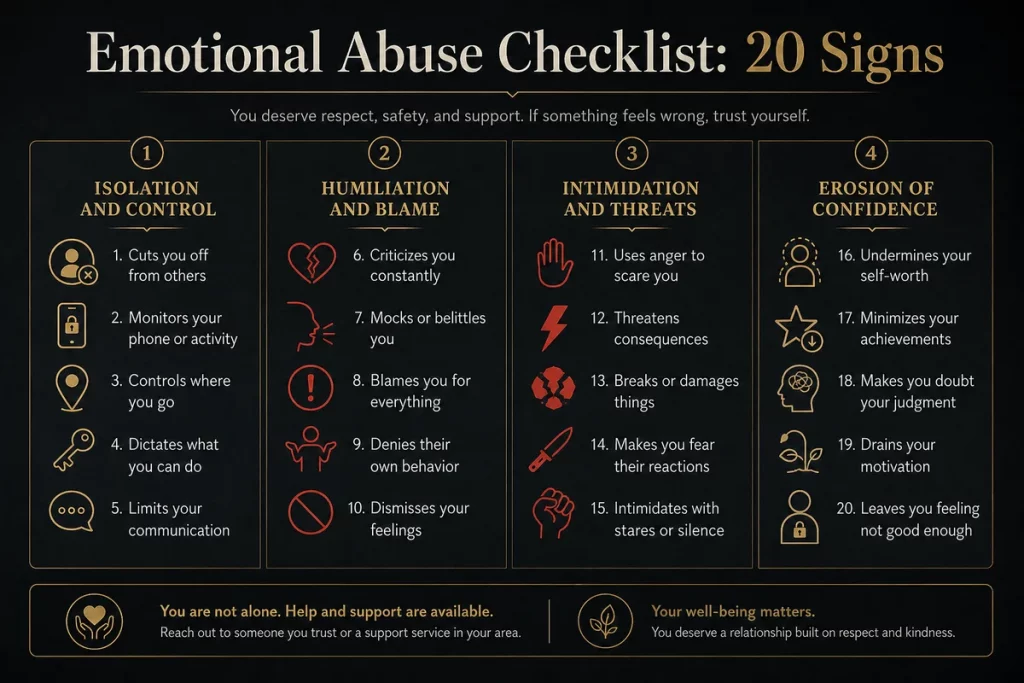
The 20-Point Emotional Abuse Checklist
Read each item carefully and thoughtfully, then check whether it describes a recurring pattern in your relationship. A single isolated incident doesn’t necessarily indicate abuse — look for recurring patterns across multiple items.
Early-Stage Patterns (Often Dismissed as “Normal”)
☐ 1. They criticize you frequently, framed as “jokes” or “help”
Persistent negative comments about your appearance, intelligence, decisions, or character — disguised as humor (“I’m just teasing”) or concern (“I’m only saying this because I care”). When you object, you’re told you “can’t take a joke” or you’re “too sensitive.” The criticism is constant, subtle, and accumulative, gradually eroding your confidence in yourself.
☐ 2. They monitor your communications and whereabouts
Checking your phone, reading your messages, wanting to know where you are at all times, and questioning you about who you’ve talked to. This is framed as concern (“I worry about you”) or relationship investment (“I just want to feel connected”). In reality, it’s surveillance designed to maintain control over your social connections and movements.
☐ 3. They guilt-trip you for spending time with others
“I guess your friends are more important than me.” “Fine, go out — I’ll just be here alone.” Making you feel selfish or disloyal for maintaining friendships, family relationships, or personal time. The goal is progressive isolation — reducing your world to the abuser as your primary (and eventually only) source of connection. Check this box on the emotional abuse checklist if you’ve started declining social invitations to avoid the emotional fallout.
☐ 4. They dismiss your feelings when you raise concerns
“You’re overreacting.” “It’s not that serious.” “You’re making a big deal out of nothing.” When your emotional responses are consistently invalidated, you learn to suppress them — which is the goal. A partner who respects you validates your feelings even when they disagree with your conclusions.
☐ 5. You find yourself apologizing even when you’ve done nothing wrong
If you routinely apologize to restore peace — without a clear understanding of what you’re apologizing for — you’ve been conditioned through guilt-tripping and blame-shifting to accept responsibility for the emotional climate of the relationship. This pattern is a foundational item on any emotional abuse checklist because it reveals the power imbalance at the relationship’s core.
Mid-Stage Patterns (Escalating Control)
☐ 6. They deny things you clearly remember happening
This is gaslighting — the deliberate denial of shared reality. “I never said that.” “That didn’t happen.” “You’re imagining things.” If your partner regularly makes you question your own memory and perception, check this box. Gaslighting is one of the most damaging items on an emotional abuse checklist because it attacks your ability to recognize the abuse itself.
☐ 7.
Their anger? You provoked it. Their cheating? You drove them to it. Their failure? You didn’t support them enough. Consistent blame-shifting means you carry the emotional weight of both your own and your partner’s actions. If you can’t recall the last time your partner took genuine responsibility for a mistake, this item applies.
☐ 8. They use the silent treatment as punishment
Withdrawing all communication — for hours, days, or weeks — after you set a boundary, express a need, or do something they disapprove of. The silent treatment creates anxiety so severe that you’ll modify your behavior to prevent it. This is stonewalling as a control mechanism, and it’s a significant item on any emotional abuse checklist because it trains you to self-censor.
☐ 9. They control finances or major decisions unilaterally
Making financial decisions without your input, restricting your access to money, demanding financial accounting for every purchase, or using money as leverage (“If you don’t do what I want, I’ll cut off the credit card”). Financial control is both emotional abuse and a practical barrier to leaving.
☐ 10. They humiliate you in front of others
Mocking you, sharing embarrassing stories, making cutting comments, or undermining you in social settings — then telling you you’re “too sensitive” when you object. Public humiliation serves as both punishment and a display of dominance, signaling to others (and to you) that you’re beneath them in the relationship hierarchy.
☐ 11. Your self-confidence has declined since the relationship began
If you felt more confident, more capable, and more like yourself before the relationship — and now feel anxious, uncertain, and diminished — that trajectory is significant. Healthy relationships build you up. Emotionally abusive relationships systematically tear you down. This item on the emotional abuse checklist measures cumulative impact rather than a specific behavior, which makes it particularly telling.
☐ 12. They alternate between intense warmth and cold distance
Monday they adore you; Wednesday they’re dismissive; Friday they’re loving again. This unpredictable cycling creates the intermittent reinforcement pattern that produces trauma bonds — a neurochemical addiction to the relationship’s emotional highs that keeps you hooked despite the lows.
Severe-Stage Patterns (Advanced Control)
☐ 13. They’ve isolated you from friends and family
If your social circle has significantly shrunk since the relationship began — whether through direct demands, manufactured conflicts with your loved ones, guilt about spending time away, or your own withdrawal due to shame — isolation is in effect. This is one of the most dangerous items on an emotional abuse checklist because it removes the external perspectives that would help you see the pattern clearly.
☐ 14. They use your vulnerabilities as weapons
Information you shared in trust — childhood trauma, insecurities, fears, past relationship pain — is deployed during arguments to hurt, control, or silence you. “No wonder your ex left you.” “With your issues, you’re lucky anyone puts up with you.” This weaponization of intimacy is among the cruelest forms of emotional abuse because it punishes vulnerability itself, making genuine connection impossible.
☐ 15. You feel like you’re “walking on eggshells”
Constantly monitoring your words, actions, and decisions to avoid triggering your partner’s anger, withdrawal, or disappointment. If you spend significant mental energy trying to predict and prevent their negative reactions, you’re living in a state of hypervigilance that characterizes emotionally abusive environments.
☐ 16. They threaten consequences to control your behavior
Threats of leaving, self-harm, revealing secrets, taking the children, or destroying your reputation — used to coerce compliance. Emotional blackmail creates a fear-based dynamic where you act not from choice but from the anticipation of threatened consequences. If threats are part of your relationship’s conflict pattern, this is a critical emotional abuse checklist item.
☐ 17. They’ve convinced you that no one else would want you
“You’re lucky to have me.” “Who else would put up with you?” “You’ll never find someone who treats you this well.” If you’ve internalized the belief that you can’t do better — or that you’re fundamentally unlovable without your partner — this belief was manufactured through systematic devaluation. It’s not true. It was installed to keep you from leaving.
☐ 18. You’ve changed in ways that feel like losses
You used to have opinions, hobbies, goals, energy, and a sense of humor. Now you’re quieter, more anxious, less confident, and unsure of what you want. These changes aren’t personal growth — they’re the erosion that emotional abuse produces. If people who knew you before the relationship say “you’ve changed” or express concern, listen to them.
☐ 19. They never genuinely apologize
“I’m sorry you feel that way.” “I’m sorry, but you started it.” “I already apologized — what more do you want?” If your partner’s apologies never include genuine acknowledgment of the specific harm, acceptance of responsibility without qualifiers, and observable behavioral change — they’re not apologies. They’re conversational tools designed to close the topic without accountability.
☐ 20. You feel trapped, hopeless, or like you’re losing yourself
The final item on this emotional abuse checklist captures the cumulative psychological state that prolonged abuse produces. If you feel trapped in the relationship despite wanting to leave, hopeless that things will improve, or disconnected from the person you used to be — these feelings are not character flaws or mental illness. They are the predictable, documented outcomes of sustained emotional abuse. Trust them.
How to Score Your Results
Count the total number of items you checked on this emotional abuse checklist. This isn’t a clinical diagnosis — it’s a self-assessment framework to help you evaluate your experience and determine next steps.
| Items Checked | Assessment | Recommended Action |
|---|---|---|
| 0-3 | Normal relationship friction | Communicate openly about specific concerns. Consider couples counseling for persistent issues. |
| 4-7 | Concerning patterns present | Seek individual therapy to evaluate the dynamic. Review our emotional manipulation tactics guide. Monitor whether patterns escalate. |
| 8-12 | Emotional abuse likely | Consult a therapist experienced in emotional abuse. Contact the National Domestic Violence Hotline (1-800-799-7233). Begin developing a support plan. |
| 13-16 | Significant emotional abuse | Seek professional support immediately. Develop an exit strategy with professional guidance. Reconnect with your support system. |
| 17-20 | Severe emotional abuse | Your safety and wellbeing are at serious risk. Contact the National Domestic Violence Hotline immediately. Prioritize creating a safe exit plan. |
For a more interactive assessment, take our emotional abuse quiz which provides immediate feedback and personalized resources. You can also review narcissistic abuse signs if you suspect your partner may have narcissistic traits.

Emotional Abuse vs. Normal Conflict
Not every difficult moment in a relationship is emotional abuse. An emotional abuse checklist must distinguish between healthy conflict and genuine abuse patterns, because mislabeling normal disagreements as abuse is as harmful as failing to recognize real abuse. Here’s how to distinguish between the two:
Healthy conflict involves two people expressing needs, listening to each other, taking mutual responsibility, and working toward resolution. Both partners feel heard afterward. Both partners sometimes compromise. Both partners can raise concerns without fear of retaliation. Disagreements may be heated, but they resolve with understanding and behavioral change. Crucially, both people maintain respect for each other’s autonomy, intelligence, and emotional experience throughout the conflict — even when they disagree strongly.
Emotional abuse involves one person systematically controlling the other through manipulation, fear, guilt, and reality distortion. One partner consistently dominates while the other submits or is silenced. Concerns raised by the victim are dismissed, denied, or weaponized against them. The abuser never genuinely takes responsibility or makes lasting behavioral change. Over time, the relationship produces a measurable decline in the victim’s self-worth, confidence, and autonomy.
The clearest distinguishing factor: how do you feel about yourself in this relationship? Healthy relationships make you feel more confident, supported, and authentically yourself over time. Emotionally abusive relationships make you feel smaller, more anxious, less confident, and disconnected from who you used to be. If the trajectory of your self-worth points downward since the relationship began, the emotional abuse checklist is likely to confirm what that trajectory is telling you.
What to Do If You Recognize These Signs
If this emotional abuse checklist has confirmed what you suspected — or revealed what you couldn’t see — here are your next steps:
You are not to blame. Emotional abuse is the abuser’s choice, not the victim’s fault. Regardless of what your partner has told you, their behavior is their responsibility. Internalizing blame is a direct effect of the abuse itself — not evidence that you caused it. If you’ve been told repeatedly that the problems are your fault, that belief was installed through systematic blame-shifting. It isn’t true. The items you checked on this emotional abuse checklist are things that were done to you — not things you caused.
Reach out for professional support. The National Domestic Violence Hotline (1-800-799-7233) provides free, confidential guidance for emotional abuse — not just physical violence. They are trained specifically in the dynamics you’re experiencing and can help you evaluate your options. A therapist specializing in emotional abuse or narcissistic abuse can help you process the experience, develop coping strategies, and create a safety plan if needed. In Canada, contact your provincial crisis line or the Assaulted Women’s Helpline at 1-866-863-0511.
Reconnect with trusted people. Share this emotional abuse checklist with a friend, family member, or therapist you trust. External perspectives restore the reality checks that isolation and gaslighting have removed. The people who care about you have likely been concerned — they may have noticed changes in you that you’ve been too close to see. Let them in. Their perspective is a lifeline.
Document the behavior. Keep a private, password-protected record of specific incidents on a device your partner doesn’t access. When concerning events happen, write down what was said, what occurred, the date, and how you felt. This documentation serves as a reality anchor that directly counteracts gaslighting, reveals patterns that isolated incidents obscure, and provides essential evidence if legal action or formal separation becomes necessary.
Protect yourself in future relationships. When you’re ready to date again, tools like GuyID provide identity verification and accountability structures that emotionally abusive people avoid. Screen matches with GuyID’s free tools, watch for early red flags like love bombing and dating app red flags, and share your Date Mode link to establish transparency from the first interaction.
How GuyID Helps
GuyID should appear when it is useful, not as a banner ad. A GuyID Trust Profile gives someone a portable way to share trust signals before a date, while identity verification and social vouching help turn vague profile claims into clearer next steps.
Useful next steps:
- Create a GuyID Trust Profile when you want a cleaner way to share verified trust signals.
- Use GuyID free tools and related guides when you need a checklist before meeting someone.
- Treat identity verification as confidence-building, not a guarantee.
- Use social vouching when you want context from people who already know the person.
- Sign up only when the extra trust layer helps the decision you are already trying to make.
Frequently Asked Questions
What are the most common signs on an emotional abuse checklist?
The most frequently identified patterns on an emotional abuse checklist are: gaslighting (denying your reality), blame-shifting (everything is your fault), silent treatment as punishment, isolation from friends and family, persistent criticism disguised as concern, and intermittent reinforcement (hot-cold cycling). These tactics often occur in combination, creating a web of control that’s difficult to recognize from inside the relationship.
Is emotional abuse really as serious as physical abuse?
Research consistently shows that emotional abuse produces psychological outcomes — anxiety, depression, PTSD, self-worth damage — comparable to physical abuse, and in some studies, more severe and longer-lasting. The National Library of Medicine has published multiple studies documenting that emotional abuse predicts poorer mental health outcomes than physical abuse alone. Emotional abuse is real abuse with real consequences.
Can emotional abuse happen in dating before a relationship forms?
Yes. Many patterns on this emotional abuse checklist begin during the dating phase — love bombing, guilt-tripping about boundaries, dismissing your feelings, and pushing past safety limits. Online dating can actually accelerate these patterns because text-based communication allows manipulators to carefully craft responses. Watch for early warning signs and verify matches through GuyID to filter for accountability.
What if I only checked a few items — is it still abuse?
Even a few items warrant attention, especially if they include high-severity patterns like gaslighting, isolation, or threats. The severity of individual items matters as much as the total count. A single pattern of gaslighting can be more damaging than several instances of minor criticism. If any item on this checklist resonated strongly, consider discussing it with a therapist.
Can an emotional abuser change?
Some can — with genuine self-awareness, professional therapy, and sustained effort over years. However, change requires the abuser to acknowledge their behavior as abusive, take full responsibility without qualifiers, and commit to ongoing therapeutic work. Many emotional abusers lack this capacity or motivation. Do not stay in an abusive relationship based on the hope of change that hasn’t materialized. Focus on protecting yourself.
Where can I get help for emotional abuse?
The National Domestic Violence Hotline (1-800-799-7233) provides free, confidential support specifically for emotional abuse. Psychology Today’s therapist directory lets you filter for abuse specialists. In Canada, contact the Canadian Association of Elizabeth Fry Societies or your provincial crisis line. Online communities on Reddit (r/emotionalabuse, r/NarcissisticAbuse) connect survivors with peer support.
How is this different from the emotional abuse quiz?
This emotional abuse checklist provides a comprehensive behavioral inventory — 20 specific patterns to evaluate. Our emotional abuse quiz provides a shorter, interactive assessment with immediate scoring and personalized feedback. Both tools identify the same core patterns; the checklist offers more detail for self-reflection, while the quiz offers faster assessment. Using both provides the most complete picture.
Is it possible to emotionally abuse someone without knowing it?
Some emotionally abusive behaviors are learned patterns repeated unconsciously — particularly guilt-tripping, criticism disguised as help, and emotional withdrawal during conflict. However, unconscious intent doesn’t reduce the impact on the victim. If you recognize your own behavior in items on this emotional abuse checklist, that self-awareness is a positive sign. Consider working with a therapist to develop healthier communication patterns.