

Reader Briefing
Reader Briefing
Start here if you need a practical read on trauma bonding in friendship: signs & recovery: who should use verification, what signals to check, and what to do before moving from online interest to an in-person plan.
Who this is for
- People meeting someone from a dating app or social platform.
- Readers preparing for a first in-person date.
- Anyone checking identity, profile consistency, and trust signals.
- Online daters improving conversations, profiles, or match screening.
You’ll learn
- How to evaluate identity signals without treating any single check as certainty.
- Which trust signals matter and how to weigh them together.
- How to move from online conversation to a safer first meeting.
- Where GuyID tools fit into a quick pre-date screening workflow.
- How to compare options using practical safety and trust criteria.
- When to slow down, ask for more context, or walk away.
Bottom line
Verification reduces uncertainty; it does not guarantee future behavior. Use a layered approach: confirm identity signals, compare profile consistency, ask for a short video call, keep early plans public, and slow down when someone pressures you to skip normal safety steps.
Key takeaways
- Identity verification improves confidence, not certainty.
- Verify before meeting privately or sharing sensitive details.
- A short video call can reveal many inconsistencies.
- Pressure to skip reasonable safety steps is useful information.
- Use GuyID tools to turn vague concerns into specific checks.
Free Tools
Catfish Probability Detector
Check whether a dating profile has suspicious identity or photo signals.
Dating Bio Red Flag Detector
Review a bio for scam, pressure, or trust-warning language.
Dating Safety Checklist
Use free GuyID tools before moving from chat to a real date.
Next step
Create your GuyID trust profile
Share consent-based trust signals before a date without turning the conversation into an interrogation.
Trauma bonding doesn’t require a romantic relationship — it can form in any dynamic where intermittent abuse and affection create neurochemical dependency, including friendships. A friend who alternates between being your greatest supporter and your harshest critic, who builds you up one week and tears you down the next, who makes you feel irreplaceable during good periods and worthless during bad ones — this friend may have created a trauma bonding friendship that’s just as difficult to leave as an abusive romantic relationship. If you’ve ever thought “I know this friendship is toxic but I can’t imagine my life without them,” you may be experiencing a trauma bond in its platonic form. This guide explains how trauma bonding friendship dynamics develop, the specific signs that distinguish them from normal friendship conflict, and how to break free.
NavigateTable of Contents25 sections
How Trauma Bonding Friendship Dynamics Form
A trauma bonding friendship develops through the same mechanism as romantic trauma bonds — intermittent reinforcement — but the friendship context adds specific elements that make recognition and escape uniquely difficult:
The idealization phase. The friendship begins with intensity that feels like finding your “soul friend.” They’re devoted, available, understanding, and make you feel uniquely seen. This mirrors the love bombing in friendship pattern — manufactured closeness that bonds you before the real dynamic reveals itself. The idealization creates the reference point your brain uses throughout the friendship: “But remember how amazing it was at the beginning?”
The introduction of harm. Gradually, the friend introduces criticism, emotional manipulation, boundary violations, or controlling behavior. It’s subtle at first — a cutting backhanded compliment disguised as humor, sharing your private information with others, making you the consistent target of “jokes” that leave a sting long after the laughter stops. Because the idealization established trust, you give them the benefit of the doubt: “They didn’t mean it.” “That’s just how they are.” “I’m being too sensitive.” Research from the National Library of Medicine on interpersonal manipulation confirms that harm introduced gradually after trust establishment is significantly harder to recognize than harm from the outset — because the established trust creates a cognitive framework that actively resists identifying the trusted person as harmful.
The intermittent reinforcement cycle. The friendship eventually settles into a recognizable cyclical pattern: periods of genuine warmth, closeness, and support alternating with periods of criticism, coldness, exclusion, or emotional punishment. The unpredictability is the key — you never know which version of the friend you’ll get, so you remain hypervigilant, constantly monitoring their mood and adjusting your behavior to maintain the “good” version. This constant hypervigilance IS the core trauma bonding friendship mechanism operating in real time: your attention, your emotional energy, your time, and your behavioral flexibility are all consumed by managing the relationship, leaving no emotional resources available for evaluating objectively whether the relationship is actually healthy for you.
Isolation from other friendships. The toxic friend gradually positions themselves as your primary social connection — through triangulation (creating conflict between you and other friends), possessiveness about your time, or criticism of your other relationships (“They don’t appreciate you like I do”). As your social world contracts, the trauma-bonded friendship becomes your primary emotional lifeline — making the prospect of losing it feel catastrophic even when the friendship itself is the primary source of your distress.
9 Signs of a Trauma Bonding Friendship
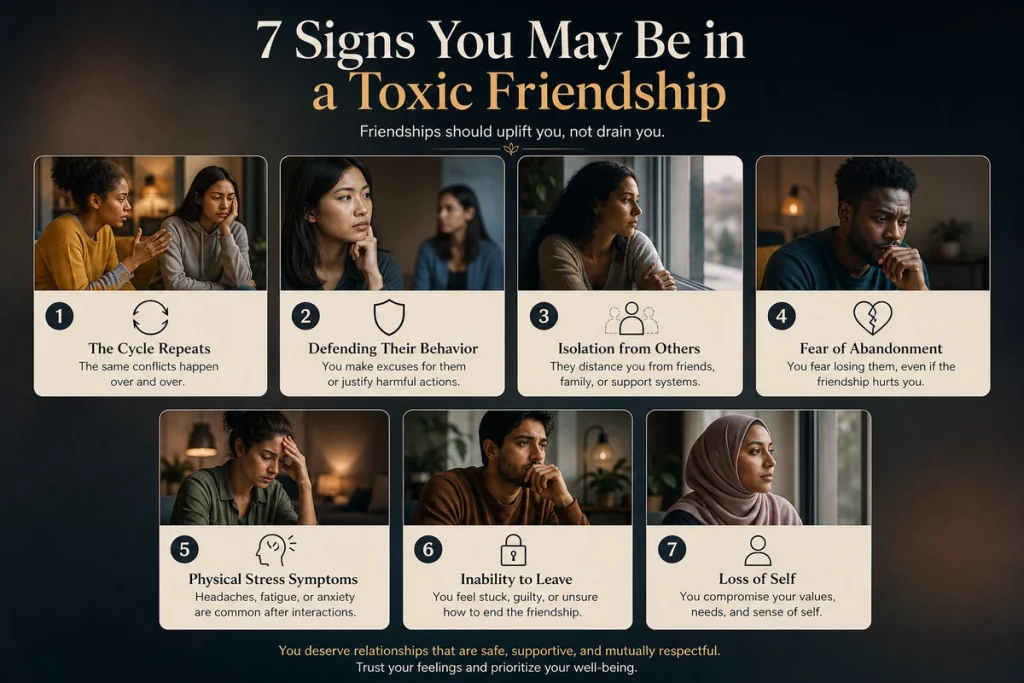
1. Hot-Cold Cycling
Your friend alternates between being your biggest supporter and your harshest critic — sometimes within the same conversation. One week they’re planning a trip together and telling you how much they value you; the next week they’re distant, dismissive, or openly critical. The inconsistency keeps you in a perpetual state of uncertainty about where you stand — which produces the hypervigilance and emotional dependency that defines a trauma bonding friendship.
2. Walking on Eggshells
You carefully monitor what you say, how you say it, and what you share to avoid triggering their negative response. You edit yourself constantly — withholding opinions, avoiding topics, managing your own emotional expression to keep them in a good mood. This behavioral self-editing isn’t “being considerate” — it’s the adaptive response to an unpredictable person whose reactions you’ve learned to fear. Genuine, healthy friends actively create safety for your authentic, unfiltered expression. A trauma bonding friendship demands curated self-presentation to avoid punishment.
3. Defending Them to Concerned Others
“You don’t know them like I do.” “They’re going through a hard time.” “They can be really sweet when they want to be.” If you find yourself repeatedly defending the friend to family members, other friends, or a therapist who’ve independently expressed concern — the defense pattern itself is a trauma bonding indicator. You’re maintaining the cognitive framework that protects the bond: “They’re good, the bad moments are exceptions, and people who don’t see their good side don’t understand.”
4. Emotional Exhaustion as the Default State
After spending time with this friend, you feel drained rather than energized. The friendship requires constant emotional labor — managing their moods, providing reassurance, absorbing criticism, navigating their expectations — and the recovery period between interactions is longer than the interactions themselves. Healthy friendships leave you feeling connected, supported, and replenished. A trauma bonding friendship leaves you depleted because the intermittent reinforcement cycle consumes more emotional energy than it provides.
5. Isolation from Your Other Relationships
Your social world has gradually contracted around this one friend. Other friendships have faded — sometimes through the toxic friend’s direct interference (gossip, triangulation, possessiveness), sometimes through the indirect effect of having no emotional energy left for other connections after managing this one. If your social life has become a single-friend ecosystem, the isolation is both a product of the trauma bonding friendship and the mechanism that sustains it — without external perspectives, there’s no one to say “this isn’t normal.”
6. Self-Blame for the Friendship’s Problems
“If I hadn’t said that, they wouldn’t have reacted that way.” “I should have known they’d be upset.” “I’m too sensitive — this is my issue, not theirs.” Self-blame is the cognitive distortion that protects the trauma bond from rational challenge. If the problems are YOUR fault, the friend remains “good” and the bond remains “worth it.” A trauma bonding friendship cultivates this self-blame actively — through gaslighting (“You’re misremembering what happened”), blame-shifting (“I only did that because you…”), and conditional affection (“When you don’t make me upset, everything is fine”).
7. Identity Loss
You’ve gradually lost track of your own opinions, preferences, and identity markers independent of this friend. Your interests have merged with theirs. Your opinions have adjusted to match theirs. You define yourself in relation to the friendship rather than as an independent person who happens to have this friendship. This identity erosion mirrors the codependent patterns seen in romantic trauma bonds and serves the same function: a person without independent identity has no platform from which to evaluate or leave the bond.
8. Euphoric Relief After Conflict Resolution
After a fight, cold period, or falling out — when they finally reach out, when the warmth returns, when they’re “your person” again — the relief feels disproportionately powerful. Not just “I’m glad we worked it out” but genuine euphoria, almost drug-like in intensity. This is the neurochemical signature of trauma bonding: the dopamine spike during reconciliation is amplified by the cortisol crash that preceded it, producing a high that normal friendship satisfaction can’t match. The American Psychological Association identifies this relief-euphoria response as a hallmark of intermittent reinforcement conditioning across all relationship types.
9. Inability to Leave Despite Knowing You Should
You’ve recognized the pattern. You’ve talked about it in therapy. You’ve told yourself “this is the last time” after multiple cycles. And yet you stay — or you leave and return. This inability to leave despite cognitive awareness of the problem is the defining feature of trauma bonding. If the friendship were merely unhealthy, leaving would be difficult but achievable through willpower. A trauma bonding friendship operates below the level of willpower — in the neurochemical circuitry that treats the friend as a necessary source of emotional regulation, making separation feel like survival-threatening deprivation rather than healthy boundary-setting. Take our trauma bonding test to assess the severity.
Trauma Bonding vs. Normal Friendship Conflict
Not every difficult friendship is a trauma bonding friendship. Healthy friendships include conflict — the distinction is in the pattern, the power dynamic, and the net emotional impact:
| Trauma Bonding Friendship | Normal Friendship Conflict |
|---|---|
| Conflict is cyclical and predictable — same pattern repeating | Conflicts are situation-specific and resolve genuinely |
| One person consistently holds more power in the dynamic | Power is roughly balanced — both people’s needs matter equally |
| You feel worse about yourself after most interactions | You feel supported even when you disagree |
| You modify your behavior to prevent their reactions | You express yourself freely knowing disagreement is survivable |
| The “good periods” feel disproportionately euphoric | Good times feel warm and natural, not relief-driven |
| Other people have expressed concern about this friendship | Others see the friendship as healthy even during rough patches |
| You can’t imagine leaving despite persistent unhappiness | You stay because the friendship genuinely enriches your life |
Why You Stay in a Trauma-Bonded Friendship
Understanding why you stay — despite wanting to leave — reduces the self-blame that perpetuates the pattern:
Neurochemical dependency. The intermittent reinforcement cycle has created genuine neurochemical attachment. Your brain has been conditioned to treat the friend as a primary source of dopamine (during good periods) and cortisol regulation (the relief when conflict resolves). Removing this source produces withdrawal that feels identical to losing a romantic partner — or stopping a substance your brain has become dependent on. This neurochemical dependency is the same mechanism measured by the trauma bonding test in the withdrawal symptoms category.
Sunk cost. “We’ve been friends for seven years — I can’t throw that away.” The time, emotional investment, and shared history feel like assets that would be wasted by leaving. But sunk costs are already spent regardless of future decisions. The question isn’t “was this friendship worth it?” but “is it worth continuing?” — and those are fundamentally different assessments that the sunk cost fallacy conflates.
Social consequences. Unlike romantic relationships (which are recognized as “breakable”), friendships are supposed to be forever — and ending one carries social stigma. Mutual friends may take sides. Your social group may fracture. The toxic friend may launch a reputation campaign. These real social consequences make leaving a trauma bonding friendship practically more complicated than leaving a romantic relationship in many cases, because the social infrastructure around friendships isn’t designed to support “friendship breakups.”
Fear of being alone. If the toxic friendship has isolated you from other connections, leaving feels like choosing total social isolation over a painful but present relationship. This fear is both genuine and exactly what the trauma bonding friendship dynamic was designed to produce — the isolation ensures that leaving feels impossible not because YOU can’t function alone or make new friends, but because the friendship has systematically removed your alternatives through possessiveness, triangulation, and time monopolization. The irony is that maintaining the trauma-bonded friendship is itself a form of social isolation — you’re socially active with one person, but that person is simultaneously your connection and your barrier to all other connections. True social recovery begins only when the primary obstacle — the trauma-bonded friendship itself — is addressed.
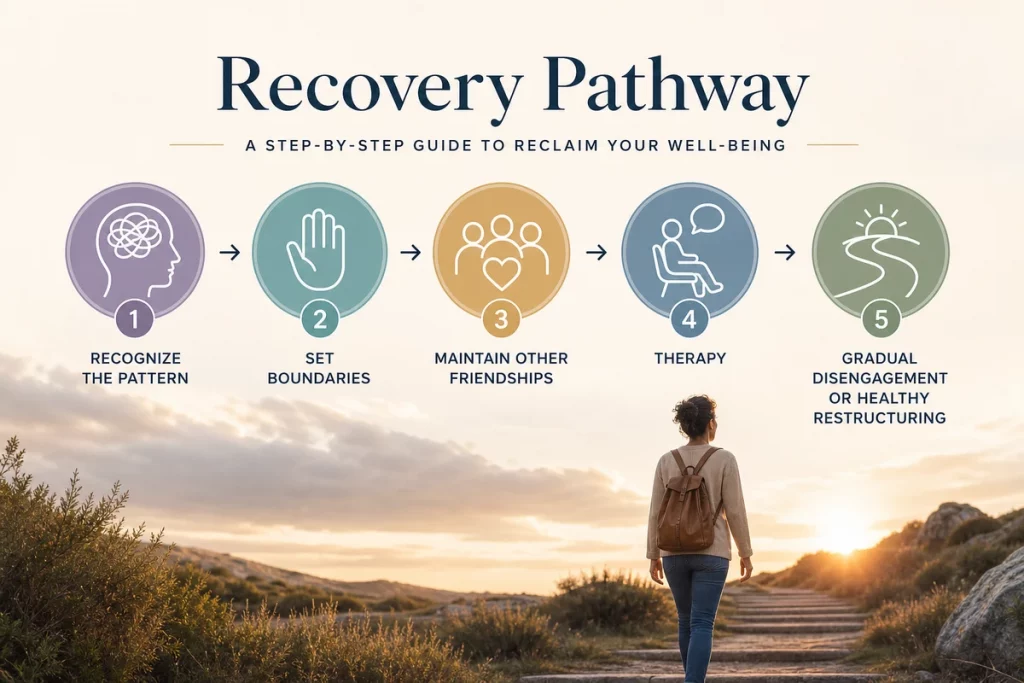
Breaking the Friendship Trauma Bond
Seek professional support first. A therapist experienced in relational trauma helps you process the bond, develop an exit strategy, and manage the withdrawal period that follows. Individual therapy is essential — not couples/friendship counseling with the toxic friend, which is typically counterproductive in trauma-bonded dynamics.
Rebuild your social network before fully disconnecting. Reconnect with old friends, join new social groups, and invest in relationships outside the trauma bond. This creates the social safety net that makes leaving feel survivable rather than isolating. You don’t need to fully disconnect from the toxic friend immediately — you need to reduce your dependence on them by building alternatives first.
Implement graduated distance. Reduce contact frequency, decline invitations more often, and stop being available on demand. Each step creates space for your nervous system to begin recalibrating to a lower level of engagement. If full no-contact feels impossible (shared social groups, work proximity), graduated distance achieves the neurochemical withdrawal more slowly but with less social disruption.
Set and enforce clear boundaries. When you’re ready: “I need our friendship to be consistently respectful — I can’t maintain a connection where I’m criticized one day and praised the next.” Their response tells you whether the friendship is salvageable (genuine accountability and sustained behavioral change) or irreparable (defensiveness, blame-shifting, gaslighting, or temporary improvement followed by regression).
For future friendships. Apply the same vigilance to new friendships that you’d apply to new romantic connections — watch for friendship love bombing, verify identities on platforms like Bumble BFF using GuyID’s free screening tools, and maintain the independent social network that prevents any single friendship from becoming the only friendship. Verify connections through GuyID — genuine people welcome transparency in all relationship types, not just romantic ones.
How GuyID Helps
GuyID should appear when it is useful, not as a banner ad. A GuyID Trust Profile gives someone a portable way to share trust signals before a date, while identity verification and social vouching help turn vague profile claims into clearer next steps.
Useful next steps:
- Create a GuyID Trust Profile when you want a cleaner way to share verified trust signals.
- Use GuyID free tools and related guides when you need a checklist before meeting someone.
- Treat identity verification as confidence-building, not a guarantee.
- Use social vouching when you want context from people who already know the person.
- Sign up only when the extra trust layer helps the decision you are already trying to make.
Frequently Asked Questions
Can trauma bonding happen in a friendship?
Yes. A trauma bonding friendship develops through the same intermittent reinforcement mechanism as romantic trauma bonds — alternating harm with kindness to create neurochemical dependency. The attachment system doesn’t distinguish between relationship types; any dynamic where someone alternates between being your greatest comfort and your greatest distress can produce a trauma bond. Friendships are actually more susceptible in some ways because the cultural framework for recognizing and leaving “toxic friendships” is less developed than for toxic romantic relationships.
How do I know if my friendship is trauma-bonded or just complicated?
The comparison table above provides the detailed distinction. The core test: does the friendship follow a repeating cycle of harm → reconciliation → calm → harm, and does the reconciliation phase produce disproportionate relief/euphoria? If yes, trauma bonding is likely present. If conflicts are situation-specific, resolve genuinely, and don’t repeat in pattern — the friendship is complicated but not trauma-bonded. Take our trauma bonding test for a scored assessment.
Is it harder to leave a trauma-bonded friendship than a romantic relationship?
In some ways, yes. Friendships don’t have formal “breakup” protocols, social circles often overlap more deeply than romantic partners’ circles, and the cultural expectation that “friends don’t break up” adds guilt to an already painful process. Additionally, friendship trauma bonds often involve shared social groups where severing the connection has visible ripple effects. The neurochemical bond is equally strong regardless of relationship type — but the social infrastructure for managing the separation is less developed for friendships.
Can a trauma-bonded friendship be repaired?
Repair may be possible only when the relationship is safe and both people acknowledge harmful behavior, respect boundaries, and demonstrate sustained change. Do not use reconciliation as a goal when there is coercion, violence, stalking, or retaliation; seek qualified support instead.
What does friendship trauma bond recovery look like?
Recovery follows the same trajectory as romantic trauma bond recovery: acute withdrawal (2-4 weeks of intense urges to reconnect), gradual recalibration (3-6 months of rebuilding independent identity and social network), and full recovery (12-18 months with therapeutic support). During recovery, you’ll likely experience: idealization of the friendship’s good moments, guilt about leaving, temptation to reconnect during stressful periods, and a gradual revelation of just how much the friendship had contracted your life and identity.
Should I tell the toxic friend why I’m distancing?
Depends on their personality. If they’re narcissistic, disclosure invites manipulation — they’ll gaslight, guilt-trip, or weaponize your vulnerability. If they’re non-narcissistic but have harmful patterns (codependent, anxious, emotionally immature), honest communication may produce genuine reflection. The safest approach: graduated distance first (to establish emotional stability outside the bond), then — if and only if you’re emotionally grounded — a clear, brief communication: “I need this friendship to change fundamentally or I need to step back for my own wellbeing.” No JADE (Justify, Argue, Defend, Explain) beyond that initial statement.
How do I prevent trauma bonding in future friendships?
Maintain several sources of support, let closeness develop gradually, notice how boundaries are received, and keep independent routines and relationships. No checklist prevents every harmful dynamic. A qualified professional can help when past experiences make new relationships feel unsafe or overwhelming.
Where can I get help with a trauma-bonded friendship?
Individual therapy with a relational trauma specialist is the most effective intervention. The National Domestic Violence Hotline (1-800-799-7233) supports people in all types of abusive relationships, including friendships. Our trauma bonding test provides a scored self-assessment. The trauma bonding signs guide covers indicators across all relationship types. The trauma bonding cycle guide explains the stages that maintain the bond. Reddit communities r/toxicfriendships and r/NarcissisticAbuse provide peer support from people navigating similar dynamics.