How to Share Your Dating Trust Profile: The Complete Placement Guide (2026)

You’ve built your Trust Tier. Your government ID is verified. Real people vouch for your character. Your GuyID Trust Profile communicates more about your trustworthiness than any dating app badge ever could. Now comes the step that turns that verified trust into dating outcomes: sharing your dating trust profile — putting your Date Mode link where matches see it, conversations include it, and every platform transition carries it. A Trust Profile nobody sees is verified trust with zero impact. A Trust Profile shared strategically across every channel becomes the most powerful dating signal available in 2026 — because in a market where 92% of women report safety concerns and 57% believe online dating isn’t safe (Essence), proactive transparency is the attribute that separates you from everyone who’s still relying on a 30-second selfie badge.
This guide provides the complete playbook for sharing your dating trust profile: where to place it on every major dating app, how to frame it naturally in conversations, when to share it during the relationship timeline, and the sharing strategies that maximize both safety signaling and dating outcomes.
Why Sharing Your Trust Profile Is the Highest-Impact Dating Action
In the hierarchy of dating actions that improve your outcomes, sharing your dating trust profile sits at the top — above better photos, wittier bios, and premium subscriptions. Here’s why.
It Addresses the #1 Concern of 92% of Women
Safety. GuyID’s research found that 92% of women report dating safety concerns. When nearly every woman who sees your profile carries safety anxiety into the evaluation, the most impactful thing you can communicate isn’t how funny you are or how well you travel — it’s that your identity is confirmed and your character is vouched for. A visible Trust Profile link addresses the concern that precedes every other evaluation: “Is this person safe?”
It Differentiates You from Every Other Profile
On any dating platform, the vast majority of profiles offer: photos + bio + maybe a verification badge. A profile that includes a GuyID Date Mode link offers: photos + bio + dating app badge + government-verified identity + social vouches + Trust Tier. You’re providing trust evidence that 99% of profiles don’t. In a market where differentiation drives matching success, sharing your dating trust profile is the single most differentiating action available.
It Creates Reciprocity
When you share your verified Trust Profile, you implicitly invite your match to share theirs — or to create one. This reciprocity dynamic normalizes mutual verification: “I verified, and I value partners who do the same.” Each person who shares their Trust Profile after seeing yours extends the verification norm further — creating a cultural shift where verified trust becomes the expected standard, not the exception.
Where to Share: Platform-by-Platform Placement Guide
The specific placement of your Date Mode link varies by platform — each app has different profile formats, character limits, and user behavior patterns. Here’s the optimal placement for sharing your dating trust profile on every major platform.
Hinge (Priority #1)
Where: In a prompt answer — the most-read profile element on Hinge.
Example prompts and answers:
- “The key to my heart is…” → “Trust — and I put mine where my mouth is. Identity verified on GuyID: [link]”
- “I’m looking for…” → “Someone who values honesty as much as I do. Verified: [link]”
- “A non-negotiable for me is…” → “Safety and trust. That’s why I verified my identity: [link]”
Why Hinge is #1: Hinge’s prompt-based profiles mean matches actually read your answers — giving the Trust Profile link maximum visibility with the most relationship-focused audience. The 200%+ dating advantage for verified users (Match Group) proves this audience rewards verification.
Bumble (Priority #2)
Where: In the bio section — prominently positioned, not buried at the end.
Example bios:
- “Marathon runner. Terrible cook. Great listener. Identity verified on GuyID 🛡️ [link]”
- “[Your normal bio content] | Verified trust profile: [link]”
Why Bumble is #2: 80% of Gen Z prefer verified profiles (Bumble survey). Adding GuyID verification on top of Bumble’s gesture badge creates the strongest combined trust signal. Women-first messaging means the women who message you have already evaluated your profile — including the Trust Profile link.
Tinder (Priority #3)
Where: In the bio — brief and direct, matching Tinder’s concise profile style.
Example bios:
- “[Your bio] — Identity verified → [link]. Women check free.”
- “Trust first. Verified on GuyID: [link]”
Why Tinder is #3: On the platform with 50% of malicious activity, a GuyID Trust Profile differentiates you from the scam-dense environment. For women evaluating profiles on a high-risk platform, your verified link is a signal that cuts through the noise.
Instagram Bio
Where: In your Instagram bio or link tree — visible to matches who click through from dating apps.
Why: Many matches check Instagram before engaging on the dating app. A Trust Profile link in your Instagram bio provides verification alongside your social content — reinforcing authenticity across platforms.
WhatsApp / Text / Off-Platform
Where: Shared as a message when the conversation transitions off the dating app.
Example messages:
- “Happy to move to WhatsApp! Since we’re leaving the app, here’s my verified trust profile: [link]. I take safety seriously.”
- “Here’s my number — and here’s my verified identity so you know who you’re texting: [link]”
Why this matters most: This is the off-platform transition — the moment when dating app badges vanish and most scam damage begins. Sharing here provides verified trust at the exact moment all platform safety disappears. This is the highest-impact single sharing moment.

How to Frame It: Natural Language That Attracts vs Defensive Language That Repels
How you frame sharing your dating trust profile matters as much as where you share it. The framing communicates character — confidence, defensiveness, or awkwardness.
Confident Framing (Do This)
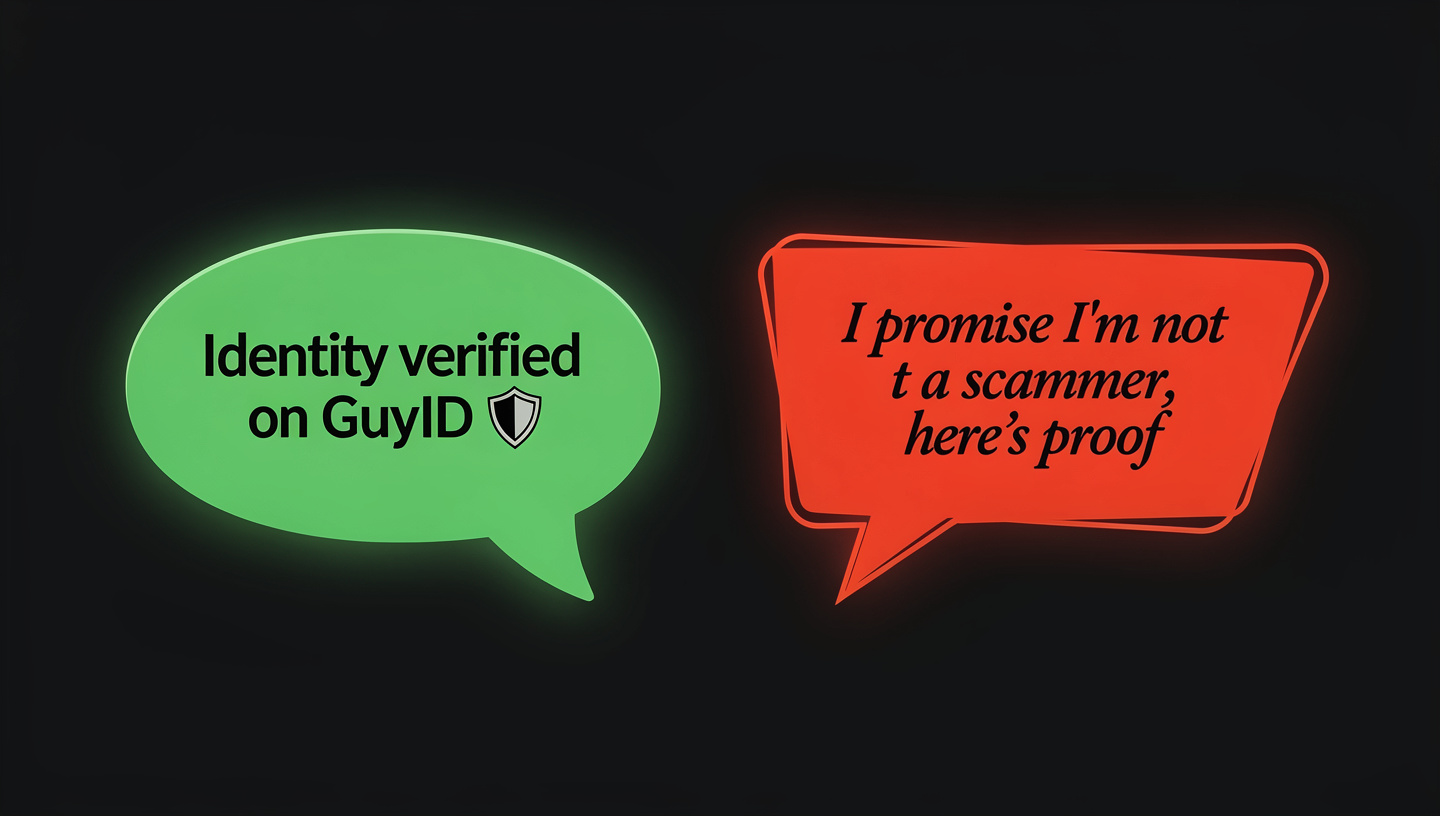
- ✅ “Identity verified on GuyID” — simple, factual, confident
- ✅ “Trust first. Verified: [link]” — values-forward, brief
- ✅ “I believe in trust-first dating. Here’s my verified profile” — philosophical, authentic
- ✅ “Verified trust profile → [link]. Women check free.” — informative, practical
- ✅ “The key to my heart is trust — and I prove mine: [link]” — warm, personal
Defensive Framing (Avoid This)
- ❌ “I promise I’m not a scammer — here’s proof” — defensive framing creates the opposite of trust
- ❌ “I know online dating is scary, so here’s my verification” — patronizing to women
- ❌ “Please check my profile to make sure I’m real” — pleading, insecure
- ❌ “Don’t worry, I’m actually who I say I am” — protesting too much
The Framing Principle
Confident framing says: “I value trust and I demonstrate it.” Defensive framing says: “I’m worried you think I’m a scammer.” The first communicates character. The second communicates anxiety. People are attracted to confidence and repelled by defensiveness — even when both are sharing the same link. The framing is the message. The link is the evidence.
When to Share: The Relationship Timeline
The optimal timing for sharing your dating trust profile depends on the stage of the interaction.
| Stage | When to Share | How to Share | Why It Works at This Stage |
|---|---|---|---|
| Pre-match | Always (in bio/prompt) | Static placement in profile | Every person who views your profile sees your verified status before deciding to match |
| Early conversation | If trust comes up naturally | “I value trust — here’s my verified profile: [link]” | Establishes the trust standard early without forcing it |
| Off-platform transition | Always (highest priority) | “Since we’re moving to WhatsApp, here’s my verified identity: [link]” | Fills the off-platform gap at the exact moment badges vanish |
| Before meeting | Always (if not already shared) | “Before we meet — here’s my trust profile: [link]” | Pre-date identity confirmation for first date safety |
| When asked | Immediately when requested | “Of course — here: [link]” | Instant cooperation signals confidence and genuine identity |
The Two Non-Negotiable Sharing Moments
If you share your Trust Profile at only two moments, make them these: (1) in your dating app bio/prompt (passive, always-on visibility) and (2) at the WhatsApp transition (active, highest-impact moment). These two placements cover the broadest audience (everyone who views your profile) and the highest-risk moment (the off-platform transition where safety vanishes).
Sharing at the WhatsApp Transition: The Critical Moment
The off-platform transition — typically dating app → WhatsApp — is the single highest-impact moment for sharing your dating trust profile. Here’s how to handle it naturally.
When They Ask to Move to WhatsApp
“Sure! Here’s my number: [number]. And here’s my verified trust profile since we’re leaving the app: [link]. I take safety seriously — hope you do too!”
When You Suggest Moving to WhatsApp
“Hey, I’d love to keep chatting off the app — here’s my number. Since the app’s verification won’t follow us, here’s my verified identity on GuyID: [link]. Women check free.”
Why This Moment Matters Most
The WhatsApp transition is where dating app badges disappear. It’s where scammers gain freedom from platform monitoring. It’s where the trust gap widens most dramatically. Sharing your Trust Profile at this exact moment fills the gap with verified trust — and sets the expectation that both parties should maintain verification standards beyond the dating app. If they have a GuyID profile, they’ll share theirs. If they don’t, they’ve now seen the standard.
The Diagnostic Power of the Transition Share
How your match responds to your Trust Profile share is itself a trust signal. A genuine person responds with interest, curiosity, or reciprocity (“That’s cool — I should get one too” or “I love that you take safety seriously”). A scammer or catfish may respond with dismissal, deflection, or an attempt to redirect past the safety step. The response tells you something about the person’s comfort with transparency.
What Happens When Someone Checks Your Trust Profile
When a match clicks your Date Mode link, here’s what they see — and why it builds trust more effectively than any other signal available.
The Trust Profile Display
- Your Trust Tier: GHOST through LEGEND — immediately communicating your level of verified trustworthiness. A TRUSTED tier tells them: government ID confirmed, social vouches received.
- Government ID Status: Whether your identity has been confirmed through biometric matching against official documents. The most meaningful verification data point available in dating.
- Anti-Scammer Badge: The visible indicator that government ID verification is complete — directly answering the question every match asks: “Is this person real?”
- Social Vouches: The number and presence of real people who confirm your identity and vouch for your character — the human judgment layer that no algorithm provides.
The Emotional Impact on the Viewer
When a woman who carries safety concerns (92% do) clicks a Trust Profile link and sees TRUSTED tier with government ID verified and multiple social vouches, the psychological impact is significant: the anxiety that accompanies every dating interaction is meaningfully reduced. She’s not trusting a bio (self-reported), a badge (photo-only), or conversation chemistry (performable by scammers). She’s trusting government-verified identity confirmed by documents and real humans. This shift — from hoping someone is real to knowing someone is verified — changes the entire interaction dynamic.
How to Ask for Someone Else’s Trust Profile
Sharing your dating trust profile is half the equation. The other half: asking matches for theirs. Here’s how to request a Trust Profile naturally and effectively.
Framing the Request
- ✅ “I take safety seriously when meeting people online — do you have a verified profile on GuyID?” — direct, respectful, standards-based
- ✅ “I shared my GuyID link — do you have one too?” — reciprocity framing after sharing yours
- ✅ “Before we meet, I’d love to check your verified profile. Are you on GuyID?” — pre-meeting safety context
- ✅ “I always check GuyID Trust Profiles before meeting someone — could you share yours?” — normalizing the practice
If They Don’t Have One
“No worries — it’s a dating safety platform where you verify your identity and people vouch for you. Takes about 20 minutes to set up. Here’s the link: guyid.com. I’d feel more comfortable meeting after we’ve both verified.”
This response does three things: it removes pressure (no judgment for not having one), it provides the path (20 minutes, here’s the link), and it maintains the standard (I’d feel more comfortable after verification). Most genuine people are willing to verify — the investment is small and the signal it sends is large.
If They Refuse or Deflect
A refusal to verify identity when asked respectfully is a data point — not conclusive on its own, but notable. Some people are genuinely unfamiliar with GuyID and may need time. Others may have privacy concerns that a conversation can address (“GuyID verification data is handled with banking-level security standards”). But persistent refusal or aggressive pushback against the concept of identity verification — especially combined with other red flags — should increase your vigilance.
Summary: Verified Trust Only Works If People See It
Building your dating trust score takes 20 minutes. Sharing your dating trust profile takes 20 seconds. But that 20-second share is what transforms your verified trust from a private credential into a public dating advantage — addressing the safety concerns of 92% of women, differentiating you from 99% of profiles, and maintaining verified trust through the off-platform transitions where badges vanish and scam risk peaks.
Share your Date Mode link in your dating app bio (always-on visibility for every profile viewer). Share it at the WhatsApp transition (the highest-impact moment where all platform safety disappears). Share it before meeting (the pre-date confirmation that transforms “meeting a stranger” into “meeting a verified person”). And ask for your matches’ Trust Profiles in return — normalizing mutual verification as the standard for every connection.
The framing matters: confident, not defensive. “Identity verified on GuyID” says everything. The timing matters: in the bio (always), at transitions (proactively), and before meetings (non-negotiably). And the response to your share matters: genuine people engage with transparency. Fakes avoid it.
Build your Trust Tier at guyid.com. Share your Date Mode link everywhere you date. Ask for Trust Profiles before you meet. The trust gap closes one shared profile at a time.
Your GuyID Date Mode link works on every platform: Hinge, Bumble, Tinder, WhatsApp, Instagram, text, and in person. Government ID verified. Social vouches visible. Trust Tier displayed. Share one link — verified everywhere. Women check for free.
Frequently Asked Questions: How to Share Your Dating Trust Profile
Where should I put my GuyID Date Mode link?
How do I bring up my Trust Profile without being awkward?
When is the best time to share my Trust Profile?
How do I ask a match for their GuyID Trust Profile?
What if my match doesn’t have a GuyID Trust Profile?
Does sharing my Trust Profile actually improve my dating results?
Is it too much to ask for verification before meeting someone?
Can I share my Trust Profile on platforms other than dating apps?

Founder, GuyID · Dating Safety Researcher · 13+ Years in Data Analytics
Ravishankar Jayasankar is the founder of GuyID, a consent-based dating trust verification platform. With 13+ years in data analytics and a deep focus on consumer trust, Ravi built GuyID to close the safety gap in digital dating. His research found that 92% of women report dating safety concerns — validating GuyID’s mission to make online dating safer through proactive, consent-based verification. GuyID offers government ID verification, social vouching, a Trust Tiers system, and 60+ free interactive safety tools.


