Reader Briefing
Reader Briefing
Start here if you need a practical read on first-date anxiety: a grounded plan before, during, and after: who should use verification, what signals to check, and what to do before moving from online interest to an in-person plan.
Who this is for
- Readers preparing for a first in-person date.
- Anyone checking identity, profile consistency, and trust signals.
- Online daters improving conversations, profiles, or match screening.
You’ll learn
- How to evaluate identity signals without treating any single check as certainty.
- Which trust signals matter and how to weigh them together.
- How to move from online conversation to a safer first meeting.
- Where GuyID tools fit into a quick pre-date screening workflow.
- When to slow down, ask for more context, or walk away.
- How to turn the article’s advice into a concrete next step.
Bottom line
Verification reduces uncertainty; it does not guarantee future behavior. Use a layered approach: confirm identity signals, compare profile consistency, ask for a short video call, keep early plans public, and slow down when someone pressures you to skip normal safety steps.
Key takeaways
- Identity verification improves confidence, not certainty.
- Verify before meeting privately or sharing sensitive details.
- A short video call can reveal many inconsistencies.
- Pressure to skip reasonable safety steps is useful information.
- Use GuyID tools to turn vague concerns into specific checks.
Free Tools
Catfish Probability Detector
Check whether a dating profile has suspicious identity or photo signals.
Dating Bio Red Flag Detector
Review a bio for scam, pressure, or trust-warning language.
Dating Safety Checklist
Use free GuyID tools before moving from chat to a real date.
Next step
Create your GuyID trust profile
Share consent-based trust signals before a date without turning the conversation into an interrogation.
Quick Answer
First-date anxiety usually becomes more manageable when you shrink the task. Choose a simple public plan, reduce last-minute decisions, set a realistic goal such as “learn how conversation feels,” and give yourself permission to leave. During the date, bring attention back to the other person and the room instead of continuously grading your performance. Afterward, separate observable facts from anxious predictions before deciding what the date meant.
Nerves do not prove that you are unready or that the date will go badly. They can reflect uncertainty, attraction, past hurt, social pressure, or a clinical anxiety condition. This guide offers practical preparation, not diagnosis or treatment.
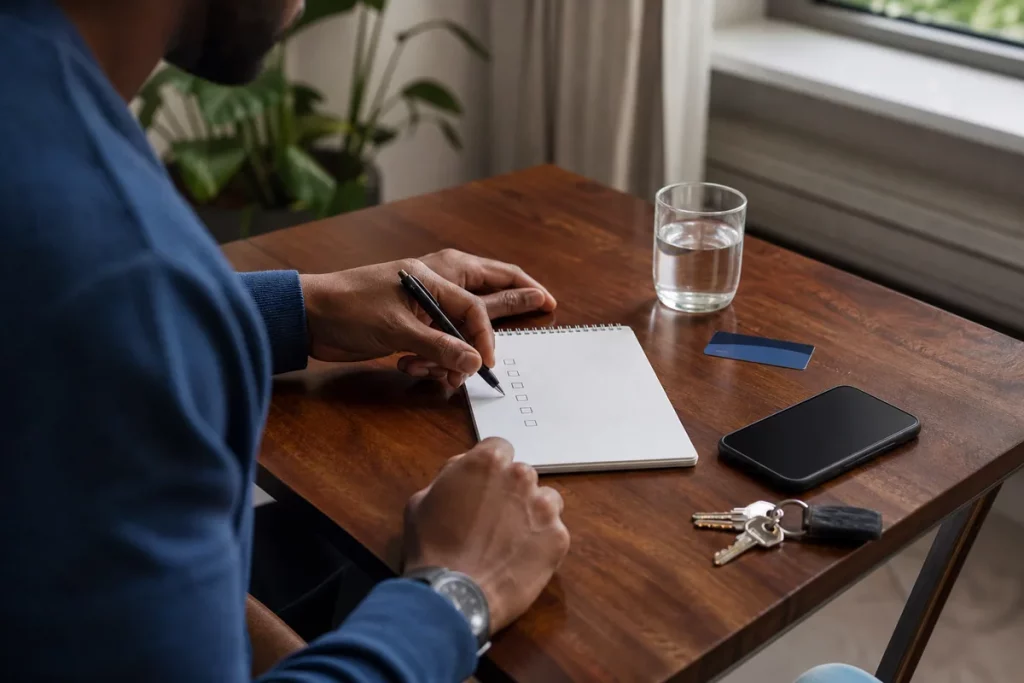
A short preparation routine can reduce avoidable uncertainty without trying to control the outcome.
NavigateTable of Contents18 sections
Distinguish Nerves From a Bigger Anxiety Pattern
Feeling keyed up before meeting a stranger is common. Your body is preparing for uncertainty and evaluation. A few hours of nerves do not establish a mental-health diagnosis.
NIMH distinguishes occasional social nervousness from social anxiety disorder, which involves persistent fear or avoidance that interferes with daily life and requires professional assessment. Review the NIMH overview if anxiety affects work, friendships, routine tasks, or many social settings—not just a particular date.
Consider professional support when you repeatedly:
- cancel desired dates because fear feels unmanageable;
- experience panic attacks or intense physical distress;
- rely on alcohol or other substances to meet people;
- spend days replaying ordinary interactions;
- cannot eat, sleep, work, or function around dating;
- remain in unsafe situations because leaving feels embarrassing;
- avoid most social contact despite wanting connection.
This is not a checklist for self-diagnosis. A clinician can assess duration, impairment, health factors, other conditions, and suitable options.
NICE recommends individual cognitive behavioral therapy designed specifically for social anxiety disorder as an initial treatment option for adults who have the condition. The full NICE recommendations also address alternatives and qualified delivery. Do not start, stop, or change medication based on a dating article.
Replace the Performance Goal
Anxiety grows when the goal is “make this person like me.” That outcome depends on another person, requires constant self-monitoring, and treats normal incompatibility as failure.
Choose a goal you can actually complete:
- learn one thing about how they spend their time;
- notice whether questions and attention are reciprocal;
- practice stating one real preference;
- check whether you feel respected;
- decide whether you want one more date;
- leave safely at the planned time.
A date is not an audition for universal approval. It is a small sample of how two particular people interact in one setting. Awkwardness can occur because both people are nervous, the venue is loud, timing is off, or the match is not right.
Use a two-sided evaluation:
| Instead of asking only | Also ask |
|---|---|
| Did they like me? | Did I feel able to be present? |
| Was I impressive? | Were they curious and respectful? |
| Did I say anything awkward? | Could we recover from ordinary pauses? |
| Will this become a relationship? | Do I want another hour with this person? |
The shift is not positive thinking. It is a more accurate assignment: observe mutual fit.
Build a Lower-Friction Date
Do not use the hardest possible environment as a test of courage. A manageable date gives you more usable information about the connection.
Choose:
- a familiar public location;
- a clear start time;
- an activity that allows conversation without demanding it constantly;
- independent transportation;
- an approximate end time;
- a backup for weather or noise;
- a level of food and alcohol you know your body handles well.
The first-date ideas guide offers adjustable options. A one-hour coffee, gallery walk, or casual snack may be easier than an expensive multi-course dinner.
Confirm the plan in one message:
“Looking forward to Thursday. Let’s meet inside Cedar Café at 6:30 and plan for about an hour. If it is packed, the library café across the street is our backup.”
Specificity reduces mental branching. You no longer need to imagine five venues, three dress codes, or whether leaving after an hour is rude.
Keep ordinary safety in place even if anxiety makes you want reassurance from the date. Use your own transport, tell a trusted person the plan, meet in public, and keep your home address private. The first-date safety check can help.
Use a 20-Minute Pre-Date Routine
A preparation routine should settle decisions, not become a ritual you must perform perfectly.
Minutes 20–15: handle logistics
- confirm address and route;
- charge your phone;
- check your return transport;
- send the plan to a trusted person;
- put essentials in one place.
Minutes 15–10: support your body
- drink water;
- eat something appropriate for you;
- use the bathroom;
- loosen your jaw and shoulders;
- choose clothing you can forget about once you leave.
Minutes 10–5: narrow attention
Name five things you see, four you feel, three you hear, two you smell, and one you taste. This is a grounding exercise, not a guaranteed treatment. If breath-focused exercises make you more anxious, skip them.
Minutes 5–0: state the assignment
“My job is to arrive, be curious, protect my boundaries, and notice how we interact. I do not need to predict the future.”
An experimental study found that extended negative anticipatory processing before a social-evaluative task was associated with worse subjective and cognitive outcomes than a distraction condition. The anticipatory-processing study involved a specific task and does not prove that distraction will solve every person’s date anxiety. It does support interrupting a long rehearsal of imagined failure.
Manage Anxiety During the Date
Anxiety pulls attention inward: How is my face? Am I boring? Did that sentence sound strange? Redirect gently toward the shared environment.
Try the NOTICE sequence:
- Name: “I am having an anxiety surge.”
- Identify: Notice two visible objects and one sound.
- Take time: Put down the cup and let one full breath pass.
- Open: Ask a question connected to what the person just said.
- Choose: Continue, pause, or leave.
This is not about hiding every symptom. It gives you one decision at a time.

A pause is part of a conversation, not proof that the date has failed.
Keep a few bridge questions available:
- “What has been the best part of your week?”
- “How did you get interested in that?”
- “What does a good weekend look like for you?”
- “Would you rather stay here or take a short walk?”
Listen to the answer instead of planning the next impressive question. Reciprocal conversation can include pauses, corrections, and modest disclosures. If the other person mocks your nerves, pushes alcohol, ignores a no, or tries to isolate you, anxiety is not the only issue. Use your exit plan.
Handle Silence and Visible Nerves
Silence is not an emergency. Take a sip, notice the room, or name the transition:
“I lost my train of thought for a second. You were telling me about the class you started.”
You can disclose nerves in proportion:
“I was a little nervous coming in, but I am glad we met.”
That is different from demanding reassurance:
“You think I am awful, don’t you? Promise you like me.”
If your hands shake, your face warms, or your words tangle, you do not need to issue a medical explanation. Most visible nerves are less defining than they feel from inside your body.
When you need a pause:
“I am going to step outside for two minutes. I will be right back.”
When you need to end:
“I am not feeling well enough to continue, so I am going home. Thank you for meeting.”
You do not need the date’s permission to leave. If you feel unsafe, prioritize distance and support rather than delivering perfect etiquette.
Stop the Post-Date Replay
Post-date anxiety often turns a few facts into a complete verdict. Create a ten-minute review window instead of reopening the case all night.
Use three columns:
| Facts | Interpretations | What I can do |
|---|---|---|
| They checked the time twice | I bored them | Wait for direct follow-through |
| We had one long pause | I failed socially | Remember we resumed the conversation |
| They said “get home safe” | They rejected me | Send one clear follow-up if interested |
| I felt tense at first | I am not ready to date | Note that tension eased after 20 minutes |
Do not crowdsource microscopic analysis to six friends. Ask one grounded person if you need perspective, then return to observable behavior.
If you want another date:
“I enjoyed talking about the neighborhood project. I would like to see you again. Are you free next weekend?”
If you do not:
“Thank you for meeting. I did not feel the match I am looking for, so I will not continue dating. I wish you well.”
The post-first-date texting guide can help you avoid using timing games as an anxiety-management strategy.
Use the GROUND Check
GuyID’s GROUND check separates manageable nerves from problems that need a different response:
- Goal: Is the goal mutual discovery rather than perfect performance?
- Route: Do you know where you are going and how you will leave?
- Options: Can you adjust the venue, duration, or activity?
- Understanding: Are direct answers and boundaries respected?
- Notice: What happened, separate from what anxiety predicts?
- Decision: Continue, pause, decline, or seek more support?
The check should increase choice. Do not use it to force yourself through a date that feels unsafe or to judge yourself for having symptoms.
A Practical Plan for the Next Date
The day before:
- confirm one simple plan;
- choose clothing and transport;
- avoid hours of profile rereading;
- tell a trusted person;
- protect sleep as well as you reasonably can.
The hour before:
- eat and hydrate;
- complete practical tasks;
- limit negative rehearsal;
- use a familiar grounding strategy;
- leave enough travel time without arriving excessively early.
During:
- use your two-sided evaluation;
- ask follow-up questions;
- let pauses exist;
- keep alcohol from becoming your coping plan;
- leave if a boundary or safety concern appears.
After:
- decompress before evaluating;
- write facts first;
- send one direct message if interested;
- do not measure your worth by the response;
- note one thing that became easier through practice.
A GuyID Trust Profile can add identity and social context to an online match. It cannot make a date risk-free or treat anxiety. Use verification alongside public meetings, boundaries, time, and your independent judgment.
How GuyID Helps
GuyID should appear when it is useful, not as a banner ad. A GuyID Trust Profile gives someone a portable way to share trust signals before a date, while identity verification and social vouching help turn vague profile claims into clearer next steps.
Useful next steps:
- Create a GuyID Trust Profile when you want a cleaner way to share verified trust signals.
- Use GuyID free tools and related guides when you need a checklist before meeting someone.
- Treat identity verification as confidence-building, not a guarantee.
- Use social vouching when you want context from people who already know the person.
- Sign up only when the extra trust layer helps the decision you are already trying to make.
Frequently Asked Questions
Should I cancel if I feel anxious?
Not automatically. Ask whether you are experiencing manageable nerves, illness, a safety concern, or distress beyond your current capacity. You may keep the date, simplify it, reschedule once with a concrete alternative, or cancel. Avoid forcing yourself into an unsafe situation to prove resilience.
Does telling a date I am nervous make me look insecure?
Brief, matter-of-fact disclosure is usually enough if you want to share. “I had some first-date nerves, and I am settling in” gives context without making the other person responsible for regulating you.
Should I drink before a first date to relax?
Using alcohol as the main way to tolerate dates can interfere with judgment, consent, medication, and learning that you can cope. Choose a plan you can attend without needing intoxication. If substance use and anxiety are linked for you, discuss it with a qualified professional.
What if I overthink everything afterward?
Set a limited review, separate facts from interpretations, and decide the next action. If post-event replay consumes hours, affects functioning, or occurs across social situations, professional assessment may help.
Can GuyID remove first-date anxiety?
No. GuyID may reduce one uncertainty by adding identity and social trust context. It does not guarantee compatibility, behavior, or safety and is not mental-health treatment.
Final Takeaway
The aim is not to erase every first-date nerve. It is to keep anxiety from making every decision. Build a smaller plan, move attention from performance to mutual fit, preserve your exit, and review facts after the date. If anxiety is persistent and limiting, treat getting qualified support as part of dating well—not as evidence that you have failed.