

Reader Briefing
Reader Briefing
Start here if you need a practical read on asexual dating: build the relationship you actually want: who should use verification, what signals to check, and what to do before moving from online interest to an in-person plan.
Who this is for
- People meeting someone from a dating app or social platform.
- Readers preparing for a first in-person date.
- Anyone checking identity, profile consistency, and trust signals.
- Online daters improving conversations, profiles, or match screening.
You’ll learn
- How to evaluate identity signals without treating any single check as certainty.
- Which trust signals matter and how to weigh them together.
- How to move from online conversation to a safer first meeting.
- Where GuyID tools fit into a quick pre-date screening workflow.
- How to compare options using practical safety and trust criteria.
- When to slow down, ask for more context, or walk away.
Bottom line
Verification reduces uncertainty; it does not guarantee future behavior. Use a layered approach: confirm identity signals, compare profile consistency, ask for a short video call, keep early plans public, and slow down when someone pressures you to skip normal safety steps.
Key takeaways
- Identity verification improves confidence, not certainty.
- Verify before meeting privately or sharing sensitive details.
- A short video call can reveal many inconsistencies.
- Pressure to skip reasonable safety steps is useful information.
- Use GuyID tools to turn vague concerns into specific checks.
Free Tools
Catfish Probability Detector
Check whether a dating profile has suspicious identity or photo signals.
Dating Bio Red Flag Detector
Review a bio for scam, pressure, or trust-warning language.
Dating Safety Checklist
Use free GuyID tools before moving from chat to a real date.
Next step
Create your GuyID trust profile
Share consent-based trust signals before a date without turning the conversation into an interrogation.
Quick Answer
Asexual dating works when people replace assumptions with an explicit relationship design. Asexuality generally describes little, no, or non-normative sexual attraction, but it does not tell you whether someone wants romance, affection, sex, exclusivity, partnership, children, or any particular living arrangement.
Start with four separate conversations: what attraction means to each person, which kinds of intimacy are wanted, what commitments define the relationship, and how changes will be discussed. Neither an ace nor an allosexual partner should agree to unwanted sex, unwanted celibacy, or a relationship structure under pressure.
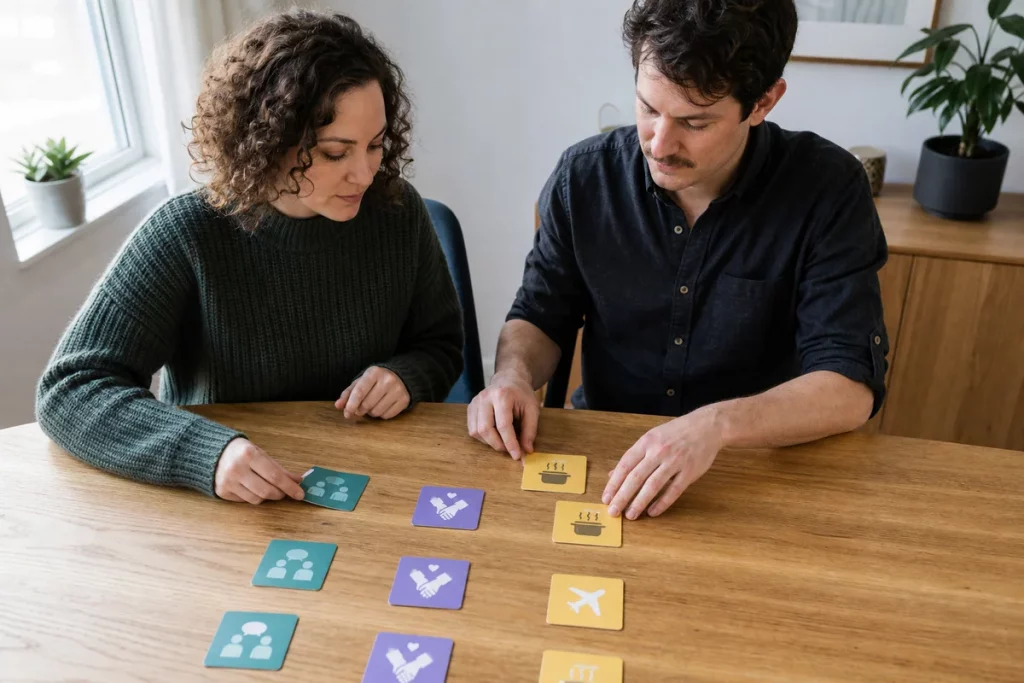
A satisfying relationship is built from choices the people in it actually want—not from a default script.
NavigateTable of Contents20 sections
Understand the Ace Umbrella
Asexuality is an umbrella covering varied experiences of little, no, or non-normative sexual attraction, and ace people may form romantic, platonic, or other intimate relationships. The Trevor Project’s overview of asexuality introduces several ace-spectrum terms while emphasizing that labels are personal tools, not rigid tests.
People may identify as:
- asexual;
- gray-asexual or graysexual;
- demisexual;
- ace-spec or ace-spectrum;
- questioning;
- another term that better fits their experience.
Sexual and romantic orientation are not always identical. A person might be asexual and heteroromantic, homoromantic, biromantic, panromantic, aromantic, or use no romantic-orientation label. A pooled analysis of seven studies found substantial variation in romantic orientation among asexual participants and reported that many experienced romantic attraction. The peer-reviewed analysis is a useful corrective to the idea that asexual automatically means aromantic.
Labels also do not dictate behavior. An ace person may be sex-favorable, sex-indifferent, sex-averse, or find their attitude changes by context. They may have sex, masturbate, experience arousal, enjoy fantasy, or choose none of those things. Do not use one experience as an eligibility test for the identity.
Name the Relationship You Want
“Dating” can hide many assumptions. Instead of asking whether an ace relationship is normal, describe the actual life you want.
Consider:
- Do you want romance, companionship, a queerplatonic relationship, or something else?
- What makes the relationship distinct from friendship for you?
- Do you want exclusivity? If so, exclusivity around what?
- Would you like to live together or maintain separate homes?
- How important are shared finances, caregiving, holidays, or family recognition?
- Do you want children or parenting?
- Which public and private labels feel right?
- What forms of affection help you feel connected?
Try:
“I want a committed romantic partnership with shared plans and affection. Sex is not something I need. What kind of relationship are you hoping to build?”
Or:
“I care about partnership and physical closeness, and sexual connection is important to me. I want to understand whether there is a structure that works freely for both of us.”
This is not a negotiation where the most socially familiar expectation automatically wins. It is an intentional dating conversation in which both people’s requirements count.
Discuss Sex Without Treating It as a Verdict
Sex can be important, unimportant, welcome, unwelcome, occasional, conditional, or absent. Talk about it without turning an answer into proof of love.
Separate these questions:
- Do you experience sexual attraction?
- Do you want sexual activity in this relationship?
- Which activities, if any, are wanted?
- Under what circumstances?
- How can either person stop or change the plan?
An ace person may choose sex because it feels pleasurable, creates closeness, supports a shared goal, or simply because they want the experience. They may also decline it. An allosexual partner may value sex and still decide that a nonsexual relationship meets their needs. Neither person’s choice is inherently more mature or loving.
Do not frame unwanted sex as a reasonable compromise. Consent must remain freely given, specific, informed, reversible, and enthusiastic enough to be clear. The same is true for a decision not to have sex: a partner should not be shamed into lifelong celibacy they do not choose.
Read the consent guide and ask concrete questions:
- “Would you like this touch, or are you agreeing because you fear I’ll leave?”
- “Are there kinds of affection you want without escalation?”
- “Is this a no, a not-now, or something you would like to discuss?”
- “What should we do if either person’s needs change?”
Create an Intimacy Menu
Intimacy is broader than sex, but “intimacy” should not become a euphemism that obscures what someone is agreeing to. Create a menu with separate choices.
| Area | Possible examples |
|---|---|
| Affection | hand-holding, hugs, cuddling, kissing |
| Emotional | reassurance, disclosure, shared rituals, repair |
| Practical | errands, caregiving, finances, household work |
| Social | meeting friends, events, public labels, holidays |
| Intellectual | projects, debate, learning, creative work |
| Sensual | massage, hair touching, sleeping close |
| Sexual | explicitly named acts, frequencies, and boundaries |
Mark items “yes,” “maybe,” “not now,” or “no.” Then add conditions: public versus private, spontaneous versus asked first, and whether one activity should remain separate from another.

An intimacy menu makes room for nuanced preferences without assuming that one form of closeness leads to another.
An agreement might say:
“Cuddling and kissing are welcome. Neither implies sex. Ask before touching under clothing. Either of us can stop without needing to justify it.”
Review the menu after a few dates, after a relationship transition, or when an answer changes. Consent is not a permanent contract.
Negotiate Commitment and Exclusivity
Commitment is not measured only through sex. In a study of 485 asexual people currently in romantic relationships, satisfaction, investment, and fewer perceived alternatives were associated with greater commitment. The investment-model study examined associations; it does not prescribe how any individual ace relationship should work.
Define commitment behaviorally:
- keeping agreed plans;
- making major decisions with appropriate consultation;
- offering care within stated capacity;
- repairing hurt;
- protecting privacy;
- being honest about other relationships;
- contributing fairly to shared responsibilities;
- revisiting agreements when circumstances change.
Define exclusivity just as clearly. It might cover romantic dates, sexual contact, cohabitation, financial partnership, or a combination. “Exclusive” is too vague if one person means sexual monogamy and the other means no emotionally primary relationships outside the partnership.
Some ace people build queerplatonic partnerships—committed relationships that are not adequately described by conventional romance or friendship. The term does not specify one structure. Ask the people using it what it means to them.
Handle Mixed-Orientation Relationships
An ace–allosexual relationship is not automatically incompatible, and love alone cannot establish compatibility.
Start with needs rather than identities:
The ace partner might need
- freedom from pressure to manufacture attraction;
- affection that does not automatically escalate;
- respect for sexual boundaries;
- confidence that their identity is believed;
- room for the relationship to matter without sex.
The allosexual partner might need
- an honest answer about the likely sexual relationship;
- freedom to say sex is important;
- reassurance through wanted forms of connection;
- a decision rather than indefinite postponement;
- room to leave without being called shallow.
Possible outcomes include:
- a mutually satisfying sexual relationship;
- a mutually satisfying nonsexual relationship;
- a relationship with occasional mutually wanted sex;
- consensual non-monogamy;
- a queerplatonic or companionate structure;
- a caring separation.
No option is the default. Non-monogamy does not solve incompatibility unless everyone genuinely wants it, has the practical capacity for it, and can revise consent. Review ethical non-monogamy before proposing it.
Use a structured check-in:
“What is working? What are you tolerating rather than choosing? What do you need that the current agreement cannot provide? Is there a freely chosen adjustment?”
If one partner repeatedly consents from fear of abandonment, the agreement is not healthy simply because it appears balanced on paper.
Reject Coercion and Invalidation
Ace people may encounter familiar forms of invalidation:
- “You are too young to know.”
- “A doctor can fix you.”
- “You have not had good sex.”
- “You are afraid of intimacy.”
- “You owe me a trial.”
- “This is just trauma.”
Health concerns deserve appropriate medical care when the person wants it, especially if there is a distressing, sudden change in desire or pain. But an asexual identity is not itself a diagnosis, and a date is not entitled to demand medical proof.
Coercion can also affect an allosexual partner:
- shaming them for valuing sexual connection;
- promising a future sexual relationship solely to keep them from leaving;
- using identity to end every conversation about compatibility;
- insisting that love should erase a stated need.
Respect sounds like:
“Neither of us is wrong. We need to decide whether the relationship we can freely offer matches the one each of us wants.”
If there is pressure, retaliation, deception, or boundary testing, step back. Use the relationship-boundaries guide to name observable behavior.
Keep Online Dating Safer
Ace identity can attract invasive questions, fetishization, or deliberate boundary challenges. Share personal information in layers.
- State only the label or preference details you want public.
- Keep home, workplace, financial, and medical information private early.
- Use in-app reporting and blocking tools.
- Preserve messages if someone threatens or harasses you.
- Meet in public and control your transportation.
- Tell a trusted person where you are going.
- Leave when a boundary is tested; you do not owe an educational conversation.
A GuyID Trust Profile may add verified identity and social context. It cannot verify orientation, consent, or compatibility, and it cannot promise safety. Use it as one evidence layer while letting behavior over time carry more weight.
Use the CLEAR Agreement
Use CLEAR to design and review the relationship:
- Closeness: Which forms of intimacy matter to each person?
- Limits: What is a yes, maybe, not now, or no?
- Expectations: What commitments and exclusivity rules apply?
- Agency: Is every agreement freely chosen rather than tolerated from fear?
- Review: When and how will changes be discussed?
Write down important agreements if that helps, but do not treat them as irreversible. The goal is shared understanding, not enforcement.
Practical Action Plan
Have one structured relationship-design conversation rather than trying to settle everything during physical intimacy:
- Each person writes what they want in romance, affection, sex, commitment, exclusivity, home life, and future planning.
- Mark every item essential, negotiable, optional, or unwanted.
- Compare the lists without treating the more conventional preference as the default.
- Turn compatible preferences into specific agreements, including what one activity does not imply.
- Name unresolved incompatibilities instead of calling them compromises prematurely.
- Choose a review date after several weeks or the next relationship transition.
End by asking, “What am I freely choosing, and what am I tolerating because I fear losing the relationship?” If either person is relying on fear, guilt, or repeated unwanted sex, pause the agreement. A relationship structure is ethical only when the people living it can genuinely choose and revise it.
How GuyID Helps
GuyID should appear when it is useful, not as a banner ad. A GuyID Trust Profile gives someone a portable way to share trust signals before a date, while identity verification and social vouching help turn vague profile claims into clearer next steps.
Useful next steps:
- Create a GuyID Trust Profile when you want a cleaner way to share verified trust signals.
- Use GuyID free tools and related guides when you need a checklist before meeting someone.
- Treat identity verification as confidence-building, not a guarantee.
- Use social vouching when you want context from people who already know the person.
- Sign up only when the extra trust layer helps the decision you are already trying to make.
Frequently Asked Questions
Can asexual people fall in love?
Yes, many do. Romantic orientation and sexual attraction are distinct, and individual experiences vary widely. Some ace people are aromantic; others experience romantic attraction and build committed romantic partnerships.
Do asexual people have sex?
Some do and some do not. Behavior does not determine whether the identity is valid. The relevant question in dating is what this person freely wants.
Is an ace–allosexual relationship likely to work?
It can work when the available relationship meets both people’s core needs without coercion. It may not work when those needs are incompatible. Honest incompatibility is healthier than pressured compromise.
When should I disclose that I am asexual?
There is no universal deadline. Disclose when you have enough safety and privacy, ideally before the other person relies on an incompatible assumption about the relationship.
Is asexuality caused by trauma or medication?
Asexuality is an orientation label, not a diagnosis. Trauma, medication, health, stress, and other factors can affect desire for some people, but outsiders should not assign a cause to someone’s identity. A person with a distressing change can choose to consult a qualified professional.
Related Reading
Continue with demisexual dating, when to be intimate in a relationship, and intentional dating.
Conclusion
Asexual dating becomes clearer when people stop asking whether an ace relationship fits a standard script and start asking what the participants genuinely want.
Separate attraction from behavior, romance from sex, and commitment from convention. Name desired intimacy, boundaries, exclusivity, and future plans. Review the agreement as people change.
The strongest outcome is not preserving every match. It is creating a relationship in which no one must perform an identity, accept unwanted sex, abandon an important need, or pretend compatibility. That honesty makes room for the relationship you actually want—or a respectful decision that this is not it.