Reader Briefing
Reader Briefing
Start here if you need a practical read on first date safety check without killing the chemistry guide: who should use verification, what signals to check, and what to do before moving from online interest to an in-person plan.
Who this is for
- People meeting someone from a dating app or social platform.
- Readers preparing for a first in-person date.
- Anyone checking identity, profile consistency, and trust signals.
- People trying to avoid romance scams, fake profiles, or pressure tactics.
You’ll learn
- How to evaluate identity signals without treating any single check as certainty.
- Which trust signals matter and how to weigh them together.
- How to spot inconsistencies, pressure, or behavior patterns that deserve caution.
- How to move from online conversation to a safer first meeting.
- Where GuyID tools fit into a quick pre-date screening workflow.
- How to compare options using practical safety and trust criteria.
Bottom line
Verification reduces uncertainty; it does not guarantee future behavior. Use a layered approach: confirm identity signals, compare profile consistency, ask for a short video call, keep early plans public, and slow down when someone pressures you to skip normal safety steps.
Key takeaways
- Identity verification improves confidence, not certainty.
- Patterns matter more than isolated incidents.
- Verify before meeting privately or sharing sensitive details.
- A short video call can reveal many inconsistencies.
- Pressure to skip reasonable safety steps is useful information.
Free Tools
Catfish Probability Detector
Check whether a dating profile has suspicious identity or photo signals.
Dating Bio Red Flag Detector
Review a bio for scam, pressure, or trust-warning language.
Dating Safety Checklist
Use free GuyID tools before moving from chat to a real date.
Next step
Create your GuyID trust profile
Share consent-based trust signals before a date without turning the conversation into an interrogation.
Introduction
A good first date has momentum. The messages are easy, the jokes land, and the plan starts to feel real. Then the practical question arrives: how do you check that someone is who they say they are without turning the flirtation into a background interview?
That is the tension behind a first-date-safety-check. People want confidence, not paranoia. They want to protect their privacy, avoid catfishing, and spot romance scam behavior early, but they also want the conversation to feel human. The best approach is not to interrogate a match or outsource your judgment to a single badge. It is to use a light, layered trust check that fits the risk of the next step.
A first-date safety check should answer a few simple questions. Does this person’s profile appear consistent? Do their photos, name, location, and story hold together? Are they willing to respect ordinary boundaries, such as a short video call or a public meeting place? Are they trying to rush intimacy, secrecy, money, or a move off-platform before trust has been earned? If a stronger trust signal is needed, can it be shared with consent and interpreted clearly?
Quick Answer
A first-date-safety-check is a lightweight process for deciding whether it is reasonable to move from messaging to an in-person date. It combines profile consistency, identity and trust signals, communication behavior, scam awareness, consent, and practical first-date planning.
The safest version is simple:
- Check whether the profile details make sense.
- Look for consistency across photos, name, location, timeline, and claims.
- Ask for one low-friction confirmation if needed, such as a brief video call.
- Choose a public place, keep your own transportation, and tell a trusted person where you are going.
- Treat money requests, secrecy, urgency, inconsistent stories, and boundary-pushing as serious red flags.
- Use consent-based trust tools, such as a GuyID trust profile, when a stronger signal would make the decision clearer.
The chemistry-friendly principle is this: make the safety check mutual, normal, and proportionate. Instead of saying, Prove you are real, say, I do a quick check before meeting anyone from an app, and I am happy to do the same. That keeps the tone respectful while still protecting your boundary.
Verification helps, but it does not guarantee safety. The NIST Digital Identity Guidelines are useful because they separate identity proofing and authentication concepts from broader claims about trust. The FTC romance scam guidance is also important because scammers often exploit emotion, urgency, and money pressure. A smart first-date safety check uses both lessons: verify what can be verified, and watch behavior that no badge can fully predict.
Editorial process still life for First Date Safety Check Without Killing the Chemistry Guide.
NavigateTable of Contents70 sections
What a First-Date Safety Check Really Means
A first-date safety check is not a police investigation. It is not a demand for private documents. It is not a reason to assume every match is dangerous. It is a practical pause before a higher-risk step.
Messaging someone on an app is usually low risk. Meeting them in a public place is a bigger step. Getting into their car, going to their home, sharing your address, sending money, or planning travel are much bigger steps. A good safety check matches the level of evidence to the level of risk.
For a normal first date, the most useful questions are modest:
- Is the person presenting a coherent identity?
- Do their photos look consistent, current, and plausible?
- Does their conversation match their stated age, location, job, and lifestyle?
- Are they willing to do a short video call or share a consent-based trust signal?
- Do they respect a public meeting plan?
- Do they avoid money requests, investment pitches, secrecy, and pressure?
The Chemistry Problem: Why Safety Requests Feel Awkward
People often avoid safety checks because they fear seeming suspicious, needy, or unromantic. That fear is understandable. Early dating is fragile. A clumsy question can make a normal person feel accused.
The solution is framing. A safety check feels awkward when it is presented as a personal accusation. It feels normal when it is presented as a mutual habit.
Compare these two approaches:
| Awkward framing | Chemistry-friendly framing |
|---|---|
| Prove you are not a catfish. | I like to do a quick video hello before meeting anyone from an app. Happy to make it easy. |
| Send me your ID. | I do not need private documents. I just prefer a quick mutual check before we make plans. |
| Why are you hiding something? | No pressure. If video is not your thing, we can keep chatting until meeting feels comfortable. |
| I need to know everything about you first. | I am excited to meet. I also keep first dates public and low-pressure. |
The difference is not only politeness. It is strategy. A respectful request gives a trustworthy person an easy path to cooperate. It also gives you useful information if the person reacts badly.
Chemistry is not damaged by a healthy boundary. Chemistry is clarified by it. If a match can handle a simple, mutual safety habit with maturity, that is a good sign for the date itself.
The Layered Trust Framework
Think of pre-date trust in four layers: identity, consistency, behavior, and date logistics. Each layer answers a different question.
1. Identity signals: Is this a real person behind the profile?
Useful identity signals before a first date include:
- A live video call that matches the profile photos.
- A stable name or nickname that does not keep changing.
- App verification or identity confidence indicators.
- A GuyID trust profile or similar consent-based trust summary.
- Social vouches from people who appear credible and connected.
Identity signals are strongest when they are transparent. If a profile says verified, ask: verified for what? Photo likeness? Phone number? Government ID? Social account ownership? Each answer has a different meaning.
2. Consistency signals: Does the story hold together?
Consistency is often more revealing than one impressive proof point. A person’s photos, prompts, messages, location, age, job, travel schedule, and availability should not require constant explanation.
Watch for patterns such as:
- A stated location that changes without explanation.
- Photos that look like different people or different eras.
- A job claim that becomes vague when asked about normal details.
- A profile age that conflicts with life events they describe.
- A sudden move from casual flirting to intense emotional intimacy.
3. Behavior signals: Do they respect ordinary boundaries?
Behavior is the layer many people underestimate. A scammer can have polished photos. A manipulative person can pass a basic identity check. But disrespect for boundaries often shows early.
Green behavior signals include:
- They accept a public meeting place without complaint.
- They do not demand your address.
- They are willing to do a quick call or offer a reasonable alternative.
- They do not push for money, investments, or secrecy.
- They respond to safety habits with maturity.
Red behavior signals include:
- They pressure you to leave the app immediately.
- They refuse all live interaction but want emotional intimacy.
- They create urgency around travel, emergencies, crypto, gift cards, or banking.
- They shame you for having boundaries.
- They try to isolate you from friends or normal caution.
The FTC warns that romance scammers often build emotional connection and then ask for money or financial help. That pattern matters before a first date and especially in long-distance situations.
4. Logistics signals: Is the date plan safe and reversible?
The safest logistics include:
- Public location.
- Your own transportation.
- A friend who knows where you are.
- No home address exchange before trust is earned.
- No first meeting at a private residence.
- A clear start time and an easy exit.
Logistics are not a substitute for trust, but they reduce downside if your read is wrong.
Comparison Table: Which Trust Signals Matter
| Trust signal | Best use before a first date | What it can tell you | What it cannot prove | Chemistry-friendly way to use it |
|---|---|---|---|---|
| Dating app verification badge | Quick baseline confidence | The account may have passed a platform check | Intent, honesty, relationship status, or safety | Treat it as one signal, not the whole decision |
| Short video call | Confirm real-time likeness and basic vibe | The person appears to match photos and can interact live | Character or future behavior | Keep it to 3 to 5 minutes and make it mutual |
| Reverse image search | Check for reused or stolen public photos | Images may appear elsewhere online | New fakes, private images, or edited media | Use quietly if something feels off; do not lead with accusation |
| Social media presence | Add context and timeline clues | Public identity may be consistent | That the profile is current or fully truthful | Ask lightly if they are comfortable sharing, but do not demand it |
| Social vouching | Human context from others | Someone else is willing to stand behind them | Vouch quality or full truth | Prefer clear, consent-based vouches over vague name-dropping |
| GuyID trust profile | Combine consent-based trust signals | Identity confidence and social trust signals in one inspectable place | Safety or intent beyond the verified signals | Share or request it as a normal trust shortcut |
| Public date plan | Reduce first-meeting risk | They respect practical boundaries | That the person is trustworthy in every setting | Frame it as your standard first-date routine |
| Money behavior | Detect high-risk scam patterns | Requests for money or investment are serious red flags | Every motive behind the request | Make it a hard boundary: no money to matches |
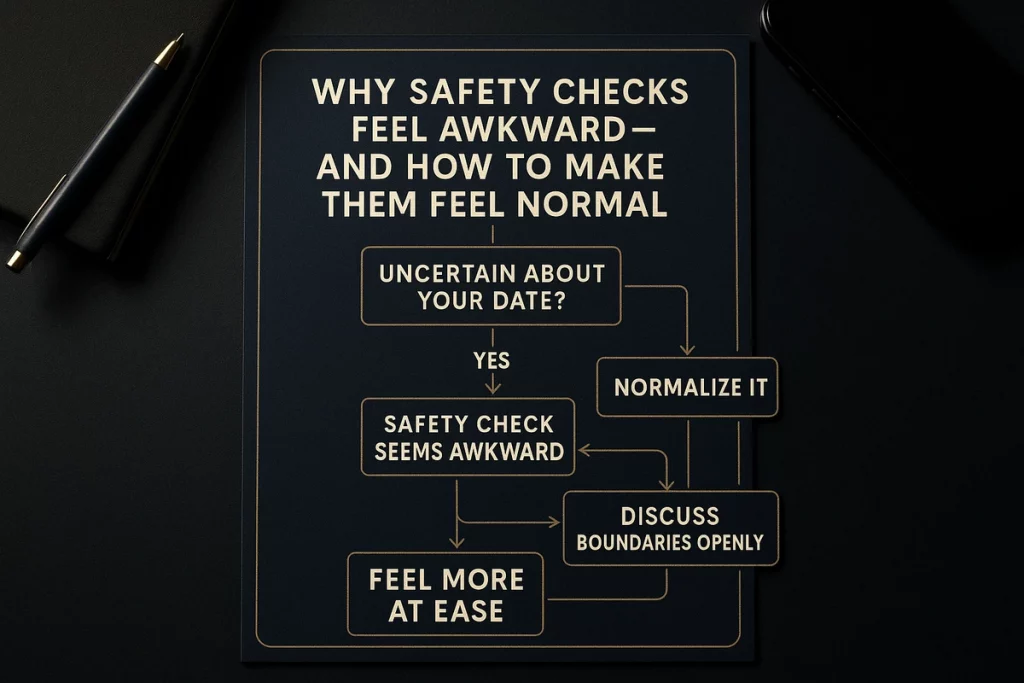
Decision Tree: What to Do Next
Use this flow when you are deciding whether to meet.
Start: Are you considering an in-person first date?
If no: keep chatting, but avoid sharing sensitive personal information. You do not need a full safety check for casual messaging.
If yes: move to the next question.
Do the profile and conversation feel basically consistent?
Yes: continue to a light confirmation step if you want one.
No: ask one direct, non-accusatory question.
Example: Your profile says you live in Austin, but you mentioned being in Miami most weeks. Are you based in Austin or just visiting?
If the answer is clear and reasonable, continue. If the answer creates more confusion, slow down.
Is the person willing to accept a normal safety boundary?
Yes: choose a public plan and continue with ordinary caution.
Has money, secrecy, or urgency entered the conversation?
No: proceed based on the full pattern.
Is the proposed date public, reversible, and comfortable?
Yes: confirm details, tell a friend, and meet with your own transportation.
No: revise the plan.
Script: I am looking forward to meeting. For first dates I keep it public, so let’s do coffee at Harbor Cafe at 6 instead.
If they accept, continue. If they pressure you to ignore your rule, do not meet.
Examples
Example 1: The charming match with inconsistent photos
A chemistry-killing response would be to accuse them of stealing photos. A better response is simple:
I am enjoying this. Before meeting, I usually do a quick video hello so we both know the vibe is real. Are you free for five minutes tonight?
Example 2: The verified profile that still feels off
The right move is to keep the conversation where it is until trust improves.
I usually stay on the app until after a first meet. If we hit it off, we can exchange numbers then.
If they respect that, fine. If they become irritated or claim you do not trust them, that reaction matters more than the badge.
Example 3: The long-distance connection with money pressure
I do not send money to people I have not met and built real trust with. I hope you find help, but I cannot be involved financially.
Then disengage if pressure continues.
Example 4: The respectful match who shares trust signals
This does not mean you abandon first-date basics. It means the signals align: identity confidence, mature behavior, public plan, and respect for your boundary. You can move forward with normal caution.
Example 5: The person who refuses video but offers a reasonable alternative
That may be acceptable depending on your comfort level. A safety check is not about rigid rules. It is about whether the total pattern supports the next step.
Practical Advice and Scripts
The words matter. A safety request should be short, normal, and easy to answer.
Script 1: The quick video call
I am excited to meet. I usually do a quick video hello before first dates from apps, just five minutes so we both know the vibe. Are you free tonight?
Why it works: It is mutual, specific, and low pressure.
Script 2: The public place boundary
That sounds fun. For first dates I keep it public, so let’s do coffee or a drink somewhere easy for both of us.
Why it works: You are not asking permission. You are stating a standard.
Script 3: The no address boundary
I do not share my address before meeting, but I can meet you at the restaurant at 7.
Why it works: It protects privacy without overexplaining.
Script 4: The off-platform request
I usually stay on the app until after we meet. If the date goes well, I am happy to exchange numbers.
Why it works: It keeps control inside the dating platform’s safety environment.
Script 5: The trust profile request
I use trust profiles for dating safety when I am meeting someone new. If you have one, feel free to share it. I can share mine too.
Why it works: It makes verification reciprocal rather than accusatory.
Script 6: The money boundary
I am sorry you are dealing with that, but I do not send money to people I have not met and built real-world trust with.
Why it works: It is firm and does not invite negotiation.
Script 7: The graceful exit
I do not think this is the right fit for me, but I wish you well.
Why it works: You do not need to litigate your safety decision. A clean exit is often safest.
Script 8: The clarification question
I may have misunderstood. You mentioned being based in Chicago, but your profile says Denver. Which is current?
Why it works: It gives room for an innocent explanation while testing consistency.
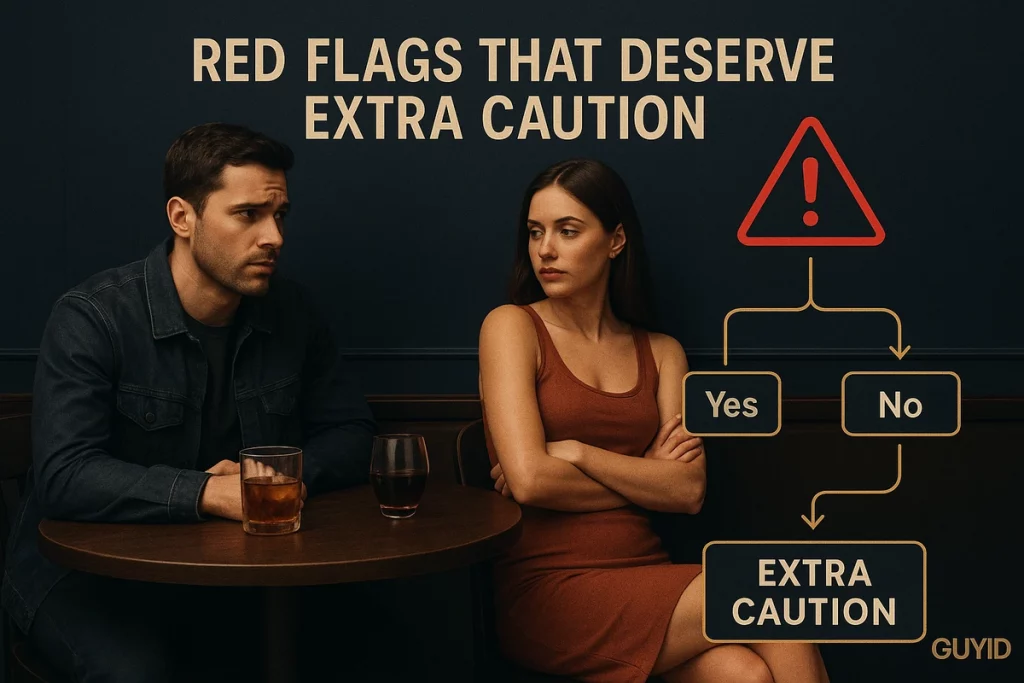
Meeting decision tree for First Date Safety Check Without Killing the Chemistry Guide.
Expert Insights
A mature dating-safety framework borrows from identity standards without pretending dating is a standards laboratory. NIST’s digital identity guidance is not a dating manual, but its discipline is useful: define the identity claim, understand the assurance level, and avoid vague trust language. In plain terms, do not say verified unless you know what was verified.
For dating, that means separating several questions that people often collapse into one:
- Is this account controlled by a real person?
- Is that person the one shown in the photos?
- Is the name or age consistent?
- Has someone credible vouched for them?
- Do they behave respectfully under light scrutiny?
- Is the first-date plan safe?
A tool can help with some of these. A person’s behavior answers others.
The editorial rule is simple: trust signals are decision support. They are not destiny.
Common Mistakes
Mistake 1: Treating chemistry as evidence
Great banter is not verification. Someone can be witty, attentive, and emotionally fluent while still misrepresenting themselves. Enjoy the chemistry, but do not make it carry the whole safety decision.
Mistake 2: Asking for too much too soon
Demanding a passport photo, home address, workplace, or legal name before a basic coffee date can be invasive and counterproductive. Start with lower-risk checks: consistency, video, public plans, and consent-based trust signals.
Mistake 3: Trusting a badge too much
A verification badge can be valuable, but it is only as strong as what it verifies. It may not confirm relationship status, criminal history, employment, intent, or emotional honesty. Use badges as one layer.
Mistake 4: Ignoring behavior because the profile looks polished
The most beautiful profile in the world does not cancel out pressure, secrecy, insults, or money requests. Behavior is evidence.
Mistake 5: Moving off-platform too quickly
Mistake 6: Overexplaining your boundary
Mistake 7: Confusing privacy with suspiciousness
Best Practices
Keep the check proportionate
For a low-risk coffee date, you usually need consistency, a public plan, and respectful communication. For travel, private meetings, financial involvement, or long-distance emotional commitment, you need stronger evidence and more caution.
Make verification mutual
A safety check lands better when both people participate. Offer the same kind of reassurance you request. If you ask for a quick video call, show up on video too. If you request a trust profile, be willing to share your own.
Protect your own sensitive information
Do not send identity documents, banking details, home address, workplace location, or intimate images to someone just because they ask. A good verification process reduces risk. It should not create leverage against you.
Use public, reversible plans
The first date should not depend on the other person for transportation, housing, or privacy. You should be able to leave without asking their permission.
Watch the pattern
One delayed reply means little. A pattern of changing stories, avoiding live confirmation, rushing intimacy, asking for secrecy, and pushing money means a lot.
Prefer clear trust signals
Step-by-Step Guide
Step 1: Define the next decision
For most first dates, the decision is: Is it reasonable to meet this person in a public place while maintaining normal safety habits?
That decision does not require perfect certainty. It requires enough confidence and a plan that limits downside.
Step 2: Review the profile for internal consistency
Look at photos, prompts, age, location, job, education, family details, and lifestyle claims. Do they fit together? Do they sound specific enough to be real but not so dramatic that every detail demands attention?
Be careful not to overread normal privacy choices. A person may use a nickname or avoid naming their employer. That is not automatically suspicious. The concern rises when the basics keep changing.
Step 3: Check the conversation pattern
Healthy early conversation has a natural pace. It may be flirty, warm, and personal, but it should not require secrecy, instant commitment, or emotional rescue.
Slow down if the person:
- Declares intense feelings before meeting.
- Avoids simple questions but asks many personal ones.
- Pushes you to leave the app immediately.
- Has a crisis that requires money.
- Discourages you from telling friends about the date.
- Makes your boundaries sound unreasonable.
Step 4: Ask for one light confirmation
Keep the ask small. You are not trying to solve every uncertainty. You are testing whether the person can respond respectfully to a normal safety step.
Step 5: Interpret the response, not just the answer
A yes is useful. A thoughtful alternative can also be useful. A hostile response is highly relevant.
For example, I am not comfortable sharing my Instagram before meeting, but I am happy to do a quick call is reasonable. Stop being paranoid, just come to my place is not.
Step 6: Choose a safer first-date plan
Pick a place that is public, familiar enough, and easy to leave. Avoid first meetings at homes, hotel rooms, isolated parks at night, or any plan where your transportation depends on the other person.
Step 7: Keep financial boundaries absolute
No money before real-world trust. No gift cards. No crypto. No emergency transfer. No package reshipping. No shared bank activity. No investment opportunity from a romantic match.
Step 8: Decide: continue, slow down, or stop
After the check, put the signals together.
Continue if the identity signals, behavior, and date plan are consistent enough for a public first meeting.
Slow down if something is unclear but not alarming. Ask one clarification or suggest a lower-risk next step.
Stop if there is money pressure, coercion, repeated deception, threats, refusal of reasonable boundaries, or a private plan you do not want.
You are allowed to leave a conversation because the trust picture is not strong enough. You do not need a final verdict on who they are.
Social sharing preview for First Date Safety Check Without Killing the Chemistry Guide.
How GuyID Fits
GuyID is designed for the moment when a dating conversation needs more clarity but less awkwardness. Instead of turning a match into a cross-examination, a GuyID trust profile can organize consent-based signals in one place: identity confidence, social vouching, and other credibility markers that are easier to inspect than scattered claims in a chat thread.
The best use is practical and mutual. You can share your own trust profile or ask whether a match has one. The point is not to prove perfection. It is to make trust easier to discuss.
A natural message might be:
I use GuyID for dating trust checks because it is simpler than trading personal details in a chat. If you have a profile, send it over. I can share mine too.
That keeps the tone calm. It also respects a core rule of dating safety: verification should be consent-based and proportionate. A trust profile is a next step when stronger confidence would help, not a replacement for public meeting plans, boundaries, or judgment.
Learn more about GuyID trust profiles if you want a cleaner way to share trust signals before a first date.
Frequently Asked Questions
What is First Date Safety Check Without Killing the Chemistry?
It is a practical way to confirm enough trust before meeting someone from a dating app while keeping the interaction respectful and natural. The goal is to combine light verification, profile consistency, behavior signals, and safer date logistics without making the other person feel interrogated.
A strong first-date-safety-check does not demand excessive private information. It uses proportionate steps such as a brief video call, a public meeting place, staying on the app until after the date, and reviewing consent-based trust signals when available.
Does verification guarantee safety?
No. Verification can increase confidence in a specific claim, such as whether an account is connected to a person, whether a face matches profile photos, or whether certain trust signals exist. It cannot guarantee intent, honesty, emotional stability, relationship status, or future conduct.
This is why identity guidance, including NIST’s digital identity framework, is useful as a discipline: it helps separate what has been verified from what remains unknown. In dating, you still need boundaries and real-world safety habits.
Which trust signals matter most before a first date?
The most useful signals are profile consistency, a respectful response to safety boundaries, a short live interaction if desired, a public date plan, and absence of high-risk behavior such as money requests or secrecy. App verification and trust profiles can add confidence, especially when they explain what their signals mean.
No single signal should override the full pattern. A verified profile with aggressive boundary-pushing is still a concern. A private person who respects public plans and offers reasonable alternatives may still be safe enough for a low-risk first meeting.
How do I ask for a safety check without sounding suspicious?
Make it about your standard routine, not their presumed dishonesty.
Try: I am looking forward to meeting. I usually do a quick video hello before first dates from apps, just to make sure we both feel comfortable.
Or: For first dates I prefer a public place and my own transportation. Let’s pick somewhere easy.
Calm, mutual language preserves chemistry because it does not accuse. It simply states how you date.
What mistakes should readers avoid with a first-date-safety-check?
Avoid treating a badge as a guarantee, asking for invasive information too early, ignoring red flags because the chemistry feels strong, and sending money to someone you have not met. Also avoid turning every mismatch into an accusation. Ask one clear question, then judge the response.
The best safety checks are firm but not theatrical. You are not trying to catch someone. You are deciding whether the next step is wise.
What if they refuse a video call?
A refusal is not automatically a red flag. Some people dislike video or have privacy concerns. Look for whether they offer a reasonable alternative, such as meeting in a public place, doing a short voice call, staying on the app, or sharing a consent-based trust signal.
Concern rises when they refuse every option and pressure you toward a private or rushed meeting. The issue is not video specifically. The issue is whether they respect your need for basic confidence.
Should I run a background check before every first date?
Usually, no. For a normal public first date, a full background check may be disproportionate and can create privacy and accuracy issues. Start with less invasive signals: consistency, video, public logistics, and consent-based trust profiles.
A stronger check may be appropriate if the situation involves higher stakes, such as travel, private meetings, childcare exposure, shared finances, or repeated inconsistencies. Even then, understand the limits of any data source.
What are the biggest romance scam red flags?
Be cautious with urgent money requests, gift cards, cryptocurrency, investment opportunities, sudden emergencies, refusal to meet or video call, inconsistent identity details, secrecy, and intense affection before real-world contact. The FTC’s romance scam guidance emphasizes that scammers often use emotional connection to create trust before asking for financial help.
If money enters the conversation before real trust exists, stop and reassess.
Key Takeaways
- A first-date-safety-check should be light, mutual, and proportionate to the next step.
- Chemistry is not a substitute for consistency, boundaries, and safe logistics.
- Verification helps with specific trust signals, but it does not guarantee safety or intent.
- Watch behavior closely: pressure, secrecy, money requests, and boundary-pushing matter.
- Use public first-date plans, your own transportation, and a trusted friend check-in.
- GuyID trust profiles can make trust signals easier to share and inspect without turning the conversation into an interrogation.
Conclusion
The best first-date safety check does not flatten romance into suspicion. It gives chemistry a safer place to breathe. When you verify lightly, communicate clearly, and keep your boundaries practical, you are not making dating colder. You are filtering for people who can handle honesty, consent, and basic care.
Use identity and trust signals for what they are: helpful evidence with limits. Combine them with behavior, consistency, and safe first-date logistics. If the signals align, enjoy the date. If they do not, slow down or walk away.
For a cleaner way to share and review consent-based trust signals, explore GuyID trust profiles. Trust should be easier to inspect, easier to explain, and still human enough to leave room for a real spark.
Related Resources
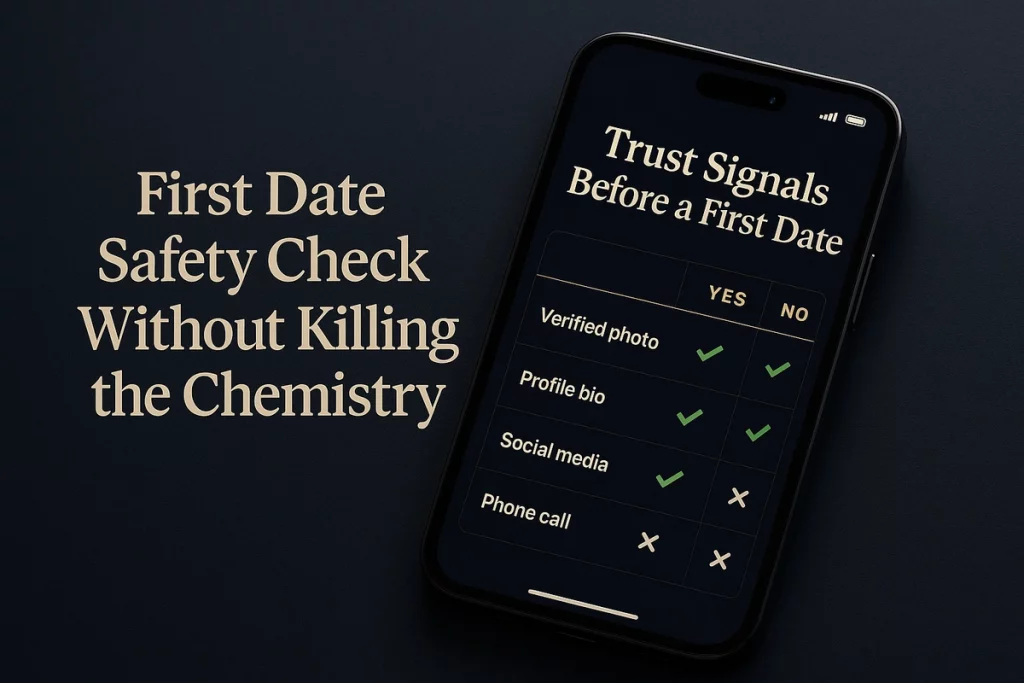
Mobile trust interface mockup for First Date Safety Check Without Killing the Chemistry Guide.