Reader Briefing
Reader Briefing
Start here if you need a practical read on first date ideas: 35 plans that make it easier to connect: who should use verification, what signals to check, and what to do before moving from online interest to an in-person plan.
Who this is for
- Readers preparing for a first in-person date.
- Anyone checking identity, profile consistency, and trust signals.
- Online daters improving conversations, profiles, or match screening.
You’ll learn
- How to evaluate identity signals without treating any single check as certainty.
- Which trust signals matter and how to weigh them together.
- How to move from online conversation to a safer first meeting.
- Where GuyID tools fit into a quick pre-date screening workflow.
- When to slow down, ask for more context, or walk away.
- How to turn the article’s advice into a concrete next step.
Bottom line
Verification reduces uncertainty; it does not guarantee future behavior. Use a layered approach: confirm identity signals, compare profile consistency, ask for a short video call, keep early plans public, and slow down when someone pressures you to skip normal safety steps.
Key takeaways
- Identity verification improves confidence, not certainty.
- Verify before meeting privately or sharing sensitive details.
- A short video call can reveal many inconsistencies.
- Pressure to skip reasonable safety steps is useful information.
- Use GuyID tools to turn vague concerns into specific checks.
Free Tools
Catfish Probability Detector
Check whether a dating profile has suspicious identity or photo signals.
Dating Bio Red Flag Detector
Review a bio for scam, pressure, or trust-warning language.
Dating Safety Checklist
Use free GuyID tools before moving from chat to a real date.
Next step
Create your GuyID trust profile
Share consent-based trust signals before a date without turning the conversation into an interrogation.
Quick Answer
The best first date idea is easy to join, easy to leave, and interesting enough to give you something to talk about. Choose a public place, keep the first plan to roughly 60–90 minutes, confirm the budget and accessibility, and leave room to extend the date only if both people want to. Coffee and a walk, a small gallery, a food market, mini golf, a bookstore browse, or a casual dessert stop all work because the activity supports conversation without demanding constant eye contact.
Do not choose a date because it looks impressive online. Choose it because it lowers pressure and lets both people notice how they feel around each other.
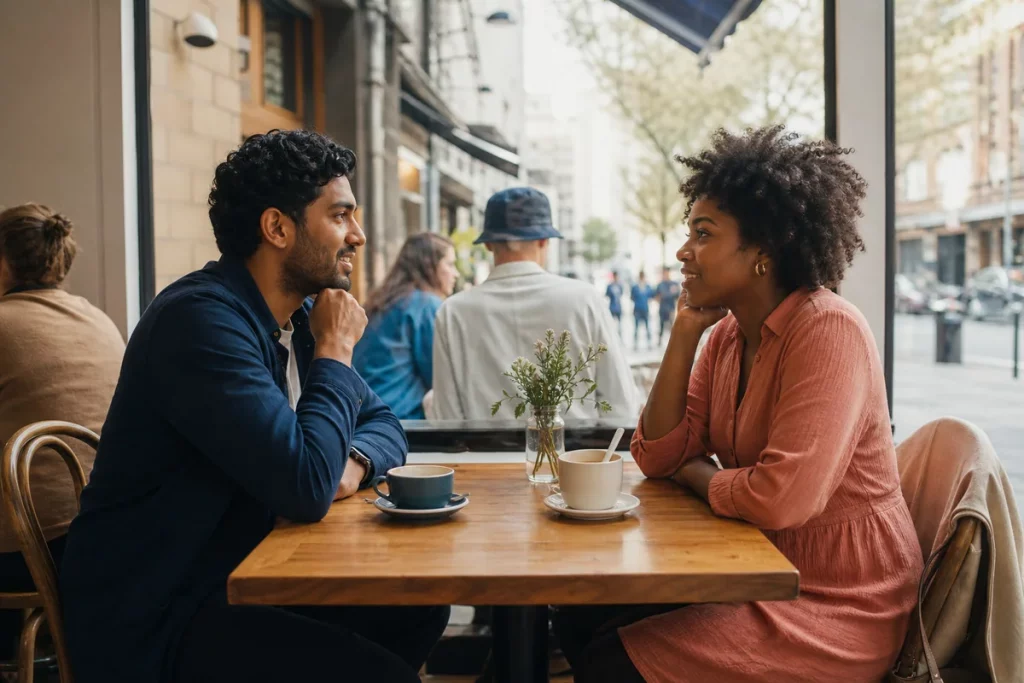
A good first-date setting gives conversation room to breathe.
NavigateTable of Contents34 sections
What Makes a First Date Idea Good
A first date is not an audition venue. It is a temporary setting for two people to discover whether conversation, comfort, and curiosity travel in both directions. The activity should help that discovery instead of becoming the entire performance.
Use the PACE framework:
- Public: The location is populated, familiar enough to navigate, and appropriate for an early meeting.
- Adjustable: You can shorten, extend, sit down, or change pace without turning the evening into a logistical problem.
- Conversational: The sound level and structure allow you to hear each other for at least part of the date.
- Equitable: Cost, travel, mobility, sensory needs, diet, and alcohol preferences have been considered rather than assumed.
This is why a modest café can be a stronger first date spot than a sought-after tasting menu. The café offers more control. If the connection is promising, you can add a walk or dessert. If it is not, finishing one drink creates a natural end.
Low pressure does not mean low effort
Effort is visible in the details: proposing a specific place, checking its hours, reserving when necessary, confirming the day before, and arriving on time. Expense and complexity are poor substitutes for consideration.
Novelty is useful in the right dose
Research with established couples has found links between shared novel activities and experienced relationship quality. That work concerns existing relationships, however, and it does not show that an elaborate first date produces compatibility. The practical takeaway is narrower: a small shared point of interest can give two people something natural to react to together. A summary of the original studies is available through PubMed.
Choose “a little new,” not “physically or emotionally overwhelming.” A new bakery is novelty. A remote all-day expedition with a stranger is unnecessary exposure.
The First-Date Idea Matrix
Choose the row that matches the conversation style you already have.
| What you want | Strong starting options | Why they work | Main caution |
|---|---|---|---|
| Easy conversation | Coffee, tea, dessert, casual lunch | Simple, time-limited, low distraction | Check noise and seating |
| Less interview-like pressure | Mini golf, market, bookstore, gallery | Gives you shared objects and moments to discuss | Preserve some quiet conversation time |
| Budget control | Free museum hour, public garden, community event | Cost is known or minimal | Confirm hours, weather, and transit |
| A sober date | Café, breakfast, craft workshop, daytime walk | Alcohol is not the default activity | Do not frame sobriety as something to defend |
| Accessibility | Spacious café, accessible gallery, seated tasting | Pace and environment can be checked in advance | Ask about needs without demanding personal details |
| Short first meeting | One drink, one pastry, one market loop | Natural stopping point | State the time window in advance |
| More playful energy | Arcade, bowling, trivia, mini golf | Reduces constant face-to-face intensity | Avoid turning it into a competition |
When two rows matter, combine them lightly. “Tea, then the small gallery next door if we feel like it” is a plan with a built-in option. It is not a promise that the second part must happen.
35 First Date Ideas by Mood
Easy conversation dates
- Coffee or tea at an independent café. Pick a place with real seating and a volume level that does not force intimacy by shouting.
- Dessert instead of dinner. One excellent pastry, ice cream, or hot chocolate feels intentional while keeping time and cost manageable.
- A casual lunch. Daylight, a clear end point, and less formality make lunch useful for people who dislike evening pressure.
- A bookstore browse. Choose one book you would recommend to each other, then talk over coffee nearby.
- A neighborhood walk with one destination. “Walk around” feels vague; “walk through the waterfront and stop at the bakery” feels planned.
- A small gallery. Art provides conversation material, and a compact venue avoids museum fatigue.
- A public garden or conservatory. This gives you movement and quiet without sending you somewhere isolated.
Playful first dates
- Mini golf. The turns create natural conversation breaks, and skill rarely matters enough to dominate the date.
- Casual bowling. One game is enough; add another only if both people are enjoying it.
- An arcade with a spending cap. Set a shared token budget so the date remains playful rather than expensive.
- Beginner-friendly trivia. Choose a venue where joining as a team feels collaborative, not like an exam.
- A board-game café with a simple game. Pick something teachable in two minutes, not a strategy marathon.
- A photo walk in a busy district. Give yourselves a small prompt, such as finding the best doorway or funniest sign.
- A public skating session. Only when both people are comfortable with the activity and the venue has rentals and places to rest.

A light activity can reduce interview pressure without taking over the date.
Food-centered dates that are not a formal dinner
- A food-hall tasting loop. Each person chooses one small thing to share or compare.
- A farmers’ market. Browse, pick a snack, and keep moving; confirm the weather first.
- A bakery crawl with two stops. One item at each place creates structure without excess.
- A casual dumpling, taco, or noodle stop. Choose food you can eat comfortably and check dietary needs before deciding.
- A public tasting event. Coffee, chocolate, cheese, or nonalcoholic tastings offer built-in conversation.
- Breakfast. Useful for busy schedules and people who prefer sober, daytime dates.
- A picnic assembled at a public market. Keep it in a busy park and have a weather backup; a home-prepared private picnic can feel too intimate for a first meeting.
Creative and curious dates
- A drop-in pottery-painting studio. The task occupies your hands while leaving room to talk.
- A short beginner craft workshop. Check that it truly welcomes beginners and does not run for three hours.
- A museum’s late opening. Choose one wing rather than attempting the entire institution.
- A used-record shop or music store. Each person finds one album connected to a story.
- A public lecture followed by a drink. Best when the talk is short and the topic interests both people.
- A botanical shop or plant market. Browse without requiring either person to buy something.
- A neighborhood architecture walk. Use a self-guided route in a populated area and finish somewhere seated.
Free or inexpensive first dates
- A free gallery opening. Verify whether the event will be too crowded to speak.
- A library exhibition. Libraries often host compact exhibits in calm, accessible spaces.
- A community festival. Agree on one meeting point and a short first loop; crowds can complicate arrival.
- A scenic transit ride with a café endpoint. Keep the route familiar and public, not remote.
- Window-shopping around a specific theme. Find the strangest home item, best vintage jacket, or most impractical gift.
- A free concert in a public square. Plan conversation before or after because music is not a substitute for meeting.
- A “two favorite places” exchange. Each person chooses one public spot within the same walkable area.
The number is less important than the pattern. Good first date ideas create a shared stimulus, an easy conversation lane, and a clean exit.
How to Match the Plan to the Person
Read the conversation you have already had. If someone mentioned that crowds drain them, do not surprise them with a packed night market. If they do not drink, do not make a cocktail bar the default and expect them to negotiate an alternative. If they love art but dislike long walks, a small seated exhibition may fit better than a museum marathon.
Ask one practical question before booking:
“Would you prefer something conversation-focused, like coffee, or a light activity, like mini golf?”
Two specific options are easier to answer than “What do you want to do?” They also reveal whether the other person participates in planning.
What the plan can and cannot tell you
A considerate plan is one positive signal. It is not proof that a person is safe, compatible, or honest. Likewise, an awkward venue choice may show inexperience rather than bad character. Look for patterns: Do they listen when you suggest a change? Do they answer reasonable logistical questions? Do their details remain consistent? Do they respect time, budget, and boundaries?
Relationship researchers use perceived responsiveness to describe feeling understood, validated, and cared for during interaction. A review of responsiveness in romantic partners’ interactions emphasizes listening and communicating that understanding. For a first date, that matters more than choosing the most original venue in the city.
Budget, Weather, and Accessibility
Make the price visible
Nobody should have to infer whether a proposed plan means a modest café bill or a triple-digit reservation. If tickets, minimum spends, equipment rentals, parking, or transit will change the real cost, mention them.
Use plain language:
“Tickets are $18 each. Does that work for you, or would coffee be better?”
Generosity is welcome when freely offered, but a person who pays does not purchase extra time, physical affection, transportation, or a second date.
Build a weather fallback
For an outdoor date, identify the indoor alternative before the forecast changes. “If it rains, the café across from the garden works” removes last-minute stress. Check heat, air quality, daylight, ice, and transit disruptions—not only rain.
Ask about access without interrogation
Accessibility includes step-free entry, seating, washrooms, lighting, sound, food restrictions, scent sensitivity, and the amount of standing or walking. You do not need a diagnosis to make a useful adjustment.
Try:
“The market can be busy and involves a lot of standing. Would a quieter seated place be more comfortable?”
Accept the answer. Do not ask someone to disclose medical history to justify a preference.
Safety and Trust Before the Date
For the first few in-person dates, RAINN recommends a public, populated location, telling a trusted person the plan, and staying in control of your own transportation. Its updated safer-dating guidance also recommends having an exit strategy. These precautions reduce exposure; they cannot guarantee another person’s behavior, and harm is never the victim’s fault.
Use a short safety checklist:
- Meet at the venue rather than sharing a home address.
- Tell a trusted person the name, place, and expected end time.
- Keep enough battery and funds to leave independently.
- Limit alcohol if it could interfere with awareness or decisions.
- Leave when pressure, boundary-crossing, or inconsistent behavior makes you uncomfortable.
Identity verification is one input, not a safety certificate. A GuyID trust profile can help a person share portable trust signals such as identity verification and social vouching without handing a new match a folder of sensitive documents. You can also use GuyID’s free tools to structure a basic pre-date check. Continue to make your own decisions based on the whole pattern.
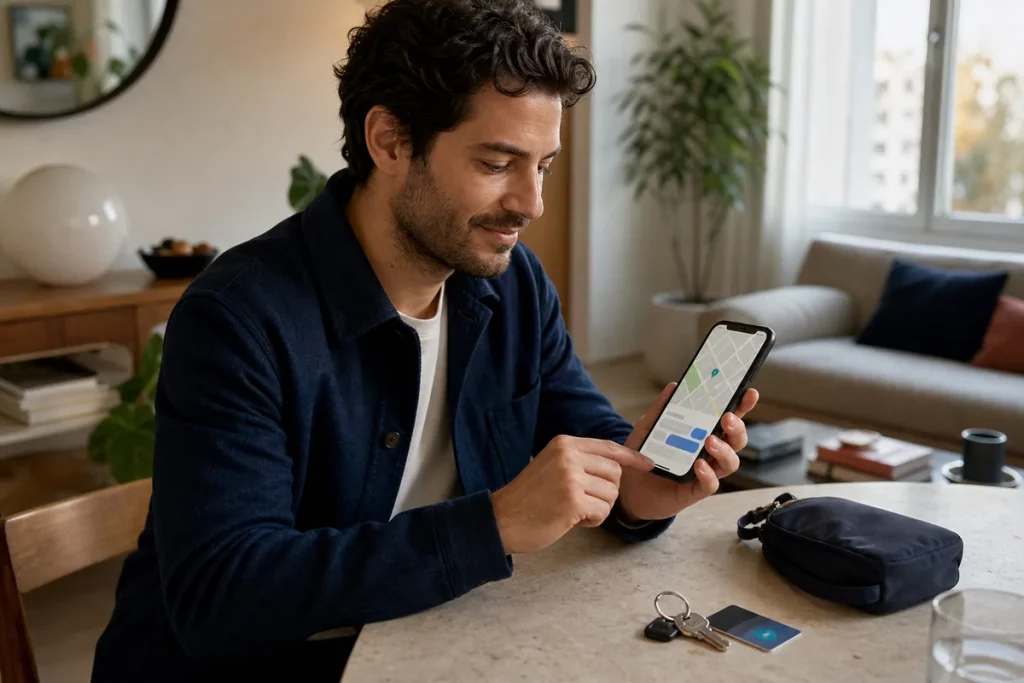
A simple check-in and independent travel plan add control before meeting.
How to Suggest the Date
A good invitation contains a plan, a reason, and room for a different answer.
If you have a shared interest
“You mentioned contemporary art. The small gallery on King has a new show—would you like to go Saturday afternoon and get coffee after?”
If you want something simple
“I’ve enjoyed talking with you. Would you like to meet for coffee at Cedar Café on Thursday around 6? No problem if another time or place is better.”
If you want an activity
“Would mini golf Sunday afternoon be fun, or would you prefer something quieter?”
If your schedule is tight
“I have about an hour after work Wednesday. Want to meet for tea near the station?”
Specificity shows effort. An alternative shows flexibility. Neither requires a long pitch.
How GuyID Helps
GuyID should appear when it is useful, not as a banner ad. A GuyID Trust Profile gives someone a portable way to share trust signals before a date, while identity verification and social vouching help turn vague profile claims into clearer next steps.
Useful next steps:
- Create a GuyID Trust Profile when you want a cleaner way to share verified trust signals.
- Use GuyID free tools and related guides when you need a checklist before meeting someone.
- Treat identity verification as confidence-building, not a guarantee.
- Use social vouching when you want context from people who already know the person.
- Sign up only when the extra trust layer helps the decision you are already trying to make.
Frequently Asked Questions
What is the best idea for a first date?
For most people, a café, casual drink, dessert, or short walk with a defined destination is the most reliable choice. It is public, affordable, conversational, and easy to end or extend. The best option still depends on access, noise, alcohol preference, weather, and travel.
How long should a first date be?
Plan a natural 60–90-minute first chapter. You can continue if interest is mutual, but neither person should feel trapped in an all-evening commitment. Ticketed events can work when their duration is clear and both people genuinely want the activity.
Is dinner too much for a first date?
Not inherently. Dinner works when the restaurant is comfortable, the price is understood, and both people like a longer seated conversation. Coffee or a casual meal gives more flexibility when you have never met in person.
What are good first date spots?
Look for public venues with moderate sound, visible prices, accessible seating, nearby transportation, and a natural stopping point. Recent reviews and photos can reveal whether a supposedly quiet café becomes a nightclub after 8 p.m.
Are at-home first dates a good idea?
They remove many of the safeguards and easy exits that public places provide. For someone you have not met or barely know, choose a populated public location. Build trust over time before sharing a home address.
Who should plan the first date?
Either person can propose it. The healthier signal is collaboration: one person offers specifics, the other responds honestly, and both can adjust the plan. Planning should not become a test of gender roles or devotion.
Should a first date be unique?
Only if the novelty suits both people. A familiar café with attentive conversation will reveal more than a spectacular activity that makes one person anxious, uncomfortable, or unable to talk.
Key Takeaways
- Use the PACE framework: public, adjustable, conversational, and equitable.
- Choose a shared point of interest, not an elaborate performance.
- State the approximate price, duration, and physical demands before the date.
- Keep transportation and the ability to leave under your control.
- Notice whether the other person participates in planning and respects changes.
- Treat verification and social vouching as useful trust signals, not final judgments.
Conclusion
The right first date idea does not create chemistry. It creates fair conditions for chemistry—or a respectful lack of it—to become clearer. Pick a public plan with enough structure to prevent awkward drift and enough flexibility to let both people stay comfortable. Then stop optimizing the venue and pay attention to the person.
For the rest of the preparation, use the complete first-date guide, review the first-date safety check, and decide what to wear based on the actual setting.