Reader Briefing
Reader Briefing
Start here if you need a practical read on how to analyze a dating profile for authenticity: 4-step framework: who should use verification, what signals to check, and what to do before moving from online interest to an in-person plan.
Who this is for
- People meeting someone from a dating app or social platform.
- Readers preparing for a first in-person date.
- Anyone checking identity, profile consistency, and trust signals.
- People trying to avoid romance scams, fake profiles, or pressure tactics.
You’ll learn
- How to evaluate identity signals without treating any single check as certainty.
- Which trust signals matter and how to weigh them together.
- How to spot inconsistencies, pressure, or behavior patterns that deserve caution.
- How to move from online conversation to a safer first meeting.
- Where GuyID tools fit into a quick pre-date screening workflow.
- How to compare options using practical safety and trust criteria.
Bottom line
Verification reduces uncertainty; it does not guarantee future behavior. Use a layered approach: confirm identity signals, compare profile consistency, ask for a short video call, keep early plans public, and slow down when someone pressures you to skip normal safety steps.
Key takeaways
- Identity verification improves confidence, not certainty.
- Patterns matter more than isolated incidents.
- Verify before meeting privately or sharing sensitive details.
- A short video call can reveal many inconsistencies.
- Pressure to skip reasonable safety steps is useful information.
Free Tools
Catfish Probability Detector
Check whether a dating profile has suspicious identity or photo signals.
Dating Bio Red Flag Detector
Review a bio for scam, pressure, or trust-warning language.
Dating Safety Checklist
Use free GuyID tools before moving from chat to a real date.
Next step
Create your GuyID trust profile
Share consent-based trust signals before a date without turning the conversation into an interrogation.
NavigateTable of Contents21 sections
You’re looking at a dating profile. The photos look good. The bio seems interesting. But something nags — or maybe nothing nags, and that’s precisely the problem, because the best fake profiles are the ones that DON’T trigger suspicion. Either way, you need a systematic way to analyze a dating profile for authenticity — not gut feelings, not vague unease, but a structured method that evaluates every observable element against known authenticity indicators and produces a clear assessment: likely real, uncertain, or likely fake. This guide provides that method: a 4-step analysis framework you can apply to any profile on any platform in under 60 seconds, turning every profile evaluation from a coin flip into an informed judgment.
Why Systematic Analysis Beats Gut Feeling
Most people evaluate profiles on instinct: “This seems legit” or “Something feels off.” Instinct works when the signals are obvious — a clearly stolen photo, a blatantly scammy bio. It fails when the signals are subtle — a well-crafted AI-generated profile, a sophisticated romance scam operator who knows exactly which buttons to push.
A systematic framework applies documented indicators consistently. It doesn’t rely on your having seen enough fakes to recognize the pattern. It checks every category — photos, bio, verification, tool confirmation — in order, and produces a scored assessment. The framework is learnable, repeatable, and improvable. Gut feeling is none of these.
Inline visual 1
The 4-Step Profile Analysis Framework
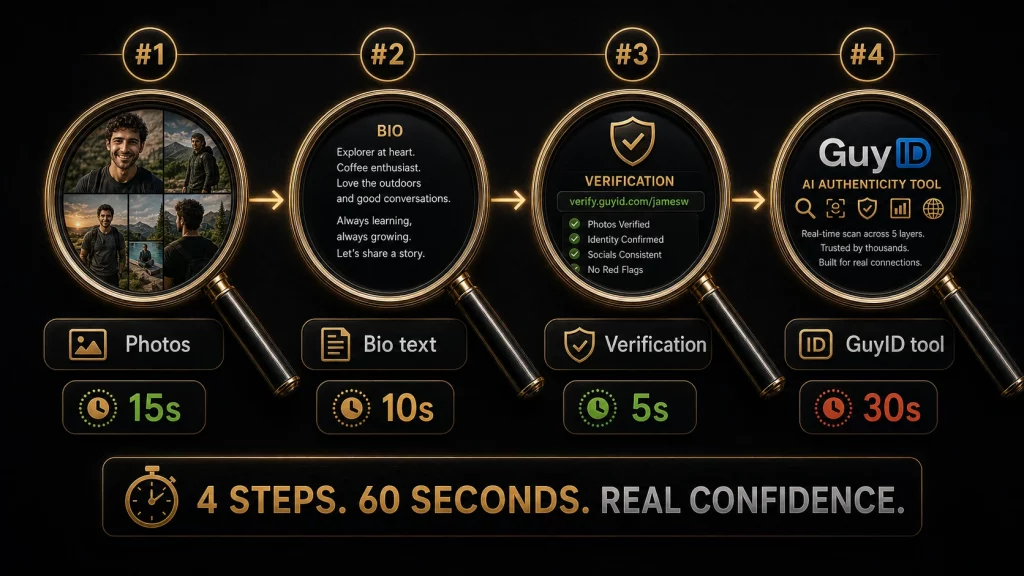
Four steps. Sixty seconds. Every profile, every platform.
| Step | What You Evaluate | Time | Primary Question |
|---|---|---|---|
| 1. Photos | Quality mix, environments, face, social context | 15 sec | “Do these photos show a real life?” |
| 2. Bio | Specificity, voice, red flags, conversation hooks | 10 sec | “Does this bio sound like a real person?” |
| 3. Verification | App badge, GuyID link, Trust Tier | 5 sec | “Has this person submitted to independent verification?” |
| 4. Tool Screening | Reverse image search, catfish probability, bio analysis | 30 sec | “Do automated tools flag anything?” |
Each step evaluates a different dimension. Together they cover visual authenticity, textual authenticity, verified identity, and automated pattern detection — the four verification signal categories that collectively determine profile trustworthiness.
Step 1: Photo Analysis (15 Seconds)
Scan every photo in the profile and score against these indicators.
Authenticity Indicators (Green Flags)
- ✅ Mixed quality: At least one great photo + some casual/candid shots. Real camera rolls have range.
- ✅ Multiple environments: Indoor + outdoor + social settings. A person who exists in only one backdrop is suspicious.
- ✅ Clear face visible: At least 2-3 photos with unobstructed face, no sunglasses, good lighting.
- ✅ Friends present: Other real people in 1-2 photos. Social context confirms social existence.
- ✅ Temporal variety: Different outfits, seasons, or hairstyles — photos from different periods.
- ✅ Imperfections: Not every photo is flattering. Real people include imperfect photos of genuine moments.
Fabrication Indicators (Red Flags)
- 🔴 All photos are professional/studio quality — potential stolen or AI-generated
- 🔴 Face obscured in every photo — concealment
- 🔴 Only one photo — minimal visual evidence
- 🔴 AI artifacts: unnatural skin, asymmetric accessories, warped background
- 🟡 All photos from same setting/outfit — potentially same-day batch, limited evidence
- 🟡 No other people in any photo — absent social proof
15-Second Photo Scan
Swipe through all photos counting green flags and red/yellow flags. Takes 15 seconds. More greens than reds: photo dimension passes. More reds/yellows: photo dimension raises concern. Continue to Steps 2-4 regardless — no single step is conclusive.
Step 2: Bio Analysis (10 Seconds)
Read the bio and evaluate against authenticity indicators.
Authenticity Indicators
- ✅ Specific details: Named places, numbered references, particular stories — too granular for mass-fabrication
- ✅ Individual voice: Reads like a person talking, not a template or AI-generated text
- ✅ Self-deprecation or vulnerability: Honest admissions that fabricated profiles avoid
- ✅ Opinions or preferences: Stances that risk alienating some readers (real people have opinions)
- ✅ Conversation hooks: Elements a match could message about specifically
Fabrication Indicators
- 🔴 Scam language: “God-fearing,” “looking for an honest woman,” “loyal and faithful” in formulaic combination
- 🔴 Career claims explaining unavailability: military deployed, oil rig, international business, “away for work”
- 🔴 Empty bio or “just ask” — zero personality evidence, zero screening value
- 🟡 Entirely generic: “love to travel, love to laugh” — could be anyone or anything
- 🟡 Perfect grammar with zero personality — technically correct but reads as template
10-Second Bio Scan
Read once. Count specifics (green) vs generics/red flags (red). A bio with 2+ specific details and zero red flags: passes. A bio with scam language or career-explains-unavailability: fails. A bio that’s generic but not flagged: inconclusive — weight Steps 3-4 more heavily.
Step 3: Verification Check (5 Seconds)
The fastest and most decisive step — check what verification the profile carries.
What to Look For
- App verification badge: Present? → Tier 2 signal — face matches photos. Better than nothing. Not sufficient alone.
- GuyID Date Mode link: Present? → Click it. Check: government ID verified? Social vouches present? Trust Tier level? This is the Tier 3-5 signal — identity and character confirmed.
What Verification Status Tells You
| Status | What It Means | Trust Level |
|---|---|---|
| No badge, no GuyID | Zero external verification — all trust is based on profile content alone | Low — rely heavily on Steps 1, 2, 4 |
| App badge, no GuyID | Face confirmed, identity unknown — standard for the platform | Moderate — face is real, everything else unconfirmed |
| App badge + GuyID at STARTER/BUILDER | Face confirmed + ID verification in progress | Good — identity partially confirmed |
| App badge + GuyID at TRUSTED or above | Face confirmed + gov ID verified + social vouches + sustained trust | Strong — multi-factor verified |
If Step 3 finds a GuyID Trust Profile at TRUSTED or above: the analysis is largely complete. Government ID + social vouches confirm what photo and bio analysis can only suggest. Steps 1-2 become supporting evidence rather than primary evidence. This is why verified profiles require less analysis — the verification carries more trust weight than any amount of visual or textual assessment.
Step 4: Tool-Assisted Screening (30 Seconds)
Automated tools catch patterns human analysis might miss — especially at scale across thousands of known fake profile templates.
The 30-Second Tool Stack
- GuyID Reverse Image Search (10 sec): Screenshot or save their main photo → upload → search for matches. Catches stolen photos used across multiple identities.
- GuyID Catfish Probability Detector (10 sec): Holistic risk assessment aggregating multiple signals beyond just image matching.
- GuyID Bio Red Flag Detector (10 sec): Paste the bio → automated analysis for scam-associated language patterns.
All three tools are free, require no account, and produce results in seconds. Together they provide: photo-source verification (is this image stolen?), holistic risk scoring (does this profile’s pattern match known fakes?), and text analysis (does this bio contain scam language?). Three automated checks supplementing your manual analysis from Steps 1-3.
What Tool Results Mean
- Photo match found under different identity: 🔴 Definitive — stolen photo, confirmed fake
- High catfish probability score: 🔴 Multiple risk signals detected — proceed with extreme caution or disengage
- Bio red flags detected: 🟡-🔴 Scam language patterns present — evaluate in context of Steps 1-3
- All tools clear: ✅ No automated flags — combine with Steps 1-3 for final assessment
Scoring Your Analysis: The Decision Matrix
After completing all four steps, combine results into a final trust decision.
| Step Results | Overall Assessment | Action |
|---|---|---|
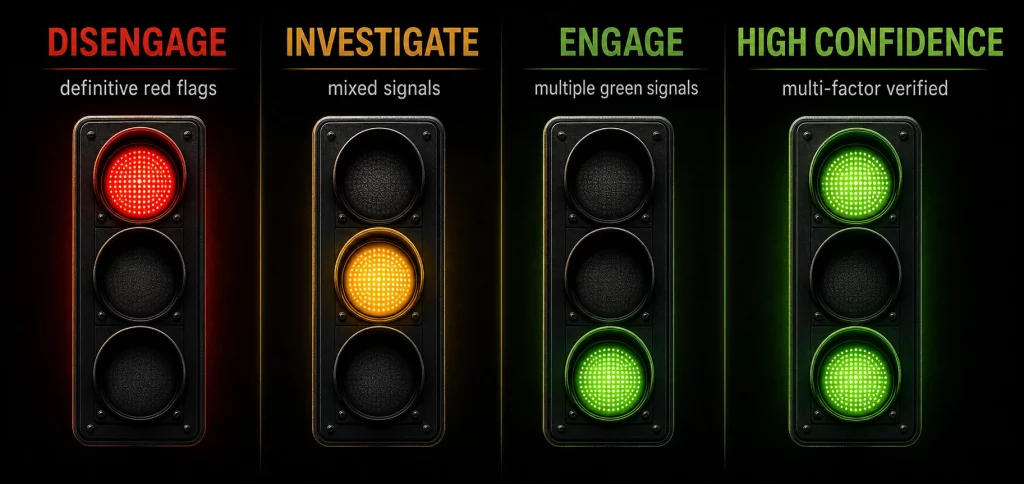
| Steps 1-2 green + Step 3 GuyID TRUSTED+ + Step 4 clear | ✅✅ High confidence — multi-factor verified | Engage confidently. Follow standard first date safety. |
| Steps 1-2 green + Step 3 badge only + Step 4 clear | ✅ Probably authentic — standard trust level | Engage with standard caution. Request GuyID Trust Profile before meeting. Video call before date. |
| Steps 1-2 mixed + Step 3 no verification + Step 4 clear | 🟡 Uncertain — insufficient evidence | Proceed cautiously. Apply dual-purpose questions. Request verification. Video call mandatory before meeting. |
| Steps 1-2 mixed + Step 3 no verification + Step 4 flags raised | 🟡 Concerning — multiple warning signals | Investigate with 5-layer method before any further investment. Do not meet without video call + verification. |
| Any step produces a definitive red flag (stolen photo, scam language, refused video) | 🔴 Likely fake — disengage | Stop contact. Report the profile. Block. If money involved: FBI IC3 + FTC. |
Practice Cases: Apply the Framework
Three scenarios to practice the 4-step analysis.
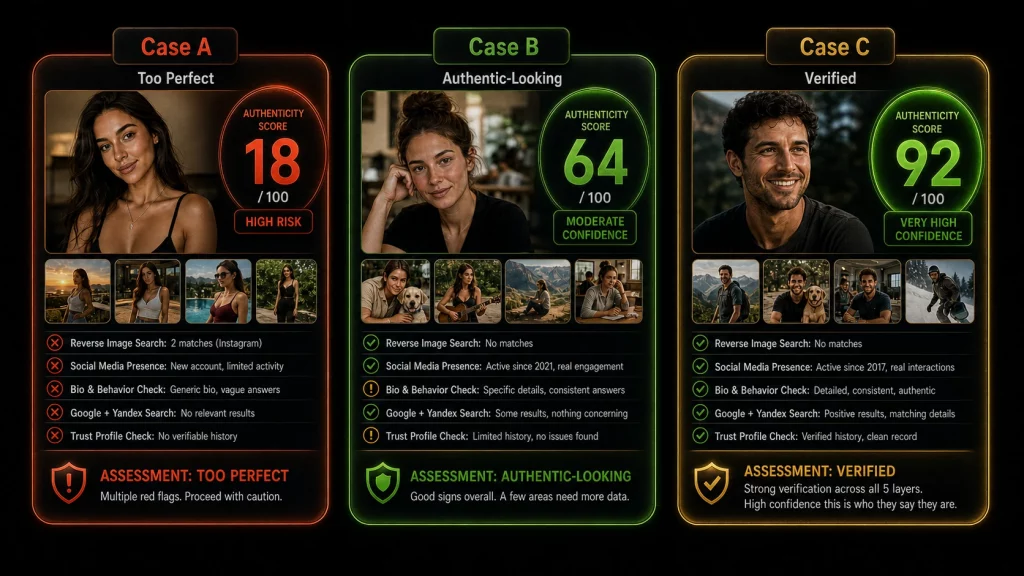
Case A: The Too-Perfect Profile
Bio: “Love to travel and try new things. Looking for my partner in crime.” Verification: No badge. No GuyID. Tools: Reverse image search returns no results.
Analysis: Step 1: 🟡 (all-professional, no friends, no variety). Step 2: 🟡 (entirely generic). Step 3: 🔴 (zero verification). Step 4: 🟡 (no stolen photo found, but no results doesn’t confirm real in the AI era). Assessment: 🟡 Uncertain to concerning. Multiple yellow flags across every step. Possibly AI-generated. Do not invest without video call and verification.
Case B: The Authentic-Looking Profile
Photos: Mix of quality — one great photo, others casual. Multiple settings. Friends in two photos. Dog in one. Bio: “Currently ranking every taco spot in the city. There’s a spreadsheet. It’s color-coded. Also: 5am runner who questions every life decision at mile 3.” Verification: Bumble badge. No GuyID. Tools: All clear.
Analysis: Step 1: ✅ (mixed quality, multiple settings, friends, pet). Step 2: ✅ (specific, funny, conversation hooks). Step 3: 🟡 (badge only — face confirmed, identity unknown). Step 4: ✅ (no flags). Assessment: ✅ Probably authentic. Strong Steps 1-2. Standard Step 3. Request GuyID Trust Profile before meeting for full confirmation.
Case C: The Verified Profile
Photos: Mixed quality across multiple settings. Clear face. Friends visible. Bio: “Engineer by day. Terrible guitar player by night. Verified real person: [GuyID link].” Verification: Hinge badge + GuyID link → clicked: TRUSTED tier, gov ID verified, 4 social vouches. Tools: All clear.
Analysis: Step 1: ✅. Step 2: ✅. Step 3: ✅✅ (multi-factor verified — gov ID + vouches + TRUSTED tier). Step 4: ✅. Assessment: ✅✅ High confidence. Multi-factor verified. Identity and character confirmed. Engage with confidence following standard safety practices.
Inline visual 2
Summary: 60 Seconds to a Trust Decision
Every profile you encounter deserves 60 seconds of systematic dating profile analysis before emotional investment begins. Four steps — photo scan (15 sec), bio scan (10 sec), verification check (5 sec), tool screening (30 sec) — produce a scored assessment that transforms profile evaluation from gut feeling into informed judgment.
The framework catches what instinct misses: the all-professional photo gallery that SEEMS appealing but signals stolen/AI photos. The bio that SEEMS fine but contains formulaic scam language. The missing verification that SEEMS unremarkable but indicates zero accountability. And the tool results that catch patterns invisible to human scanning.
The strongest shortcut through the framework: a profile with a GuyID Trust Profile at TRUSTED tier. Government ID + social vouches + sustained trust confirmation makes Steps 1-2 supplementary — the verification carries more trust weight than any amount of manual analysis. For profiles without that shortcut: the 4-step framework provides the next best thing — systematic, consistent, and improvable with practice.
Apply it to every match. Every platform. Every time. Sixty seconds of analysis before investing emotion is the most efficient safety practice available — and the free tools that power Step 4 make the final 30 seconds automated. Screen first. Invest after.
Frequently Asked Questions
How do I analyze a dating profile for authenticity?
What’s the single most important indicator of a fake profile?
How long does it take to check a profile?
Can AI-generated profiles pass this analysis?
What if the analysis is inconclusive?
Should I analyze every profile I see?
Evidence note
The FTC reported 64,003 romance-scam reports in 2023, with $1.14 billion in reported losses and a $2,000 median reported loss (Federal Trade Commission, 2024).