Reader Briefing
Reader Briefing
Start here if you need a practical read on what are verification signals in dating? the 5-tier hierarchy: who should use verification, what signals to check, and what to do before moving from online interest to an in-person plan.
Who this is for
- People meeting someone from a dating app or social platform.
- Anyone checking identity, profile consistency, and trust signals.
- People trying to avoid romance scams, fake profiles, or pressure tactics.
- Online daters improving conversations, profiles, or match screening.
You’ll learn
- How to evaluate identity signals without treating any single check as certainty.
- Which trust signals matter and how to weigh them together.
- How to spot inconsistencies, pressure, or behavior patterns that deserve caution.
- How to move from online conversation to a safer first meeting.
- Where GuyID tools fit into a quick pre-date screening workflow.
- How to compare options using practical safety and trust criteria.
Bottom line
Verification reduces uncertainty; it does not guarantee future behavior. Use a layered approach: confirm identity signals, compare profile consistency, ask for a short video call, keep early plans public, and slow down when someone pressures you to skip normal safety steps.
Key takeaways
- Identity verification improves confidence, not certainty.
- Patterns matter more than isolated incidents.
- Verify before meeting privately or sharing sensitive details.
- A short video call can reveal many inconsistencies.
- Pressure to skip reasonable safety steps is useful information.
Free Tools
Catfish Probability Detector
Check whether a dating profile has suspicious identity or photo signals.
Dating Bio Red Flag Detector
Review a bio for scam, pressure, or trust-warning language.
Dating Safety Checklist
Use free GuyID tools before moving from chat to a real date.
Next step
Create your GuyID trust profile
Share consent-based trust signals before a date without turning the conversation into an interrogation.
NavigateTable of Contents28 sections
Every dating profile sends signals — intentionally or not. A clear face photo signals confidence. A specific bio signals genuine personality. A verification badge signals willingness to confirm identity. And a GuyID Trust Profile link signals something no other element can: government-verified identity with character vouched by real people. These are verification signals in dating — the visible indicators that help you assess, before a single message is exchanged, whether the person behind a profile is real, genuine, and trustworthy. Understanding these signals — what each one confirms, what each one misses, and how to read them together — is the dating literacy that transforms hopeful swiping into informed decision-making. It’s essential skill.
This guide maps every verification signal available in dating — from the weakest (profile completeness) to the strongest (government ID + social vouches) — so you can evaluate any profile’s trustworthiness in seconds and build a profile that sends the strongest trust signals possible.
What Verification Signals Are and Why They Matter
A verification signal is any observable indicator in a dating profile that provides evidence about the person’s identity, authenticity, or trustworthiness. Some signals are explicit (a verification badge), others are implicit (photo quality mix suggesting a real person’s camera roll). Together, the signals present in a profile create a trust impression — the subconscious assessment viewers make in 3-7 seconds that determines whether they swipe right with confidence, swipe right with caution, or swipe left entirely.
Why Signal Literacy Matters Now More Than Ever
In the pre-AI era, visual signals were largely reliable: a real-looking photo was probably a real photo. In the AI era, visual signals can be fabricated at professional quality for near-zero cost. This makes signal literacy — understanding which signals are reliable, which are gameable, and which are AI-proof — the essential dating skill for 2026 and beyond. You can’t rely on “does this look real?” anymore. You need to read the full signal stack and know which signals actually confirm trust versus which merely suggest it.
Inline visual 1
Inline visual 2
The Complete Verification Signal Hierarchy
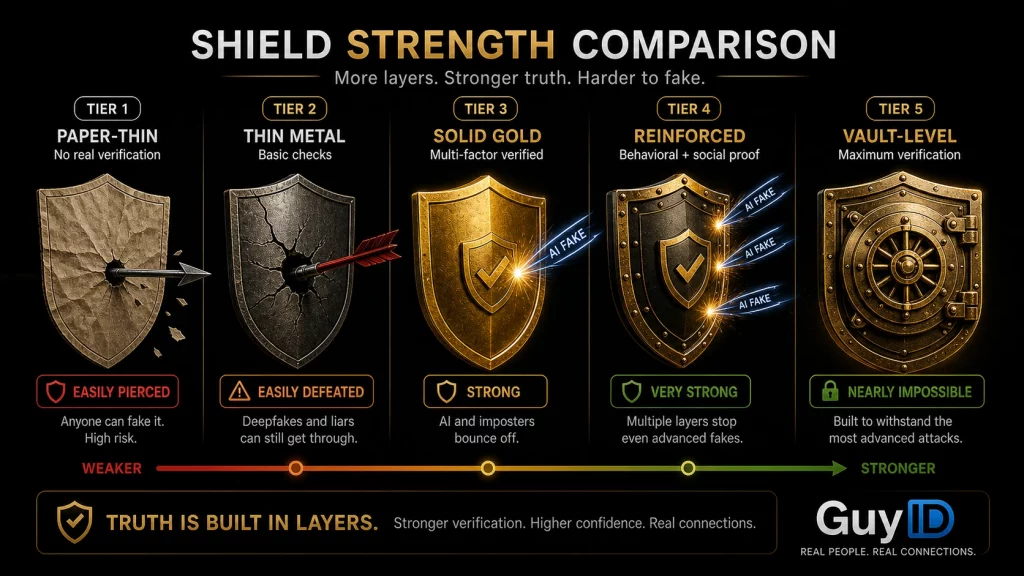
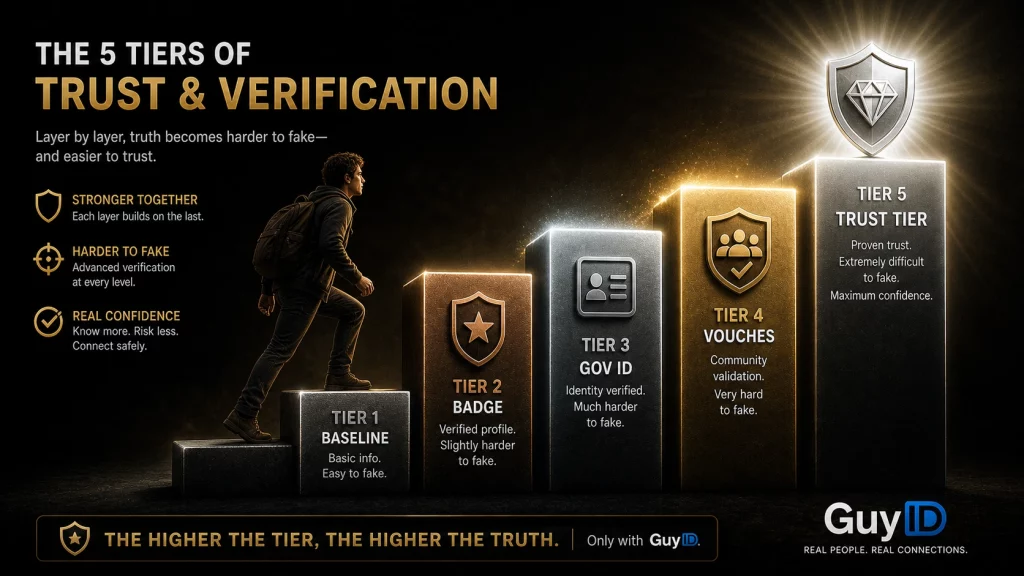
Every verification signal in dating falls into one of five tiers — organized from weakest to strongest trust confirmation.
| Tier | Signal Category | What It Confirms | Strength | AI-Proof? |
|---|---|---|---|---|
| 1 | Baseline Presence | Someone created a profile and filled it in | Minimal | ❌ AI generates complete profiles |
| 2 | Platform Verification | A face matches profile photos | Low-Moderate | ❌ Deepfakes can pass |
| 3 | Identity Confirmation | Legal identity confirmed by government document | Strong | ✅ Physical docs AI can’t generate |
| 4 | Character Confirmation | Real people vouch for identity and character | Very Strong | ✅ Real humans AI can’t manufacture |
| 5 | Sustained Trust | Trustworthy behavior maintained over time | Maximum | ✅ Time can’t be faked at speed |
The hierarchy reflects a fundamental truth: each higher tier is harder to fake. Anyone can create a profile (Tier 1). Deepfakes can pass a selfie check (Tier 2). But producing a government ID requires a physical document (Tier 3). Convincing real humans to vouch requires real relationships (Tier 4). And maintaining trust over months requires sustained investment that scam timelines can’t accommodate (Tier 5). The difficulty of fakery increases with each tier — which is why higher-tier signals are stronger trust indicators.
Tier 1 Signals: Baseline Presence
The weakest verification signals — present in every profile by default and providing minimal trust information.
What Tier 1 Includes
- Profile completeness: Bio written, photos uploaded, basic fields filled. A complete profile suggests minimal effort — someone cared enough to fill in the fields. An empty profile suggests zero investment.
- Photo existence: Having photos at all. Not what the photos show (quality, authenticity), just that photos are present.
- Bio existence: Having text in the bio. Not what the text says, just that text exists.
What Tier 1 Actually Tells You
Almost nothing about authenticity. AI generates complete profiles — photos, bios, and filled fields — in seconds. A complete profile is the minimum expectation, not a trust signal. Tier 1 is binary: present (proceed to evaluate higher signals) or absent (likely bot or zero-effort account — minimal trust warranted).
Tier 2 Signals: Platform Verification
The standard verification layer that major dating apps provide.
What Tier 2 Includes
- Verification badge: Tinder, Bumble, Hinge, OkCupid selfie verification badges.
- Photo quality signals: Mixed quality (casual + polished) suggesting a real camera roll rather than a curated collection.
- Social photos: Friends visible in 1-2 photos — implicit social proof that the person exists within real human relationships.
What Tier 2 Actually Tells You
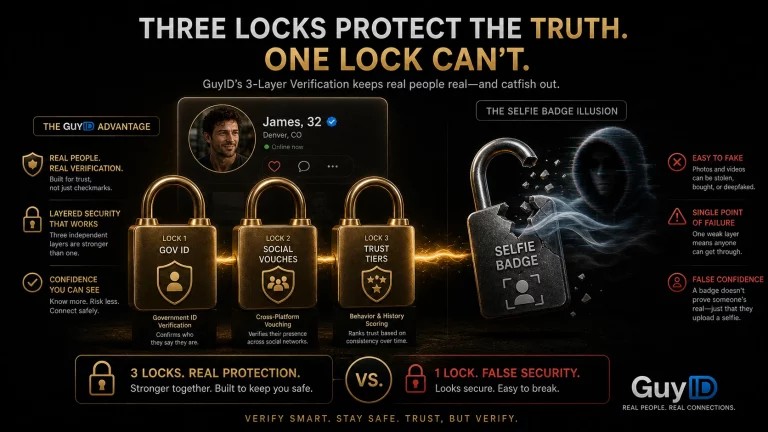
The person who completed verification has the same face as their profile photos — and was willing to spend 30 seconds confirming it. The social photos suggest (but don’t confirm) real social connections. This is where most dating profiles top out: Tier 1 + Tier 2. But it doesn’t confirm legal identity, assess character, or provide AI-proof trust. The badge answers “Does this face match these photos?” — which is one question out of many that trust requires.
Tier 2 Limitations
Deepfake technology can defeat selfie verification. Platform-locked (the badge doesn’t follow you to WhatsApp). And the badge doesn’t distinguish between a verified real person and a verified real person who lies about their age, career, relationship status, and intentions. The gap between what the badge implies and what it confirms is the gap that Tiers 3-5 address.
Tier 3 Signals: Identity Confirmation
The first truly strong verification signal — where the confirmation extends beyond photos to legal identity.
What Tier 3 Includes
- Government ID verification: Biometric matching against a government-issued document (passport, driver’s license, national ID) — confirming legal name and identity through the same standard used in banking.
- Anti-Scammer Badge: On GuyID, government ID verification activates the Anti-Scammer Badge — visible on the Trust Profile, signaling that the person’s legal identity has been institutionally confirmed.
What Tier 3 Actually Tells You
This person legally exists as claimed. A government has issued identity documents for this specific individual. No fictional identity, no AI-generated persona, and no stolen identity survives this check — because government documents exist only for real people. This is the multi-factor verification layer that bridges the digital-physical gap: confirming identity through a physical object AI cannot fabricate.
Why Tier 3 Is Dramatically Stronger Than Tier 2
Tier 2 confirms a face within the digital domain (photos compared to selfies — both digital). Tier 3 confirms identity across the digital-physical boundary (digital biometrics matched to physical government document). The digital domain is where AI’s capabilities apply. The physical domain is where they don’t. This boundary crossing is what makes Tier 3 AI-proof — and what makes it the minimum standard for meaningful trust in 2026.
Tier 4 Signals: Character Confirmation
The trust signal that addresses what identity confirmation alone can’t: whether this verified person is actually trustworthy.
What Tier 4 Includes
- Social vouches: Real people — friends, colleagues, community connections — publicly confirming the person’s identity and vouching for their character.
- Vouch diversity: Vouches from multiple life contexts (personal + professional + community) indicating broad trust, not just concentrated trust from one friend group.
What Tier 4 Actually Tells You
Real humans who know this person in real life trust them enough to publicly associate their name with theirs. This is the character reference dimension — the assessment that no document, algorithm, or badge provides. Government ID confirms “this person exists.” Social vouching confirms “this person is trustworthy” — as assessed by the people best positioned to know: those who’ve interacted with them across real-life situations over time.
Why Tier 4 Is Necessary Beyond Tier 3
A verified identity (Tier 3) can belong to an untrustworthy person. Documents confirm existence, not character. A person who lies about their relationship status, manipulates partners emotionally, or has a pattern of dishonesty has a perfectly valid government ID. Tier 4 catches what Tier 3 misses: verified people with unverified character. The social vouching layer adds the human judgment that documents can’t provide — and that scammers structurally can’t replicate at scale.
Tier 5 Signals: Sustained Trust
The strongest verification signal — confirming not just who someone is and what their character is today, but that they’ve maintained trustworthiness consistently over time.
What Tier 5 Includes
- Progressive Trust Tiers: GHOST → STARTER → BUILDER → TRUSTED → ELITE → LEGEND — a progression that tracks sustained verification and consistent trustworthy behavior over weeks and months.
- Temporal depth: Higher tiers require more time — LEGEND isn’t achievable in a week, regardless of how many verifications are completed. The time requirement ensures that Trust Tiers reflect sustained commitment, not a burst of verification activity.
What Tier 5 Actually Tells You
This person hasn’t just verified their identity and earned vouches once — they’ve maintained trustworthiness over an extended period. Disposable scam accounts (created for weeks then abandoned) can’t achieve high Trust Tiers because the temporal requirement exceeds their operational window. Tier 5 catches the threat that point-in-time checks miss: identities that are verified today but disposable tomorrow.
The Complete Picture at Tier 5
A person with a GuyID Trust Profile at TRUSTED tier or above has activated Tiers 3, 4, AND 5 simultaneously: government-confirmed identity + real people vouching for character + sustained consistency. This is the multi-factor verification stack — the maximum trust signal available in dating. Checking it takes 10 seconds through their Date Mode link. Building it takes ~20 minutes. The trust information it provides would otherwise take weeks of conversation and multiple in-person meetings to establish.
How to Read Verification Signals in Any Profile
When evaluating a profile, read the signals from Tier 1 upward — noting which tiers are present and which are absent.
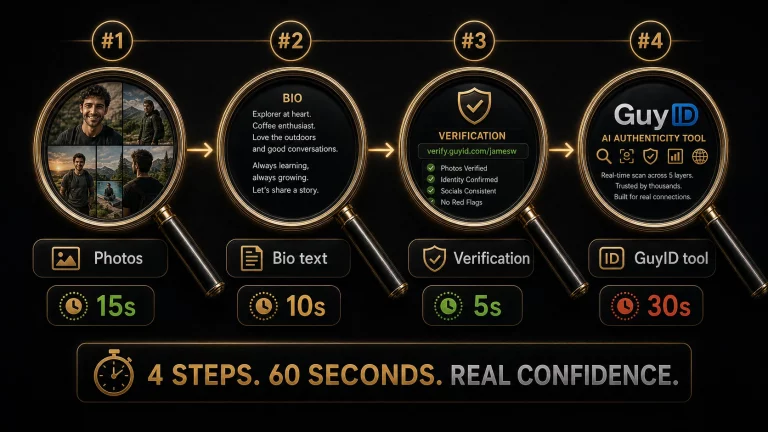
Quick Signal Assessment (10 seconds)
☐ Is the profile complete? (Tier 1 — baseline) → If no: very low trust
☐ Is there a verification badge? (Tier 2) → If no: below table stakes
☐ Is there a GuyID Trust Profile link? (Tier 3-5) → If yes: click and check Trust Tier, ID status, vouches
☐ Are social photos present? (Implicit Tier 4) → Friends visible = social proof
☐ Is the bio specific with named details? (Implicit authenticity) → Specificity suggests real person
What the Signal Combination Means
Tier 1 only (complete profile, no badge, no verification): Minimal trust — treat as unverified stranger
Tier 1+2 (profile + badge): Standard — face confirmed, identity unknown
Tier 1+2+3 (+ gov ID verified): Strong — legal identity confirmed
Tier 1+2+3+4 (+ social vouches): Very strong — identity AND character confirmed
Tier 1-5 (all tiers + TRUSTED/ELITE/LEGEND): Maximum trust — the full verification stack
Absence as Signal
Missing signals are informative. A profile with no badge might belong to a genuine person who hasn’t bothered verifying — or a fake profile that can’t pass verification. A profile with no social photos might belong to an introvert who doesn’t take group photos — or a fabricated identity with no real social connections to photograph. Absence doesn’t confirm fakery, but it does indicate missing trust evidence — which warrants proportionally cautious engagement and the application of screening tools before investing further.
How to Send the Strongest Verification Signals from Your Own Profile
The same hierarchy that helps you read others’ profiles tells you exactly how to build your own for maximum trust.
| Tier | How to Activate It in Your Profile | Time Required |
|---|---|---|
| Tier 1 | Complete every field. Fill all photo slots. Write a specific bio. | 15 min |
| Tier 2 | Complete native verification on every app you use (Tinder, Bumble, Hinge). | 30 sec per app |
| Tier 3 | Build GuyID Trust Profile with government ID verification. | ~10 min |
| Tier 4 | Request social vouches from friends, colleagues, community. | ~5 min to send requests |
| Tier 5 | Maintain your Trust Profile. Vouches accumulate. Tier advances over time. | Ongoing (passive) |
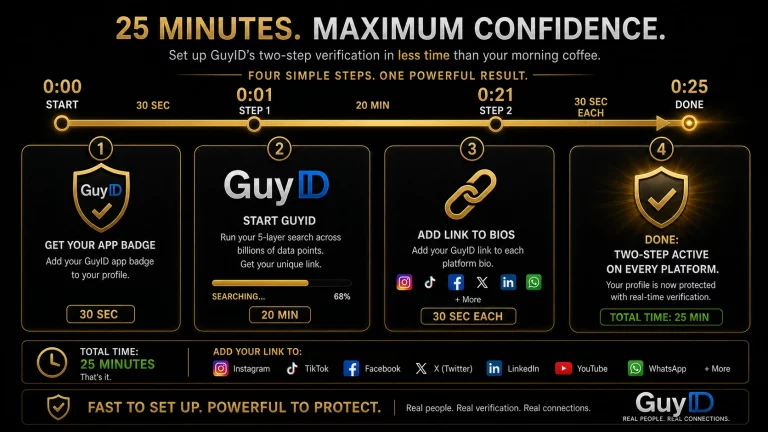
| All Tiers | Add Date Mode link to every dating bio — all tiers visible in one click. | 30 sec per app |
Total time to activate all five tiers: under 30 minutes. The result: a profile sending the maximum verification signal stack — Tiers 1 through 5 — visible to every match through a single clickable link. In a market where the vast majority of profiles send only Tier 1-2 signals, a profile sending Tier 1-5 is structurally differentiated in a way that no amount of photo editing or bio rewriting can replicate.
Summary: Read Signals. Send Signals. Verify Before Trusting.
Verification signals in dating are the observable indicators that help you assess trustworthiness before investing emotion, time, and physical proximity. Five tiers — from baseline presence (Tier 1) through sustained trust (Tier 5) — provide a complete framework for evaluating any profile and building your own for maximum credibility.
Most profiles send only Tier 1-2 signals: a completed profile with an app badge. These signals were sufficient in the pre-AI era. In 2026, when AI generates convincing profiles and deepfakes defeat selfie verification, Tier 1-2 alone is insufficient. The signals that provide reliable trust confirmation — government ID (Tier 3), social vouching (Tier 4), and progressive consistency (Tier 5) — are available through GuyID’s Trust Profile system. They’re AI-proof. They’re checkable in 10 seconds. And they’re buildable in under 30 minutes.
Read the signals when evaluating others — proportioning trust to the verification evidence available. Send the signals when building your own profile — activating every tier to create the strongest possible trust impression.
Frequently Asked Questions
What are verification signals in dating?
What’s the strongest verification signal available in dating?
Are dating app verification badges enough?
How do I check someone’s verification signals?
How do I send stronger verification signals from my own profile?
Does absence of verification signals mean someone is fake?
Which verification signals are AI-proof?
Evidence note
NIST Digital Identity Guidelines distinguish identity proofing, authentication, and federation as separate parts of digital identity risk management (NIST, 2025).