
Free Tools
Catfish Probability Detector
Check whether a dating profile has suspicious identity or photo signals.
Dating Bio Red Flag Detector
Review a bio for scam, pressure, or trust-warning language.
Dating Safety Checklist
Use free GuyID tools before moving from chat to a real date.
Next step
Create your GuyID trust profile
Share consent-based trust signals before a date without turning the conversation into an interrogation.
Dating apps are not disappearing tomorrow. Tinder, Bumble, Hinge, Match, Grindr, and niche dating communities will still exist. Millions of people will still download them, swipe through profiles, and hope the next match turns into something real.
But something more important is ending: the belief that a swipe feed, a selfie badge, and a chat box are enough infrastructure for modern dating.
That era is cracking.
The controversial version is simple: the end of dating apps is near.
The more precise version is better: the end of dating apps as the primary trust layer is near.
For more than a decade, the dating industry treated matching as the hard problem. Who should you see? Who should you swipe on? Who should the algorithm place in front of you next? But users are no longer only asking, “Who is attractive?” or “Who is nearby?” They are asking much harder questions:
- Is this person real?
- Are they who they claim to be?
- Has anyone trustworthy vouched for them?
- Are there patterns that suggest risk?
- Can I verify enough before I meet them?
- Can I carry trust from one platform to another?
Those are not matching questions. They are trust questions.
And the dating app model was not built to answer them.
NavigateTable of Contents22 sections
Quick Answer
The end of dating apps is not the end of online dating. It is the end of trusting dating apps to solve identity, safety, and credibility by themselves.
People will still meet online. They may still use apps. But the next version of dating will need an independent trust layer that works across platforms, group chats, social media, and real-life introductions. That is where GuyID has a credible opening: it can help people inspect and share verified trust signals before a date, instead of forcing users to gamble on profile photos and vibes.
Why This Claim Is Controversial
“Dating apps are ending” sounds extreme because dating apps became the default romantic infrastructure for a generation.
They normalized the idea that connection starts with a profile card. They turned attraction into a feed. They made strangers feel discoverable. They also helped many people meet partners they might never have encountered otherwise.
That matters. A serious critique should not pretend dating apps did nothing useful.
Pew Research Center found that three in ten U.S. adults had used a dating site or app as of its July 2022 survey. Among adults under 30, the share was 53%. Pew also found that one in ten partnered adults met their current partner through online dating, rising to 20% among partnered adults under 30.
So no, the apps did not fail completely.
They solved discovery.
They did not solve trust.
That distinction is the whole argument.
The swipe era assumed that if enough people entered the marketplace, the right match would eventually appear. But dating is not only a marketplace. It is a risk decision, an emotional decision, and often a physical safety decision. When the system gives users more strangers but not more certainty, volume starts to feel like exposure.
That is why the next category winner may not be another swipe app. It may be the trust layer that sits above them.

What Is Actually Ending
The phrase “the end of dating apps” should not be read literally. The app stores will not empty out. People will not stop wanting convenient ways to meet.
What is ending is the old bargain:
- Upload photos.
- Write a short bio.
- Swipe through strangers.
- Trust the platform badge.
- Move to chat.
- Meet if the conversation feels good.
That bargain worked better when the internet felt less adversarial. It works worse in a world of AI-generated photos, romance scam operations, account farming, low-effort swiping, private-message migration, and users who have learned through experience that a polished profile can still hide risk.
The old model was optimized around attention and matching. The next model has to be optimized around verification, context, and consent-based trust.
The end of dating apps is really the end of three assumptions:
- The profile is enough. It is not. A profile is a claim, not proof.
- The platform badge is enough. It is not. Many badges confirm photos, not identity, character, or consistency.
- The app is the whole journey. It is not. Modern dating moves from apps to Instagram, WhatsApp, iMessage, FaceTime, group chats, real dates, and sometimes back again.
Trust has to travel with the person.
The Data Behind Dating App Fatigue
Dating app fatigue is not just a meme. It is a measurable pattern across user surveys, market commentary, and safety research.
Pew’s 2023 report found a divided market: 53% of online dating users described their experiences as at least somewhat positive, while 46% described them as somewhat or very negative. That is not a dead market, but it is not a healthy love affair either.
The same Pew report found that 48% of online dating users had experienced at least one unwanted behavior on dating sites or apps, such as unsolicited sexual messages, continued contact after disinterest, offensive names, or threats. Among women under 50 who had used dating sites or apps, Pew reported that 66% had experienced at least one of those unwanted behaviors.
Safety perceptions are also split. Pew found that 49% of Americans said dating sites and apps are not too safe or not at all safe for meeting people, while 48% said they are very or somewhat safe. Women were more concerned than men: 57% of women said dating sites and apps are not a safe way to meet people.
Those numbers point to the same conclusion: dating apps created access, but access without trust creates exhaustion.
External signals tell the same story. In the U.K., The Guardian reported on Ofcom’s 2024 Online Nation findings, noting declines for several top dating apps and a broader conversation about Gen Z shifting toward lower-pressure, more authentic ways to meet. In the U.S., a Forbes Health survey reported by the New York Post found that 78% of surveyed dating app users felt fatigue with dating apps at least sometimes.
The exact percentages will vary by country, method, and sample. The direction is harder to ignore: users want connection, but many no longer trust the process.
Why Safety Became the Core Product Problem
The early dating app pitch was convenience. You could meet people outside your immediate social circle. You could filter by location, age, photos, prompts, and preferences. You could start a conversation without the awkwardness of walking up to someone in public.
Convenience was the innovation.
Now convenience is table stakes.
The harder question is whether the person behind the profile is safe enough to meet.
The scam data is brutal. The FTC reported that in 2022 nearly 70,000 people reported a romance scam and reported losses hit $1.3 billion, with a median reported loss of $4,400. The FTC also reported that 40% of people who said they lost money to a romance scam said contact started on social media, while 19% said it started on a website or app.
The FBI’s 2024 IC3 Annual Report listed 17,910 Confidence/Romance complaints and $672,009,052 in reported losses. For people age 60 and older, IC3 reported $389,312,356 in Confidence/Romance losses.
Those numbers are not simply “bad dates.” They are a trust infrastructure failure.
And they understate the real problem because many victims do not report. Shame, embarrassment, fear of judgment, and confusion all suppress reporting. A dating ecosystem that depends on users detecting professional manipulation after the fact is not a safe ecosystem. It is a system that puts the burden on the person with the least information.
That is why safety is no longer a support feature. It is the product.
The Swipe Model Has a Trust Gap
Dating apps can do moderation. They can remove reported users. They can add photo verification. They can blur explicit images. They can prompt people to meet in public. They can warn against money requests. These are useful interventions.
But most of them happen inside the app.
Modern dating does not stay inside the app.
Someone matches on Hinge, then moves to Instagram. Someone starts on Tinder, then moves to WhatsApp. Someone meets through a friend, then shares a phone number. Someone reconnects on LinkedIn, talks through iMessage, and meets in person. The dating app is only one doorway into a much larger trust journey.
That creates the trust gap:
| Question | Dating app answer | What the dater actually needs |
|---|---|---|
| Is this photo connected to a real person? | Sometimes | Identity confidence |
| Is this the person’s legal identity? | Usually no | Stronger verification |
| Do real people trust them? | Usually no | Social vouching |
| Does trust travel outside this app? | Usually no | Portable trust |
| Can I inspect risk before meeting? | Partly | Context and decision support |
| Can I verify without sharing too much? | Not consistently | Consent-based trust signals |
This is why a platform badge is not enough. A badge may say something happened inside one app. It does not necessarily tell you who the person is across the broader dating journey.
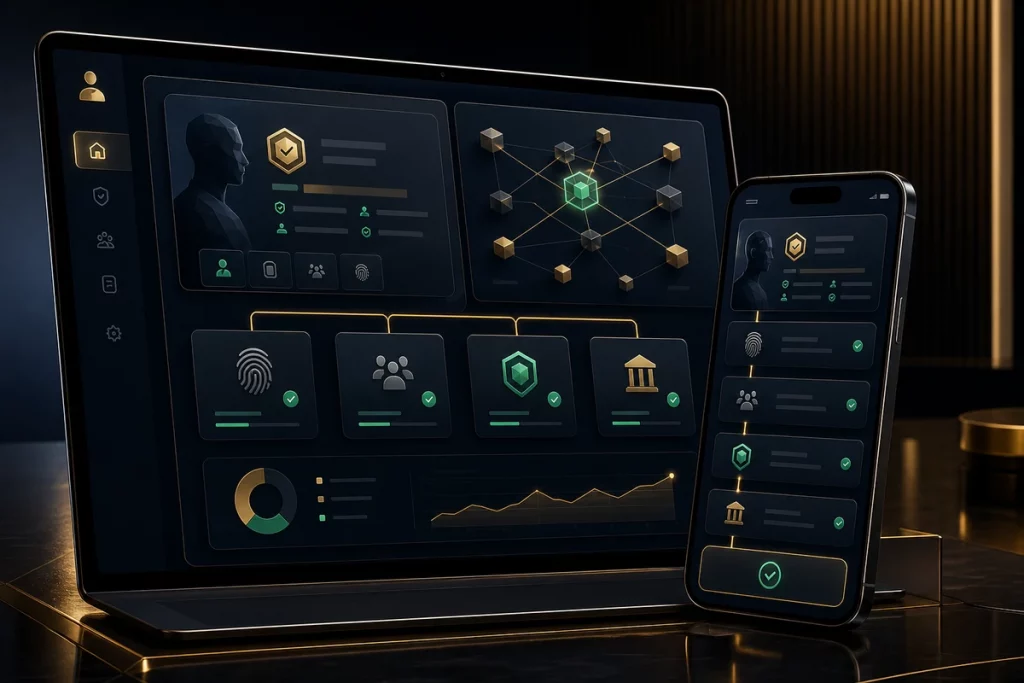
GuyID’s opportunity is to solve the missing layer: trust that is portable, consent-based, inspectable, and understandable before a date.
Why AI Makes the Problem Worse
AI does not kill dating apps by itself. But AI changes the economics of deception.
A fake profile used to require effort: stolen photos, copied bios, clumsy messages, and enough consistency to avoid suspicion. Now generative tools can help create convincing photos, polished bios, fluent messages, and emotionally adaptive scripts at scale.
That does not mean every suspicious profile is AI. It does mean the old trust signals are weaker.
Historically, people relied on small clues:
- Does the profile look real?
- Do the photos seem natural?
- Does the person write like a human?
- Does the story sound plausible?
- Do they respond consistently?
AI makes those clues less reliable. A profile can look polished because a tool polished it. A message can sound warm because a tool drafted it. A scammer can maintain emotional consistency because scripts and automation make consistency cheaper.
This does not mean users should become paranoid. It means the dating ecosystem needs stronger proof mechanisms.
The answer is not “trust no one.”
The answer is “trust better evidence.”
That is the philosophical shift GuyID should own.
What Comes After Dating Apps
The future of dating is not offline-only nostalgia. Meeting through friends, events, communities, workplaces, hobbies, and social platforms will grow, but phones are not leaving people’s romantic lives.
The future is hybrid:
- discovery may happen on dating apps
- conversation may happen in private messages
- credibility may come from social proof
- safety may depend on identity verification
- comfort may depend on mutual transparency
- trust may need to move between platforms
In that world, the winning layer is not necessarily the place where two people first saw each other’s faces. It is the place where they decide whether the interaction deserves more trust.
That is a different job.
Dating apps optimize the top of the funnel: more profiles, more likes, more matches, more messages.
The next layer optimizes the trust checkpoint: before meeting, before sharing sensitive information, before moving to a private location, before ignoring a concern because the chemistry feels good.
This is why GuyID should not merely describe itself as another safety tool. It should describe itself as the dating trust layer.
Where GuyID Fits
GuyID is not the savior because savior language is bad architecture.
A savior asks people to believe.
A trust layer helps people verify.
That difference matters.
GuyID’s strongest positioning is not “we will replace every dating app.” It is more practical and more powerful:
Dating apps help you meet people. GuyID helps you decide who deserves more trust.
That role can work across the whole dating journey:
- A person creates a GuyID Trust Profile.
- They complete identity and trust-signal steps.
- They can share a profile or Date Mode link when trust matters.
- A match can inspect signals without needing to join the same dating app.
- The decision becomes more evidence-based and less vibe-based.
This does not eliminate risk. No trust system can promise that. But it changes the starting point.
Instead of asking “Do I feel good enough to take a chance?” the dater can ask:
- Is this person identity-verified?
- Do they have meaningful social vouches?
- Are their trust signals current?
- Is the verification portable?
- Does anything about the interaction conflict with what I can inspect?
That is a better pre-date decision.
It also helps good actors. Many people on dating apps are genuine, respectful, and tired of being treated with suspicion because the system gives everyone too little verifiable context. A portable trust profile lets them make trust visible without oversharing private documents or turning the first conversation into an interrogation.
Comparison: Dating App Verification vs GuyID
| Dimension | Typical dating app verification | GuyID trust layer |
|---|---|---|
| Main purpose | Confirm a profile photo or account signal | Help evaluate identity and trust before a date |
| Portability | Usually locked to one app | Designed to travel across platforms |
| Social proof | Limited or absent | Social vouching can support trust context |
| User control | Platform-defined | Consent-based sharing |
| Context | Usually a badge | Trust profile, tiers, and explainable signals |
| Best use | Reducing low-effort impersonation inside one app | Supporting pre-date trust decisions across the dating journey |
The point is not that dating app verification is useless. It is useful, but narrow.
Photo verification can reduce some forms of catfishing. In-app warnings can prevent some obvious scams. Reporting systems can remove bad actors after harm or suspicious behavior.
But the future belongs to systems that help users before harm, before the private meetup, before the money request, before the emotional escalation, and before the decision is based only on attraction.
That is the category GuyID should build.
A Better Dating Workflow
The old workflow was:
- Match.
- Chat.
- Hope.
- Meet.
- Learn the truth gradually.
The better workflow is:
- Match or meet anywhere.
- Look for consistency.
- Verify identity signals before trust escalates.
- Use public, low-pressure plans early.
- Keep private information private until trust is earned.
- Use stronger trust signals when the relationship moves forward.
This is not unromantic. It is respectful.
Trust does not kill chemistry. It gives chemistry a safer place to grow.
What GuyID Should Not Claim
Because this article is intentionally provocative, the guardrails matter.
GuyID should not claim:
- dating apps will disappear immediately
- every dating app is unsafe
- verification guarantees good behavior
- background checks solve every problem
- a trust profile replaces judgment
- every unverified person is suspicious
- every bad date can be predicted
Those claims would be false or irresponsible.
The stronger claim is also more credible:
The swipe era is losing trust, and the next dating infrastructure needs portable verification, social proof, and consent-based trust signals. GuyID is building that layer.
That is bold enough.
And it is much more defensible.
Key Takeaways
- Dating apps solved discovery, but they did not solve trust.
- Safety is now the core product problem, not a side feature.
- AI weakens old profile-based trust signals.
- The next dating workflow will be hybrid, portable, and verification-aware.
- GuyID’s best role is not replacing every dating app; it is becoming the trust layer that makes dating safer across apps, messages, and real-world meetings.
Frequently Asked Questions
Are dating apps really ending?
Not literally. Dating apps will continue to exist, but the old swipe-first model is losing cultural trust. The more likely shift is that dating apps become discovery channels while independent trust layers help people verify identity, safety signals, and credibility before meeting.
Is GuyID trying to replace Tinder, Bumble, or Hinge?
GuyID does not need to replace dating apps to matter. Its stronger role is to work across them. A person can meet someone on a dating app, social media, through friends, or offline, then use GuyID to inspect and share trust signals before the interaction becomes more serious.
Why are people tired of dating apps?
Common reasons include repetitive swiping, low-effort conversations, ghosting, safety concerns, scam exposure, and the emotional fatigue of sorting through strangers with limited verified context. Surveys and market commentary point to a growing mismatch between what users want and what swipe-based systems deliver.
Can verification make dating completely safe?
No. Verification improves confidence; it does not guarantee future behavior. The purpose of GuyID is to help people make better trust decisions with clearer signals, not to remove the need for judgment, boundaries, and public early-date safety.
What makes GuyID different from a dating app badge?
Many dating app badges are platform-specific and narrow. GuyID is designed around portable trust: identity signals, social vouching, trust profiles, and consent-based sharing that can work across the broader dating journey.
Should someone refuse to meet anyone who is not verified?
Not automatically. Verification is one signal. The right decision depends on context, behavior, consistency, and comfort. But if someone resists reasonable, low-pressure verification while pushing for private access, money, secrecy, or urgency, that resistance is meaningful information.
Conclusion
The end of dating apps is near only if we define dating apps by their weakest assumption: that a profile feed can carry the full weight of modern romantic trust.
That assumption is ending.
People still want connection. They still want romance. They still want the possibility that one message could become a real relationship. What they no longer want is to gamble their safety, time, and emotional energy on systems that give them more strangers without enough trust.
The next chapter of online dating will not be won by the app that creates the most swipes. It will be won by the infrastructure that makes trust easier to inspect, share, and verify.
That is why GuyID matters.
Not as a slogan. Not as a savior myth. As a practical trust layer for the dating world that comes next.