Reader Briefing
Reader Briefing
Start here if you need a practical read on military scammer list: how to identify fake military profiles: who should use verification, what signals to check, and what to do before moving from online interest to an in-person plan.
Who this is for
- People meeting someone from a dating app or social platform.
- Readers preparing for a first in-person date.
- Anyone checking identity, profile consistency, and trust signals.
- People trying to avoid romance scams, fake profiles, or pressure tactics.
You’ll learn
- How to evaluate identity signals without treating any single check as certainty.
- Which trust signals matter and how to weigh them together.
- How to spot inconsistencies, pressure, or behavior patterns that deserve caution.
- How to move from online conversation to a safer first meeting.
- Where GuyID tools fit into a quick pre-date screening workflow.
- When to slow down, ask for more context, or walk away.
Bottom line
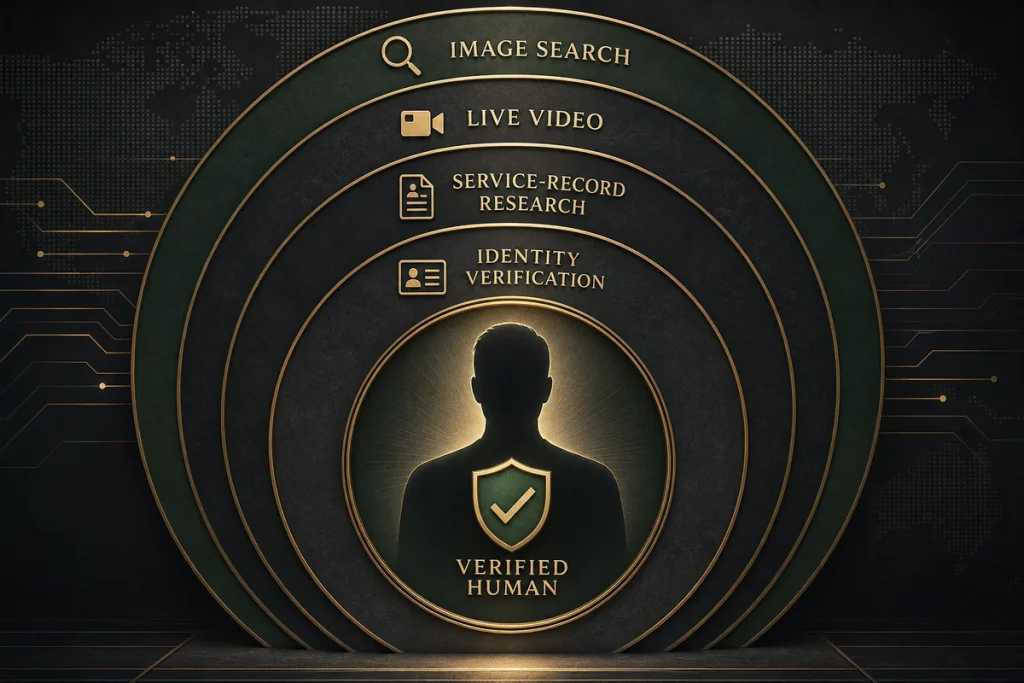
Verification reduces uncertainty; it does not guarantee future behavior. Use a layered approach: confirm identity signals, compare profile consistency, ask for a short video call, keep early plans public, and slow down when someone pressures you to skip normal safety steps.
Key takeaways
- Identity verification improves confidence, not certainty.
- Patterns matter more than isolated incidents.
- Verify before meeting privately or sharing sensitive details.
- A short video call can reveal many inconsistencies.
- Pressure to skip reasonable safety steps is useful information.
Free Tools
Catfish Probability Detector
Check whether a dating profile has suspicious identity or photo signals.
Dating Bio Red Flag Detector
Review a bio for scam, pressure, or trust-warning language.
Dating Safety Checklist
Use free GuyID tools before moving from chat to a real date.
Next step
Create your GuyID trust profile
Share consent-based trust signals before a date without turning the conversation into an interrogation.
He’s deployed overseas. He can’t video call because of “security restrictions.” He needs money for leave papers, satellite phone access, or a medical emergency. If you’re searching for a military scammer list, you may already suspect that the uniformed hero in your DMs isn’t who they claim to be — and your suspicion is likely correct. Military romance scams are among the most profitable and emotionally devastating forms of online fraud, exploiting the genuine respect most people feel for service members to build trust that is then systematically converted into financial extraction. This guide provides the specific names, patterns, and verification methods that expose military romance scammers — plus the reality-check framework that protects you from the emotional manipulation these scams depend on.
NavigateTable of Contents21 sections
Why Scammers Specifically Use Military Identities
Military romance scams aren’t random — the military identity is chosen strategically because it solves every logistical problem a scammer faces. According to the National Domestic Violence Hotline’s research on technology-facilitated romance fraud, military identities are the single most commonly exploited profession in romance scams because the military context provides built-in explanations for every suspicious behavior:
Deployment explains why they can’t meet. A scammer claiming to be a civilian needs to keep inventing reasons to avoid in-person meetings — which becomes suspicious quickly. A scammer claiming to be deployed overseas has a built-in, plausible, emotionally compelling reason: “I’m serving my country and I can’t come home right now.” The deployment narrative can be maintained for months or years without the target becoming suspicious because the story evokes sympathy rather than skepticism.
Security restrictions explain communication limitations. Can’t video call? “Security protocol.” Can’t share their location? “Classified.” Can’t use regular messaging apps? “Military communications restrictions.” Every verification attempt the target makes can be deflected with the “security” excuse — which the target accepts because they don’t know enough about actual military communications to challenge it. In reality, deployed service members have regular access to video calls, social media, and standard communication tools. The “security restriction” story is fabricated specifically to prevent the verification that would expose the scam.
The uniform creates automatic trust. Research from the American Psychological Association on authority-based trust confirms that uniforms — particularly military uniforms — trigger automatic respect and reduced skepticism in most people. A profile photo in military dress uniform communicates honor, discipline, sacrifice, and trustworthiness before a single word is exchanged. Scammers exploit this automatic trust transfer: the uniform does the trust-building work that the scammer’s actual behavior can’t support.
Financial requests seem legitimate. “I need money for leave papers so I can come visit you.” “My military pay is delayed and I need to pay for satellite phone access.” “There’s a medical emergency and my insurance won’t cover it overseas.” Every financial extraction is wrapped in military-specific language that sounds plausible to someone unfamiliar with how the military actually works. In reality: leave doesn’t require payment. Military pay isn’t delayed. Medical care for active service members is covered. Every financial request from an alleged military person you’ve never met in person is a scam indicator — not an exception. Our military romance scam signs guide covers these financial extraction patterns in comprehensive detail.
The 10 Patterns Every Military Scammer Uses
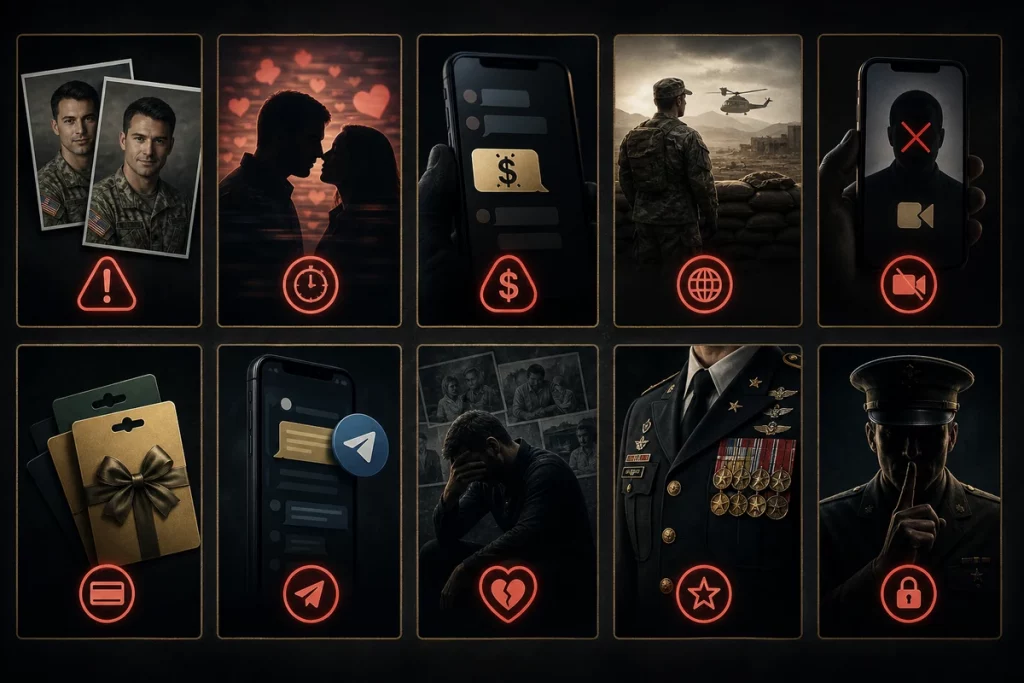
1. Stolen Photos of Real Service Members
Military scammers use photos stolen from the social media profiles of actual military personnel — often high-ranking officers whose photos appear professional and authoritative. The same stolen photos may appear across dozens of scam profiles simultaneously. A reverse image search of their profile photos is the fastest way to detect this: if the photos appear on other profiles under different names, the identity is stolen. The US Army Criminal Investigation Division regularly publishes advisories about specific photos being used in scam operations — which is the closest thing to an official military scammer list that exists.
2. Rapid Emotional Escalation
“I’ve never felt this connection before.” “You’re the reason I keep fighting.” “I think about you every moment I’m not on duty.” The love bombing is intense and arrives within days of initial contact — far too fast for genuine emotional development, especially from someone you’ve never met in person. The rapid escalation serves a strategic purpose: it creates emotional investment before the financial requests begin, because a person who feels deeply connected is more likely to send money than a person who’s still in the evaluation phase.
3. Can’t Video Call — Ever
The number one verification-defeating tactic: “I can’t video call because of security protocols / poor internet at the base / restricted communications.” Real deployed service members video call their families regularly using standard military internet access. The refusal to video call — maintained across weeks or months of otherwise constant messaging — is among the most reliable indicators on any military scammer list because it’s the simplest verification the scammer cannot pass. If they can message you for hours daily but can never manage a 30-second video call, the person in the photos and the person typing the messages are not the same individual.
4. Vague or Inconsistent Military Details
The scammer’s military knowledge is surface-level: they mention their “rank” and “deployment location” but can’t discuss unit details, chain of command, daily operations, or military culture with the specificity that actual service members possess automatically. Ask specific questions: “What’s your MOS?” “Who’s your commanding officer?” “What unit are you with?” Genuine military personnel answer these instantly; scammers stall, deflect, or provide answers that don’t match military structure. The romance scammer detection guide covers the verification questions that expose knowledge gaps.
5. Financial Requests Escalate Gradually
By the time the requests reach thousands of dollars, the target has invested so much financially and emotionally that the sunk cost trap prevents them from accepting the truth: every dollar was stolen, not borrowed, and no amount of additional money will produce the in-person meeting the scammer promises after every payment.
6.
Leave was cancelled. Deployment was extended. Travel papers were denied. Medical hold prevents travel. Every planned meeting falls through for military-specific reasons that sound plausible individually but form an unmistakable pattern collectively: they will NEVER meet you in person because the person you’re communicating with doesn’t look like the person in the photos. This pattern continues indefinitely — the scammer will maintain the relationship as long as the money flows, inventing new obstacles to meeting each time the target begins to insist.
7. Communicates Through Non-Standard Channels
Military scammers often prefer platforms that don’t verify identity: Hangouts (before its shutdown), WhatsApp, Telegram, or direct Instagram messaging. They resist communicating through platforms where their profile can be more easily verified or where their IP location might be exposed. If someone claiming to be in Afghanistan is messaging from a Nigerian IP address, the platform’s security features could expose this — which is why scammers prefer unverified communication channels.
8. Tragic Backstory Creates Sympathy
“My wife died in a car accident.” “My daughter is being raised by my elderly mother while I serve.” “I grew up an orphan and the military is my only family.” The tragic backstory serves dual purposes: it generates the sympathy that makes financial exploitation feel like helping rather than being scammed, and it creates emotional intensity that accelerates the attachment the scammer needs to maintain the relationship through increasingly obvious red flags.
9. Claims High Rank to Amplify Authority
Many military scammer profiles claim to be Generals, Colonels, or Sergeants Major — high-ranking positions that amplify the authority-trust effect while explaining why they “can’t” use social media openly or “have security restrictions” ordinary soldiers don’t. In reality, high-ranking officers are the MOST visible military personnel — their names, photos, and biographies are publicly available on military websites. If someone claiming to be a General can’t be found on any official military page, they’re not a General.
10. Pressure to Keep the Relationship Secret
“Don’t tell your family about us — they won’t understand.” “Military regulations prevent me from having a public relationship.” “Keep this between us until I’m home.” The secrecy request isolates the target from the outside perspective that would identify the scam immediately. The manipulation tactics guide identifies isolation requests as a primary control mechanism across all forms of relationship exploitation.
How to Verify a Military Person’s Identity
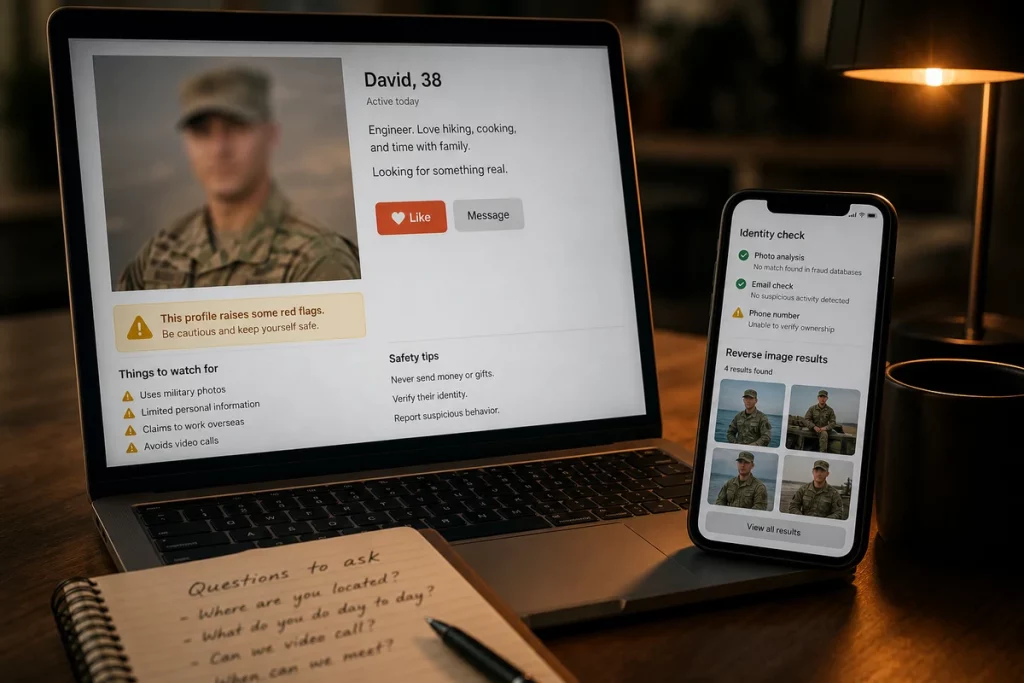
Reverse image search their photos. Upload every profile photo to Google Images and TinEye. If the photos appear on other profiles under different names — or on military advisory sites listing known scam photos — the identity is stolen. This single step catches the majority of military romance scams because they ALL use stolen photos. Our reverse image search guide provides the step-by-step process.
Request a live video call. Not a pre-recorded video. Not a voice-only call. A real-time video call where you can see the person, ask them to wave or hold up a specific number of fingers, and verify that the person on camera matches the profile photos. According to the National Library of Medicine’s research on identity verification in online dating, video calls are the single most effective anti-catfish measure available — because the scammer cannot produce a live video of someone else’s face on demand. Repeated refusal to video call after weeks of daily messaging is diagnostic.
Verify through official channels. The Defense Finance and Accounting Service (DFAS) can confirm whether a person is an active military member. The US Army CID (Criminal Investigation Division) maintains a list of known scam photos and identities. Individual branch websites (Army, Navy, Air Force, Marines) list personnel above certain ranks. If someone claims to be a Colonel stationed in Afghanistan and no official source confirms their existence, the claim is fabricated.
Use GuyID’s free screening tools. Government ID verification through GuyID confirms actual identity — not the stolen identity the scammer is presenting. Ask your contact to verify through GuyID and share their Date Mode link. A genuine military person will have no objection to proving their identity; a scammer will produce an excuse for why they can’t. That refusal IS the verification — it tells you everything the video call would have confirmed.
Military Scammer List: Known Tactics and Stolen Identities
No single military scammer list can be comprehensive because scam operations generate new fake profiles continuously. However, certain patterns are well-documented enough to serve as reference points:
Most commonly stolen identities: Scammers disproportionately steal photos from US Army and Marine Corps generals and colonels — because their professional photos are the most easily found online and the most visually impressive. Names like “General James” or “Sergeant Williams” are used across hundreds of scam profiles simultaneously, often with the same set of stolen photos matched to different names depending on which platform the scam operates on.
Most common deployment claims: Afghanistan, Syria, Iraq, and “United Nations peacekeeping missions” are the most frequently cited deployment locations — chosen because they’re remote enough to explain communication difficulties and dangerous enough to generate sympathy. The specific location is less important than the emotional weight it carries: the target feels they’re supporting a hero in danger, which makes financial requests feel like patriotic duty rather than fraud.
None of these are legitimate military expenses — real leave requires no payment from the service member, military communication infrastructure is provided, medical care is covered by military insurance, discharge processes don’t require personal payment, and military logistics handles shipping. Every financial request is the extraction mechanism the entire scam was built to deliver.
Reporting military scammers. Report to the FTC (reportfraud.ftc.gov), the FBI’s Internet Crime Complaint Center (IC3.gov), the relevant military branch’s criminal investigation division, and the dating platform where you encountered the profile. Reporting doesn’t guarantee recovery of lost funds — but it contributes to the data that helps law enforcement identify and disrupt scam operations that target others.
What to Do If You’ve Been Targeted by a Military Scammer
Stop all contact immediately. Block the scammer across all platforms. Don’t respond to follow-up messages, guilt trips, or emotional appeals. The scammer will attempt to re-engage using guilt (“after everything we shared, you’re abandoning me?”), new urgency (“I’m in danger and only you can help”), or appeals to the emotional investment you’ve made (“don’t throw away what we have”). Every continued interaction extends the manipulation — no-contact is the only effective boundary.
Don’t blame yourself. Military romance scams are sophisticated social engineering operations — not evidence of your gullibility. The dating over 60 safety guide addresses the specific targeting of mature, financially stable individuals who are precisely the demographic most frequently targeted by these operations. The shame victims feel is exactly what prevents reporting — and what allows scammers to continue operating. You were targeted by criminals who manipulate human connection for profit. That’s their failing, not yours.
Report to authorities. File reports with the FTC, IC3, and the relevant military CID. Provide screenshots of communications, records of financial transfers, and all identifying information about the scam profile. Even if recovery of your specific funds is unlikely, the reports contribute to the patterns that help law enforcement disrupt these networks and protect future targets.
Seek support. The emotional aftermath of a military romance scam often mirrors the grief of a real breakup — because the emotional investment was real even though the person was fake. Individual therapy with a practitioner familiar with romance fraud recovery helps process the grief, shame, and trust damage that these scams produce. The bad breakup recovery guide provides the framework that applies to scam aftermath just as it applies to genuine relationship endings.
Protect yourself going forward. Use GuyID’s free screening tools for identity verification before investing emotionally in ANY online connection. Reverse image search EVERY profile photo. Insist on video calls before developing emotional attachment. Apply the red flags framework to every new connection regardless of how compelling their story is — because the same emotional openness that made you vulnerable to the scam is the same emotional openness that will eventually connect you with someone genuine. The goal isn’t to close yourself off from connection — it’s to verify before investing, to maintain healthy skepticism alongside genuine warmth, and to ensure that the next person who earns your trust has demonstrated through verified identity that they deserve it. Share your Date Mode link through GuyID and require the same from anyone you’re developing a connection with — because mutual transparency is the standard that every genuine person will meet willingly and every scammer will resist.
How GuyID Helps
GuyID should appear when it is useful, not as a banner ad. A GuyID Trust Profile gives someone a portable way to share trust signals before a date, while identity verification and social vouching help turn vague profile claims into clearer next steps.
Useful next steps:
- Create a GuyID Trust Profile when you want a cleaner way to share verified trust signals.
- Use GuyID free tools and related guides when you need a checklist before meeting someone.
- Treat identity verification as confidence-building, not a guarantee.
- Use social vouching when you want context from people who already know the person.
- Sign up only when the extra trust layer helps the decision you are already trying to make.
Frequently Asked Questions
Is there an official military scammer list?
No single comprehensive list exists because scam operations generate new fake profiles continuously. However, the US Army Criminal Investigation Division (CID) regularly publishes advisories about specific photos being used in scam operations, and websites like romancescams.org maintain databases of known scam profiles. The most reliable approach isn’t checking a list — it’s applying the verification framework (reverse image search, video call, official channel check, GuyID verification) to every military person you encounter online.
Do real military members ask for money?
Essentially never for the reasons scammers cite. Real military personnel don’t need money for leave papers (leave is an entitlement, not a purchase), satellite phone access (military communications are provided), medical care (covered by military insurance), or early discharge paperwork (no such fee exists). If anyone claiming military service asks you for money for ANY military-specific reason — regardless of the emotional context — it’s a scam. This is the single most reliable indicator on any military scammer list.
How do I verify if someone is really in the military?
Four steps: (1) Reverse image search their photos — stolen photos will appear on other profiles and scam advisory sites. (2) Request a live video call — repeated refusal after weeks of messaging is diagnostic. (3) Check official military databases — DFAS can confirm active duty status, and branch websites list personnel above certain ranks. (4) Use GuyID’s free identity verification — government ID confirmation proves actual identity regardless of what uniform they’re wearing in photos.
Can I get my money back from a military romance scam?
Recovery is difficult but sometimes possible depending on how the money was sent. Wire transfers and cryptocurrency are typically unrecoverable. Credit card payments may be reversible through chargebacks. Bank transfers may be recoverable if reported quickly (within 24-48 hours). Report to your bank immediately, file with the FTC and FBI IC3, and be wary of “recovery scams” — fraudulent services that claim to recover stolen funds for an upfront fee, which is itself a second scam targeting the same victim.