

Reader Briefing
Reader Briefing
Start here if you need a practical read on narcissistic abuse examples: 20 real patterns to recognize: who should use verification, what signals to check, and what to do before moving from online interest to an in-person plan.
Who this is for
- Readers preparing for a first in-person date.
- Anyone checking identity, profile consistency, and trust signals.
- People trying to avoid romance scams, fake profiles, or pressure tactics.
- Online daters improving conversations, profiles, or match screening.
You’ll learn
- How to evaluate identity signals without treating any single check as certainty.
- Which trust signals matter and how to weigh them together.
- How to spot inconsistencies, pressure, or behavior patterns that deserve caution.
- How to move from online conversation to a safer first meeting.
- Where GuyID tools fit into a quick pre-date screening workflow.
- When to slow down, ask for more context, or walk away.
Bottom line
Verification reduces uncertainty; it does not guarantee future behavior. Use a layered approach: confirm identity signals, compare profile consistency, ask for a short video call, keep early plans public, and slow down when someone pressures you to skip normal safety steps.
Key takeaways
- Identity verification improves confidence, not certainty.
- Patterns matter more than isolated incidents.
- Verify before meeting privately or sharing sensitive details.
- A short video call can reveal many inconsistencies.
- Pressure to skip reasonable safety steps is useful information.
Free Tools
Catfish Probability Detector
Check whether a dating profile has suspicious identity or photo signals.
Dating Bio Red Flag Detector
Review a bio for scam, pressure, or trust-warning language.
Dating Safety Checklist
Use free GuyID tools before moving from chat to a real date.
Next step
Create your GuyID trust profile
Share consent-based trust signals before a date without turning the conversation into an interrogation.
Narcissistic abuse doesn’t announce itself — it infiltrates. The patterns are so gradual, so wrapped in charm and intermittent affection, that most people don’t recognize them until the damage is deeply embedded. Understanding narcissistic abuse examples in concrete, specific terms — not clinical abstractions but the actual words, behaviors, and scenarios that play out in real relationships — is the fastest path to recognizing whether what you’re experiencing is love with rough edges or systematic psychological harm with a romantic veneer. This guide provides 20 narcissistic abuse examples across four categories, explains why each one works, and gives you the recognition framework that transforms vague unease into actionable clarity.
NavigateTable of Contents32 sections
Narcissistic Abuse Examples: The Idealization Phase
The idealization phase is where narcissistic abuse begins — and where it’s hardest to identify because it feels like the best relationship you’ve ever had. According to the American Psychological Association’s research on narcissistic personality patterns, the idealization phase serves a strategic function: it creates the emotional attachment that makes the subsequent devaluation phase effective. Without the idealization high, the devaluation low wouldn’t produce the desperate attachment the narcissist requires. These narcissistic abuse examples from the idealization phase look like love — but they’re infrastructure for control.
1. Overwhelming Early Intensity
“I’ve never felt this way about anyone.” “You’re my soulmate — I knew from the moment I saw you.” “I’ve been looking for you my entire life.” These declarations arrive within days or weeks — far too early for genuine depth. This love bombing creates the intoxicating illusion that you’ve found extraordinary connection, making you invest emotionally at a pace that serves the narcissist’s timeline rather than the relationship’s natural development. The intensity isn’t passion — it’s acceleration designed to lock in attachment before you’ve had time to evaluate the person objectively.
2. Mirroring Your Identity
They love everything you love. They share your values, your humor, your taste in music, your life philosophy. The alignment feels miraculous — finally, someone who truly GETS you. But the alignment is manufactured: the narcissist has studied your preferences and reflected them back as their own identity. You’re not falling in love with them; you’re falling in love with your own reflection wearing their face. The mirroring collapses once attachment is secured — which is when you discover the person you fell for doesn’t actually exist.
3. Future Faking
“We should move in together.” “I can see us getting married.” “Let’s plan a trip to Italy next summer.” Grand future promises create shared investment in a relationship trajectory that the narcissist has no intention of following through on. Future faking anchors you to the relationship through anticipated experiences rather than actual ones — and when the promises quietly evaporate, questioning them makes YOU seem demanding rather than the narcissist seem dishonest. Our player detection guide covers future faking as a manipulation strategy.
4. Isolating Through Intensity
“I just want to be with you ALL the time.” “Why do you need to see your friends when we have each other?” “Your sister doesn’t understand our connection.” The intensity of the idealization phase naturally produces isolation — not through overt prohibition but through the sheer volume of attention that leaves no room for other relationships. By the time the devaluation begins, your support system has atrophied from neglect, leaving you more dependent on the narcissist and less able to access the outside perspective that would identify the abuse.
5. Positioning as Your Rescuer
“Your ex didn’t deserve you.” “Your family doesn’t appreciate you.” “Nobody has ever treated you the way you deserve — until me.” The narcissist positions themselves as the antidote to every previous disappointment, creating a narrative where THEY are the only source of the love and validation you deserve. This positioning makes future criticism of the narcissist feel like ingratitude — how can you complain about someone who “rescued” you from your terrible past?
Narcissistic Abuse Examples: The Devaluation Phase
The devaluation phase is where the narcissistic abuse examples become recognizably harmful — but by this point, the idealization phase has created enough attachment that leaving feels impossible. Research from the National Library of Medicine on trauma bonding confirms that the alternation between idealization and devaluation produces the most powerful attachment bonds in human psychology — more powerful than consistent kindness, because the intermittent reinforcement pattern activates the same neurological pathways as addiction.
6. The Subtle Shift to Criticism
“I love you, but you’d look better if you lost a few pounds.” “You’re smart, but you make terrible decisions.” “I’m attracted to you, but that outfit isn’t doing you any favors.” The devaluation begins with criticism wrapped in compliments — making it difficult to identify as abuse because the positive framing disguises the corrosive message. Each “but” erodes self-esteem incrementally: you’re almost good enough, but never quite. Over months, the criticism intensifies while the compliments diminish — but the gradient is so gradual you adjust to each new baseline without recognizing the cumulative decline.
7. Gaslighting Your Reality
“I never said that.” “That didn’t happen — you’re making things up.” “You’re remembering it wrong.” “Everyone agrees with ME, not you.” The narcissist systematically denies your experience of reality, producing the self-doubt that makes you dependent on THEIR version of events. Over time, you stop trusting your own memory, your own judgment, and your own perception — which is exactly the outcome gaslighting is designed to produce, because a person who can’t trust themselves can’t identify abuse, can’t leave effectively, and can’t advocate for themselves when the narcissist’s narrative contradicts their experience.
8. The Silent Treatment as Punishment
You expressed a need. You set a boundary. You disagreed about something minor. And now your partner has vanished — emotionally, communicatively, sometimes physically — leaving you in the agonizing uncertainty of not knowing what you did wrong, when it will end, or what you need to do to restore the connection. The silent treatment (stonewalling) is one of the most common narcissistic abuse examples because it costs the narcissist nothing while inflicting maximum distress on the target — who spends the silence period frantically reviewing their behavior trying to identify the “mistake” that triggered the withdrawal.
9. Weaponizing Your Vulnerabilities
Remember those intimate disclosures during the idealization phase — your deepest fears, your childhood wounds, your insecurities? The narcissist stored them. And during the devaluation phase, they deploy them as weapons: “No wonder your father left — you’re impossible to love.” “Maybe your ex was right about you.” “You told me you were afraid of being alone — so maybe you should stop complaining and be grateful someone puts up with you.” The weaponization of vulnerability is among the most devastating narcissistic abuse examples because it punishes the very openness that healthy relationships require.
10. Triangulation
“My coworker said the funniest thing today…” (with implications of attraction). “My ex texted me — they want to get back together” (creating jealousy). “Everyone else thinks I’m great — maybe the problem is you.” Triangulation introduces a third party (real or imagined) to create insecurity, competition, and the fear that you’re replaceable. The narcissist doesn’t need to act on the triangulation — the threat alone produces the desperate, people-pleasing behavior they want from you. Our manipulation tactics guide covers triangulation as a control mechanism in detail.
Narcissistic Abuse Examples: Control and Manipulation
11. Moving the Goalposts
You cooked dinner? It should have been a different meal. You got a promotion? You should be earning even more. You lost weight? Now you need to tone up. The standard for approval is always positioned just beyond whatever you’ve achieved — ensuring you remain in a permanent state of trying harder, doing more, and never reaching the satisfaction that was implicitly promised. The goalposts move because your actual achievement is irrelevant; what matters is maintaining your pursuit of the narcissist’s unattainable approval.
12. Deflection From Accountability
“I wouldn’t have yelled if you hadn’t provoked me.” “What about when YOU forgot our anniversary?” “You’re the one with the problem, not me.” Every attempt to address the narcissist’s behavior is immediately redirected to YOUR behavior — ensuring they never face accountability for anything. The deflection is so automatic and skilled that you leave every conversation about THEIR behavior having apologized for YOURS.
13. Conditional Love
Warmth, affection, and emotional engagement are dispensed as rewards for compliance and withdrawn as punishment for independence. The narcissist’s love has terms — unspoken but rigidly enforced — and violating those terms (having opinions, setting boundaries, maintaining friendships, prioritizing yourself) triggers withdrawal that teaches you the cost of autonomy. Over time, you learn to suppress your needs to maintain the connection — which is the definition of a transactional relationship operating at its most coercive level.
14. Playing the Victim
A person may reframe your report of harm as an attack on them: “You calling me out is emotionally abusive,” “I’m the one suffering,” or “People keep blaming me.” Focus on the behavior rather than diagnosing the person. The pattern is concerning when it repeatedly redirects accountability, pressures you to comfort the person who hurt you, or makes it unsafe to discuss your experience.
15. Financial Manipulation
Controlling access to money, creating financial dependency, making extravagant promises then reneging, or using financial generosity as leverage: “After everything I’ve bought you…” Financial manipulation ensures the practical barrier to leaving is as high as the emotional one — and the dating over 60 safety guide covers the specific financial exploitation patterns that narcissistic individuals deploy against partners with accumulated assets.
Narcissistic Abuse Examples: Discard and Hoovering
16. The Sudden Discard
After months or years of investing in the relationship under increasingly punitive conditions, the narcissist abruptly ends it — often without explanation, often for someone new (the next supply source). The cruelty of the discard is itself a narcissistic abuse example: it communicates that your investment, your suffering, and your efforts to meet impossible standards were ultimately worthless to someone who has already moved on without processing, grieving, or acknowledging the damage they caused.
17. Hoovering (The Return)
“I made a terrible mistake.” “Nobody understands me like you do.” “I’ve changed — I’ve been going to therapy.” The hoover sucks you back in after the discard, using the exact idealization tactics that worked the first time — because the narcissist knows your neurological wiring has been conditioned to respond to their specific pattern. The hoover works on trauma-bonded targets because the relief of reconnection produces the same neurochemical reward as the original idealization — even though the intellectual mind knows the cycle will repeat.
18. Post-Discard Smear Campaign
After the relationship ends, the narcissist tells mutual friends, family, and social networks a version of events that positions them as the victim and you as the unstable, abusive, or unreasonable party. The smear campaign serves two functions: it preemptively discredits any account of abuse you might share, and it isolates you from the shared social network at the moment you need support most.
19. Using Children or Shared Obligations as Leverage
“If you leave, I’ll make sure you never see the kids.” “I’ll tell everyone what you did.” “Good luck affording this on your own.” Post-relationship, the narcissist uses shared obligations (children, property, finances, social connections) as control mechanisms that extend the abuse beyond the relationship’s formal end. Co-parenting with a narcissist is among the most exhausting narcissistic abuse examples because the control tactics continue indefinitely through the child as intermediary.
20. The Intermittent Breadcrumb
Months after the discard, a late-night text: “Thinking about you.” A social media like. A “happy birthday” message that opens the door just enough to reactivate your hope without committing to anything. These breadcrumbs are narcissistic abuse examples that operate at minimal cost to the narcissist while producing maximum disruption to your healing — each breadcrumb resetting the recovery clock and reactivating the attachment circuits that the no-contact period was slowly deactivating.
Why Narcissistic Abuse Works: The Psychology
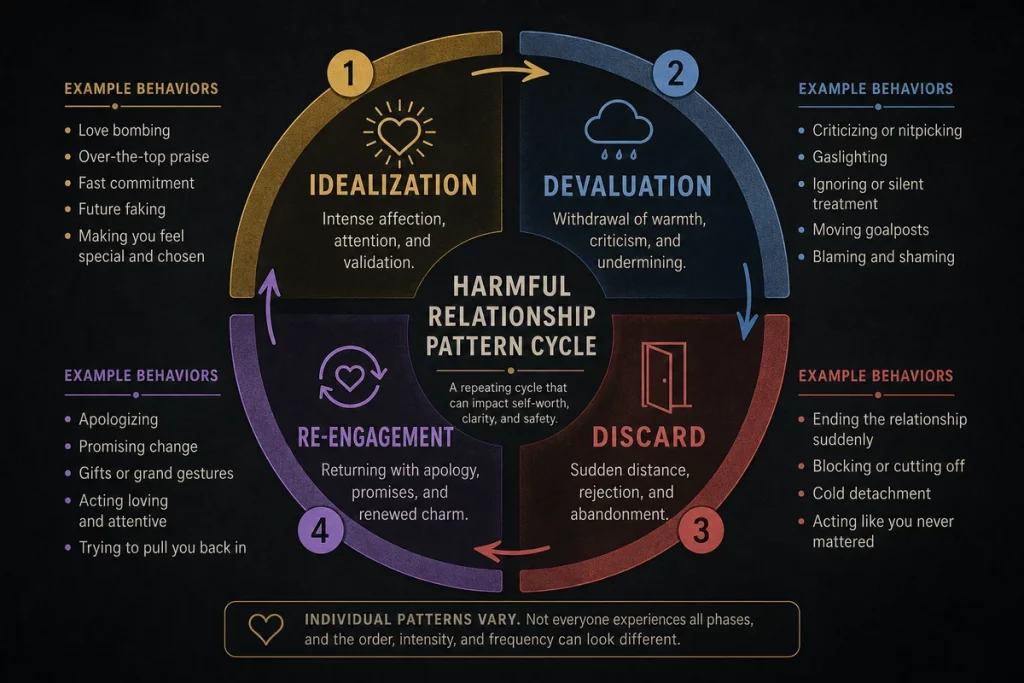
Intermittent reinforcement. The alternation between reward (idealization, warmth, charm) and punishment (devaluation, criticism, withdrawal) produces the strongest attachment bonds in behavioral psychology — stronger than consistent kindness. The unpredictability keeps the target in a state of hypervigilance, constantly working to restore the “good version” of the relationship, which maintains the narcissist’s centrality in the target’s psychological landscape.
Identity erosion. The sustained criticism, gaslighting, and reality distortion progressively erode the target’s self-concept until they no longer trust their own judgment, memory, or perception. A person who can’t trust themselves depends on external validation — which the narcissist provides intermittently, creating the dependency loop that makes leaving feel impossible.
Trauma bonding. The neurochemical cycle of stress (devaluation) → relief (idealization return) produces physiological addiction to the relationship. The target knows intellectually that the relationship is harmful, but the body’s stress-relief response to the narcissist’s intermittent warmth overrides the cognitive understanding — just as an addict knows their substance is harmful but can’t resist the relief it provides. This is why “just leave” is such useless advice for narcissistic abuse targets: the leaving isn’t prevented by a lack of willpower; it’s prevented by a neurological addiction that operates below conscious control and requires the same deliberate, supported recovery process that any other addiction requires. The trauma bonding guide provides the complete neurological framework for understanding and breaking this specific attachment pattern.
What to Do If You Recognize These Narcissistic Abuse Examples
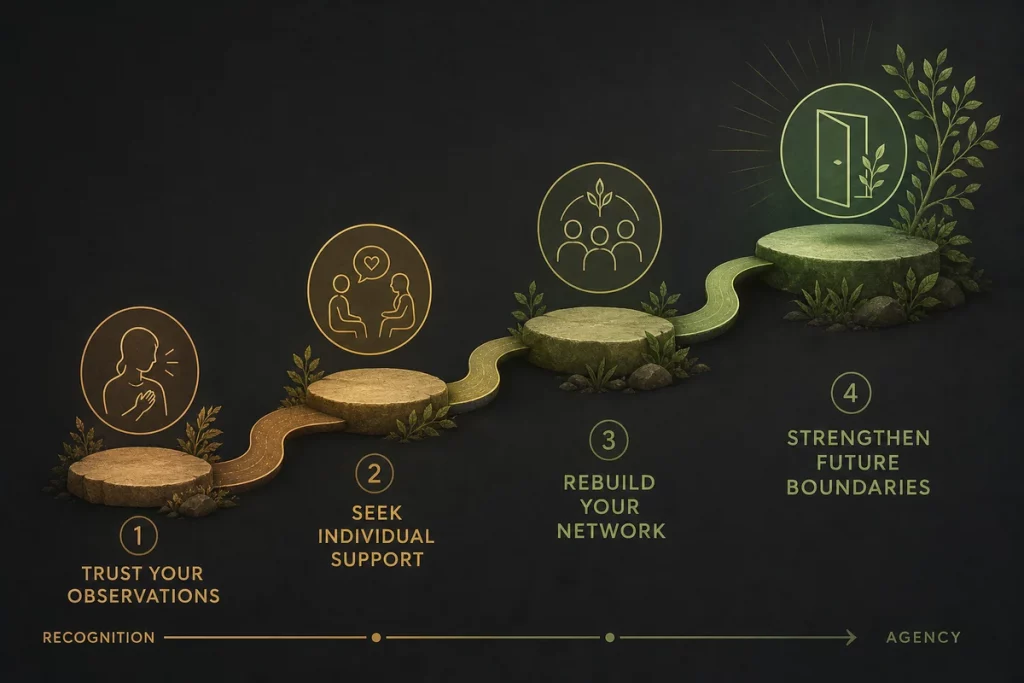
Trust your recognition. If multiple examples on this list describe your experience, your perception is valid — regardless of what the narcissist has told you about your perception. The self-doubt you feel isn’t evidence that the abuse isn’t real; it’s evidence that the abuse has been effective at undermining your self-trust.
Seek individual therapy — not couples therapy. Couples therapy with a narcissist gives them a new audience to perform for and new tools to manipulate with. Individual therapy with a practitioner experienced in narcissistic abuse dynamics provides the validation, reality-testing, and strategic planning that recovery requires. The National Domestic Violence Hotline (1-800-799-7233) provides referrals to therapists specializing in narcissistic abuse recovery.
Rebuild your support system. The isolation that narcissistic abuse creates is deliberate — and reversing it is essential. Reach out to the friends and family the narcissist distanced you from. Join a support group (online or in-person) for narcissistic abuse survivors. Break the secrecy that the narcissist’s shame-based control depends on.
For people evaluating new connections. Use these 20 narcissistic abuse examples as an early-detection framework. The idealization-phase patterns (love bombing, mirroring, future faking, isolation through intensity) are visible within the first 1-3 months — long before the devaluation phase reveals the full pattern. Verify identity through GuyID’s free screening tools and share your Date Mode link through GuyID. Use the emotionally abusive test, red flag quiz, and green flags assessment to build the comprehensive evaluation framework that prevents narcissistic patterns from establishing themselves in your next connection.
How GuyID Helps
GuyID should appear when it is useful, not as a banner ad. A GuyID Trust Profile gives someone a portable way to share trust signals before a date, while identity verification and social vouching help turn vague profile claims into clearer next steps.
Useful next steps:
- Create a GuyID Trust Profile when you want a cleaner way to share verified trust signals.
- Use GuyID free tools and related guides when you need a checklist before meeting someone.
- Treat identity verification as confidence-building, not a guarantee.
- Use social vouching when you want context from people who already know the person.
- Sign up only when the extra trust layer helps the decision you are already trying to make.
Frequently Asked Questions
What are common narcissistic abuse examples?
Common examples include: love bombing and overwhelming early intensity, gaslighting your perception of reality, the silent treatment as punishment, weaponizing your vulnerabilities, triangulation with third parties, moving goalposts for approval. Deflection from accountability, conditional love based on compliance, sudden discard followed by hoovering to pull you back, and smear campaigns after the relationship ends. These patterns follow a predictable cycle: idealization → devaluation → discard → hoover → repeat.
How do I know if it’s narcissistic abuse or just a bad relationship?
Key differentiators: narcissistic abuse follows the idealize-devalue-discard CYCLE (bad relationships may have consistent problems but not this specific oscillation). Narcissistic abuse includes reality distortion (gaslighting) — bad relationships may include dishonesty but not systematic perception manipulation. Narcissistic abuse produces progressive identity erosion — you become less confident, less trusting of yourself, and more dependent over time. Bad relationships may be unsatisfying without producing that specific trajectory. The emotionally abusive test provides the structured assessment.
Can a narcissistic abuser change?
Narcissistic personality patterns are deeply entrenched and resistant to change — though not impossible to modify with sustained, long-term therapy (typically years) that the narcissist voluntarily pursues. The critical word is “voluntarily” — change mandated by relationship pressure or consequences rarely produces lasting modification. If your partner claims to have changed after a brief period, exercise extreme caution: the “changed” presentation may be another idealization phase rather than genuine transformation. Our narcissistic abuse signs guide covers the pattern recognition that helps distinguish genuine change from performative improvement.
How long does recovery from narcissistic abuse take?
Recovery timelines vary based on the duration and severity of the abuse, the quality of support available, and whether professional therapy is involved. Most practitioners estimate 1-3 years for significant recovery from a long-term narcissistic relationship — with the first year focused on stabilization and reality-testing, and subsequent years focused on rebuilding identity, trust, and relationship capacity. No-contact with the narcissist accelerates recovery; continued contact (especially hoovering cycles) extends it significantly. The bad breakup recovery guide covers the broader framework that applies to narcissistic abuse recovery.