
Free Tools
Catfish Probability Detector
Check whether a dating profile has suspicious identity or photo signals.
Dating Bio Red Flag Detector
Review a bio for scam, pressure, or trust-warning language.
Dating Safety Checklist
Use free GuyID tools before moving from chat to a real date.
Next step
Create your GuyID trust profile
Share consent-based trust signals before a date without turning the conversation into an interrogation.
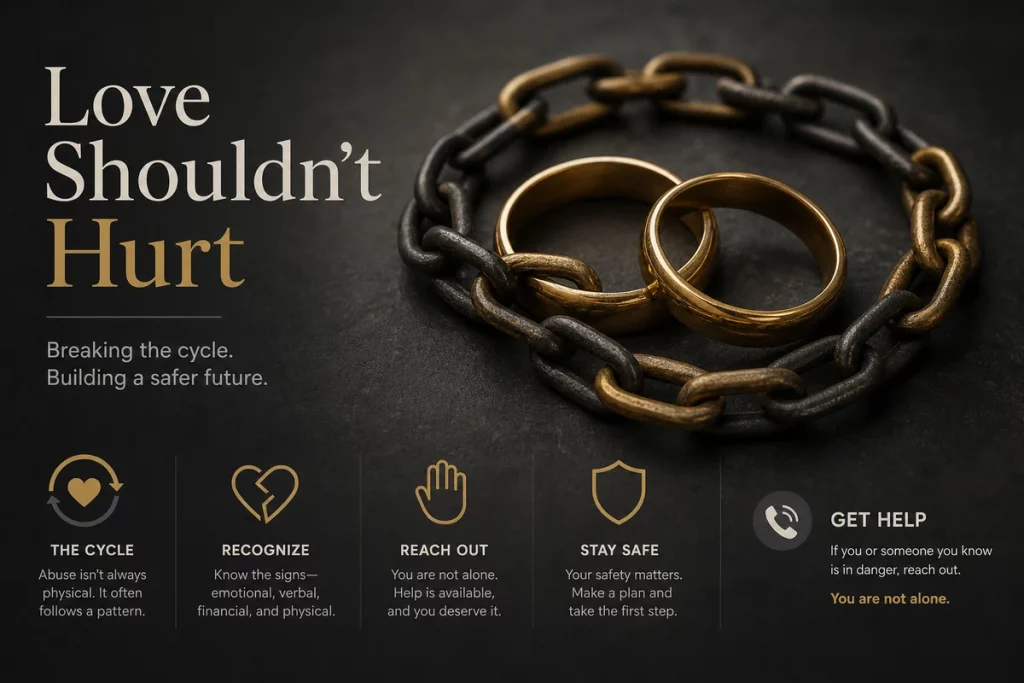
A married trauma bond is among the most difficult relationship situations to address because the legal, financial, and social structures of marriage intensify every barrier to leaving that trauma bonding already creates. The intermittent reinforcement cycle that produces trauma bonds in dating relationships operates with significantly more power within a marriage — where shared finances, children, social identity, religious commitments, and legal entanglements compound the neurochemical attachment with practical constraints. If you’re trapped in a trauma bonding marriage, you’re not weak for staying; you’re navigating a situation where the neurological bond operates simultaneously with real-world barriers that make leaving genuinely more complicated than “just walk away.” This guide addresses the marriage-specific dimensions of trauma bonding, how to recognize the pattern within a long-term relationship, and how to plan an exit when every system — neurological, financial, social, legal — is working to keep you in place.
NavigateTable of Contents21 sections
How Trauma Bonding Marriage Differs from Dating
The core mechanism of trauma bonding — intermittent reinforcement through cycles of abuse and affection — operates identically in marriage and dating. But marriage adds layers that make the bond significantly more entrenched and the exit significantly more complex:
Time compounds the bond. A trauma bond that forms over 3 months of dating operates at one neurochemical intensity level. A trauma bonding marriage that has been cycling for 5, 10, or 20 years operates at a profoundly deeper level — the neural pathways associated with the abuse-relief cycle have been reinforced thousands of times. Research from the National Library of Medicine on long-term relationship neuroplasticity shows that repeated behavioral patterns physically restructure neural connections over time, making long-standing trauma bonds genuinely harder to dissolve at the neurological level than newer ones formed in shorter dating relationships.
Financial entanglement creates practical dependency. Shared bank accounts, mortgages, retirement funds, debts, and tax filings create a financial web that makes separation logistically complex even without the psychological barriers. In many marriages with this pattern, the abusive partner has engineered financial dependency — controlling access to money, preventing the spouse from working, or accumulating debt in the victim’s name. Financial control is one of the most common co-occurring patterns with emotional abuse in marriage.
Social identity is at stake. Marriage confers social identity — “husband,” “wife,” “married couple” — that dating doesn’t. Leaving a marriage means dismantling not just a relationship but a social role, a shared social circle, potentially a religious community’s expectations, and the narrative you’ve built about your life. For people whose families or communities view divorce as failure, the perceived social cost of leaving a trauma bonding marriage adds a layer of community-driven shame to an already overwhelming and deeply personal decision.
Sunk cost is measured in years and decades. “I’ve invested 15 years” produces exponentially more resistance to leaving than “I’ve invested 3 months.” The sunk cost fallacy — the irrational belief that past investment justifies continued investment — operates with devastating effectiveness in trauma bonding marriages because the past investment is genuinely enormous: years, children, financial resources, social connections, and the best and most productive decades of your adult life. The correct framing: those years are gone regardless of what you decide next. The only question is whether the NEXT 15 years will follow the exact same destructive pattern.
8 Signs of Trauma Bonding in Marriage
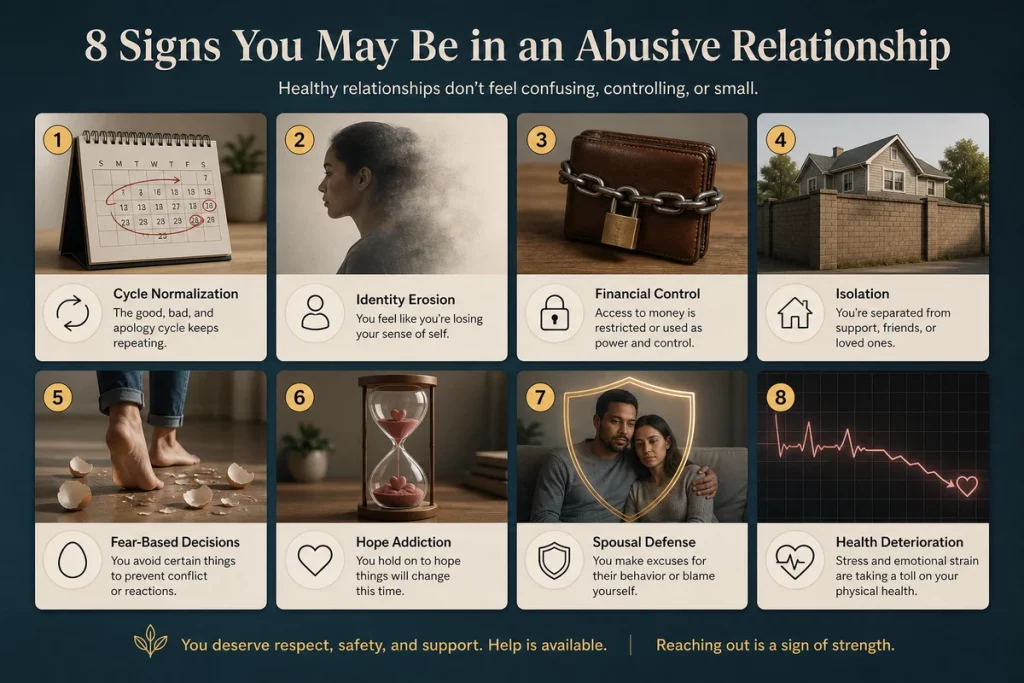
1. The Abuse-Reconciliation Cycle Has Become “Normal”
The trauma bonding cycle — tension → incident → reconciliation → calm → tension — has repeated so many times that it’s your relationship’s normal operating rhythm. You can predict when the cycle will escalate and when the “good phase” will return. This predictability doesn’t indicate that you have any meaningful control over the dynamic; rather it indicates that the pattern has become so deeply embedded that you’ve adapted to it rather than escaping it.
2. You’ve Lost Your Pre-Marriage Identity
The person you were before the marriage — your interests, friendships, goals, opinions, personality — has been gradually replaced by the role the relationship requires. You exist in relation to your spouse rather than as an independent person. Friends from before the marriage have fallen away. Hobbies have been abandoned. Opinions are shaped by what minimizes conflict rather than what you actually think. This identity erosion is both a product of the trauma bonding marriage and a mechanism that perpetuates it.
3. Financial Control Is Part of the Dynamic
Your access to money is limited, controlled, or monitored. You need “permission” for purchases. You don’t have visibility into shared finances. Or conversely: you’ve been given full financial responsibility while debt accumulates because the abuser spends without accountability. Financial control in a trauma bonding marriage creates practical dependency that compounds the neurochemical dependency — even if the trauma bond dissolved overnight, the financial barriers to leaving would remain.
4. You’re Isolated from Your Support Network
Friends, family, and colleagues who once expressed concern about the relationship have either been pushed away (through your spouse’s hostility toward them) or pulled away (because you’ve defended the marriage so many times that they’ve stopped trying). Isolation is both a manipulation tactic the abuser uses and a natural consequence of the trauma bond — you stop reaching out because explaining the cycle is exhausting, and defending your decision to stay is even more exhausting.
5. You Make Decisions Based on Fear, Not Love
“I don’t want to upset them.” “If I bring this up, it’ll start a fight.” “I should just let it go — it’s easier.” When your daily decision-making is organized around avoiding your spouse’s negative reactions rather than around your own genuine preferences, the relationship is operating through fear management rather than partnership. In a healthy marriage, decisions are collaborative. In this dynamic, decisions are strategic — calculated to minimize harm rather than maximize mutual wellbeing.
6. You’re Addicted to Hope
Every reconciliation phase renews the hope that the cycle has finally ended — that this time the apology is genuine, the change is permanent, the good version of your spouse is the real version. This hope addiction is the psychological fuel that sustains trauma bonding marriages across decades — because each reconciliation provides just enough evidence to justify staying, and the alternative (accepting that the pattern won’t change) is too painful to contemplate. Take our trauma bonding test to assess how deeply this cycle operates.
7. You Defend Your Spouse to Everyone
When friends express concern, you explain why they don’t understand the full picture. When family members suggest counseling or separation, you minimize the problems. You’ve become your spouse’s most effective PR agent — protecting their reputation at the cost of your access to support. This defense pattern serves the trauma bond by maintaining the cognitive distortion that the relationship is acceptable while cutting off the external perspectives that might challenge it.
8. Physical Health Problems Have Emerged
Chronic stress from a trauma bonding marriage produces measurable physical health consequences: insomnia, digestive problems, chronic pain, weakened immune function, elevated blood pressure, autoimmune flare-ups, and cardiovascular risk. According to American Psychological Association research on chronic relational stress, the physiological toll of sustained trauma bonding can reduce life expectancy — making the health dimension not a secondary concern but an urgent one.
Why Leaving a Trauma Bonding Marriage Is Harder
Every barrier to leaving a trauma-bonded dating relationship exists in marriage — plus several marriage-specific barriers that compound the difficulty enormously:
Legal complexity. Divorce requires lawyers, court filings, asset division, custody arrangements, and often months or years of legal process. This isn’t a barrier that can be overcome with a single courageous decision — it’s a sustained process that requires financial resources, emotional endurance, and logistical capacity that the trauma bond has systematically depleted. Many people in these marriages don’t leave not because they haven’t decided to, but because the process of leaving is too complex to navigate from inside the cognitive fog of an active trauma bond.
Financial fear. “Can I afford to live alone?” “What will happen to the house?” “I haven’t worked in years — how will I support myself?” These aren’t irrational fears; they’re legitimate concerns that the abuser may have engineered through financial control. The financial dimension requires specific, specialized professional guidance that goes beyond standard divorce support — a divorce attorney experienced in financial abuse, a financial advisor who understands marital asset protection, and sometimes a forensic accountant for hidden assets.
Children as leverage. “If you leave, I’ll fight for full custody.” “The kids need both parents in the home.” “What kind of mother/father leaves?” Children become the abuser’s most effective leverage in a trauma bonding marriage — because the victim’s genuine love for their children is weaponized to maintain the bond. The fear that leaving will harm the children often overrides the recognition that staying is already harming them.
Religious and cultural pressure. Communities that view marriage as permanent regardless of circumstances create additional barriers for people in trauma bonding marriages. Religious leaders who counsel “staying and praying” without understanding trauma dynamics can inadvertently enable abuse. Cultural norms that equate divorce with failure compound the shame of an already shame-laden situation.
When Children Are Involved
Children add by far the most emotionally complex layer to a married trauma bond situation — because the decision affects not just you but people you’d sacrifice anything to protect:
Children absorb the cycle. Even when abuse isn’t directed at children, they witness it, absorb it, and learn from it. Research consistently shows that children raised in homes with the abuse-reconciliation cycle are significantly more likely to develop anxious attachment, to enter abusive relationships themselves, and to exhibit behavioral and academic problems. The belief that “staying together for the kids” protects children is contradicted by decades of research: a peaceful single-parent home produces better outcomes than a two-parent home with an active abuse cycle.
Co-parenting after a trauma bond requires structure. If leaving is the decision, a structured custody arrangement that minimizes contact with the abusive ex-spouse while protecting the children’s relationship with both parents requires legal expertise. Parallel parenting (minimal direct communication, structured hand-offs, written-only communication) is often more appropriate than cooperative co-parenting when one parent has narcissistic or abusive patterns.
Children need their own therapeutic support. Whether you stay or leave, children who’ve witnessed the household abuse dynamic benefit from age-appropriate therapy that helps them process what they’ve experienced and develop healthy relationship models. The National Domestic Violence Hotline can provide referrals for child-specific support in your area.
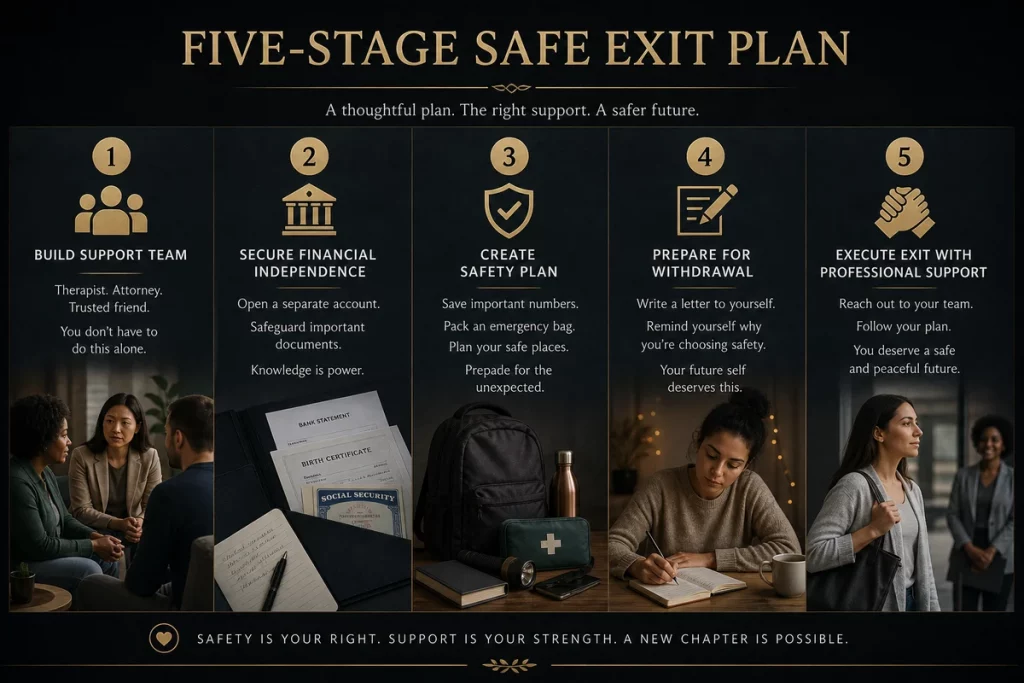
Planning a Safe Exit
Leaving a trauma bonding marriage safely requires planning that addresses the neurological, financial, legal, and physical dimensions simultaneously:
Build a support team before announcing departure. Therapist (individual, not couples — couples therapy with an abuser is dangerous), divorce attorney (many offer free initial consultations), financial advisor, trusted friend or family member who can provide practical support. Assemble this team while still in the marriage, before the exit announcement triggers the abuser’s escalation response.
Secure financial independence. Open an individual bank account the abuser doesn’t know about. Gradually move essential documents (passport, birth certificates, marriage certificate, financial records, medical records) to a safe location. Understand your marital financial situation — assets, debts, accounts, property — before the divorce process begins.
Create a safety plan. If physical danger is possible during or after the exit, the National Domestic Violence Hotline (1-800-799-7233) provides personalized safety planning including: identifying a safe place to go, packing an emergency bag, establishing communication protocols with your support team, and documenting the abuse for legal proceedings.
Understand that the trauma bond will fight the exit. The neurochemical withdrawal that follows separation from a trauma bond is real and intense — and it will tell you that leaving was a mistake, that they’ll change, that going back will stop the pain. Prepare for this in advance: write yourself a letter during a moment of clarity that describes why you’re leaving, what the cycle looks like, and why returning won’t change the pattern. Read it during the withdrawal moments when the bond pulls you back.
Recovery After a Trauma Bonding Marriage
Recovery involves addressing the same neurochemical bond dissolution as any trauma bond, plus the marriage-specific dimensions of identity rebuilding, co-parenting navigation, and re-entry into dating after years or decades within a single relationship:
Individual therapy is the foundation. EMDR for trauma processing, attachment-focused therapy for relationship pattern restructuring, and somatic therapy for the physical tension patterns the marriage embedded in your body. A therapist experienced in narcissistic abuse and divorce recovery provides the most targeted support for post-divorce trauma recovery specifically.
Rebuild the identity the marriage eroded. Who are you outside this relationship? What did you enjoy before the marriage consumed your identity? What opinions, interests, and goals were suppressed to maintain the peace? Recovery includes rediscovering — or discovering for the first time — who you are as an independent person. This process is both exciting and terrifying, because the identity erosion of the marriage may mean you genuinely don’t know the answer yet.
Allow yourself to grieve fully. Recovery from a trauma bonding marriage involves grieving multiple losses simultaneously — not just the spouse, but the marriage you imagined, the family structure you built, the years invested, the social identity you held, and the version of yourself that believed the cycle would end. Each of these losses deserves its own grieving process, and they don’t all resolve on the same timeline. The grief for the imagined future may persist long after the grief for the person has faded. A trauma-informed therapist helps you navigate this layered grief without the common pitfall of suppressing certain losses (grief for the good moments, grief for the person they were during reconciliation phases) out of shame for missing someone who harmed you. Missing someone who hurt you is a normal, expected component of trauma bond dissolution — it’s the bond’s neurochemical residue, not evidence that the relationship should have continued.
When ready to date again: verify from the start. After years in a trauma bonding marriage, your “normal meter” is miscalibrated — intensity may feel like love because that’s what the marriage trained you to equate with connection. When you re-enter dating, use GuyID’s free screening tools to verify matches. Watch for love bombing and early red flags. Use GuyID verification for identity confirmation. Share your Date Mode link to establish mutual transparency. Set boundaries early and observe responses. The goal isn’t to avoid vulnerability — it’s to direct vulnerability toward someone whose consistent, verifiable behavior earns it.
How GuyID Helps
GuyID should appear when it is useful, not as a banner ad. A GuyID Trust Profile gives someone a portable way to share trust signals before a date, while identity verification and social vouching help turn vague profile claims into clearer next steps.
Useful next steps:
- Create a GuyID Trust Profile when you want a cleaner way to share verified trust signals.
- Use GuyID free tools and related guides when you need a checklist before meeting someone.
- Treat identity verification as confidence-building, not a guarantee.
- Use social vouching when you want context from people who already know the person.
- Sign up only when the extra trust layer helps the decision you are already trying to make.
Frequently Asked Questions
How do I know if my marriage involves trauma bonding?
Take the trauma bonding test — its 15-question assessment evaluates emotional dependency, cycle recognition, defense patterns, and withdrawal symptoms that characterize a trauma bonding marriage. The 8 signs in this guide provide additional marriage-specific indicators: cycle normalization, identity erosion, financial control, isolation, fear-based decisions, hope addiction, spousal defense, and physical health deterioration. If multiple indicators are present, professional evaluation with a trauma-informed therapist is strongly recommended.
Can couples therapy help a trauma bonding marriage?
In most cases, no — and it can be actively dangerous. Couples therapy with an abusive partner gives the abuser access to your vulnerabilities (shared in therapy), therapeutic language to weaponize (“You’re projecting”), and a platform to perform the “changed partner” role that characterizes the reconciliation phase. Individual therapy for you is the appropriate first step. Only if the abusive partner independently seeks and sustains their own therapeutic work — AND demonstrates genuine behavioral change over months — should couples therapy be considered, and then only with a therapist experienced in abuse dynamics rather than standard marital therapy.
Should I stay for the kids?
Research consistently shows that children are more harmed by witnessing the abuse-reconciliation cycle than by experiencing parental separation. A peaceful single-parent household produces better developmental outcomes than a two-parent home with an active abuse cycle. Staying teaches children that the cycle is normal — increasing their likelihood of repeating it in their own relationships. Leaving teaches children that abuse doesn’t have to be tolerated — modeling the healthy boundary-setting you want them to develop.
How long does recovery from an abusive marriage with trauma bonding take?
Longer than dating trauma bonds due to the bond’s duration and the complexity of marital disentanglement. Most therapists describe 1-3 years of recovery for long-term abusive marriages — including acute withdrawal (2-6 months), identity rebuilding (6-18 months), and relationship pattern recalibration (12-36 months). The timeline varies based on the marriage’s duration, the abuse’s severity, children’s involvement, and the quality of therapeutic support. Full recovery means not just leaving, but restructuring the attachment patterns that made the bond possible.
Where can I get help right now?
The National Domestic Violence Hotline (1-800-799-7233) provides 24/7 crisis support, safety planning, and local resource referrals — including for people in trauma bonding marriages who aren’t experiencing physical violence (emotional abuse is abuse). Our trauma bonding test, emotional abuse checklist, and toxic relationship quiz provide structured self-assessment. A divorce attorney experienced in domestic abuse cases can advise on legal options. You are not trapped, even when the bond makes you feel that way.