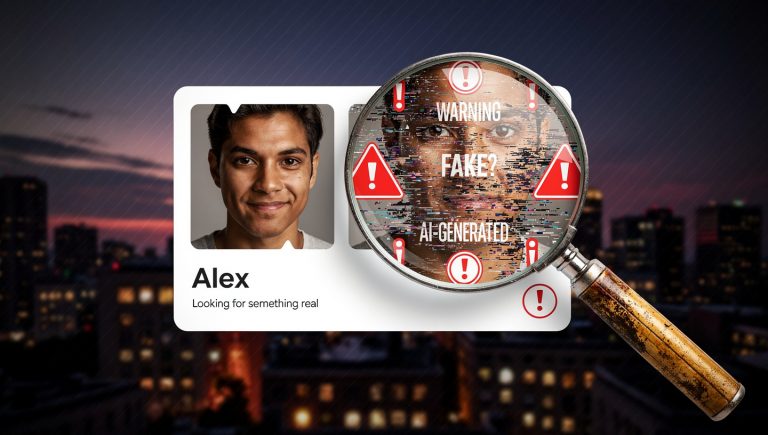

Why Dating Apps Can’t Solve the Safety Problem Alone: 7 Structural Barriers (2026)
Dating apps spend hundreds of millions on safety annually. Tinder employs AI moderation across billions of interactions. Bumble built women-first messaging, photo verification, and in-app video calling. Hinge developed the strongest selfie verification among major platforms. And yet: $1.3 billion is still stolen through romance scams every year (FTC, 2026). 1 in 4 Americans still encounter fake profiles (McAfee, Feb 2026). 92% of women still report dating safety concerns. 57% still believe online dating isn’t safe (Essence). The platforms aren’t failing because they don’t care. They’re failing because the safety problem is structurally unsolvable within the dating app business model. Understanding why dating apps can’t solve the safety problem alone isn’t a criticism of platforms — it’s a diagnosis that reveals why the solution must come from outside the competitive dating app ecosystem.
This analysis examines the seven structural barriers that prevent dating apps from solving dating safety — barriers rooted in business incentives, competitive dynamics, technical limitations, and the fundamental architecture of platform-based verification. Each barrier exists regardless of any individual platform’s safety intentions. Together, they explain why the trust gap persists despite billions in combined industry investment — and why independent trust layers like GuyID are structurally necessary, not merely supplementary.
The Paradox: Massive Investment, Persistent Failure
The starting point for understanding why dating apps can’t solve safety alone is the paradox between investment and outcome.
What the Industry Invests
Match Group (Tinder, Hinge, Match, OkCupid) and Bumble Inc. collectively invest hundreds of millions annually in trust and safety: AI moderation teams, machine learning detection systems, human review operations, verification technology, reporting infrastructure, and safety feature development. These aren’t token investments — they’re substantial, well-resourced operations employing sophisticated technology and significant talent.
What the Investment Achieves
Platform safety systems catch millions of bot accounts, spam profiles, and obvious scam operations annually. AI detection removes mass-created fake profiles, known scam images, and templated scam messages at scale. Verification badges incentivize users to confirm their photos. Reporting systems enable users to flag suspicious behavior. These achievements are real and meaningful — millions of harmful interactions are prevented.
What Persists Despite the Investment
$1.3 billion in annual losses. 1 in 4 Americans encountering fakes. 630,000+ active scam operators (SpyCloud, Feb 2026). 35% spotting AI-generated photos. 55% of victims never reporting (AARP, Feb 2026). 92% of women with safety concerns. The numbers haven’t improved proportionally to the investment. This gap between investment and outcome is the signal that the problem is structural — not solvable by scaling the current approach.
Barrier 1: The Business Model Conflict
Dating apps are businesses optimized for user growth, engagement, and revenue. Safety competes with these metrics at multiple points.
Friction vs Growth
Stronger verification creates friction. Government ID verification adds 2-5 minutes to signup — and industry data suggests 30-50% signup abandonment for each additional verification step. In a market where user acquisition costs $5-15+ per user, losing 30-50% of signups to identity verification is a business decision no growth-stage company makes voluntarily. The result: platforms implement the lightest verification that provides some safety signal (30-second selfie) without the friction that comprehensive verification (government ID) would create.
User Count vs User Quality
Fake profiles inflate user counts — making the platform appear larger and more active. Aggressive fake removal reduces apparent user base. While platforms genuinely work to remove harmful fakes (scammers, harassers), the business incentive to maintain large, active-appearing user counts creates structural tension with comprehensive cleanup. Every fake profile removed is a user-count reduction that affects investor metrics, marketing claims, and competitive positioning.
Engagement vs Safety
Safety features that slow interaction (mandatory verification before messaging, identity confirmation before matching) reduce engagement metrics — messages sent, matches made, time in app. Platforms are measured by engagement. Features that increase safety by decreasing engagement face an uphill business case within organizations optimized for the opposite.
None of this means platforms don’t care about safety. It means their business model creates inherent tensions between safety optimization and business optimization — tensions that an independent trust layer, whose only business model IS trust, doesn’t face.

Barrier 2: The Verification Ceiling
Every major dating app verifies the same thing: face matches photos. This verification ceiling exists because of what platforms are willing — and able — to verify within their business constraints.
What Platforms Verify
Facial similarity. Tinder: pose selfie. Bumble: gesture selfie. Hinge: video selfie. All confirm the same dimension: the person taking the selfie has the same face as the profile photos. This is the verification ceiling — the maximum that platform economics will support.
What Platforms Don’t Verify
Legal name. Real age. Government-issued identity. Relationship status. Character. Criminal history. Employment. Education. Intentions. Every dimension beyond facial similarity remains unverified — not because it’s technically impossible but because verifying it creates friction, cost, legal liability, or competitive disadvantage that the business model won’t absorb.
Why the Ceiling Won’t Lift Through Market Forces Alone
The first platform to require government ID verification loses 30-50% of signups to competitors who don’t. The competitive dynamics create a race-to-the-bottom on verification friction — each platform matching the lightest verification that the market expects. The ceiling lifts only through external pressure (regulation) or external provision (independent trust layers like GuyID that provide verification platforms won’t).
Barrier 3: The Off-Platform Blind Spot
Dating apps have zero visibility into what happens after conversations leave the app — and this is where the majority of harm occurs.
The Visibility Cliff
On-platform: AI moderation scans messages, reports trigger review, behavioral analysis detects patterns, and the platform can investigate and act. Off-platform (WhatsApp, phone, text, in-person): the platform sees nothing. No monitoring. No reporting connected to the dating profile. No intervention capability. The conversation moved outside their infrastructure — permanently invisible.
Why This Is Structural
Dating apps have no technical ability to monitor WhatsApp conversations (end-to-end encrypted, different company). No legal authority to track phone calls. No business incentive to invest in off-platform safety (generates zero revenue). And no competitive reason to protect users on a channel that benefits competitors equally. The off-platform blind spot is permanent — it cannot be solved within the dating app’s own architecture.
Why It Matters
Scammers push conversations to WhatsApp within 24-48 hours specifically to exploit this blind spot. Virtually all romance scam financial extraction happens off-platform. The dating app that facilitated the initial connection has zero ability to protect the user once the conversation migrates. Portable verification that follows the user off-platform — like GuyID’s Date Mode link — addresses the gap that platform architecture structurally cannot.
Barrier 4: The Competitive Isolation Problem
Dating apps compete with each other. This competition prevents the cooperation needed to solve safety systemically.
No Data Sharing
A scammer banned from Tinder can create a new profile on Bumble minutes later. Platforms don’t share ban lists, scam operator databases, or fraud intelligence with competitors. Each platform’s safety infrastructure is a walled garden — protecting users within its walls while the same threats freely move between platforms. Cross-platform scam intelligence sharing would dramatically improve safety. Competitive dynamics prevent it.
No Verification Portability
Your Hinge verification doesn’t transfer to Bumble. Your Bumble badge doesn’t work on Tinder. Users verify separately on each platform — duplicating effort with zero cumulative benefit. If verification were portable across platforms, one verification would protect across all. Competitive dynamics prevent this — each platform’s verification is a proprietary feature, not a shared safety standard.
First-Mover Disadvantage
The first platform to create comprehensive safety that works on competitors effectively subsidizes competitor safety while bearing the full development cost. In competitive markets, this generosity is punished. No rational actor moves first when the cost is borne individually but the benefit is shared universally. Independent trust layers bypass this dynamic entirely — GuyID works on all platforms without any single platform bearing the cost of building cross-platform trust.
Barrier 5: The False Positive Trap
Aggressive scam detection inevitably bans legitimate users — creating a customer experience problem that limits how aggressively platforms can detect.
The Calibration Problem
A genuine user who travels frequently (location changes), uses professional photos (high-quality images), sends similar opening messages to multiple matches (because it’s a good opener), or is new to the platform (recently created account) can trigger the same signals as a scam profile. Every false positive — a real user banned unfairly — is a lost customer, a support burden, negative reviews, and potential media coverage. Platforms calibrate detection to minimize false positives, which mathematically means maximizing false negatives (scams that pass through).
Why This Can’t Be Solved
The false positive rate is a mathematical trade-off, not a technology problem. More aggressive detection catches more scams (true positives increase) but also catches more legitimate users (false positives increase). Less aggressive detection protects legitimate users (false positives decrease) but misses more scams (false negatives increase). Every platform finds its equilibrium on this curve — and every equilibrium allows some scams through. The only way to eliminate false negatives is to accept intolerable false positive rates — which no consumer platform will do.
Barrier 6: The AI Symmetry Problem
Platforms use AI to detect scams. Scammers use AI to create scams. Both sides use the same technology — and neither gains lasting advantage.
The Arms Race
Platform deploys AI to detect stolen photos → scammers switch to AI-generated photos. Platform deploys AI to detect template messages → scammers deploy AI chatbots writing unique messages. Platform deploys selfie verification → scammers deploy deepfake face-swapping. Each detection advancement is met by a generation advancement — because both are built on the same underlying AI research. The arms race produces continuous escalation without resolution.
Why Platforms Can’t Win This Race
The detection side (platforms) must be correct 100% of the time — one missed scam can cause thousands in victim losses. The evasion side (scammers) only needs to succeed occasionally — one successful scam across thousands of attempts is profitable. This asymmetry, combined with AI symmetry (both sides have equivalent tools), structurally favors the attacker. The only verification methods that break this symmetry are those operating outside the digital domain entirely: government documents (physical objects AI can’t generate) and social vouching (real humans AI can’t manufacture).
Barrier 7: The Character Assessment Void
No dating app assesses character. Not partially. Not weakly. Not at all. Character assessment is entirely absent from every dating platform — and this void enables the majority of non-scam dating harm.
What the Void Enables
Relationship status deception (15-30% misrepresent), emotional manipulation, pattern dishonesty, financial deception, and behavioral patterns that make someone unsafe to date — none detectable through photos, AI, or verification badges. These aren’t criminal behaviors that background checks catch. They’re character issues that only people who know someone personally can assess — through the social vouching that platforms don’t provide.
Why Platforms Can’t Fill This Void
Character assessment requires human judgment from personal relationships. Platforms have billions of data points about user behavior — swipes, messages, time-in-app — but zero data about character as observed by the people in a user’s real life. No amount of behavioral AI replicates the assessment that a friend who’s known someone for 10 years can provide. The character void is unfillable through platform-side technology — it requires the real-human input that social vouching systems collect.
What the Structural Analysis Implies: The Case for Independent Trust
Seven structural barriers. Each permanent. Each independent of investment level. Each requiring a solution that exists outside the dating app architecture. The combined implication is clear: dating apps can’t solve safety alone — and the missing piece must come from an independent system that bypasses every barrier simultaneously.
What the Independent System Must Be
| Barrier | What the Independent System Must Provide | GuyID Implementation |
|---|---|---|
| Business model conflict | A system whose only business model is trust — no growth/engagement tension | GuyID exists solely to verify trust — no competing metrics |
| Verification ceiling | Identity verification beyond photo matching — government ID | Biometric matching against government-issued documents |
| Off-platform blind spot | Portable verification that works on WhatsApp, phone, in person | Date Mode link works on 11 of 11 channels |
| Competitive isolation | Cross-platform system not owned by any competitor | Independent of all platforms, works with all platforms |
| False positive trap | Voluntary verification that doesn’t risk banning real users | Consent-based — users choose to verify, no false-positive risk |
| AI symmetry | Verification outside the digital domain that AI can’t defeat | Government ID (physical documents) + social vouching (real humans) |
| Character void | Human character assessment from personal relationships | Social vouching from friends, colleagues, community |
Every barrier. Every requirement. Every implementation. The seven structural barriers that prevent dating apps from solving safety create seven corresponding requirements for an independent system — and GuyID addresses all seven through government ID verification, social vouching, progressive Trust Tiers, and portable Date Mode links.

Summary: The Case for Independent Trust Layers
Dating apps can’t solve the safety problem alone — not because they don’t invest, not because they don’t care, but because seven structural barriers prevent any platform from solving it within the dating app business model and architecture. The business model creates friction/growth conflicts. The verification ceiling limits what platforms will verify. The off-platform blind spot makes harm invisible. Competitive isolation prevents cross-platform solutions. The false positive trap limits detection aggression. AI symmetry ensures scam tools match detection tools. And the character void remains unfillable through platform-side technology.
These barriers are permanent and structural — not solvable through more investment, better AI, or stronger intentions. The solution exists outside the platform ecosystem: an independent trust layer that bypasses every barrier by being trust-focused (no competing business metrics), identity-based (government ID beyond photo matching), portable (working on every channel), cross-platform (independent of all competitors), consent-based (no false positive risk), AI-proof (government documents + real humans), and character-informed (social vouching from personal relationships).
GuyID is that layer. Not replacing dating apps — supplementing them with the verification they structurally cannot provide themselves. The dating apps catch the mass threats (bot networks, spam, known scam images). GuyID confirms the things apps can’t: real identity, real character, real trust — portable across every platform and every conversation.
The $1.3 billion scam crisis, the 92% safety concern rate, and the persistent trust gap aren’t problems waiting for dating apps to try harder. They’re structural problems waiting for a structural solution. The structural solution is independent, identity-based, character-informed, portable trust. It exists today.
Government ID verification. Social vouching. Trust Tiers. Portable Date Mode links. The independent trust layer that bypasses every structural barrier dating apps face. Women check for free. Build your Trust Profile today.
Frequently Asked Questions: Why Dating Apps Can’t Solve Safety Alone
Why can’t dating apps solve the safety problem despite massive investment?
Do dating apps do anything useful for safety?
Why won’t dating apps implement government ID verification?
Why can’t dating apps protect users on WhatsApp?
Why don’t dating apps share scam intelligence with each other?
Can AI solve the dating safety problem?
What should users do given these structural limitations?
Is GuyID trying to replace dating apps?

Founder, GuyID · Dating Safety Researcher · 13+ Years in Data Analytics
Ravishankar Jayasankar is the founder of GuyID, a consent-based dating trust verification platform. With 13+ years in data analytics and a deep focus on consumer trust, Ravi built GuyID to close the safety gap in digital dating. His research found that 92% of women report dating safety concerns — validating GuyID’s mission to make online dating safer through proactive, consent-based verification. GuyID offers government ID verification, social vouching, a Trust Tiers system, and 60+ free interactive safety tools.