
Dating Profile Bio: How to Write One That Actually Gets Matches (2026)
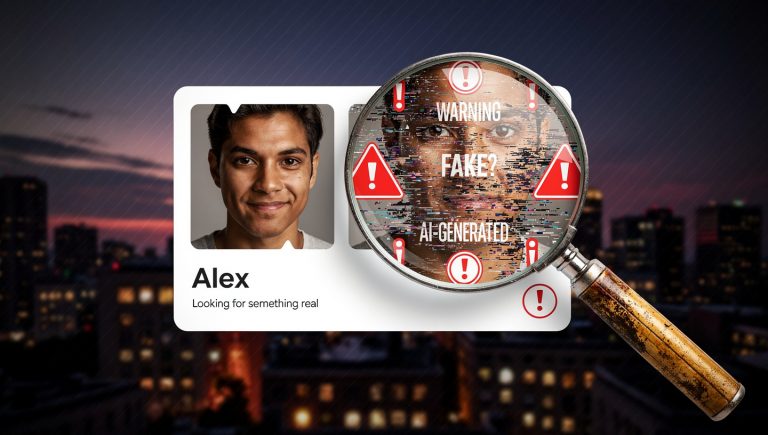
Your dating profile bio is a 500-character sales pitch to strangers who will decide in 3-7 seconds whether you’re worth a conversation. Most bios fail — not because the person behind them isn’t interesting but because the bio doesn’t communicate anything worth stopping for. “Love to laugh, enjoy traveling, looking for my person” describes 40 million people. It tells a potential match nothing they couldn’t guess about anyone on the platform. A dating profile bio that actually converts — that turns profile views into matches and matches into conversations — does three things: it communicates something specific about who you are, it gives the reader something to respond to, and it signals trust in a market where 92% of women carry safety concerns into every interaction. This guide teaches you how to write all three into a bio that works.
Whether you’re writing your first bio or rewriting one that isn’t getting results, this guide covers the dating profile bio framework: what makes bios fail, what makes them convert, the specific formulas that work across platforms, how to integrate trust signals that set you apart from unverified profiles, and real structural templates you can adapt in 10 minutes.
Why Most Dating Bios Fail
Understanding why the average dating profile bio doesn’t convert is the first step toward writing one that does.
The Generic Trap
“I love to travel, laugh, and try new things. Looking for someone genuine who doesn’t take themselves too seriously.” This bio — or a close variation — appears on millions of profiles. It says nothing distinguishing. Everyone loves to laugh (it’s a human reflex). Everyone “loves to travel” (even if their last trip was three years ago). “Looking for someone genuine” is the dating equivalent of a restaurant advertising “food that tastes good” — it’s the minimum expectation, not a differentiator. Generic bios fail because they describe the category (a person who dates) rather than the individual (you specifically).
The Resume Trap
“Marketing manager. NYU grad. Runner. Dog dad. 6’1.” This is a list of facts about a human being, not a personality. Facts are verifiable (good for screening) but not engaging (bad for starting conversations). A resume bio tells someone what you are but not who you are — and who you are is what makes someone swipe right and message first.
The Negativity Trap
“No hookups. Don’t message me if you can’t hold a conversation. Swipe left if you still talk to your ex.” Negative bios tell people what you DON’T want — which communicates nothing about who you ARE and creates a hostile first impression. Filters belong in your screening behavior, not your bio. The matches you want are repelled by negativity as much as the matches you’re trying to filter out.
The Empty Trap
“Just ask 😊” or “I’m an open book.” This communicates: “I couldn’t be bothered to write anything.” In a market of millions, expecting a stranger to invest effort in asking you questions when you invested zero effort in giving them something to ask about is a losing strategy. Every empty bio is an opportunity for a competitor with a real bio to win the match instead.
The Three Elements Every Converting Dating Profile Bio Needs
A dating profile bio that converts views into matches and matches into conversations contains three elements — in this order of priority.
1. A Hook (Stops the Scroll)
Your first line determines whether anything else gets read. On swipe-based apps (Tinder, Bumble, Hinge), the first line appears in the preview — alongside your photos but before the reader taps to see more. If the first line is generic, the reader swipes without opening. If it’s specific, intriguing, funny, or unexpected — they tap. The hook’s job is to earn the tap.
2. Substance (Gives Them Something to Respond To)
After the hook earns attention, the body of your bio needs to provide at least 2-3 specific details about you that a reader can reference in a first message. “I’m really into cooking” gives them nothing to say except “Cool, me too.” “Currently on attempt #4 of homemade pasta — the dough keeps winning” gives them a conversation starter: “How’s the pasta going?” or “Have you tried adding an extra egg yolk?” or “I have a recipe that changed my life.” Specificity creates conversation hooks. Generality creates dead air.
3. A Trust Signal (Sets You Apart from Unverified Profiles)
In a market where 1 in 4 encounters are with fakes and 92% of women carry safety concerns, a bio that signals verified trustworthiness is a competitive advantage. Including your GuyID Date Mode link, mentioning that you’re identity-verified, or referencing your Trust Tier communicates: “I’m real, I’m verified, and I’m accountable.” This signal addresses the #1 concern of the people evaluating your profile — before they even message you.
The Hook: First Lines That Stop the Scroll
The most important line in your dating profile bio is the first one. Here are hook formulas that work.
The Specific Skill or Obsession Hook
Lead with something you’re genuinely into — stated with enough specificity to be memorable.
- “I make the best shakshuka you’ve never had. Open to proving it.”
- “Currently training for a half marathon and questioning every life decision that led here.”
- “Three guitars, zero ability to play Wonderwall. Working on it.”
- “I’ve seen every episode of every cooking competition show. This is not a flex, it’s a confession.”
The Unexpected Juxtaposition Hook
Combine two things about yourself that don’t obviously go together — creating intrigue through contrast.
- “Data analyst by day. Terrible dancer by night. Consistent at both.”
- “Read philosophy books. Watch reality TV. Judge neither.”
- “Can explain blockchain. Cannot parallel park.”
- “Vegetarian who makes better ribs than your uncle at the cookout.”
The Conversational Question Hook
Open with something the reader wants to answer — immediately creating the impulse to message.
- “Controversial opinion: cereal is a soup. Fight me or join me.”
- “What’s the most underrated restaurant in [your city]? I’m building a list.”
- “Hot take: the best travel experiences are the ones that went wrong.”
The Honest Vulnerability Hook
Lead with something genuinely honest that shows self-awareness — more disarming than any polished statement.
- “Genuinely good at my job, genuinely terrible at writing dating bios. Here’s my attempt.”
- “Recently learned that ‘vibes’ is not a personality trait. Working on having actual ones.”
- “I’m better in person than in text. Trying to close the gap.”
The Substance: Specificity That Sparks Conversation
After the hook, your bio needs 2-3 specific details that give readers something to message about.
The Specificity Upgrade
| Generic (Forgettable) | Specific (Memorable + Messageable) |
|---|---|
| “I love to travel” | “Last trip was a solo week in Lisbon — found the best pastel de nata spot on a side street I can’t find on Google Maps” |
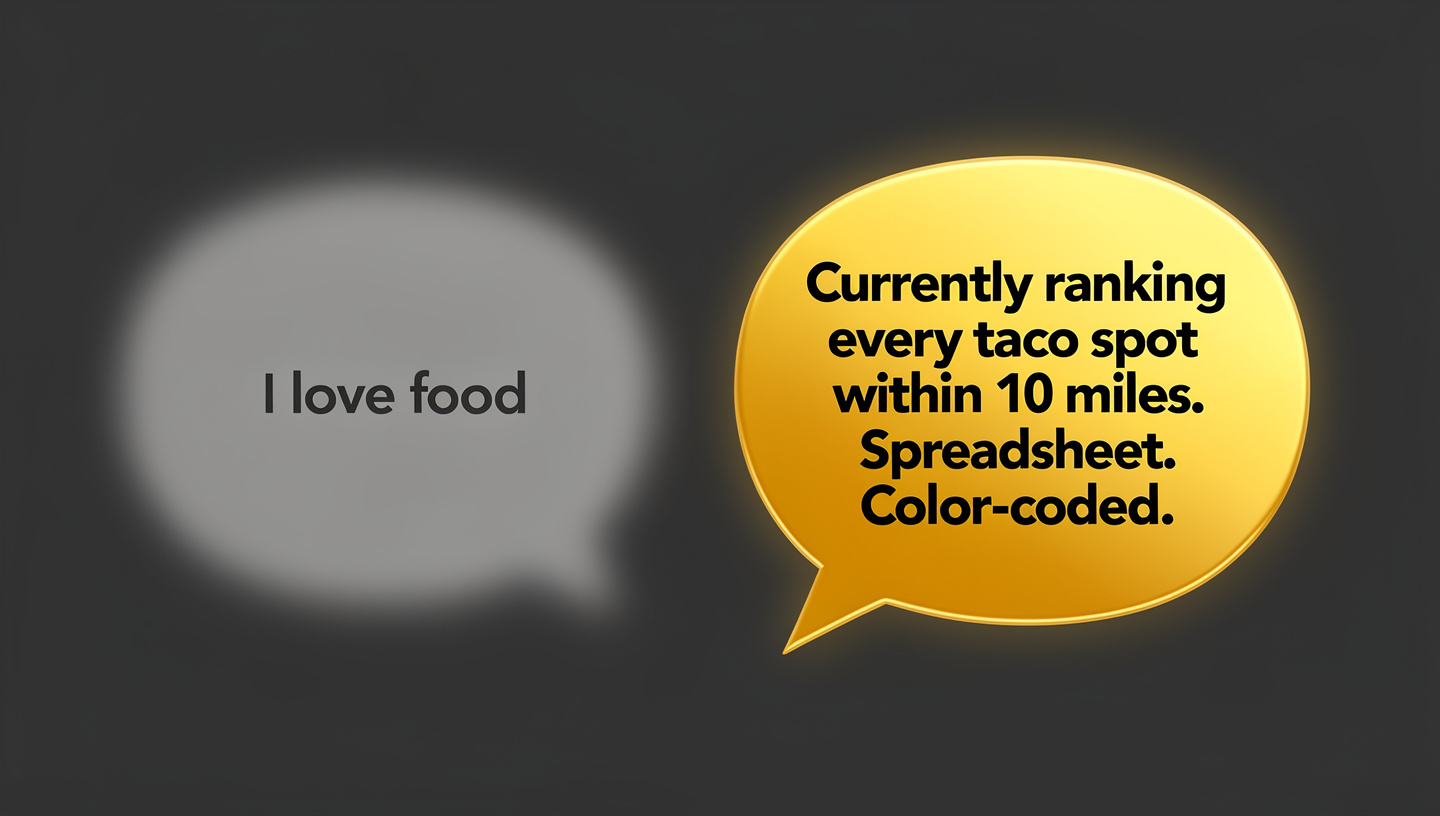
| “Foodie” | “Will drive 45 minutes for a good taco. Have spreadsheet ranking the top 12 in the city.” |
| “I love music” | “Saw Khruangbin live three times this year. No regrets. Seeking someone who understands.” |
| “Active lifestyle” | “5am gym person (not by choice, by caffeine). Sunday morning hikes when the weather cooperates.” |
| “Looking for something real” | “Done with surface-level. Looking for someone who wants to actually know the person behind the profile.” |
| “Dog lover” | “My golden retriever thinks she’s a lap dog. She’s 75 lbs. She wins every argument.” |
The left column describes a category. The right column describes a person. Matches connect with people, not categories. Every generic statement in your bio can be converted to a specific one by answering: “What’s the STORY behind this interest?” The story is the substance.
The Conversation Hook Test
For every line in your bio, ask: “Could someone send me a message about this specific thing?” If the line is “I enjoy hiking,” the only possible message is “Me too!” (dead conversation). If the line is “Did a 14-mile trail to a waterfall last weekend and my legs are still filing a complaint,” the messages write themselves: “Which trail?” “Was the waterfall worth it?” “My legs are filing a similar complaint from [their activity].” If a line doesn’t pass the conversation hook test, replace it with one that does.
The Trust Signal: Standing Out Through Verified Credibility
This is the section that transforms your dating profile bio from “interesting profile” to “interesting AND trustworthy profile” — the combination that converts in a safety-conscious market.
Why Trust Signals Convert
92% of women report dating safety concerns. 57% believe online dating isn’t safe (Essence). 47% want background checks required (Pew/SSRS). The person evaluating your profile is weighing two questions simultaneously: “Am I interested?” and “Is this person safe?” A bio that answers only the first question competes against every other interesting profile. A bio that answers BOTH questions competes against virtually no one — because almost no profiles address safety proactively.
How to Include Trust Signals
- The link approach: Include your GuyID Date Mode link in your bio: “Verified on GuyID: [link].” The link is clickable — matches can check your Trust Tier, government ID status, and social vouches in 10 seconds without leaving your profile. This is the strongest trust signal available in a dating bio.
- The mention approach: “ID-verified on GuyID because I think trust should be proven, not promised.” Communicates the verification plus the value system behind it — signaling that you take dating safety seriously.
- The casual approach: “Verified identity, real friends who’ll vouch for me, and a golden retriever who thinks she’s a guard dog.” Integrates verification into personality description naturally — trust signal wrapped in personality.
What Trust Signals Communicate to Different Audiences
- To women with safety concerns (92%): “This person has done what virtually no other profile has — confirmed their identity and earned vouches from real people. The bar is met before conversation begins.”
- To serious relationship seekers: “This person takes dating seriously enough to verify. If they invest in trust infrastructure, they invest in the relationship.”
- To quality matches generally: “This person is transparent, accountable, and proactively addressing trust. That’s a character signal — not just a safety feature.”
Platform-Specific Bio Strategies
Each platform has different bio formats, character limits, and cultures. Here’s how to optimize your dating profile bio for each.
Tinder (500 characters)
Shortest format. Every word must earn its place. Lead with the hook (first line visible in stack). 2-3 specific details maximum. Include GuyID link as the final line — it’s the most impactful closing for a platform with the highest scam density. Tone: witty, concise, confident. Avoid: lists of adjectives, long paragraphs, anything that reads like a resume.
Bumble (300 characters)
Shortest mainstream format — extreme conciseness required. One killer hook + one specific detail + trust signal. Bumble’s prompt system supplements the bio, so use prompts for personality depth and the bio for your strongest hook + verification link. Tone: warm, approachable, direct.
Hinge (Prompt-based)
Hinge replaces traditional bios with prompts — short-answer questions visible on your profile. Each prompt answer is a mini-bio. Apply the same principles: specificity over generality, stories over statements, conversation hooks over descriptions. Use one prompt to include your GuyID link naturally: “The way to win me over is… proving you’re real. Here’s my verified trust profile: [link].”
OkCupid (Essay-length sections)
The longest format — multiple essay sections (self-summary, what I’m doing with my life, favorites, etc.). Use the self-summary section for hook + substance + trust signal. Use other sections for deeper personality detail. OkCupid rewards depth — the match question system means people who reach your profile have already established baseline compatibility. Your bio can be more substantive and less performative than on swipe apps.
Bio Templates You Can Adapt Right Now
Copy, adapt, personalize. Replace the bracketed sections with your actual details.
[Unexpected hobby or obsession stated specifically]. [Second interest with a story or detail]. [What you’re looking for — specific, not generic].
Example: “Currently ranking every pizza place within a 10-mile radius (spreadsheet, color-coded, very serious). Weekend mornings are for trail runs and wondering why I signed up for another race. Looking for someone who has opinions about pizza toppings and doesn’t mind bad running puns.”
[Professional skill] by day. [Unexpected hobby] by night. [Self-aware admission]. [Verified trust signal].
Example: “Engineer by day. Very amateur woodworker by night. My bookshelf is crooked but I built it myself, so it stays. ID-verified on GuyID because trust should come standard: [link].”
[Question or hot take that invites response]. [One specific personal detail]. [What you bring to the table — specific].
Example: “Unpopular opinion: the best date is a farmer’s market, not a fancy restaurant. Currently teaching myself film photography — lots of blurry sunsets so far. I’ll make you laugh, cook you dinner, and prove I’m real: [GuyID link].”
[Hook that shows personality]. [What you value in connection]. [Verification as a statement of values].
Example: “Three things I take seriously: making pasta from scratch, knowing my neighbors’ names, and being the kind of person your friends approve of. Verified identity, vouched by real people: [GuyID link]. Ask me about the pasta.”

What to Leave Out of Your Bio
- Negativity and filters: “No hookups,” “Don’t bother if…,” “Tired of games” — repels good matches as much as bad ones. Filter through your screening behavior, not your bio.
- Generic self-descriptions: “Loyal, honest, funny, down-to-earth” — self-applied adjectives carry zero credibility. SHOW these traits through specific stories rather than listing them.
- Height/stats as the bio: “6’1. That’s it. That’s the bio.” Communicates zero personality. Include stats if you want — but not AS the bio. They’re supplementary information, not a substitute for substance.
- Sensitive personal information: Full last name, employer name, home neighborhood, information that enables identification beyond what you’d share with a stranger. Your bio is visible to everyone on the platform — treat it as a public document.
- Children’s details: If you’re a parent, mention it (“Dad of 2”) but don’t include children’s names, photos, or identifiable details. See the single parent safety guide.
- Desperation signals: “Why is dating so hard?” “Is anyone on here real?” “Last try before I delete this app.” These communicate frustration, not attraction. Even if you feel it — and everyone does — the bio isn’t the place for it.
Summary: Specific, Conversational, Verified
The dating profile bio that converts follows a simple formula: a hook that stops the scroll (specific, intriguing, funny, or unexpected), substance that sparks conversation (2-3 details with stories that a reader can message about), and a trust signal that addresses safety before the first message (verified identity, GuyID Date Mode link, or trust-forward statement).
Most profiles compete on the first two elements — hook and substance. The trust signal is the differentiator that virtually no one else is using. In a market where 92% of women have safety concerns and 1 in 4 encounters are with fakes, a bio that proactively communicates verified trustworthiness doesn’t just stand out — it addresses the primary concern that determines whether your match feels safe engaging with you.
Write the bio in 10 minutes using the templates above. Build your GuyID Trust Profile in 20 minutes. Add the Date Mode link to your bio. Now your profile communicates three things no competitor profile does: who you specifically are (hook + substance), that you’re verifiably real (government ID), and that real people trust you (social vouches). Specific. Conversational. Verified. That’s the bio that converts.
Build your GuyID Trust Profile in 20 minutes. Add your Date Mode link to your dating bio. Now every match sees: verified identity + social vouches + Trust Tier — before the first message. The trust signal that no amount of clever writing can replicate. Women check for free.
Frequently Asked Questions: Dating Profile Bio
What makes a good dating profile bio?
How long should a dating bio be?
Should I put my GuyID link in my dating bio?
What should I NOT put in my dating bio?
How do I make my bio stand out from everyone else’s?
Do women really check verification in dating bios?
Can I use the same bio on every platform?

Founder, GuyID · Dating Safety Researcher · 13+ Years in Data Analytics
Ravishankar Jayasankar is the founder of GuyID, a consent-based dating trust verification platform. With 13+ years in data analytics and a deep focus on consumer trust, Ravi built GuyID to close the safety gap in digital dating. His research found that 92% of women report dating safety concerns — validating GuyID’s mission to make online dating safer through proactive, consent-based verification. GuyID offers government ID verification, social vouching, a Trust Tiers system, and 60+ free interactive safety tools.