Reader Briefing
Reader Briefing
Start here if you need a practical read on premiumdateid alternative: strong verification without premium pricing: who should use verification, what signals to check, and what to do before moving from online interest to an in-person plan.
Who this is for
- Anyone checking identity, profile consistency, and trust signals.
- People trying to avoid romance scams, fake profiles, or pressure tactics.
- Online daters improving conversations, profiles, or match screening.
You’ll learn
- How to evaluate identity signals without treating any single check as certainty.
- Which trust signals matter and how to weigh them together.
- How to spot inconsistencies, pressure, or behavior patterns that deserve caution.
- Where GuyID tools fit into a quick pre-date screening workflow.
- How to compare options using practical safety and trust criteria.
- When to slow down, ask for more context, or walk away.
Bottom line
Verification reduces uncertainty; it does not guarantee future behavior. Use a layered approach: confirm identity signals, compare profile consistency, ask for a short video call, keep early plans public, and slow down when someone pressures you to skip normal safety steps.
Key takeaways
- Identity verification improves confidence, not certainty.
- Patterns matter more than isolated incidents.
- A short video call can reveal many inconsistencies.
- Pressure to skip reasonable safety steps is useful information.
- Use GuyID tools to turn vague concerns into specific checks.
Free Tools
Catfish Probability Detector
Check whether a dating profile has suspicious identity or photo signals.
Dating Bio Red Flag Detector
Review a bio for scam, pressure, or trust-warning language.
Dating Safety Checklist
Use free GuyID tools before moving from chat to a real date.
Next step
Create your GuyID trust profile
Share consent-based trust signals before a date without turning the conversation into an interrogation.
NavigateTable of Contents19 sections
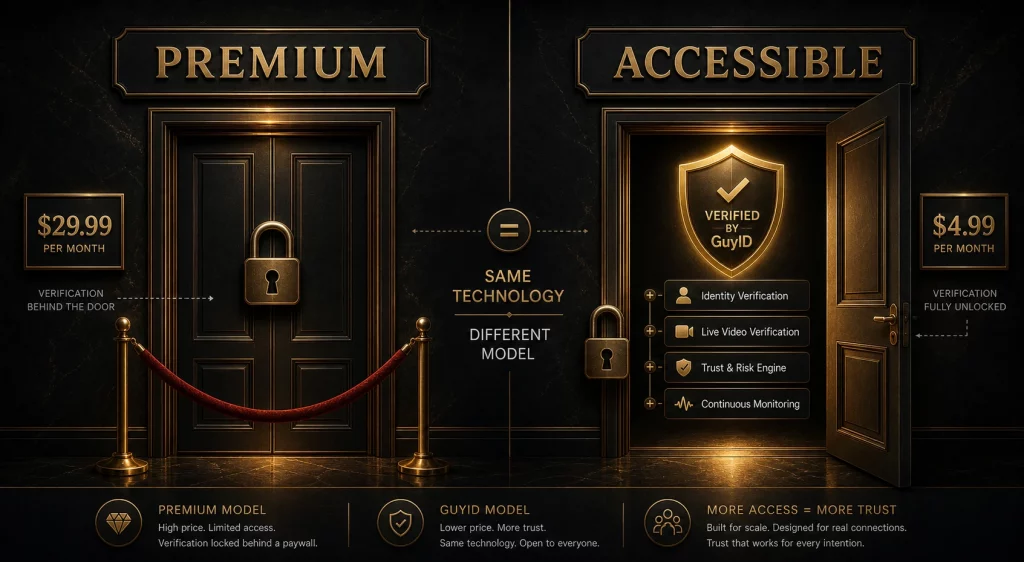
Premium dating verification services position trust as a luxury product — higher prices, exclusive access, curated membership. The messaging: “Pay more, get safer.” The implication: real safety is reserved for people willing to pay premium rates, and everyone else can take their chances with free app badges. This model gets one thing right (verification has value) and one thing dangerously wrong (making safety a luxury creates a market where protection correlates with income rather than need). If you’re searching for a PremiumDateID alternative, you may be looking for verification that provides the same depth — government ID, character confirmation, trust measurement — without the premium paywall that limits who can access it. This guide evaluates the premium verification model, identifies what it gets right and wrong, and compares it to the approach where strong verification is accessible rather than exclusive.
The Premium Verification Model: What It Gets Right and Wrong
What Premium Services Get Right
- Verification has real value: Treating identity verification as worth paying for — rather than a free afterthought — correctly acknowledges that trust confirmation is a valuable service. People pay for security in every other domain. Dating verification deserves the same legitimacy.
- Depth matters: Premium services often provide deeper verification than free app badges — government ID checks, background screening, and sometimes human review. This depth is genuinely more protective than a selfie-matching badge.
- Signaling seriousness: A paid verification signal communicates that the person invested money in proving their trustworthiness. Investment signals commitment. This is a real (if imperfect) trust indicator.
What Premium Services Get Wrong
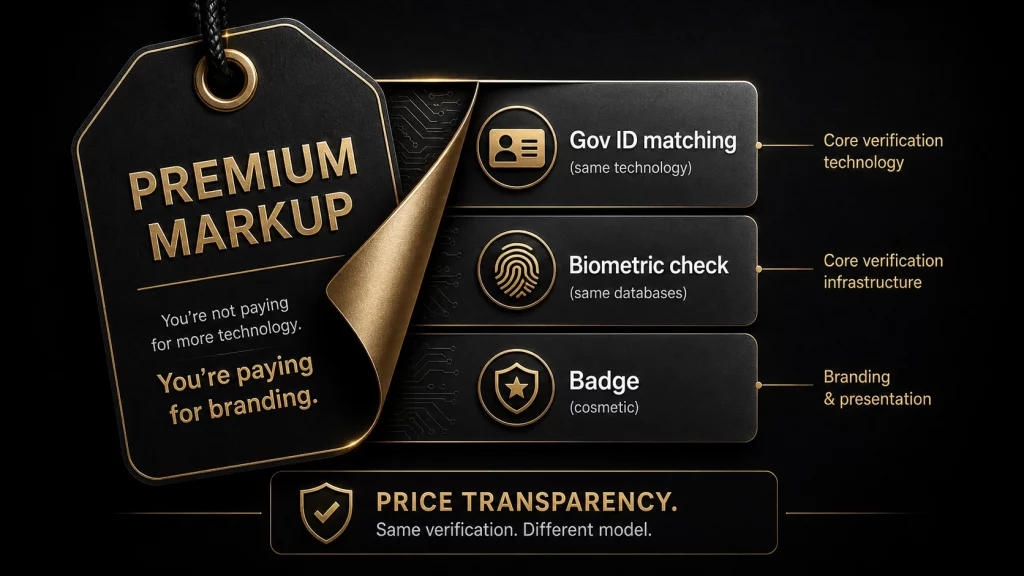
The underlying verification doesn’t improve with price — the branding does.
- Exclusivity undermines the network effect: Verification’s value depends on adoption. Exclusivity works for luxury goods. It fails for trust infrastructure.
- Creating a safety class system: When verification is priced as a luxury, the implicit message is: “Safety is for people who can afford it.” This runs counter to the principle that everyone deserves safety in dating — regardless of income. The people MOST vulnerable to romance scams are often not in the demographic that pays premium subscription prices.
What Premium Pricing Actually Buys
Understanding what you’re paying for — versus what you think you’re paying for — is essential when evaluating PremiumDateID alternatives.
| Feature | What Premium Services Charge For | What It Actually Provides |
|---|
| Exclusive badge design | Part of premium branding | A visually distinct badge — cosmetic, not functional. The verification behind it is identical. |
| “Curated” membership | Marketing language | Smaller user base (limited adoption) framed as exclusivity (selective membership) |
You’re paying for the brand, not the verification.
Inline visual 1
The Accessibility Problem: When Safety Becomes a Luxury
The most consequential problem with premium-only verification isn’t the price — it’s the adoption barrier that price creates.
Why Adoption Matters More Than Exclusivity
Verification produces value only when two conditions are met: (1) the verified person displays their trust signal, and (2) the person evaluating them can check it. Premium models often fail at condition #2 — because checking the verification also requires payment or registration on the premium platform.
When a match sees a trust signal they can’t check without paying or signing up for a new service, the verification is functionally invisible. A badge that nobody can verify isn’t a trust signal — it’s a sticker. The trust it communicates is proportional to the ability of matches to confirm it. This is why GuyID’s free-for-women checking model exists: if checking requires payment, checking doesn’t happen. If checking is free and instant, checking becomes standard practice.
The Network Effect in Verification
Every successful trust system depends on network effects: the more people who participate, the more valuable participation becomes. Premium pricing caps the network at the population willing to pay premium rates — a fraction of the dating market. This cap limits the badge’s recognition, checkability, and ultimately its trust value. An accessible verification system with broad adoption creates a trust standard that everyone recognizes, everyone can check, and everyone benefits from — the positive network effect that exclusivity prevents.
GuyID: Comprehensive Verification Without the Premium Gate
GuyID provides multi-factor verification — the same depth premium services offer — through an accessible model designed for adoption rather than exclusivity.
What GuyID Provides at Standard Pricing
- Government ID verification: Biometric matching against official documents — the same technology premium services use, at standard pricing
- Social vouching: Real people confirming character — a feature premium services typically DON’T offer, because human character assessment can’t be automated at any price point
- Progressive Trust Tiers: 6-tier trust measurement evolving over time — more sophisticated than any premium service’s binary badge
- Date Mode link: Portable across every platform — no platform lock-in, no app dependency
- 60+ free screening tools: Reverse image search, catfish detection, bio analysis — free for everyone, no account required
What GuyID Provides for Free
No subscription, no account, no barrier. Click the Date Mode link → see gov ID status, vouches, Trust Tier. Ten seconds. Zero cost.
- All screening tools: 60+ safety tools free for everyone — reverse image search, catfish probability, bio red flags, scam calculators, and more.
Why This Model Works Better Than Premium
Accessible pricing for builders + free checking for evaluators = maximum adoption. Every man who builds a Trust Profile increases the number of verified profiles women encounter. Every woman who checks for free increases the value men receive from building. The network effect compounds: more verified profiles → more checking → more demand for verification → more verified profiles. Premium pricing breaks this cycle by limiting both sides.
Head-to-Head: Premium Verification vs GuyID
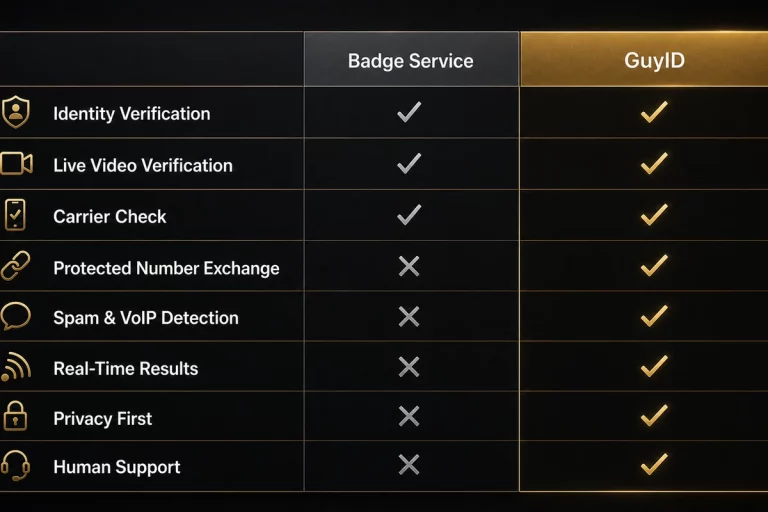
| Dimension | Typical Premium Service | GuyID |
|---|---|---|
| Government ID verification | ✅ Included at premium price | ✅ Included at standard price |
| Character assessment | ❌ Typically not offered | ✅ Social vouches — real people confirming character |
| Progressive trust | ❌ Binary badge (verified/not) | ✅ 6 progressive tiers |
| Free screening tools | ❌ None or limited | ✅ 60+ free tools |
| Portability | Varies — often platform-locked | ✅ Universal — every platform + off-app |
| Exclusivity/branding | ✅ “Premium” badge and membership | ❌ No exclusivity positioning — accessibility-first |
| Network effect potential | Limited by price ceiling | Maximized by free checking + standard builder pricing |
| AI resilience | Varies — depends on verification factors | ✅ Gov ID + real vouchers = AI-proof |
The comparison reveals that premium pricing buys two things GuyID doesn’t offer: exclusivity branding and bundled background checks. GuyID provides three things premium services typically don’t: character assessment through social vouching, progressive trust measurement through 6 tiers, and 60+ free screening tools. The features that premium services charge most for (government ID verification, portability) are available at standard pricing through GuyID. The features that create the deepest trust (character vouching, progressive tiers) are GuyID-exclusive regardless of price.
Why Verification Adoption Requires Accessibility
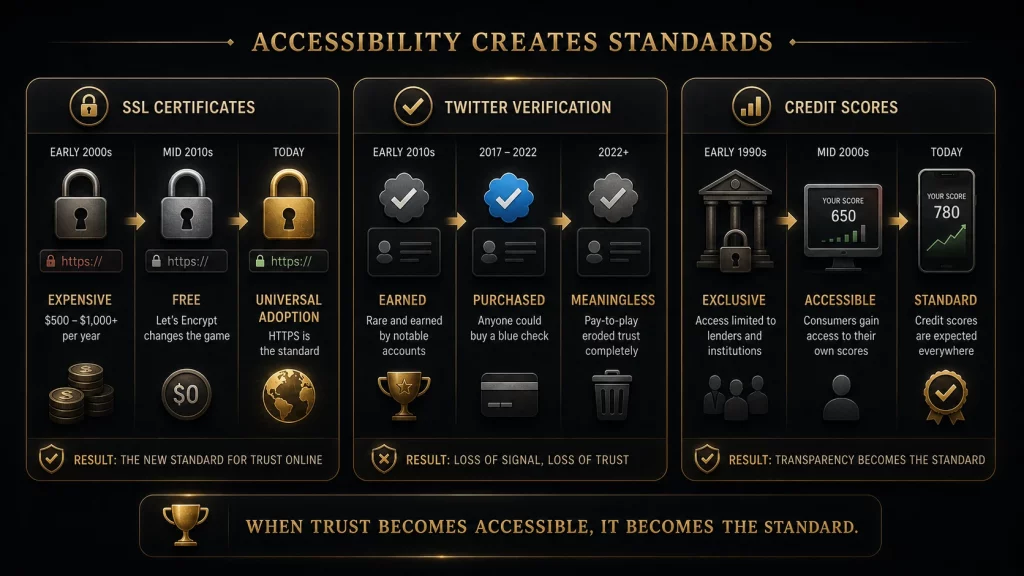
The history of trust systems shows a consistent pattern: the systems that become standards are the ones that achieve broad adoption — and broad adoption requires accessibility.
Lessons from Other Trust Systems
- SSL certificates (website security): Website encryption became universal when Let’s Encrypt made SSL certificates free. When free: every website adopted. The security infrastructure improved for everyone — not because the technology changed, but because accessibility changed.
Trust signals need earned legitimacy, not purchased access. - Credit scores: Credit reporting became meaningful when everyone had a score and everyone could check scores at low/no cost. A credit system that only scored wealthy borrowers would be useless for the economy. Broad participation created broad value.
Inline visual 2
The Implication for Dating Verification
Dating verification will become meaningful when verified profiles are common enough that matches routinely check for them — and when checking is free enough that verification is routinely evaluated. Premium-only models prevent this. Accessible models enable it. The verification platform that achieves broad adoption will define the standard — and that platform will be the one that removed barriers rather than the one that raised them.
Next Steps: Compare Accessible Verification Options
The best PremiumDateID alternative isn’t a cheaper premium service — it’s a fundamentally different model where strong verification is accessible rather than exclusive. The verification technology (government ID matching, biometric confirmation) is the same regardless of price point. The character assessment (social vouching) that premium services don’t offer is available through GuyID. The progressive trust measurement (6 tiers) that premium services replace with binary badges is GuyID’s standard. And the free checking model that drives adoption is GuyID’s design principle.
Safety in dating shouldn’t be a luxury product. Government-confirmed identity, human-vouched character, and progressive trust measurement should be available to everyone who takes dating seriously — not just those who can afford premium subscriptions. GuyID provides this: multi-factor verification at standard pricing, with free checking for women, free screening tools for everyone, and the accessibility-first design that turns verification from a luxury badge into a dating standard.
Frequently Asked Questions
What’s the best alternative to premium dating verification services?
Does paying more mean better verification?
Is GuyID verification as thorough as premium services?
Will a GuyID Trust Profile be recognized by matches?
Related Reading
Evidence note
NIST Digital Identity Guidelines distinguish identity proofing, authentication, and federation as separate parts of digital identity risk management (NIST, 2025).