
Reader Briefing
Reader Briefing
Start here if you need a practical read on things to ask online dating matches before meeting: 30+ questions: who should use verification, what signals to check, and what to do before moving from online interest to an in-person plan.
Who this is for
- People meeting someone from a dating app or social platform.
- Readers preparing for a first in-person date.
- Anyone checking identity, profile consistency, and trust signals.
- People trying to avoid romance scams, fake profiles, or pressure tactics.
You’ll learn
- How to evaluate identity signals without treating any single check as certainty.
- Which trust signals matter and how to weigh them together.
- How to spot inconsistencies, pressure, or behavior patterns that deserve caution.
- How to move from online conversation to a safer first meeting.
- Where GuyID tools fit into a quick pre-date screening workflow.
- How to compare options using practical safety and trust criteria.
Bottom line
Verification reduces uncertainty; it does not guarantee future behavior. Use a layered approach: confirm identity signals, compare profile consistency, ask for a short video call, keep early plans public, and slow down when someone pressures you to skip normal safety steps.
Key takeaways
- Identity verification improves confidence, not certainty.
- Patterns matter more than isolated incidents.
- Verify before meeting privately or sharing sensitive details.
- A short video call can reveal many inconsistencies.
- Pressure to skip reasonable safety steps is useful information.
Free Tools
Catfish Probability Detector
Check whether a dating profile has suspicious identity or photo signals.
Dating Bio Red Flag Detector
Review a bio for scam, pressure, or trust-warning language.
Dating Safety Checklist
Use free GuyID tools before moving from chat to a real date.
Next step
Create your GuyID trust profile
Share consent-based trust signals before a date without turning the conversation into an interrogation.
The conversation between matching and meeting is your screening window — the period where you evaluate whether this person is worth your time, your energy, and your physical proximity. Most dating advice treats this window as a chemistry test: “Ask about their hobbies! Find common interests!” That’s fine for compatibility. The right questions reveal chemistry and red flags simultaneously — so that by the time you meet in person, you’ve evaluated both compatibility and trustworthiness through the conversation itself.
This guide provides 30+ questions organized by purpose: questions that build connection while revealing character, questions that screen for red flags without sounding like an interrogation, questions that verify identity claims naturally, and the responses that should raise your guard versus the responses that signal genuine interest.
NavigateTable of Contents14 sections
⚡ Key Takeaways
The best dating questions assess chemistry AND character simultaneously
“What do you do for fun?” tests compatibility. “What does a typical Friday night look like?” tests compatibility AND verifies lifestyle claims AND reveals social context. Design every question to serve dual purposes.
How someone answers matters more than what they answer
Specificity, consistency, reciprocal curiosity, and comfort with direct questions are stronger signals than the content of any single answer. Vagueness, deflection, and irritation at normal questions are red flags regardless of what’s being asked.
Safety screening doesn’t have to feel like an interrogation
Every screening question in this guide is framed as natural getting-to-know-you conversation. You’re not conducting an interview — you’re having the normal exchange that reveals character alongside compatibility.
Ask the verification question before meeting — not after something goes wrong
“Do you have a GuyID Trust Profile?” or “Would you be open to a quick video call before we meet?” — asked naturally during the pre-meeting conversation — screens for identity and intent before physical proximity.
Why What You Ask Matters for Safety — Not Just Chemistry
The pre-meeting conversation serves two functions most people only optimize for one of. The obvious function: discovering whether you like this person enough to meet. The safety function: discovering whether this person is who they claim, whether their story is consistent, and whether their communication patterns match genuine human behavior versus scripted manipulation or AI chatbot responses.
The things to ask online dating matches in this guide are designed to serve both functions simultaneously. Each question reveals something about compatibility (their interests, values, personality) AND something about authenticity (their specificity, consistency, and comfort with normal self-disclosure). You’re not choosing between enjoyable conversation and safety screening — you’re having conversation that accomplishes both.
Connection Questions That Double as Character Assessment
These questions feel like standard getting-to-know-you conversation — because they are. But each also reveals character dimensions that matter for safety assessment.
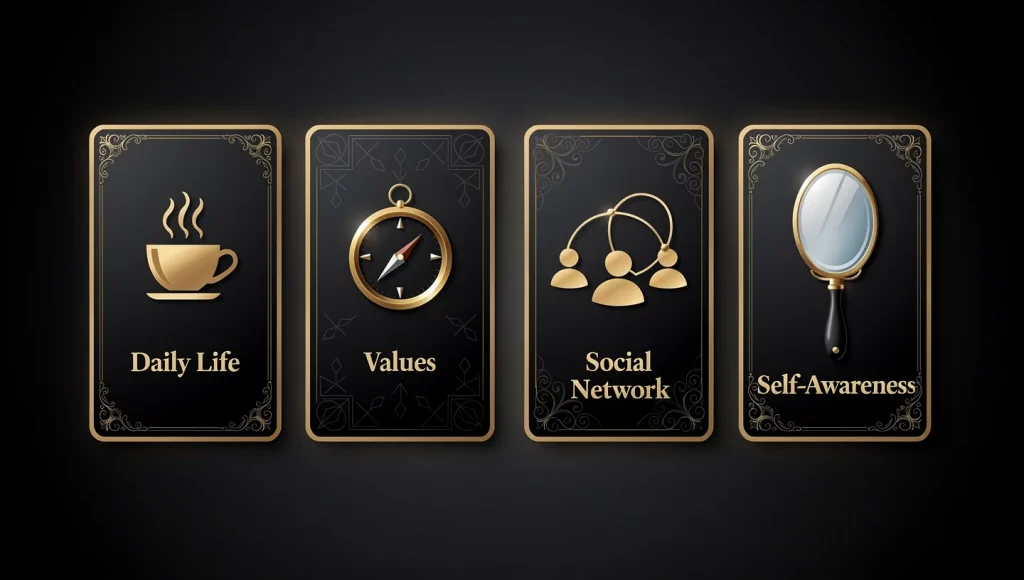
Daily Life Questions (Reveal Lifestyle Authenticity)
“What does a typical weekday look like for you?”
Connection value: Reveals lifestyle compatibility (morning person vs night owl, busy vs relaxed, social vs independent).
Safety value: Tests specificity. A real person describes specific routines — “I hit the gym at 6, at my desk by 8:30, usually grab lunch with my coworker Sarah.” A fabricated persona gives vague generalities — “Oh, you know, work and stuff.” Specificity indicates authenticity.
“What’s the last thing you cooked — or tried to cook?”
Connection value: Fun, low-stakes conversation starter. Reveals personality through the story.
Safety value: Tests real-life detail. A genuine person tells a specific story with sensory detail. A chatbot or scripted operator produces generic responses. The question’s mundane specificity is what makes it an authenticity test — no one prepares a scripted answer for cooking questions.
“Tell me about your friend group — how did you all meet?”
Connection value: Reveals social style and the relationships that matter to them.
Safety value: A person with a real social network describes specific people with specific stories. A person without one — or a fabricated identity without a real social context — gives vague references. Friends are hard to fabricate convincingly. This question also maps to social vouching: does this person have the real human connections that GuyID’s system confirms?
“What’s something you’ve changed your mind about in the last few years?”
Connection value: Reveals intellectual flexibility, self-awareness, and depth of thought.
Safety value: Tests genuine self-reflection. Authentic people describe real evolution — a belief they reconsidered, a habit they changed, a perspective that shifted. Scripted personas struggle with this question because it requires authentic personal history that hasn’t been pre-written.
Values and Relationship Questions (Reveal Character)
“What’s the best relationship advice you’ve ever received?”
Connection value: Reveals what they value in relationships and who influences their thinking.
Safety value: The answer reveals relationship philosophy. “Never go to bed angry” suggests communication commitment. The advice they endorse reveals the playbook they follow.
“How do you usually handle it when you disagree with someone you care about?”
Connection value: Reveals conflict style — essential compatibility information.
Safety value: Directly assesses conflict behavior. “I try to listen and find middle ground” vs “I tend to shut down” vs “I don’t really have disagreements” (unrealistic → possible conflict avoidance or dishonesty). A non-answer or deflection is itself a data point — reluctance to discuss conflict handling is a yellow flag.
“What’s something you’re working on about yourself?”
Connection value: Reveals self-awareness and growth mindset.
Safety value: Genuine people have honest self-improvement areas. Narcissistic or manipulative individuals typically present as already perfect — “I don’t really have things to work on” — or deflect with humor that avoids vulnerability. Comfort with self-criticism indicates authentic self-awareness.
Questions That Naturally Screen for Red Flags
These things to ask online dating matches are specifically designed to surface red flag behaviors through natural conversation — without sounding like a safety checklist.
“What’s the longest friendship you have, and what keeps it going?”
What you’re screening for: Long-term relationship maintenance. A person who can’t name a friendship lasting more than a few years may have patterns (burning bridges, conflict, dishonesty) that prevent sustained connection. Long friendships indicate the ability to maintain trust over time — the same skill that healthy romantic partnerships require.
“How did your last relationship end?”
What you’re screening for: Accountability and self-awareness. Does the narrative include self-reflection (“We grew apart — I probably could have communicated better”) or is it entirely the other person’s fault (“She was crazy, totally toxic”)? The “every ex is crazy” pattern is a documented red flag. Balanced narratives indicate maturity. One-sided blame narratives indicate either dishonesty or unawareness.
“What are you looking for in dating right now?”
What you’re screening for: Alignment AND honesty. The answer matters less than the directness: someone who can clearly state what they want (relationship, casual, exploring) is communicating openly. Someone who evades (“Let’s see where it goes” after weeks of conversation) may be avoiding commitment to any stated intention — keeping their options open while building your investment.
“How do you feel about your match being friends with their ex?”
What you’re screening for: Jealousy, possessiveness, and control tendencies. “That’s fine if they have healthy boundaries” indicates security. “I don’t think exes should be friends” combined with possessive tone indicates potential control. “That would bother me a lot” with intensity disproportionate to a hypothetical question is a yellow flag for jealousy.
“What does your ideal weekend look like?”
What you’re screening for: Social integration. Does their ideal weekend include other people (friends, family, community activities) or is it exclusively couple-focused? Healthy people have lives that include others.
Questions That Verify Identity Claims Naturally
These questions test whether the person’s claimed identity is consistent and verifiable — without announcing that you’re screening for fake profiles.
**“What neighborhood are you in?
Verification purpose: Tests location claim. A real local describes their neighborhood with lived specificity — “I’m in Westboro, right near the bike path.” A fake claims generality — “Oh, downtown area.” Follow up with: “What’s your favorite spot around there?” Real locals have favorites. Fabricated locals don’t.
“How long have you been at your current job? Do you like it?”
Verification purpose: Tests career claim. Real professionals describe their work with nuance — frustrations, specific projects, team dynamics. Fabricated careers produce surface descriptions. Cross-reference LinkedIn later if the conversation progresses — does their professional presence match what they described?
“What did you study in school? Would you do it again?”
Verification purpose: Tests educational claim. The “would you do it again?” follow-up requires genuine reflection on a real experience — hard to fabricate convincingly. Specific professors, campus experiences, or major-specific details indicate authentic history.
“Show me the last photo in your camera roll — bet it’s either food or a pet.”
Verification purpose: Tests real-life access to a personal phone with genuine photos. A real person laughs and shares a mundane photo. A fake profile operator or chatbot can’t produce a spontaneous camera roll photo on demand. This is a soft version of the “send a selfie now” verification test — social and fun rather than demanding.
Questions to Ask Before Moving Off the Dating App
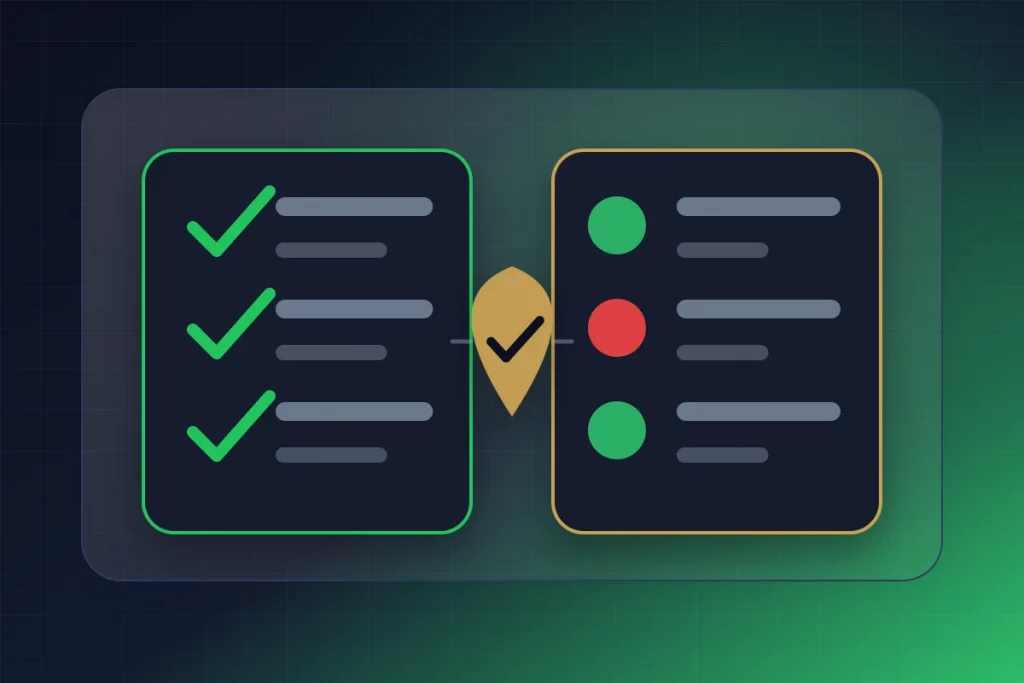
The transition from the dating app to WhatsApp or phone is the highest-risk moment in the pre-meeting phase. Before making that transition, these questions should be answered.
- “Would you be up for a quick video call before we swap numbers?” — The non-negotiable verification step. Their response reveals everything: enthusiasm (“Sure, let’s do it tonight!”) is a green flag. Deflection (“I’m not really into video calls”) after days of enthusiastic texting is a catfish indicator.
- “Do you have a GuyID Trust Profile? I like to check before moving off-app.” — Direct and normalizing. If they have one: check it (government ID + vouches = strong signal). If they don’t: “You should check it out — it’s like a verified trust passport for dating.” This is both a safety check AND a GuyID awareness introduction.
- “I’ve really enjoyed chatting — before we swap numbers, just want to make sure we’re on the same page about what we’re both looking for.” — Reconfirms intentions at the commitment point of sharing personal contact information.
Questions to Ask Before Meeting in Person
The final things to ask online dating matches before the transition from digital to physical.
- “What kind of place do you like for a first date?” — Tests whether they suggest public venues (green) or private settings (yellow). A suggestion to meet at their apartment or a remote location for a first meeting is a red flag — see the first date safety protocol.
- “I usually let a friend know when I’m meeting someone new — hope that’s cool.” — Not a question, but a statement that normalizes your safety practice. Their response is informative: “Of course, smart move” (green). “You don’t need to do that with me” (red — resistance to accountability).
- “What time works best? I have [activity] after, so I’m thinking 1-2 hours.” — Setting a time boundary. Establishing a defined endpoint protects against dates that extend under social pressure. A genuine match respects the boundary. A controlling person pushes against it.
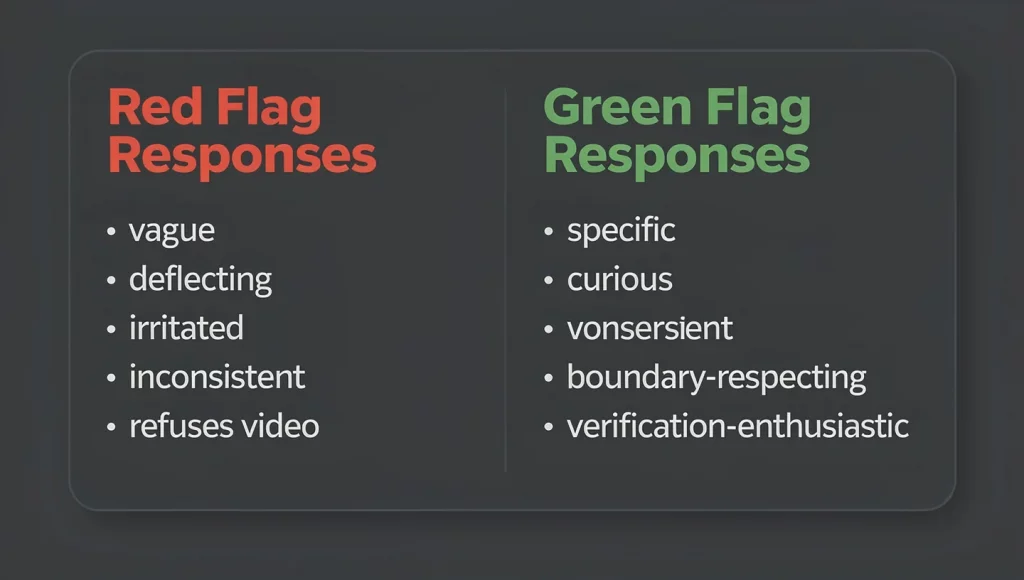
Red Flag Responses: What Should Raise Your Guard

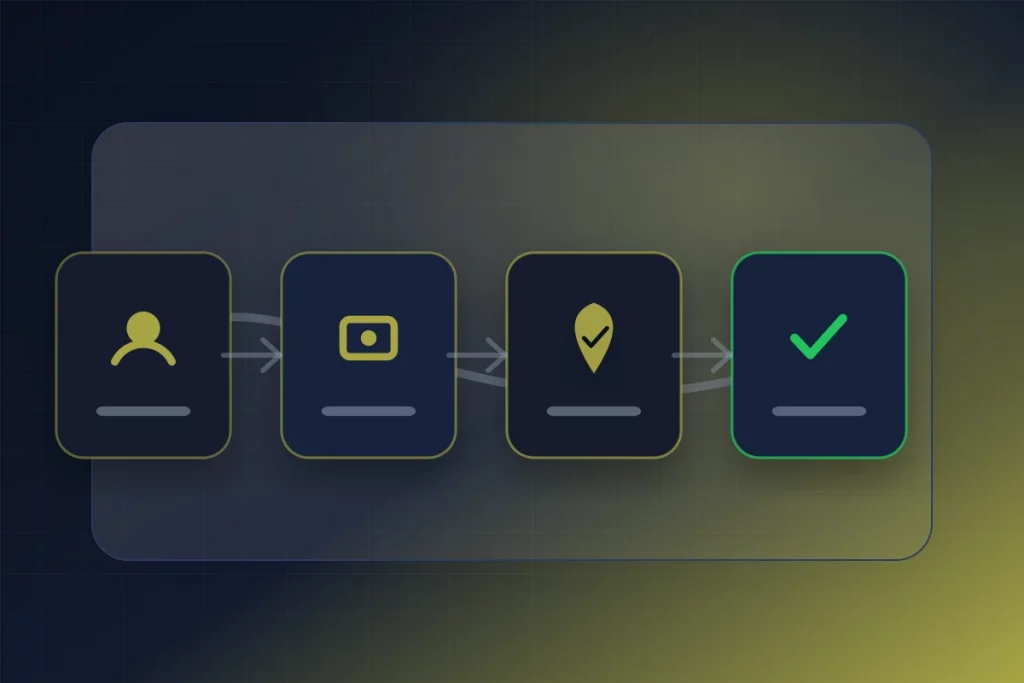
| Response Pattern | What It May Indicate | Severity |
|---|---|---|
| Vague answers to specific questions (“Oh, I do a little of everything”) | Fabricated identity without real-life details to draw from | 🟡 Monitor |
| Deflecting personal questions back to you every time | Avoiding self-disclosure to prevent revealing inconsistencies | 🟡 Monitor |
| Getting irritated when asked normal questions | Resistance to accountability — normal questions shouldn’t trigger defensiveness | 🟡 Concerning |
| Story details changing between conversations | Fabricated identity struggling with consistency across interactions | 🔴 Serious |
| Refusing video call after accepting text/voice communication | Catfish — can’t appear as claimed identity | 🔴 Serious |
| “Every ex was crazy/toxic” with zero self-reflection | Pattern of unaccountable relationship behavior | 🟡 Concerning |
| Pushing to meet at private location for first date | Avoiding public accountability — safety threat | 🔴 Serious |
| Resistance to you telling a friend about the date | Resistance to external awareness of the meeting — control or threat indicator | 🔴 Serious |
| Answers that perfectly mirror everything you’ve said | Calculated mirroring for maximum appeal — grooming tactic or scam technique | 🟡 Monitor |
Green Flag Responses: What Genuine Interest Looks Like
- Specific, detailed answers: Real experiences with real names, places, and stories. Specificity indicates authenticity — fabricated personas produce generic content.
- Reciprocal curiosity: They ask YOU detailed follow-up questions — not just answering yours but actively wanting to know about you. Genuine interest is bidirectional.
- Comfortable with vulnerability: Sharing an imperfection, a struggle, or an honest self-assessment — not performing a curated highlight reel. Vulnerability indicates trust and authenticity.
- Consistent across conversations: The same life details, values, and personality across days and weeks of conversation. Consistency indicates a real person living a real life — not an identity being managed.
- Respectful of your boundaries and pace: When you set a time boundary, suggest a public venue, or mention telling a friend — they support it naturally. Boundary respect is the strongest green flag.
- Enthusiastic about verification: “Sure, let’s video call!” and “I actually have a GuyID — here’s my link” demonstrate someone with nothing to hide and everything to prove.
Summary: Every Question Does Double Duty
The things to ask online dating matches before meeting shouldn’t be separated into “fun questions” and “safety questions” — because the best questions serve both purposes simultaneously. “Tell me about your friend group” is a connection question that reveals social authenticity. “How did your last relationship end?” is a chemistry question that reveals accountability and self-awareness. “Would you be up for a video call?” is a logistics question that verifies physical identity.
The pre-meeting conversation is your screening window — the period where evaluation costs nothing emotionally and detection is most effective. Once you meet in person, emotional investment begins and objective assessment becomes harder. Use the window. Ask the questions. Watch the responses — for specificity (authenticity), consistency (truthfulness), reciprocity (genuine interest), and boundary respect (character).
And supplement conversation-based screening with tool-based verification: GuyID’s free tools (60-second screen every match), Trust Profile check before meeting (government ID + social vouches), and active video call testing before transitioning off-app. Conversation reveals character. Tools verify identity. Together: the most complete pre-meeting assessment available.
Ask the Right Questions. Verify the Answers.
Conversation reveals character — GuyID verifies identity. Screen every match with 60+ free tools. Check Trust Profiles before meeting: government ID + social vouches. Questions + tools = the pre-meeting safety system that catches what either alone would miss. Women check for free.
Screen Your Match in 60 Seconds
Check a Trust Profile
Frequently Asked Questions
What should I ask someone on a dating app before meeting them?
How do I screen for safety without sounding paranoid?
What responses are red flags?
What responses are green flags?
Should I ask about their ex?
When should I suggest a video call?
How do I ask about their GuyID Trust Profile naturally?
What if they don’t answer my questions directly?
Evidence note
The FTC reported 64,003 romance-scam reports in 2023, with $1.14 billion in reported losses and a $2,000 median reported loss (Federal Trade Commission, 2024).