Reader Briefing
Reader Briefing
Start here if you need a practical read on questions to ask on a first date: 60 prompts that create real conversation: who should use verification, what signals to check, and what to do before moving from online interest to an in-person plan.
Who this is for
- Readers preparing for a first in-person date.
- Anyone checking identity, profile consistency, and trust signals.
- Online daters improving conversations, profiles, or match screening.
You’ll learn
- How to evaluate identity signals without treating any single check as certainty.
- Which trust signals matter and how to weigh them together.
- How to move from online conversation to a safer first meeting.
- Where GuyID tools fit into a quick pre-date screening workflow.
- How to compare options using practical safety and trust criteria.
- When to slow down, ask for more context, or walk away.
Bottom line
Verification reduces uncertainty; it does not guarantee future behavior. Use a layered approach: confirm identity signals, compare profile consistency, ask for a short video call, keep early plans public, and slow down when someone pressures you to skip normal safety steps.
Key takeaways
- Identity verification improves confidence, not certainty.
- Verify before meeting privately or sharing sensitive details.
- A short video call can reveal many inconsistencies.
- Pressure to skip reasonable safety steps is useful information.
- Use GuyID tools to turn vague concerns into specific checks.
Free Tools
Catfish Probability Detector
Check whether a dating profile has suspicious identity or photo signals.
Dating Bio Red Flag Detector
Review a bio for scam, pressure, or trust-warning language.
Dating Safety Checklist
Use free GuyID tools before moving from chat to a real date.
Next step
Create your GuyID trust profile
Share consent-based trust signals before a date without turning the conversation into an interrogation.
Quick Answer
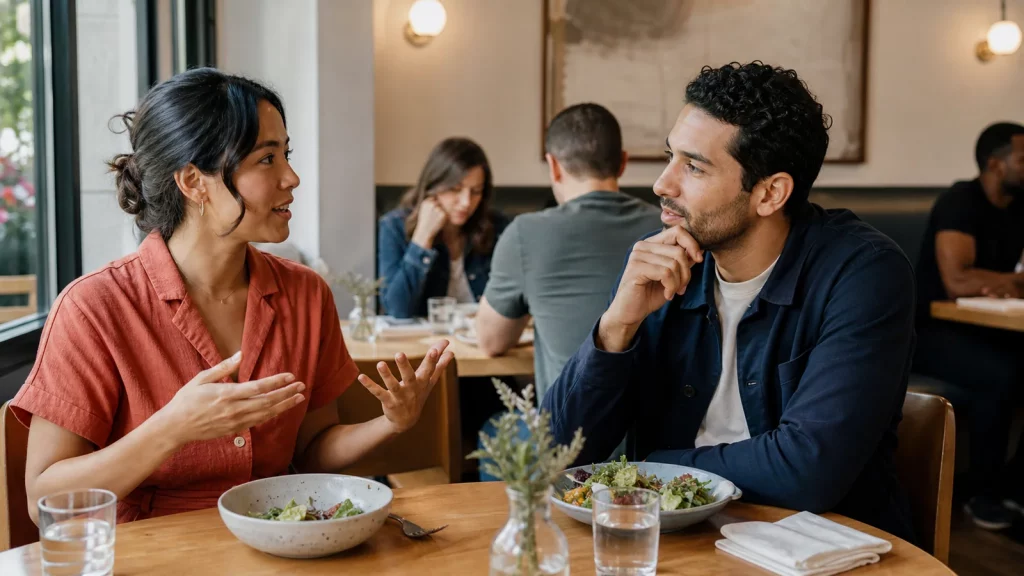
Good questions to ask on a first date are open enough to invite a story, specific enough to answer, and easy to decline. Start with the present—what they enjoy, how they spend time, what brought them here—then follow the parts of their answer that genuinely interest you. Share your own answer too. A date should feel like two people building a conversation, not one person administering a compatibility test.
The best follow-up is often simple: “What do you like about that?”, “How did that start?”, or “What happened next?” Use the list below as a menu, not a script.

Curiosity works best when the answer changes what you ask next.
NavigateTable of Contents30 sections
How to Ask Without Making It an Interview
Use the ASK–LISTEN–OFFER pattern:
- Ask one question connected to the moment or something they already said.
- Listen for the detail with energy, meaning, or emotion.
- Offer a related piece of yourself before asking another question.
For example:
“You said you started running last year. What made you begin?”
After the answer:
“That makes sense. I got into swimming because I needed something that separated work from the evening. Do you run for the routine now, or are you training for something?”
The exchange has curiosity and reciprocity. By contrast, five unrelated questions in a row—job, siblings, travel, music, future—can feel like form completion even when every question is polite.
Follow-up questions are more useful than a high question count
A 2017 series of studies found that people who asked more questions, particularly follow-ups, were often perceived as more responsive and better liked in getting-acquainted conversations. The paper also analyzed speed-dating conversations. See the study abstract on PubMed.
That result is not a dating cheat code. A published reanalysis and critique argued that the experimental effects were modest and questioned conclusions drawn from the speed-dating data. The sensible lesson survives the disagreement: listen well enough to ask about the answer you actually received. Do not count questions or assume curiosity guarantees attraction.
60 First-Date Questions by Depth
Ten easy opening questions
- What has been the best part of your week so far?
- What made you choose this place—or what do you think of it?
- What do you look forward to when you have a free evening?
- Have you discovered anything good lately: a place, show, recipe, or hobby?
- What kind of weekend leaves you feeling restored?
- Are you more likely to plan ahead or decide on the day?
- What is one small thing you are unusually particular about?
- What is a local place you would take a visiting friend?
- What has made you laugh recently?
- What is something you are glad you tried, even if you were bad at it?
These work because they are current and concrete. They do not demand disclosure about childhood, money, health, or past relationships before trust exists.
Ten questions about interests and everyday life
- What hobby makes you lose track of time?
- What do you wish you had more time to learn?
- What kind of music do you put on when nobody else is choosing?
- Do you prefer making things, collecting experiences, or learning facts?
- What is your ideal way to spend a day outdoors—or indoors?
- Is there a book, film, or game you keep recommending?
- What food do you enjoy making for yourself?
- What is a routine that improves your day?
- Which part of your work or studies feels most satisfying?
- What interest of yours tends to surprise people?
Do not use interests as a scoring system. Different tastes can be engaging when both people respect them. Pay attention to whether they can be enthusiastic without belittling what others enjoy.
Ten story-generating questions
- What trip or day out did not go to plan but became a good story?
- Who taught you something you still use?
- What is the kindest thing a stranger has done for you?
- What was your first job like?
- When have you changed your mind about something important?
- What is a tradition you genuinely enjoy?
- What is a small risk you are happy you took?
- What place feels familiar to you as soon as you arrive?
- What skill took you longer to learn than expected?
- What is a compliment you still remember?
Stories reveal context better than labels. “I’m adventurous” is a claim; a story about taking a solo train trip shows what adventure means to that person.

Shared surroundings can create better prompts than memorized questions.
Ten playful questions
- What is your most defensible unpopular food opinion?
- Which ordinary task would you gladly outsource forever?
- What would your extremely low-budget documentary be about?
- Which fictional home would you actually want to live in?
- What harmless topic could you give a ten-minute talk about with no preparation?
- What is the least impressive thing you are proud of?
- If this neighborhood had a mascot, what should it be?
- What small purchase has improved your life most?
- Which song would be a terrible choice for your entrance music?
- What is a very specific sign that you are having a good day?
Playful questions should invite play, not embarrassment. If the other person answers briefly, change lanes instead of escalating to something “edgier.”
Ten values and compatibility questions
- What does a healthy amount of independence look like to you in dating?
- How do you usually make room for friends, family, and a relationship?
- What does reliability look like in everyday life?
- When plans change, do you prefer a quick update or a detailed explanation?
- What helps you feel heard during a disagreement?
- What are you hoping dating adds to your life right now?
- What pace feels comfortable when you are getting to know someone?
- How important are routines compared with spontaneity for you?
- What is one boundary you appreciate people asking about?
- What makes you feel that effort is mutual?
These are intentional questions, but they should grow from the conversation. Asking all ten on one date would feel intense. Choose one or two only when the tone supports them.
Ten questions for deciding whether to meet again
- What kind of date would be fun for you next time?
- Is there something nearby you have wanted to try?
- What is your next week looking like?
- Did anything we talked about make you think of a place or activity?
- Would you rather do something active or conversation-focused next time?
- Is there a part of the city you enjoy spending time in?
- What is a good second-date length for you?
- Are evenings or weekends generally easier?
- Is there anything that would make a future plan more comfortable?
- Would you like to do this again?
Number 60 is the clearest. You do not need to disguise interest as a hypothetical planning survey.
The Follow-Up Ladder
Use four levels and stop wherever the other person seems comfortable.
| Level | Purpose | Example |
|---|---|---|
| Clarify | Understand the basic fact | “Was that your first time there?” |
| Explore | Invite detail | “What did you enjoy most about it?” |
| Meaning | Learn why it matters | “What makes that tradition important to you?” |
| Connect | Offer your own relevant experience | “I have a similar ritual with my sister…” |
The ladder is not a route to forced intimacy. Some answers do not need deeper excavation. If a person gives a short answer, changes the subject, looks uncomfortable, or says they would rather not discuss it, move on graciously:
“Of course. What kind of food are you excited to try next?”
Listen for the noun, the feeling, or the choice
When you do not know what to ask next, pick one element:
- Noun: “You mentioned your grandmother’s garden—what did she grow?”
- Feeling: “You sounded proud of that. What made the result meaningful?”
- Choice: “What made you choose the smaller company?”
This keeps the conversation anchored in what they said rather than in your stored list.
What Not to Ask on a First Date
The topic is not always the problem; entitlement is.
Avoid questions that demand:
- A home address, exact workplace location, daily route, passwords, or financial details
- Trauma disclosure or a detailed account of abuse
- Sexual history, body details, or explanations of identity
- A diagnosis, medication list, fertility plan, or health disclosure
- Immigration status or other sensitive legal information
- A verdict on marriage or children before the person has chosen that depth
- Comparisons with former partners
- Proof that their boundaries are reasonable
Some people happily discuss politics, faith, children, non-monogamy, disability, or past relationships early because those topics affect compatibility. That is fine when the conversation is mutual and voluntary. Ask permission where appropriate:
“Is that something you are comfortable talking about on a first date?”
Accept “not yet” as a complete answer.
What to Talk About When Your Mind Goes Blank
Use the HERE reset:
- Happening: Comment on something in the environment.
- Earlier: Return to a detail they mentioned before.
- Recommendation: Ask for a local, cultural, or food recommendation.
- Experience: Share one short story that gives them something to respond to.
Examples:
“That drink looks much better than mine. What did you order?”
“You mentioned your friend got you into climbing—how did that first session go?”
“I have one free afternoon next weekend. What would you do with it?”
Silence is not automatically failure. Take a sip, look around, and let the conversation restart without apologizing for every pause. Two nervous people can mistake speed for chemistry and quiet for incompatibility.
Questions That Reveal Compatibility
Compatibility emerges from how answers fit together, not whether someone produces an ideal response.
Pace
Ask what getting to know someone normally looks like for them. One person may prefer frequent texting and quick plans; another may need more space. Neither is wrong, but an unexplained mismatch can create friction.
Availability
Instead of asking “Are you emotionally available?”, ask about observable life:
“What kind of time and energy do you realistically have for dating?”
Specific routines often tell you more than a flattering label.
Conflict and repair
You do not need a first-date interrogation about attachment. A lighter question works:
“When a plan goes wrong, do you usually want to solve it immediately or take a little time?”
Notice whether they can describe their preference without declaring everyone else defective.
Intentions
Ask directly and answer directly:
“What are you hoping to find through dating right now?”
“I’m open” can be honest, but you can still ask what it means in practice. Do not translate ambiguity into the answer you want.
Safety, Privacy, and Boundaries
Questions can build connection, but access to a conversation is not access to every part of a person. RAINN’s consent guidance emphasizes clear communication without pressure and the right to change one’s mind. That principle applies beyond physical intimacy: a respectful dater does not punish someone for declining a personal question.
Do not disclose sensitive information simply to prove you are trusting. A home address, employer details, personal documents, and financial data are not necessary for a first-date conversation.
If you met online and want more confidence before meeting, discuss a proportionate check such as a brief video call or an identity verification method. A GuyID trust profile can combine identity verification and social vouching into portable trust signals while letting the owner control what they share. It does not guarantee intentions or behavior. Use it alongside a public meeting, independent transportation, and the first-date safety check.

Good conversation and sensible privacy can exist at the same time.
How GuyID Helps
GuyID should appear when it is useful, not as a banner ad. A GuyID Trust Profile gives someone a portable way to share trust signals before a date, while identity verification and social vouching help turn vague profile claims into clearer next steps.
Useful next steps:
- Create a GuyID Trust Profile when you want a cleaner way to share verified trust signals.
- Use GuyID free tools and related guides when you need a checklist before meeting someone.
- Treat identity verification as confidence-building, not a guarantee.
- Use social vouching when you want context from people who already know the person.
- Sign up only when the extra trust layer helps the decision you are already trying to make.
Frequently Asked Questions
How many questions should I ask on a first date?
There is no target. Ask enough to create balance, then follow the conversation. If you know ten facts about them and they know none about you, offer more of yourself. If you have spoken for several minutes, invite their perspective.
What are the top five first-date questions?
These five cover ease, interests, intentions, reciprocity, and the next step.
- “What has been the best part of your week?”
- “What do you enjoy when you have a free day?”
- “What are you hoping dating adds to your life?”
- “What makes effort feel mutual to you?”
- “Would you like to do this again?”
Should I ask about previous relationships?
Only when it arises naturally and both people are comfortable. Focus on what someone learned or wants now, not a forensic account of an ex. A refusal to provide details is not evidence that they are hiding something.
Is it okay to ask what someone is looking for?
Yes. It is a practical compatibility question. Ask without demanding the same answer as yours, and be prepared to respond honestly yourself. Your answers may reveal alignment or a mismatch.
What if my date gives one-word answers?
Try one follow-up and one new topic. If conversation remains one-sided, stop carrying the entire interaction. Nervousness is possible, but sustained participation is part of reciprocity.
How do I answer a question I do not like?
Say, “I’d rather not get into that yet,” or, “That’s personal for a first date—can we talk about something else?” A respectful person will adjust without bargaining.
Key Takeaways
- Treat the 60 questions as a menu, not a sequence.
- Ask about the answer you heard instead of changing topics immediately.
- Offer related information about yourself so curiosity is reciprocal.
- Move from easy topics toward meaning only when the other person participates.
- Respect a declined question without asking for justification.
- Use direct language when you want a second date.
Conclusion
The purpose of first-date questions is not to complete a profile of the person before the check arrives. It is to discover how conversation feels between you: whether curiosity is mutual, boundaries are easy to express, and each person can be both heard and known.
For more situational prompts, read the first-date conversation starters. Pair them with modern first-date etiquette and the guide to reading body language without pretending to read minds.