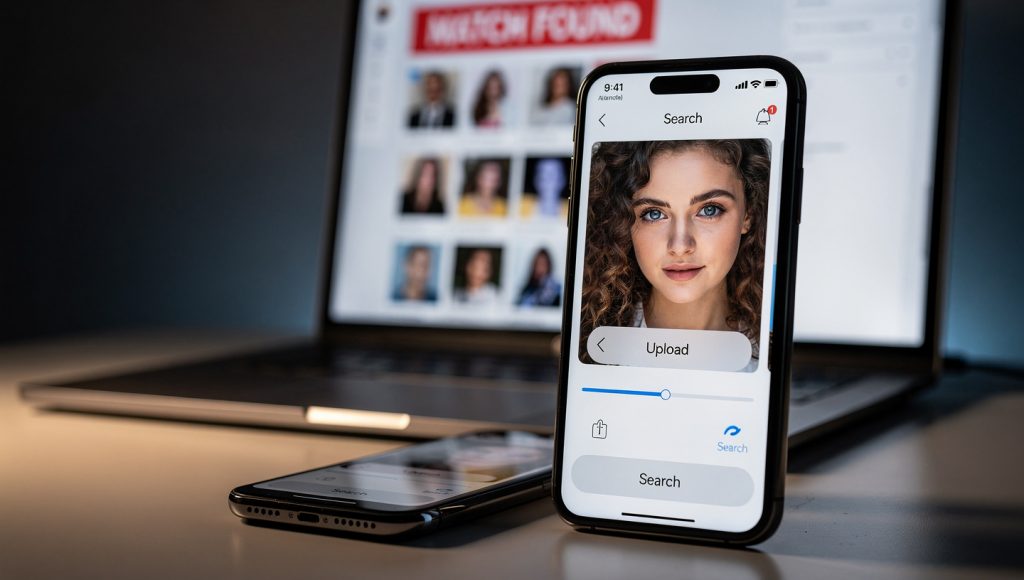
Reverse image search for dating is the single fastest, highest-impact safety technique available to online daters in 2026. In 30 seconds, a reverse image search can expose a stolen profile photo, reveal a scam identity used across multiple dating platforms, or identify a stock photo being passed off as a real person. With 1 in 4 Americans encountering fake profiles or AI bots on dating apps (McAfee, Feb 2026), POF accounting for 78% of fake dating app installations (McAfee Labs, 2026), and $1.3 billion lost annually to romance scams (FTC, 2026), reverse image search for dating should be as routine as checking reviews before booking a restaurant — a 30-second habit that catches the majority of fake profiles before they cost you time, money, or heartbreak.
This guide covers everything about using reverse image search for dating: which tools to use, step-by-step instructions for every platform, how to interpret results, what reverse image search can’t catch (and what to do about it), and how to build it into a complete proactive dating safety workflow. Whether you’ve never used reverse image search or you want to maximize your detection capabilities, this is the definitive guide.
Why Reverse Image Search Is the #1 Dating Safety Tool
Reverse image search for dating earns the #1 ranking among all dating safety tools for a simple reason: it provides the highest detection rate per second of effort. No other technique matches its speed-to-impact ratio.
Speed: 30 Seconds Per Photo
Saving a profile photo and uploading it to a reverse image search tool takes 30 seconds. In that time, you’ve queried millions of indexed images for matches — checking databases of known scam profiles, stock photography libraries, social media indexes, and the broader web. Compare this to other verification methods: social media cross-referencing (5 minutes), video calls (5-15 minutes), identity verification requests (minutes of conversation to frame, plus wait time). Reverse image search is the fastest safety check available.
Detection Rate: 60-70% of Fake Profiles Caught
The majority of fake dating profiles — across all platforms — use stolen photos from real people’s social media, stock photography, or images recycled from other scam operations. All of these are detectable through reverse image search because the original source exists somewhere on the indexed web. This makes reverse image search for dating the broadest-catching single technique: it addresses the most common type of profile fraud with a single 30-second action.
Cost: $0
Every major reverse image search tool — GuyID’s dating-optimized search, Google Images, TinEye, and Yandex — offers free searches. The most effective dating safety technique costs nothing to use, has no usage limits for basic searches, and requires no account creation. There is literally zero barrier between you and the 30-second check that catches the majority of fake profiles.
The ROI Calculation
30 seconds and $0 invested → catches 60-70% of fake profiles → prevents exposure to scams that cost $2,001–$4,000 on average (NordProtect, Jan 2026) and weeks of emotional recovery. The return on investment for reverse image search for dating is mathematically infinite — zero cost, massive protection. Anyone who dates online and doesn’t reverse image search is leaving the most effective free safety tool unused.
How to Reverse Image Search a Dating Profile: Step by Step
Here’s the complete, step-by-step process for using reverse image search for dating on any dating platform. These instructions work regardless of which app you use — Tinder, Bumble, Hinge, POF, OkCupid, Facebook Dating, or any other platform.
Step 1: Save the Profile Photo
On most dating apps: Take a screenshot of the profile photo. On iOS, press Side Button + Volume Up simultaneously. On Android, press Power + Volume Down simultaneously. The screenshot saves to your camera roll.
If the app blocks screenshots (some apps do in certain regions): take a photo of your phone screen using a second device (another phone, tablet, or computer webcam). The image quality will be slightly lower but still sufficient for reverse image search matching.
Critical rule: Save ALL of their photos, not just the main profile photo. Scammers frequently mix sources — one AI-generated main photo that produces no search results combined with secondary photos stolen from a real person’s Instagram. Catching one stolen photo exposes the entire fake profile.
Step 2: Upload to GuyID’s Reverse Image Search
Go to GuyID’s free safety tools and select the reverse image search function. Upload the saved screenshot. GuyID’s search is optimized specifically for dating safety — querying databases that include known scam profile images, dating-specific image repositories, and web-indexed photos. Results appear in seconds.
Step 3: Check Google Images
Open images.google.com on your phone or computer. Tap or click the camera icon (Google Lens icon) in the search bar. Upload the same screenshot. Google searches its entire web index — billions of indexed images — for matches and visually similar images. Google’s massive index catches photos from any publicly accessible website, social media platform, or news article.
Step 4: Check TinEye (For Modified Photos)
Go to tineye.com and upload the screenshot. TinEye specializes in finding exact matches and modified versions — photos that have been cropped, resized, filtered, color-adjusted, or slightly altered to avoid detection. Scammers who modify stolen photos before uploading them to dating apps are caught by TinEye when Google and GuyID’s similarity-based matching might miss the modified version.
Step 5: Check Yandex (For Eastern European Sources)
Go to yandex.com/images and upload the screenshot. Yandex has the strongest index for Russian-language and Eastern European social media — VKontakte (VK), Odnoklassniki, and regional platforms that Google doesn’t fully index. A significant percentage of stolen dating profile photos originate from these platforms, making Yandex the engine that catches what the other three miss.
Step 1 (screenshot): 10 seconds. Step 2 (GuyID): 30 seconds. Step 3 (Google): 30 seconds. Step 4 (TinEye): 20 seconds. Step 5 (Yandex): 20 seconds. Total for the 4-engine reverse image search for dating process: approximately 2 minutes per profile. For maximum efficiency, batch your searches — screenshot all photos from a profile first, then run them through all four engines sequentially.
The Best Reverse Image Search Tools for Dating (Ranked)
Not all reverse image search engines are equal for dating safety. Each has different strengths, indexes, and matching algorithms. Here’s the ranking of the best tools for reverse image search for dating based on detection capability, speed, and relevance to dating fraud.
| Rank | Tool | Best For | Unique Strength | Cost |
|---|---|---|---|---|
| 1 | GuyID Reverse Image Search | Dating-specific scam detection | Optimized for dating profiles, checks scam databases | Free |
| 2 | Google Images | Broadest web coverage | Largest index — catches photos from any Google-indexed source | Free |
| 3 | TinEye | Modified/altered photos | Detects cropped, filtered, and color-adjusted versions | Free (basic) |
| 4 | Yandex Images | Eastern European sources | Best index for Russian/Eastern European social media | Free |
Why GuyID Is #1 for Dating
GuyID’s reverse image search is purpose-built for dating safety — not a general-purpose image search repurposed for dating. This means it checks against databases specifically relevant to dating fraud: known scam profile images reported by victims and platforms, stock photography commonly used in fake profiles, and image sets flagged across dating-specific repositories. General-purpose tools (Google, TinEye, Yandex) search the broad web — powerful, but not optimized for the specific images that appear in dating scams.
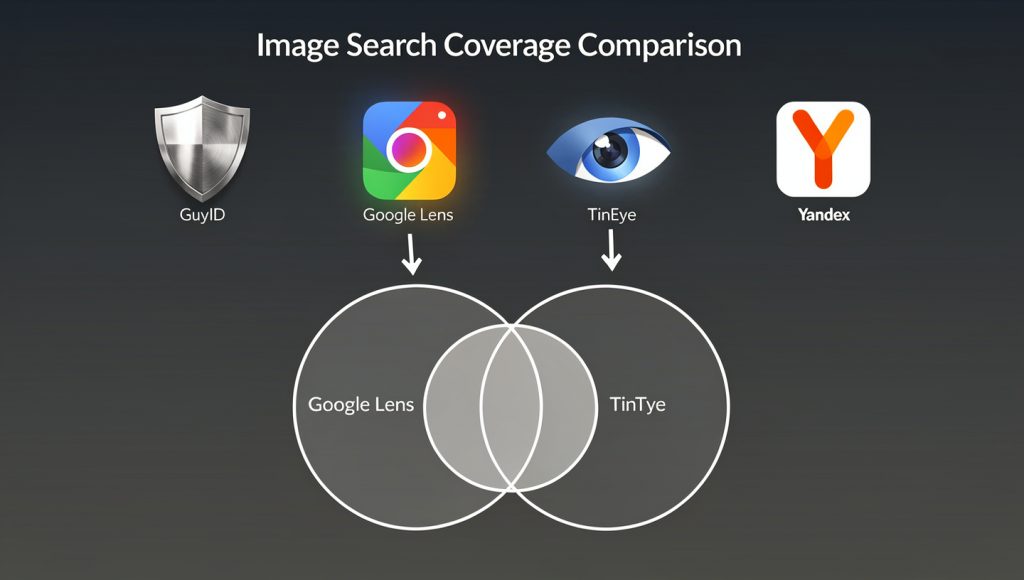
The optimal approach: use GuyID first (catches dating-specific fraud), then supplement with Google (broadest coverage), TinEye (catches modifications), and Yandex (catches Eastern European sources). Together, the four engines provide the most comprehensive reverse image search for dating coverage available.
How to Interpret Reverse Image Search Results
Knowing how to run a reverse image search for dating is half the skill. Knowing how to interpret the results — distinguishing between definitive fraud signals, positive signals, and ambiguous results — is the other half.
Definitive Fraud Signals (Take Action Immediately)
- Same photo appears under a different name on another dating site or social media: The profile is using stolen photos. This is conclusive — no legitimate explanation exists for the same face appearing under different names on different platforms. Unmatch immediately and report the profile.
- Photo appears on a stock photography website: The profile used a purchased or free stock image as their dating photo. No real person uses stock photos of themselves. Report immediately.
- Photo appears in a scam report database: The image has been previously reported by victims or fraud analysts as part of a known scam operation. This is definitive evidence of fraud.
- Same photo appears across multiple dating platforms under different names/ages/locations: A scam operation is deploying the same identity across platforms to maximize target volume. Report to every platform where it appears.
Positive Signals (Encouraging, Not Conclusive)
- Photo appears on a social media profile matching the same name: The person’s dating profile photo also appears on their Instagram, Facebook, or LinkedIn under the same name. This is a positive identity consistency signal — the person likely exists under this name and uses this photo across platforms. Continue verification but with increased confidence.
- Photo appears in a legitimate context (news article, company website, conference photo) matching claimed identity: Strong positive signal. The person appears to exist in the real world with the identity they claim on the dating app.
Ambiguous Results (Proceed with Caution)
- No results found across any search engine: This is the most common ambiguous result — and it requires careful interpretation. No results can mean the person’s photos are genuine personal photos that haven’t been indexed elsewhere (positive scenario). Or it can mean the photos are AI-generated — original images with no source to find (negative scenario). A clean reverse image search is better than a fraud match, but it’s not proof of authenticity. Proceed to the supplementary checks described in the next sections.
- Visually similar results showing different people: Google sometimes returns faces that look similar but aren’t the same person. This is a false positive — not evidence of fraud. Compare the search results carefully against the profile photo. If the faces are similar but clearly different people, the result is irrelevant.
The 4-Engine Search Method: Maximum Coverage for Dating Safety
The most effective approach to reverse image search for dating is the 4-engine method — running every photo through all four major search engines. Each engine has a different index and matching algorithm, meaning photos missed by one engine may be caught by another.
Why Multiple Engines Matter
GuyID catches dating-specific fraud that general engines may miss. Google catches photos indexed from any website but may miss images behind restricted-access platforms. TinEye catches modified versions of stolen photos that similarity-based engines miss. Yandex catches photos from Eastern European social media that Western engines don’t fully index. Together, they cover the entire web — no single engine achieves this alone.
Real-World Examples of Multi-Engine Detection
- Scenario 1: A profile photo returns no results on GuyID and Google. TinEye finds a cropped version of the photo on a Ukrainian social media site — the original photo showed a different background that the scammer removed before uploading. Caught by TinEye, missed by the other two.
- Scenario 2: A profile photo returns no results on GuyID, Google, or TinEye. Yandex finds the same face on a VKontakte profile belonging to a Russian model — a common source for stolen dating photos targeting Western users. Caught by Yandex, missed by all three others.
- Scenario 3: GuyID flags a photo matching a known scam profile database entry. Google, TinEye, and Yandex return no results because the photo was only used within dating platforms, not on the broader web. Caught by GuyID’s dating-specific database, missed by general engines.
These scenarios illustrate why the 4-engine approach is the gold standard for reverse image search for dating. The 2-minute investment catches fraud that any single engine would miss.
What Reverse Image Search Can’t Catch: The Critical Limitation
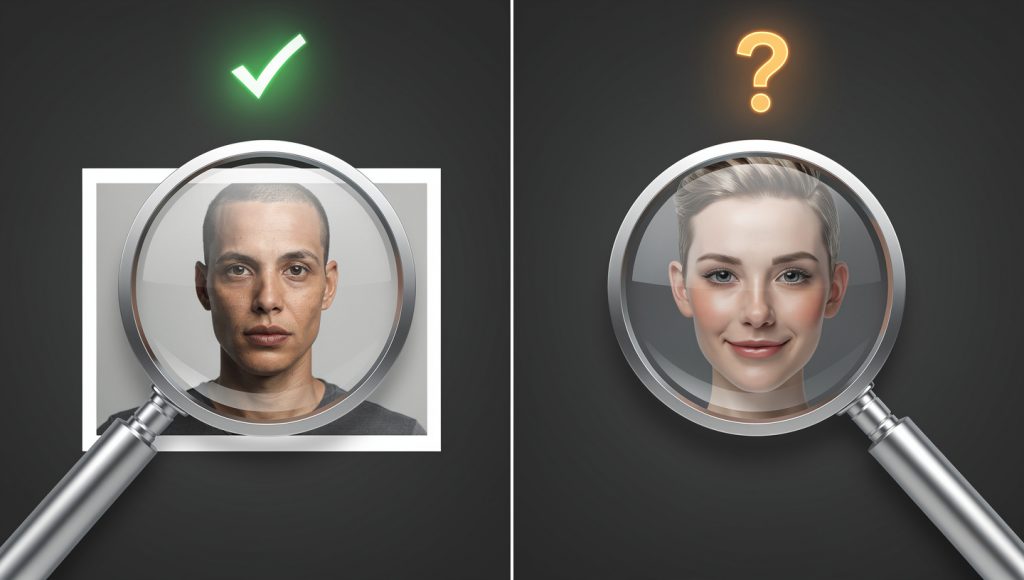
The most important limitation of reverse image search for dating — and the reason it should never be your only verification method — is that it cannot detect AI-generated photos.
Why AI Photos Are Invisible to Reverse Image Search
Reverse image search finds copies — photos that exist elsewhere on the web. AI-generated photos are originals — they were created from mathematical models, not copied from any source. No original exists to match against because the face, the person, and the photo were generated from scratch. When a scammer uses Midjourney, Stable Diffusion, or Flux to generate a fictional person’s face, reverse image search finds nothing because there’s nothing to find.
With 35% of Americans reporting they’ve spotted AI-generated photos on dating apps (McAfee, Feb 2026), this limitation is significant and growing. The photos you don’t detect through reverse image search may be AI-generated — and the scam operations using AI photos are typically more sophisticated than those using stolen photos.
What to Do When Reverse Image Search Returns Nothing
A clean reverse image search result is a positive signal (no stolen photos detected) but not proof of authenticity. When all four engines return no matches, proceed to supplementary verification:
- Inspect for AI photo characteristics: Excessively smooth skin, background artifacts, accessory inconsistencies, hand anomalies, unnaturally uniform eye reflections, and the “uncanny valley” quality of photos that look too perfect for casual selfies.
- Run the catfish probability detector: This holistic assessment considers multiple signals beyond photos — bio patterns, behavioral indicators, and overall profile composition — catching what photo-only analysis misses.
- Request a spontaneous selfie: “Send me a photo holding up three fingers and pointing at something blue.” This takes a real person 10 seconds. No AI can generate it on demand. Any delay, excuse, or refusal is a red flag.
- Video call with active deepfake testing: Full head turns, hand-over-face movements, room changes, and lighting shifts expose deepfake overlays that static photos can’t reveal.
- Request a GuyID Trust Profile: Government ID verification + social vouching confirms real-world identity that neither stolen photos nor AI-generated photos can survive. The definitive check when reverse image search is inconclusive.
Reverse Image Search + AI Detection: The Complete Photo Verification Stack
Reverse image search for dating is the foundation of photo verification — but for comprehensive protection in 2026, it needs to be paired with AI detection techniques. Together, they cover both major photo fraud categories: stolen photos (caught by reverse image search) and AI-generated photos (caught by AI detection).
The Combined Photo Check Process
| Step | Technique | What It Catches | Time |
|---|---|---|---|
| 1 | GuyID reverse image search | Stolen photos, known scam images, stock photos | 30 sec |
| 2 | Google Images + TinEye + Yandex | Photos indexed elsewhere, modified stolen photos, Eastern European sources | 90 sec |
| 3 | Visual AI inspection (manual) | AI-generated photo artifacts — smooth skin, background errors, hand anomalies | 30 sec |
| 4 | Spontaneous selfie request | All non-real identities — no AI can generate on demand | 10 sec to request |
Total time for the complete photo check: approximately 3 minutes. This process catches both stolen photos (Steps 1-2) and AI-generated photos (Steps 3-4), covering the full spectrum of photo fraud in the 2026 dating landscape. Combined with the catfish probability detector and bio red flag detector, this is the complete Level 1-2 screening in the 5-level verification system.
Building Reverse Image Search Into Your Dating Routine
The power of reverse image search for dating is maximized when it becomes automatic — a routine step applied to every match, not a reactive measure used only when something feels suspicious.
The Routine Approach
Make reverse image search the first thing you do after matching — before reading their bio carefully, before crafting your first message, before allowing yourself to start imagining a connection. The 30-second check happens in the neutral zone before emotional investment begins. This is the proactive dating safety approach applied to its highest-impact tool.
Why Routine Matters More Than Suspicious-Triggered
If you only reverse image search when something feels “off,” you’ll miss the most dangerous fakes — the ones that look perfect. The most sophisticated scam profiles use professionally curated (or AI-generated) photo sets that trigger no suspicion. They have polished bios, verified badges, and convincing conversation skills. These are exactly the profiles that suspicion-based searching misses and that routine searching catches. The 30-second habit catches the fakes you didn’t know to suspect.
The Batch Processing Workflow
For efficiency, batch your reverse image search for dating sessions. Instead of searching one photo at a time between conversations, dedicate 5-10 minutes to screening all your recent matches at once. Screenshot all photos from each match, run them through GuyID → Google → TinEye → Yandex in sequence, and flag any results that require further investigation. This batch approach makes routine verification time-efficient and prevents the mental overhead of interrupting conversations for individual checks.
Integration with Other Verification Steps
Reverse image search is Step 1 in the 5-level verification system. After the photo check, proceed to bio analysis (Level 2), social media cross-referencing (Level 3), video calls with deepfake testing (Level 4), and GuyID Trust Profile verification (Level 5) for matches you want to pursue. Each level builds on the foundation that reverse image search provides — catching progressively more sophisticated fraud as you invest more verification effort in the matches that matter.
Summary: The 30-Second Habit That Catches Most Fake Profiles
Reverse image search for dating is the highest-impact, lowest-effort safety technique available to online daters. In 30 seconds (single engine) to 2 minutes (all four engines), it catches stolen photos, reused scam identities, stock images, and photos deployed across multiple dating platforms under different names — the foundation of 60-70% of fake dating profiles.
The tools are free: GuyID’s dating-optimized reverse image search for scam-database-matched detection, Google Images for the broadest web coverage, TinEye for modified photo detection, and Yandex for Eastern European sources. Used together, they cover the entire indexed web in 2 minutes.
The critical limitation: reverse image search for dating cannot detect AI-generated photos because they’re originals with no source to find. A clean search result is a positive signal, not proof of authenticity. Supplement with visual AI inspection, spontaneous selfie requests, the catfish probability detector, video calls with deepfake testing, and GuyID Trust Profile verification for comprehensive protection.
The most important practice: make it routine. Search every match, not just suspicious ones. The 30-second habit applied to every match catches the dangerous fakes that look perfectly legitimate — the ones you’d never think to investigate. Proactive dating safety starts with the simplest, fastest, most effective check available. Reverse image search is that check. Use it on your next match. Use it on every match after that. The 30-second habit costs nothing and prevents everything that stolen photos enable — from wasted weeks of conversation to thousands of dollars in scam losses.
GuyID’s free reverse image search is optimized for dating safety — checking scam databases, stock photos, and web-indexed images. Combine with 60+ free safety tools, catfish detection, and verified Trust Profiles for complete protection. Women check for free.