

Reader Briefing
Reader Briefing
Start here if you need a practical read on platonic love: the most important love nobody talks about: who should use verification, what signals to check, and what to do before moving from online interest to an in-person plan.
Who this is for
- Readers preparing for a first in-person date.
- Anyone checking identity, profile consistency, and trust signals.
- People trying to avoid romance scams, fake profiles, or pressure tactics.
- Online daters improving conversations, profiles, or match screening.
You’ll learn
- How to evaluate identity signals without treating any single check as certainty.
- Which trust signals matter and how to weigh them together.
- How to spot inconsistencies, pressure, or behavior patterns that deserve caution.
- How to move from online conversation to a safer first meeting.
- Where GuyID tools fit into a quick pre-date screening workflow.
- When to slow down, ask for more context, or walk away.
Bottom line
Verification reduces uncertainty; it does not guarantee future behavior. Use a layered approach: confirm identity signals, compare profile consistency, ask for a short video call, keep early plans public, and slow down when someone pressures you to skip normal safety steps.
Key takeaways
- Identity verification improves confidence, not certainty.
- Patterns matter more than isolated incidents.
- Verify before meeting privately or sharing sensitive details.
- A short video call can reveal many inconsistencies.
- Pressure to skip reasonable safety steps is useful information.
Free Tools
Catfish Probability Detector
Check whether a dating profile has suspicious identity or photo signals.
Dating Bio Red Flag Detector
Review a bio for scam, pressure, or trust-warning language.
Dating Safety Checklist
Use free GuyID tools before moving from chat to a real date.
Next step
Create your GuyID trust profile
Share consent-based trust signals before a date without turning the conversation into an interrogation.
We write songs about romantic love, build entire industries around it, and measure life milestones by it — but the love that actually sustains most people through their hardest moments, longest years, and deepest identity crises is platonic love. This affection is the deep, non-romantic affection between two people — the love you feel for a best friend, a mentor, a sibling-like bond, or anyone whose presence in your life feels essential without any romantic or sexual dimension. Understanding this matters because a culture that treats non-romantic bonds as lesser leaves people chronically underinvested in the connections most likely to determine their long-term happiness, resilience, and sense of belonging.
NavigateTable of Contents18 sections
What Is Platonic Love?
This bond is deep, genuine affection for another person that exists without romantic desire, sexual attraction, or the exclusivity expectations that characterize romantic partnerships. The term originates from Plato’s Symposium, where the philosopher described a progression of love that begins with physical attraction but ascends to pure appreciation for another person’s character, wisdom, and soul — love that transcends the body entirely. In modern usage, the term describes the powerful emotional bond between close friends, mentors and mentees, and chosen family members who feel as essential as biological relatives.
What makes platonic love distinct isn’t the absence of something (romance, sex) — it’s the presence of something specific: unconditional positive regard that exists independently of physical attraction or romantic fulfillment. According to the American Psychological Association, this type of bond fulfills core human needs for belonging, acceptance, and emotional safety in ways that complement but don’t replicate romantic attachment. The person who loves you platonically loves you for who you are at your core — not for what you provide romantically, not for how you look, and not contingent on the chemistry that romantic love requires to sustain itself over time.
Understanding this concept also means recognizing what it is NOT: it’s not unrequited romantic love that you’ve resigned yourself to calling “friendship.” It’s not the awkward territory between attraction and friendship where one person secretly wants more. Genuine non-romantic affection is complete in itself — it doesn’t aspire to become romantic love any more than a painting aspires to become a sculpture. They’re different art forms serving different purposes, and neither is diminished by the existence of the other. Our platonic relationship guide covers the structural dynamics of these connections; this guide focuses on the emotional dimension — the love itself.
The Science Behind Platonic Love
Platonic love isn’t just a cultural concept — it has measurable neurological and physiological foundations that explain why these bonds feel as powerful as romantic ones:
Oxytocin and bonding. Research from the National Library of Medicine on social bonding neurochemistry confirms that close friendships produce oxytocin — the same “bonding hormone” associated with romantic attachment and parent-child bonds. When you hug a close friend, share a meaningful conversation, or experience emotional vulnerability together, your brain releases oxytocin that strengthens the attachment bond through the same neurological pathway that romantic love uses. The brain doesn’t distinguish between romantic and platonic sources of oxytocin — which is why losing a best friend can produce grief as intense as losing a romantic partner.
Mirror neurons and emotional attunement. Close platonic bonds develop the same mirror neuron synchronization that romantic partners develop — the ability to intuitively sense what the other person is feeling, to complete their sentences, to know something is wrong before they say a word. This attunement develops through repeated shared experience and emotional disclosure over time, and it operates identically regardless of whether the relationship is romantic or platonic. The “best friend telepathy” that people describe isn’t mystical — it’s neurological synchronization built through years of mutual emotional investment.
Support during stress. A trusted friend can offer perspective, practical help, and a sense that you are not facing a difficult event alone. The physiological effects of social support vary by person, context, and study design, so avoid treating friendship as a guaranteed stress intervention. Its value is more practical: a dependable relationship can make coping resources easier to access when pressure rises.
Longevity effects. A landmark study published by the National Institutes of Health found that strong social connections — the majority of which are platonic rather than romantic — are as significant a predictor of longevity as quitting smoking, and more significant than exercise or diet. Platonic love isn’t just emotionally valuable — it extends your life. The mechanism: sustained social connection reduces chronic inflammation, improves cardiovascular function, strengthens immune response, and prevents the cognitive decline associated with social isolation.
Types of Platonic Love

Best Friend Love
The most recognized form of platonic love: the bond with a person who knows you completely, accepts you unconditionally, and occupies a position in your emotional architecture that nobody else — including romantic partners — can fill. Best friend love often develops during formative periods (childhood, college, early career) when identity is actively forming, creating a bond built on shared self-discovery rather than completed self-presentation. The best friend who watched you become who you are has a relationship to your identity that no one who met you later can replicate.
Mentor Love
The affection between a mentor and mentee transcends professional respect — it becomes genuine care for the other person’s growth, wellbeing, and success. Mentor love operates across the generational divide, providing the younger person with wisdom and the older person with purpose. This form of platonic love is uniquely valuable because it incorporates admiration (upward from mentee) with nurturing (downward from mentor), creating a complementary dynamic that builds both people.
Chosen Family Love
The deep bonds with non-biological people who function as family — particularly common in LGBTQ+ communities, expatriate communities, and among people estranged from biological families. Chosen family love carries the same weight and obligation as biological family love, with the added dimension that it was CHOSEN rather than assigned by birth. This form of platonic love often provides the acceptance and belonging that biological family couldn’t or didn’t — making it feel more precious precisely because it was actively built rather than inherited.
Community Love
The affection that develops within tight-knit communities — religious congregations, recovery groups, creative collectives, sports teams, neighborhood networks. Community love is diffuse rather than concentrated (spread across many people rather than focused on one), but its cumulative effect is profound: the sense that you belong somewhere, that people notice your absence, that your contributions are valued, and that your wellbeing matters to a group larger than your immediate circle. Community love provides the belonging that prevents the isolation linked to depression, anxiety, cognitive decline, and shortened lifespan — making it one of the most practically important forms of human connection for long-term health and happiness.
Cross-Gender Friendship Love
Deep affection between people of genders that could theoretically involve romantic attraction — and doesn’t. This form faces the most cultural skepticism (“are you SURE you’re just friends?”) but can be among the most valuable because it provides perspective that same-gender friendships don’t. A close female friend offers a man insight into women’s experiences that improves his romantic relationships; a close male friend offers a woman the same cross-perspective benefit. The platonic relationship guide addresses the specific challenges and rewards of maintaining these connections within a culture that insists they must contain hidden romantic motives.
How Platonic Love Differs From Romantic Love
Understanding the distinction isn’t about ranking them — it’s about recognizing that they serve different psychological functions and making sure your life includes both:
Platonic love is more stable. Romantic love follows a well-documented neurochemical arc: intense infatuation (dopamine surge) → attachment deepening (oxytocin) → eventual baseline normalization (reduced intensity). Platonic love lacks the infatuation spike, which means it also lacks the inevitable intensity decline — producing a steadier, more consistent emotional baseline that doesn’t require the same constant maintenance to sustain. This stability is why close friendships often outlast romantic relationships: they weren’t built on the neurochemical high that inevitably attenuates.
Platonic love carries less existential weight. When romantic love is threatened, the response is often panic — because romantic attachment activates abandonment fears, anxious attachment patterns, and identity-threatening loss scenarios. When platonic love faces difficulty, the response is typically sadness or frustration rather than existential terror — because the attachment, while genuine, doesn’t carry the same survival-system activation that romantic bonds trigger. This lighter existential weight makes conflicts in platonic bonds easier to navigate, compromises easier to reach, and repair easier to accomplish — which is why friendships often survive disagreements that would end romantic relationships.
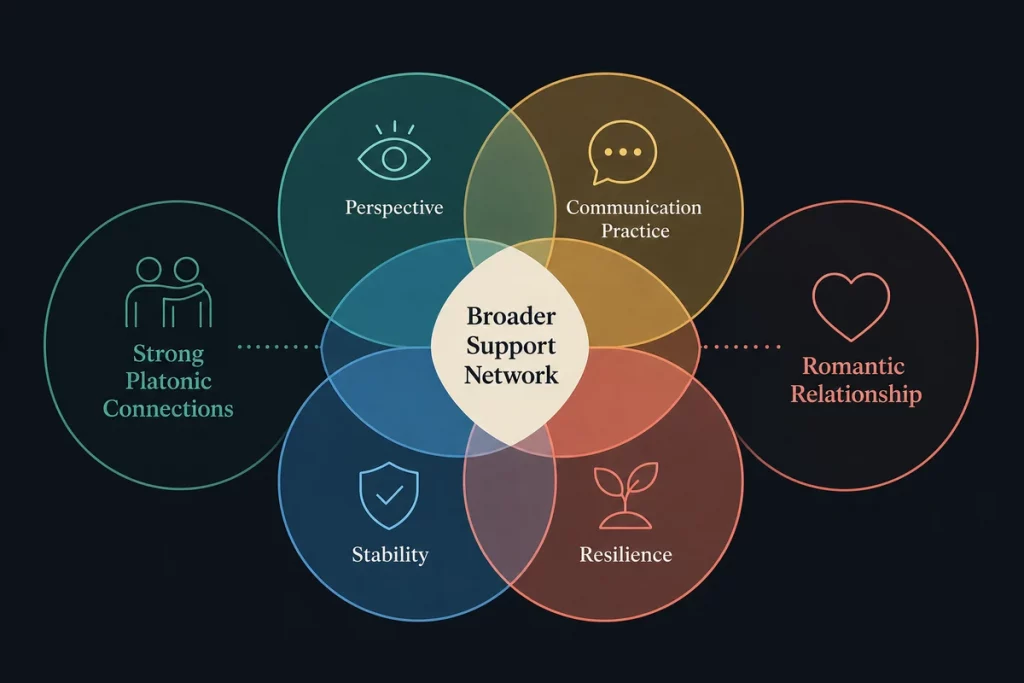
Platonic love allows for multiplicity. Romantic love (in most cultural frameworks) is exclusive: one partner, full commitment, no division of romantic energy. Platonic love thrives on multiplicity: five close friends, each filling different roles, each bringing different strengths, each providing a different facet of the belonging and acceptance you need. This multiplicity provides resilience — the loss of one close friendship is painful but not devastating when other platonic bonds remain. The romantic model of concentrating all love into a single relationship creates fragility; the platonic model of distributing love across multiple bonds creates robustness.
Platonic love is more honest. Romantic love includes the pressure to maintain attraction, manage impressions, and navigate the sexual dimension — all of which create incentives for selective self-presentation. Platonic love, freed from these pressures, often produces more complete honesty. Your best friend sees you without makeup (literally and figuratively) in a way that romantic partners may not — because the friendship doesn’t depend on maintaining the curated version of yourself that romantic attraction sometimes requires. This honesty is why friends often give better advice about your romantic relationships than romantic partners give about themselves: the friend has no incentive to be anything other than honest about what they observe.
How to Nurture Deep Non-Romantic Bonds
Name it. Tell the people you love platonically that you love them. “I love you” isn’t exclusively romantic vocabulary, but cultural conditioning has made many people — particularly men — uncomfortable expressing love to friends. Breaking through that conditioning with direct expression strengthens the bond: “You’re one of the most important people in my life and I love you” is a sentence that your best friend deserves to hear, and hearing it produces the same oxytocin-mediated bonding that romantic “I love you” produces.
Prioritize it as deliberately as romance. If non-romantic connection receives only the leftover attention after romantic and professional obligations are met, it atrophies — not dramatically, but gradually, through the accumulation of cancelled plans, unreturned calls, and “we should catch up soon” messages that never convert to actual meetings. Treating these connections as a priority means scheduling friend time as deliberately as date night, showing up for important moments in your friends’ lives as reliably as you show up for your partner’s, and investing attention and energy into connections that research confirms are among the strongest predictors of your overall life satisfaction.
Practice vulnerability. Platonic love deepens through the same mechanism as romantic love: shared vulnerability. Telling a friend “I’m struggling” or “I need help” or “That thing you said bothered me” builds the depth that casual maintenance doesn’t. Many people reserve vulnerability for romantic partners, producing friendships that remain at a pleasant but shallow level. The friendships that produce the deepest non-romantic bonds are those where both people have risked honesty, expressed needs, and navigated difficult conversations — just as the deepest romantic bonds require the same risks. Boundary-setting and honest communication aren’t just romantic skills — they’re human connection skills that apply wherever genuine love exists.
Show up during the hard parts. Platonic love is tested not during celebratory moments (everyone shows up for the good times) but during crises. The friend who appears during your bad breakup, sits with you during grief, drives you to the appointment you’re dreading, or simply sends the “thinking of you” text on the hard anniversary — that friend is demonstrating the green flags of genuine love through behavior rather than words. Showing up during the hard parts is what transforms casual affection into enduring deep connection.
Where Platonic and Romantic Love Intersect in Your Dating Life
These two forms of love aren’t separate domains — they interact constantly, and the health of one influences the health of the other:
Your friendships predict your romantic success. People who maintain healthy, communicative, boundaried friendships bring those same skills to romantic relationships. Conversely, people who have no close friendships often struggle in romance because they haven’t developed the emotional regulation, conflict resolution, and reciprocal vulnerability skills that close bonds require. If someone you’re dating has no close friends — no one they genuinely trust and love platonically — that absence is a red flag worth examining: what prevents them from maintaining close connections, and will the same thing eventually prevent them from maintaining a connection with you?
Your friends protect your romantic wellbeing. Platonic love provides the outside perspective that helps you evaluate romantic relationships accurately. Friends who know you well can see patterns you can’t see from inside the relationship — love bombing that looks like devotion to you, gaslighting that makes you doubt yourself, narcissistic patterns that erode your confidence so gradually you don’t notice. The friend who says “I’m worried about how this person treats you” is expressing deep friendship through honest concern — and dismissing that concern in favor of the romantic partner’s reassurance is how many people remain in harmful relationships longer than they should.
A romantic partner who respects your platonic love is worth keeping. When evaluating romantic partners, observe how they relate to your friendships. A partner who celebrates your closest friendships — who encourages your friend time, speaks positively about your close friends, and never makes you choose between romance and friendship — is demonstrating the emotional security and generosity that predict long-term partnership. A partner who competes with your friends, criticizes them, or gradually isolates you from them is demonstrating the control patterns that predict an abusive trajectory.
When entering the dating world, carry your non-romantic bonds as both armor and compass. Use GuyID’s free screening tools for identity verification so your romantic connections begin with the same transparency your friendships provide naturally. Share your Date Mode link through GuyID to demonstrate that you value verified trust in every connection — romantic and platonic alike. The best romantic partnerships are those where both people arrived with full non-romantic social lives and chose to add romance on top of an already-solid foundation of love, support, and belonging.
How GuyID Helps
GuyID should appear when it is useful, not as a banner ad. A GuyID Trust Profile gives someone a portable way to share trust signals before a date, while identity verification and social vouching help turn vague profile claims into clearer next steps.
Useful next steps:
- Create a GuyID Trust Profile when you want a cleaner way to share verified trust signals.
- Use GuyID free tools and related guides when you need a checklist before meeting someone.
- Treat identity verification as confidence-building, not a guarantee.
- Use social vouching when you want context from people who already know the person.
- Sign up only when the extra trust layer helps the decision you are already trying to make.
Frequently Asked Questions
What does platonic love mean?
This bond is deep, genuine affection between two people that exists without romantic or sexual dimensions. Named after the philosopher Plato, who described love that transcends physical attraction and appreciates another person’s character, wisdom, and essence. In modern usage, the term describes the powerful emotional bond between close friends, mentors, and chosen family members — connections that feel essential and irreplaceable without any romantic component.
Is platonic love real love?
Yes. Platonic love can include attachment, care, loyalty, intimacy, and grief without romantic or sexual intent. Research on social connection supports the importance of close relationships for wellbeing, but no single friendship determines health or longevity. The clearest evidence is relational rather than biochemical: people can build durable, meaningful bonds across many forms of love.
Can platonic love turn into romantic love?
Yes — and many of the strongest romantic relationships begin as friendships. The transition requires mutual interest and honest communication. If feelings shift on one side, addressing them directly preserves the friendship whether the romantic interest is reciprocated or not. Our platonic relationship guide covers the dynamics of navigating boundary shifts, and the genuine interest signs guide helps identify whether a friend’s behavior has shifted from platonic to romantic.
How do I tell the difference between platonic love and romantic feelings?
The key differentiators: romantic feelings include physical attraction, desire for exclusivity, jealousy when the person dates others, and the “butterfly” nervous-system activation of infatuation. Platonic love includes deep affection, desire for the person’s happiness (including with romantic partners), comfort without physical desire, and emotional safety without romantic anxiety. If you feel warmth, protectiveness, and joy around someone but no physical desire or romantic jealousy, what you.re experiencing is genuine non-romantic affection — and it’s complete as it is.
Is platonic love as important as romantic love?
Research suggests it may be MORE important for overall wellbeing. Studies on life satisfaction consistently find that the quality of non-romantic social connections is a stronger predictor of happiness, health, and longevity than romantic relationship status. This doesn’t diminish romantic love — it elevates platonic love to its deserved position alongside it. The healthiest, happiest people invest in both forms, treating non-romantic connection as the essential life infrastructure it is rather than the romantic consolation prize culture often frames it as.