

Reader Briefing
Reader Briefing
Start here if you need a practical read on deflection in relationship: how to recognize and respond: who should use verification, what signals to check, and what to do before moving from online interest to an in-person plan.
Who this is for
- Readers preparing for a first in-person date.
- Anyone checking identity, profile consistency, and trust signals.
- Online daters improving conversations, profiles, or match screening.
You’ll learn
- How to evaluate identity signals without treating any single check as certainty.
- Which trust signals matter and how to weigh them together.
- How to move from online conversation to a safer first meeting.
- Where GuyID tools fit into a quick pre-date screening workflow.
- How to compare options using practical safety and trust criteria.
- When to slow down, ask for more context, or walk away.
Bottom line
Verification reduces uncertainty; it does not guarantee future behavior. Use a layered approach: confirm identity signals, compare profile consistency, ask for a short video call, keep early plans public, and slow down when someone pressures you to skip normal safety steps.
Key takeaways
- Identity verification improves confidence, not certainty.
- Verify before meeting privately or sharing sensitive details.
- A short video call can reveal many inconsistencies.
- Pressure to skip reasonable safety steps is useful information.
- Use GuyID tools to turn vague concerns into specific checks.
Free Tools
Catfish Probability Detector
Check whether a dating profile has suspicious identity or photo signals.
Dating Bio Red Flag Detector
Review a bio for scam, pressure, or trust-warning language.
Dating Safety Checklist
Use free GuyID tools before moving from chat to a real date.
Next step
Create your GuyID trust profile
Share consent-based trust signals before a date without turning the conversation into an interrogation.
You raise a legitimate concern — their lateness, their broken promise, the way they spoke to you at dinner — and somehow, by the end of the conversation, YOU’RE apologizing. The issue you raised is forgotten. Your feelings are dismissed. And the person who should be addressing their behavior has successfully made the conversation about your “tone,” your “sensitivity,” or something YOU did three months ago that has nothing to do with anything. This is deflection in relationship dynamics — one of the most effective and least-recognized emotional manipulation tactics, and it works because it exploits your desire to be fair. If every attempt to address your partner’s behavior transforms into a conversation about YOUR behavior, you’re experiencing deflection in relationship patterns that systematically prevent accountability while training you to stop raising concerns entirely.
NavigateTable of Contents20 sections
Deflection in Relationships: Definition and Pattern
Deflection in relationship contexts is the act of redirecting a conversation away from the deflector’s behavior and toward something — anything — else. The “something else” varies: your behavior, your tone, your motivations, your past mistakes, other people’s opinions, irrelevant tangents, or philosophical abstractions that sound meaningful but avoid the specific issue at hand. The goal is consistent regardless of the method: prevent accountability by making the conversation about anything other than what the deflector did.
Unlike denial (which says “I didn’t do that”) or minimization (which says “it wasn’t that bad”), deflection in relationship dynamics doesn’t directly address the issue at all — it changes the subject while maintaining the illusion of engaging with it. The deflector appears to be participating in the conversation. They’re responding to your words. They may even display appropriate emotional engagement. But the content of their response has nothing to do with the concern you raised — and by the time you notice, the original issue has been buried under the deflected material and you’ve lost the conversational thread that would have held them accountable.
Research from the American Psychological Association on defensive communication patterns identifies deflection as a particularly damaging strategy because it combines the emotional harm of having your concerns dismissed with the cognitive confusion of being unable to identify exactly HOW the dismissal occurred. When someone yells “I don’t want to talk about this,” you know you’ve been shut down. When someone deflects, you often don’t realize you’ve been shut down until the conversation is over and you’re wondering how you ended up apologizing for raising a legitimate concern.
7 Types of Deflection in Relationship Dynamics
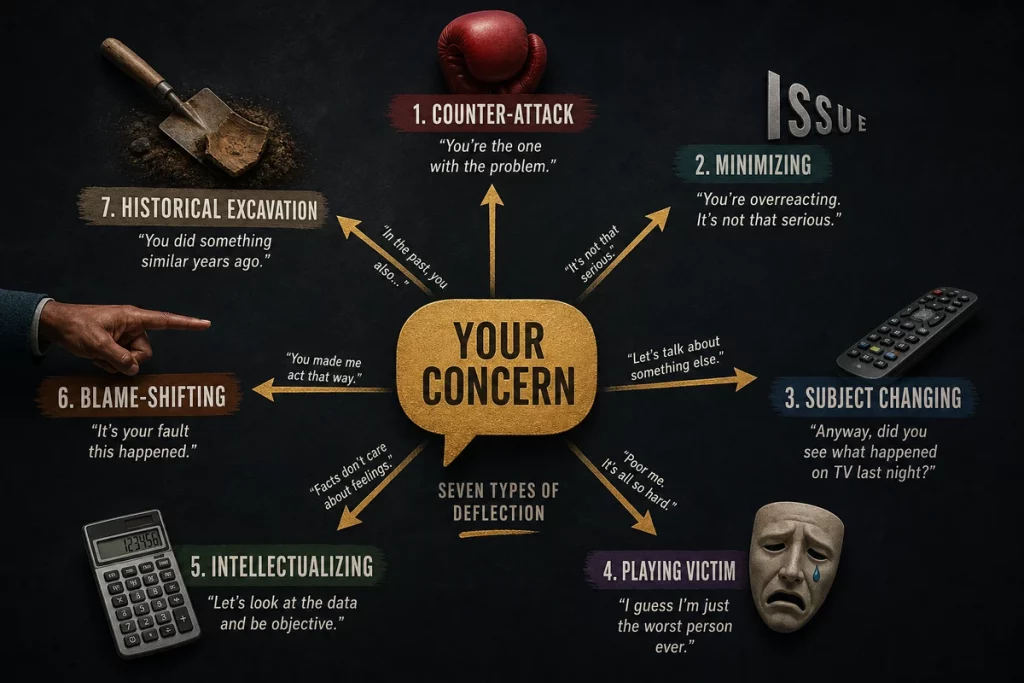
1. The Counter-Attack
“Well, YOU did [something].” The most common form of deflection in relationship arguments. Instead of addressing the concern you raised, they immediately launch a counter-accusation — often about something completely unrelated. You say “You promised to pick up the kids and forgot.” They say “Well, you forgot to pay the electric bill last month.” The counter-attack is effective because it activates your defensive response — suddenly you’re defending yourself instead of holding them accountable, and the original issue evaporates while both parties argue about whose failure is worse.
2. Whataboutism
“What about when YOU…?” Similar to the counter-attack but specifically frames the deflection as a fairness comparison. The implicit argument is: “You have no right to address my behavior because you’ve done similar things.” This exploits the reasonable desire to be fair — if you’ve made mistakes too, isn’t it hypocritical to call out theirs? But whataboutism as deflection in relationship dynamics ignores that two people can both need to address their behavior, and that the current conversation is about THEIR behavior specifically. Both things can be true simultaneously without either canceling the other.
3. Victim Flipping
“I can’t believe you’d accuse me of that. I’m so hurt.” The deflector transforms from the person being held accountable into the person being victimized — by your accusation, by your tone, by your lack of trust, by the “attack” of being asked to address their behavior. This is one of the most disorienting forms of deflection in relationship patterns because it activates your empathy: you care about this person’s feelings, and now they’re expressing pain — which shifts you from “addressing the issue” to “comforting them,” effectively derailing the conversation while positioning the deflector as the wounded party.
4. Tone Policing
“I’d listen to you if you weren’t so aggressive about it.” The deflector dismisses the CONTENT of your concern by focusing on the DELIVERY. Your frustration (which is a natural response to repeated boundary violations) is reframed as the problem — not the behavior that caused the frustration. Tone policing as deflection in relationship communication creates an impossible standard: you must raise concerns about hurtful behavior while displaying zero emotion about it, and any emotional expression is used to invalidate the concern itself.
5. Historical Excavation
“This is just like that time in 2019 when you…” The deflector digs into the relationship’s past to find an incident that they can use to redirect the current conversation. The excavated incident may be genuinely relevant, partially related, or completely irrelevant — it doesn’t matter, because the goal isn’t resolution; it’s deflection. Historical excavation buries the present concern under layers of past grievance, making the conversation impossibly complex while the original issue remains completely unaddressed.
6. Generalization
“You ALWAYS do this. You NEVER let anything go.” Instead of addressing the specific behavior you raised, the deflector generalizes your concern into a character attack — reframing “you forgot to pick up the kids” into “you think I’m a terrible parent.” The generalization is unfair and usually inaccurate — you raised a specific concern, not a sweeping character judgment — but it forces you to defend against the generalized accusation instead of maintaining focus on the specific issue. You end up saying “I don’t think you’re a terrible parent!” instead of “But you did forget the kids today.”
7. Emotional Overwhelm Display
Crying, shutting down, having a panic attack, or displaying such intense emotional distress that continuing the conversation feels cruel. When genuine, these responses indicate emotional flooding — a temporary state that a structured break can address. When used as deflection in relationship arguments, however, the emotional display is proportionally calibrated to end the conversation: intense enough to make you feel guilty for raising the issue, timed to coincide with accountability moments, and resolved suspiciously quickly once the conversation has been successfully abandoned.
Why Deflection in Relationship Dynamics Works So Well
Deflection is effective because it exploits several psychological mechanisms that operate automatically in people who care about being fair:
Empathy weaponization. If you care about your partner’s feelings — which you do, because you’re a decent person — their expressed hurt (whether genuine or performed) activates your empathy system, shifting you from accountability mode to caretaking mode. Deflection in relationship dynamics works best on people with high empathy — which is precisely why manipulative partners target empathetic people and why the advice to “just be less empathetic” is both unhelpful and misguided. The solution isn’t less empathy; it’s recognizing when empathy is being weaponized.
Fairness exploitation. “But you did it too” exploits your desire to be fair by creating a false equivalence between your behavior and theirs. Fair-minded people instinctively respond to perceived hypocrisy charges by examining their own behavior — which is exactly the redirect the deflector wants. The counter: both things can be true and both can be addressed, but THIS conversation is about THIS issue. Fairness doesn’t require that all issues be addressed simultaneously or that raising one concern grants immunity from being raised on another.
Cognitive load overload. By introducing multiple tangential topics (counter-accusations, historical grievances, character generalizations), the deflector increases the conversation’s cognitive complexity beyond manageable levels. You can’t simultaneously defend yourself against a counter-attack, respond to a historical excavation, clarify a generalization, AND maintain focus on the original concern. Something has to be dropped — and the deflector ensures it’s the original concern that gets dropped first.
Trained silence. Over time, repeated deflection in relationship dynamics trains the partner to stop raising concerns because the cost of raising them (inevitable counter-attacks, victim flipping, emotional displays, historical excavation) exceeds the perceived benefit (the issue never gets addressed anyway). This trained silence is the deflector’s ultimate goal: a partner who has learned that accountability conversations are futile and painful, and who therefore stops initiating them. When deflection reaches this stage, it has crossed from communication failure into emotional manipulation — systematically suppressing the partner’s voice within the relationship through conditioned avoidance.
The Impact on the Deflected Partner
Chronic deflection in relationship dynamics produces specific psychological effects that accumulate over time. Research from the National Library of Medicine on demand-withdraw communication patterns confirms that deflection contributes to depression, anxiety, and relationship dissatisfaction in the deflected partner — and that the severity of these outcomes increases proportionally with the duration and consistency of the deflection pattern.
Self-doubt escalates as the deflected partner begins questioning whether their concerns are legitimate. When every raised issue is met with “you’re overreacting” or “what about YOUR behavior,” the natural response is to wonder if you ARE overreacting — and if your behavior IS comparable. This self-doubt mirrors the effects of gaslighting because deflection systematically undermines your confidence in your own perceptions and judgments. According to the National Domestic Violence Hotline, chronic invalidation of a partner’s concerns — whether through direct denial or through the indirect mechanism of deflection — constitutes a form of emotional abuse when it functions to suppress the partner’s voice within the relationship.
Anxious attachment activation intensifies the experience of deflection because anxiously attached partners already question whether their needs are “too much.” When a deflecting partner confirms this fear by redirecting every concern back to the person who raised it, the attachment wound deepens — creating a cycle where the person most vulnerable to deflection’s effects is the least equipped to recognize and resist it.
Resentment builds because the issues that prompted the conversations remain unresolved. Each deflected conversation adds another unaddressed grievance to the backlog, and the accumulated weight of unresolved issues transforms normal relationship friction into chronic, pervasive dissatisfaction. The deflected partner feels increasingly hopeless — not about any single issue, but about the relationship’s fundamental capacity to address problems. This hopelessness often manifests as emotional withdrawal: the partner stops investing emotionally in the relationship because investment requires the belief that problems can be worked through together, and deflection has systematically destroyed that belief.
Communication atrophy occurs as the deflected partner gradually stops attempting difficult conversations. When every attempt to address concerns produces counter-attacks, victim flipping, or emotional overwhelm displays — but never resolution — the brain’s learning systems conclude that these conversations are high-cost and zero-reward, and motivation to initiate them drops accordingly. This communication atrophy is particularly dangerous because relationships that cannot address problems cannot adapt, grow, or survive — they simply accumulate unresolved tensions until the structure collapses under the weight. Partners experiencing communication atrophy from chronic deflection in relationship dynamics often report feeling more alone inside the relationship than they ever felt when single — because single loneliness lacks the additional pain of having someone present who consistently refuses to engage with what matters to you. Our boundary-setting guide provides frameworks for re-establishing your voice if deflection has eroded it.
Deflection vs. Healthy Defense: The Critical Distinction
| Deflection | Healthy Defense |
|---|---|
| Redirects away from the issue entirely | Engages with the issue while providing context |
| “What about when YOU forgot?” | “I hear you — I did forget, and here’s what happened” |
| The original concern is never addressed | The original concern is acknowledged and responded to |
| Leaves the raising partner feeling unheard | Leaves the raising partner feeling heard, even if they disagree |
| Creates a pattern of avoided accountability | Creates a pattern of mutual accountability |
| Uses emotional displays to end conversations | Expresses genuine emotions while maintaining engagement |
The critical differentiator: does the response include acknowledgment of the original concern? Even a response you disagree with (“I see it differently — here’s why”) engages with what you raised. Deflection in relationship communication specifically avoids engagement with the original concern — replacing it with something else while maintaining the appearance of conversation. A partner who says “I understand you’re upset about the kids, and you’re right — I messed up, but I also want to talk about the electric bill” is defending themselves while engaging. A partner who says “Well, what about the electric bill?” without acknowledging the kids issue is deflecting.
How to Respond to Deflection in Relationship Arguments
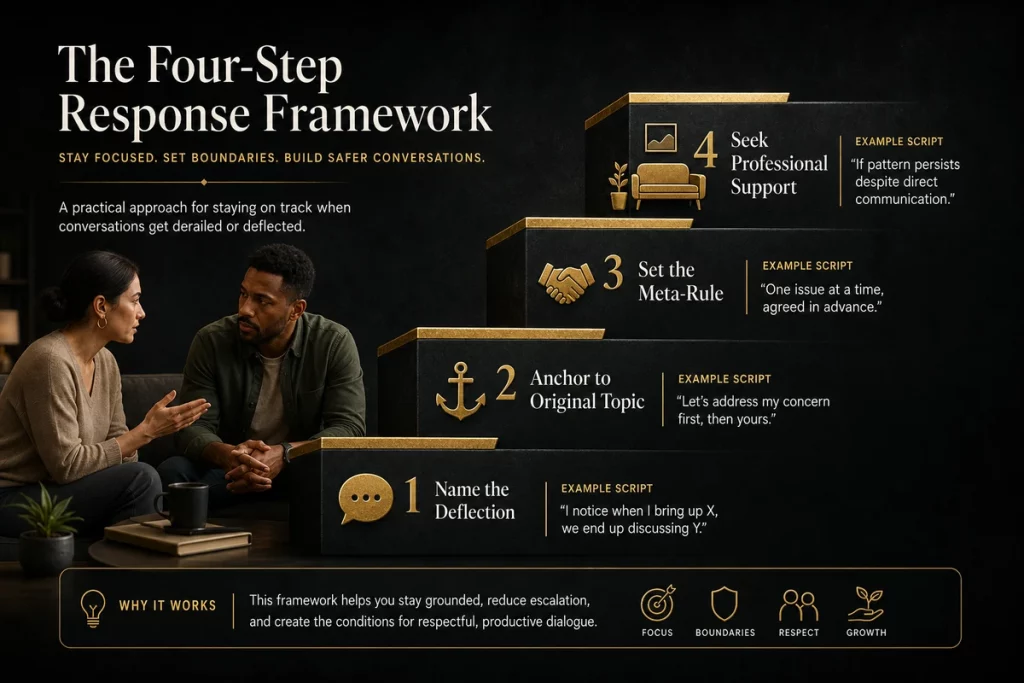
Name the deflection in real time. “I hear that you want to discuss [deflected topic], and we can — but right now I need us to address [original concern] first.” This statement accomplishes three things: it validates that their counter-concern exists (preventing them from feeling dismissed), it establishes the conversational priority (your original concern was raised first), and it creates a verbal commitment to addressing their topic afterward (demonstrating fairness). Most importantly, it names the redirect without accusing — which keeps the conversation productive rather than escalating into a meta-argument about communication tactics.
Use the “broken record” technique. When deflection attempts continue, calmly return to the original concern: “I understand you feel that way, and we can discuss it — after we address [original concern].” Repeat as needed. The broken record technique works because deflection requires the other person to follow the redirect; when you consistently decline to follow, the deflection strategy fails and the deflector must either engage with the original concern or openly refuse to discuss it — which is at least honest about the avoidance.
Set a conversational structure. “Let’s address one issue at a time. I’ll go first since I raised this, then you can raise yours.” Structure removes the deflector’s primary tool (introducing new topics) by establishing that topics are addressed sequentially rather than simultaneously. Both partners get heard; neither partner gets to bury the other’s concern under their own.
Recognize when deflection is part of a larger pattern. If your partner deflects consistently across conversations, combines deflection with gaslighting, stonewalling, narcissistic patterns, or love bombing cycles, the deflection is likely a component of a broader manipulation strategy rather than an isolated communication weakness. Use the emotional abuse checklist and toxic relationship quiz to evaluate the broader pattern. Individual therapy helps you develop the clarity and boundaries to navigate or exit the dynamic.
For future relationships. When dating, test for deflection early by raising small concerns and observing the response. Does the person engage with what you said, or redirect to something else? A partner who can hear “it bothered me when you were late” without counter-attacking, generalizing, or victim-flipping demonstrates the green flags of healthy communication. Verify matches through GuyID’s free screening tools and share your Date Mode link through GuyID to build connections with partners whose transparency extends to accountability.
How GuyID Helps
GuyID should appear when it is useful, not as a banner ad. A GuyID Trust Profile gives someone a portable way to share trust signals before a date, while identity verification and social vouching help turn vague profile claims into clearer next steps.
Useful next steps:
- Create a GuyID Trust Profile when you want a cleaner way to share verified trust signals.
- Use GuyID free tools and related guides when you need a checklist before meeting someone.
- Treat identity verification as confidence-building, not a guarantee.
- Use social vouching when you want context from people who already know the person.
- Sign up only when the extra trust layer helps the decision you are already trying to make.
Frequently Asked Questions
What is deflection in a relationship?
Deflection in relationship dynamics is the act of redirecting a conversation away from the deflector’s behavior and toward something else — counter-accusations, your past mistakes, your tone, or irrelevant tangents. The result: the original concern goes unaddressed, accountability is avoided, and the partner who raised the concern ends up defending themselves instead. Over time, chronic deflection trains the partner to stop raising concerns entirely.
Is deflection a form of emotional abuse?
Occasional deflection during heated arguments is a common (if unproductive) communication habit. Chronic deflection in relationship dynamics — where every attempt to address concerns is systematically redirected, resulting in the partner learning to suppress their needs — crosses into emotional manipulation. When combined with gaslighting, stonewalling, or narcissistic patterns, deflection is reliably a component of an abusive dynamic. Use the is stonewalling abuse framework to evaluate the broader pattern.
How do I stop my partner from deflecting?
Name the deflection calmly: “I want to discuss your topic too — after we address mine.” Use the broken record technique to return to the original concern. Set conversational structure: one issue at a time, raised in order. If deflection continues despite direct communication, couples therapy with a therapist experienced in communication pattern disruption provides structured intervention. If your partner refuses therapy or the deflection is part of a broader manipulation pattern, individual therapy helps you develop boundaries and clarity.
Why does my partner always turn things around on me?
They turn things around because deflection works — and because it has been reinforced by successfully avoiding accountability in past conversations. Common drivers include fear of criticism (turning things around prevents them from sitting with the discomfort of being wrong), narcissistic traits (inability to tolerate being perceived as imperfect), and learned behavior (modeled in their family of origin). Understanding the driver helps determine the appropriate response: therapy for fear-based deflection, boundaries for narcissistic deflection.
How can I spot deflection tendencies when dating?
Raise a small concern early in dating — “it bothered me when…” — and observe the response. A non-deflective partner engages: “I’m sorry — that makes sense.” A deflective partner redirects: “Well, you did…” or “You’re being too sensitive.” The green flags guide identifies accountability as a key positive indicator. Verify matches through GuyID’s free tools for identity, then apply behavioral assessment for communication quality.