Reader Briefing
Reader Briefing
Start here if you need a practical read on searching for singles: best ways: who should use verification, what signals to check, and what to do before moving from online interest to an in-person plan.
Who this is for
- People meeting someone from a dating app or social platform.
- Readers preparing for a first in-person date.
- Anyone checking identity, profile consistency, and trust signals.
- People trying to avoid romance scams, fake profiles, or pressure tactics.
You’ll learn
- How to evaluate identity signals without treating any single check as certainty.
- Which trust signals matter and how to weigh them together.
- How to spot inconsistencies, pressure, or behavior patterns that deserve caution.
- How to move from online conversation to a safer first meeting.
- Where GuyID tools fit into a quick pre-date screening workflow.
- How to compare options using practical safety and trust criteria.
Bottom line
Verification reduces uncertainty; it does not guarantee future behavior. Use a layered approach: confirm identity signals, compare profile consistency, ask for a short video call, keep early plans public, and slow down when someone pressures you to skip normal safety steps.
Key takeaways
- Identity verification improves confidence, not certainty.
- Patterns matter more than isolated incidents.
- Verify before meeting privately or sharing sensitive details.
- A short video call can reveal many inconsistencies.
- Pressure to skip reasonable safety steps is useful information.
Free Tools
Catfish Probability Detector
Check whether a dating profile has suspicious identity or photo signals.
Dating Bio Red Flag Detector
Review a bio for scam, pressure, or trust-warning language.
Dating Safety Checklist
Use free GuyID tools before moving from chat to a real date.
Next step
Create your GuyID trust profile
Share consent-based trust signals before a date without turning the conversation into an interrogation.
Finding available people to date in 2026 looks nothing like it did even five years ago — and understanding where and how to find compatible people determines whether your search produces genuine connections or wasted time. The modern landscape spans everything from sophisticated algorithm-driven dating apps to real-world singles events, niche interest communities to traditional friend-of-friend networks. But the specific method you choose matters significantly less than the strategic approach you bring: verified connections built on genuine transparency consistently outperform unverified matches found through any platform, and the personal safety practices you apply ultimately determine whether your efforts lead to fulfilling relationships or frustrating (or dangerous) dead ends. This guide covers every viable channel for finding singles in 2026, ranks them by effectiveness for different goals, and provides the verification framework that makes any search method safer.
NavigateTable of Contents15 sections
Searching for Singles on Dating Apps
Dating apps remain the most popular channel for searching for singles — and for good reason: they provide access to a larger pool of people actively seeking connection than any other method. But which app serves which goal matters enormously:
For serious relationships: Hinge leads the conversation, with its prompt-based profiles, relationship-oriented user base, and higher conversation quality. eHarmony’s compatibility matching serves relationship-seekers willing to invest in detailed profiles. Bumble’s women-first messaging gives female users control over initial contact. Coffee Meets Bagel’s curated daily matches reduce overwhelm for users who prefer quality over quantity.
For casual connections: Tinder’s massive user base and swipe simplicity make it the default for users who prioritize volume and spontaneity. Feeld serves users seeking non-traditional relationship structures. Grindr serves the LGBTQ+ male community with location-based matching.
For specific demographics: Widow dating websites serve people dating after loss. OurTime and SilverSingles serve users over 50. Christian Mingle, JDate, and Salaam Swipe serve faith-specific communities. The more specific your demographic, the more a niche platform improves your results by pre-filtering for shared experience or values.
The app search optimization framework: Regardless of which platform you choose for searching for singles, these principles maximize results across all apps. First, invest in professional-quality photos — your first photo is responsible for the vast majority of swipe decisions. Second, complete every profile section available — algorithms reward complete profiles with higher visibility. Third, verify your profile through the app’s verification system AND through GuyID for government ID confirmation that distinguishes you from unverified profiles. Fourth, be active consistently — algorithms prioritize active users over dormant ones. Fifth, use the platform’s features as intended — Hinge rewards prompt engagement, Bumble rewards quick responses, Tinder rewards daily swiping.
Research from the American Psychological Association on dating app effectiveness confirms that profile quality and engagement consistency are stronger predictors of match outcomes than platform choice — meaning optimizing your presence on one app typically outperforms spreading thin attention across five.
Singles Events and Meetups
For people who prefer face-to-face connection over screen-based matching, finding potential partners through events provides the organic interaction that apps can’t replicate:
Speed dating. Structured speed dating events remain surprisingly effective for the same reason they were invented: they compress the assessment process into 3-5 minute interactions that provide more data than a profile photo while filtering through dozens of potential matches in a single evening. Modern speed dating has evolved from generic events to niche-targeted sessions (professionals-only, age-specific, interest-based, LGBTQ+), improving match quality by pre-selecting attendees who share baseline characteristics. Cities like Chicago, Toronto, NYC, and London have active speed dating scenes — check Eventbrite, Meetup.com, and local event listings for upcoming sessions.
Singles mixers. Less structured than speed dating, singles mixers provide social environments where attendees can approach conversations naturally. The advantage over bars (where attendees may or may not be single or looking) is that everyone at a singles mixer is explicitly available and open to connection — removing the ambiguity of approaching someone in a general social setting. Many cities have recurring mixers organized through Meetup groups, local event companies, or venue-hosted socials. The format varies: some are casual cocktail events with icebreaker activities, others are themed (wine tasting singles, outdoor adventure singles, brunch singles), and the best ones attract 30-80 attendees with roughly balanced gender ratios. Searching for singles through mixers works best when you attend consistently — becoming a familiar face in a recurring event community produces warmer interactions over time than a single appearance at a one-off event.
Activity-based meetups. Hiking groups, cooking classes, book clubs, volunteer organizations, recreational sports leagues, and other interest-based gatherings provide organic social interaction without the explicit dating-event pressure. The advantage: you meet people who share your interests in a natural context, and the activity provides built-in conversation material that eliminates the “so, what do you do?” small talk that plagues traditional dating interactions. The limitation: not everyone at these events is single or looking, and the social norms around approaching someone romantically in a non-dating context require more subtlety than a dating-specific event. The most effective approach: become a regular, build genuine friendships within the group, and let romantic interest develop organically if it’s going to — rather than attending with a transparent agenda that changes the group dynamic.
Professional and networking events. Industry conferences, professional development workshops, and networking mixers connect you with people who share career interests and ambition levels. While these aren’t dating events, research from the National Library of Medicine on relationship formation shows that shared professional context is a strong predictor of long-term compatibility — stronger than physical attraction alone.
Social and Community Channels
Beyond apps and events, finding potential partners through social and community channels provides connections with built-in social context:
Friend-of-friend introductions. The original “matching algorithm” — and still one of the most effective. Friends who know both parties can assess compatibility in ways that algorithms can’t: personality dynamics, communication styles, lifestyle compatibility, and the intangible “vibe” that determines whether two specific people will click. If you’re actively searching for singles, telling your friends explicitly (“I’m open to being set up if you know someone who might be a good match”) converts your social network into a matching service with the advantage of personal knowledge and accountability.
Religious and spiritual communities. For faith-oriented singles, religious communities provide shared values, social structure, and often explicit matchmaking support. Many churches, synagogues, mosques, and temples host singles groups, social events, and community activities designed to facilitate connection among members. The built-in value alignment and community accountability that religious contexts provide can accelerate trust-building — though verification through GuyID’s free tools remains important regardless of the context in which you meet someone.
Alumni networks. Shared educational background provides instant common ground and a degree of social vetting (you both attended the same institution). University alumni events, LinkedIn alumni groups, and homecoming gatherings connect you with people who share a formative experience. The limitation: alumni networks vary enormously in activity level, and geographic concentration may limit local options.
Social media and online communities. Facebook groups centered on hobbies, interests, or local activities; Reddit communities for specific demographics; Instagram’s interest-based discovery — all provide organic connection opportunities with people who share your passions. The distinction between “looking for dates on social media” and “meeting someone through shared interests online” is important: the latter feels more natural and produces connections based on genuine commonality rather than profile-based first impressions.
Niche Search Methods
Matchmaking services. Professional matchmakers offer curated, high-touch searching for singles — interviewing you extensively, understanding your priorities, and hand-selecting matches from their client pool. The advantage: significantly higher match quality and a human filter that algorithms can’t replicate. For users who can afford it and value quality over quantity, matchmaking consistently produces the highest satisfaction rates of any partner-finding method.
Interest-specific dating apps. Platforms like Strava (for runners), Untappd (for beer enthusiasts), and various hobby-specific communities provide connection opportunities centered on shared passion. While not explicitly dating platforms, they facilitate the organic connection that many people prefer over the transactional feel of traditional dating apps.
Co-living and co-working spaces. Shared living and working environments provide daily proximity to potential matches — the same organic exposure that school and workplace proximity once provided. Co-living communities (Common, Starcity, Bungalow) and co-working spaces (WeWork, Industrious) are increasingly popular with singles who want social connection built into their daily routine rather than scheduled into separate events.
Optimizing Your Search: What Actually Works
Regardless of the channel, certain principles consistently produce better results when searching for singles:
Clarity about what you want. “I’m looking for a committed relationship with someone who shares my values around family and career ambition” is infinitely more useful — to yourself and to the algorithms or people helping you — than “I’m looking for someone nice.” Specificity doesn’t narrow your options destructively; it focuses your energy on connections with genuine potential and helps you evaluate matches against clear criteria rather than vague feelings. Write down your top 5 non-negotiable qualities and top 5 nice-to-haves. Use the non-negotiables as filters and the nice-to-haves as ranking criteria. This clarity prevents the common trap of accepting anyone who shows interest rather than selecting for genuine compatibility.
Consistency over intensity. Searching for singles produces better results through steady, sustained effort than through sporadic bursts of intense activity. Swiping for 15 minutes daily produces more matches over a month than a 3-hour session once a month — because algorithms reward daily activity, your responsiveness improves with regular practice, and the natural timing of connection (someone who’s perfect for you might join the platform on any given day) requires consistent presence. The same principle applies to events: attending one mixer per month for six months outperforms attending three mixers in one week and then quitting for five months.
Quality profile investment. Whether it’s a dating app profile, your social media presence, or the impression you make at events — investing in how you present yourself is the highest-return investment in the searching for singles process. Professional photos for dating apps, a genuine and specific bio, and Bumble/Hinge prompts that reveal personality rather than reciting clichés produce compounding returns across every match and interaction.
The multi-channel approach. The most successful singles in research studies don’t rely on a single channel — they maintain presence across 2-3 complementary methods. A typical effective combination: one primary dating app used daily with a fully optimized profile, one recurring social activity (weekly sports league, monthly book club, regular volunteer shift) that provides organic face-to-face interaction, and an active social network that knows you’re looking. This multi-channel approach hedges against the weaknesses of any single method while compounding the strengths of each.
Don’t mistake activity for progress. Swiping for hours without messaging matches, attending events without approaching people, and telling friends you’re looking without following up on introductions they offer — all represent activity without progress. The searching for singles process has clear milestones: matching → messaging → phone/video call → first date → second date → defined relationship. If you’re stuck at any stage for more than 2-3 weeks, the bottleneck deserves diagnosis rather than more volume at stages that are already working. More swiping doesn’t fix a messaging problem. More events don’t fix an approach problem. Diagnosing and addressing the specific bottleneck produces more results than increasing overall effort.
Take breaks without quitting. Dating fatigue is real and well-documented — the repetitive cycle of matching, messaging, and meeting produces diminishing emotional returns without periodic rest. Planned breaks (2 weeks off every 2-3 months of active searching) prevent burnout and allow you to return with refreshed energy and perspective. The key distinction: a planned break (with a specific return date) is healthy self-management. An unplanned disappearance driven by frustration is giving up. Schedule breaks proactively rather than letting fatigue make the decision reactively.
Invest in yourself between dates. The most attractive quality in any searching-for-singles context is a full, engaged life — hobbies you’re passionate about, friendships you maintain, goals you’re pursuing, and wellbeing you prioritize. People who are interesting independent of their relationship status attract better matches and evaluate those matches more clearly. The time between dates isn’t waiting — it’s building the life that makes you a compelling partner and a confident evaluator of potential matches.
Safety for Every Search Method
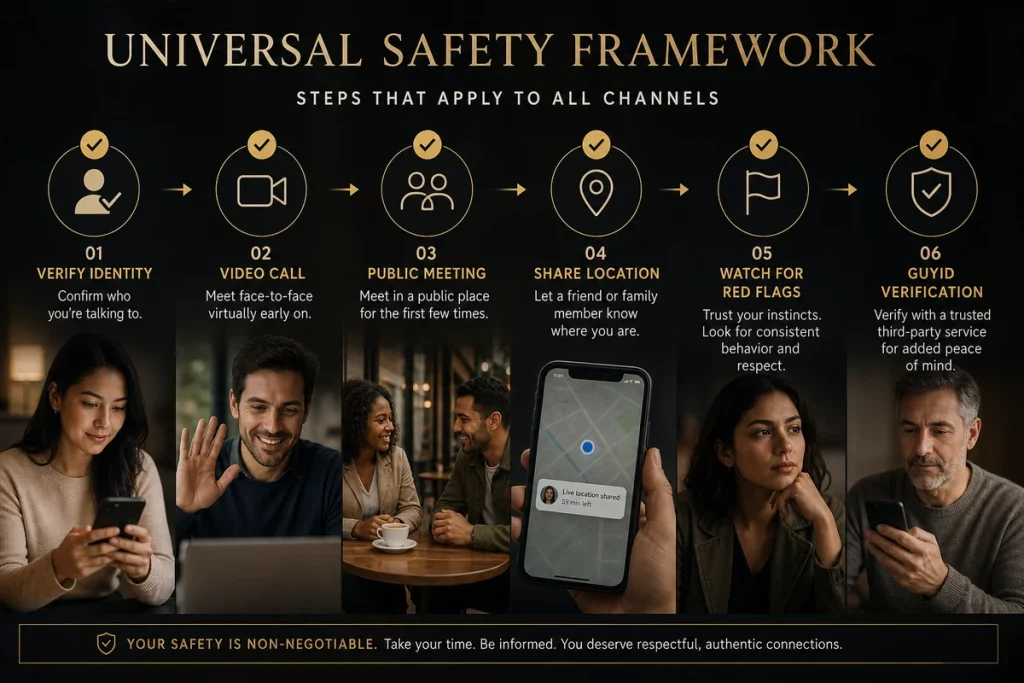
Whether you’re searching for singles on apps, at events, through friends, or anywhere else — the safety fundamentals apply universally:
Verify before trusting. Regardless of where you met someone: reverse image search their photos if you connected online, cross-reference on social media for a consistent digital footprint, video call before meeting in person (even for app matches who seem verified), and use GuyID verification for government ID confirmation. The context in which you meet someone (app vs. event vs. friend introduction) changes the social dynamics but not the fundamental need for identity confirmation before emotional investment.
Meet in public first. First meetings — from any source — should happen in public locations. Coffee shops, restaurants, parks, and public events provide visibility that private locations don’t. This applies equally to app matches and friend-of-friend setups — the social context of a friend introduction doesn’t eliminate the risk of meeting someone whose behavior isn’t yet observable.
Watch for universal red flags. Love bombing, rapid intensity escalation, breadcrumbing, boundary violations, and emotional manipulation occur across all meeting contexts — not just dating apps. The red flag vocabulary you’ve developed through dating app awareness applies equally to people you meet at events, through friends, or in community settings. Share your Date Mode link through GuyID to establish mutual verification from the start, regardless of how you first connected. Use GuyID’s free screening tools to verify anyone before significant emotional or time investment.
Tell someone where you’re going. Every first meeting with a new person — app match, event connection, friend setup — warrants sharing your location and plans with a trusted friend or family member. The National Domestic Violence Hotline recommends this practice as a standard safety measure for all new social interactions, not just dating-specific ones.
How GuyID Helps
GuyID should appear when it is useful, not as a banner ad. A GuyID Trust Profile gives someone a portable way to share trust signals before a date, while identity verification and social vouching help turn vague profile claims into clearer next steps.
Useful next steps:
- Create a GuyID Trust Profile when you want a cleaner way to share verified trust signals.
- Use GuyID free tools and related guides when you need a checklist before meeting someone.
- Treat identity verification as confidence-building, not a guarantee.
- Use social vouching when you want context from people who already know the person.
- Sign up only when the extra trust layer helps the decision you are already trying to make.
Frequently Asked Questions
What’s the most effective way of searching for singles?
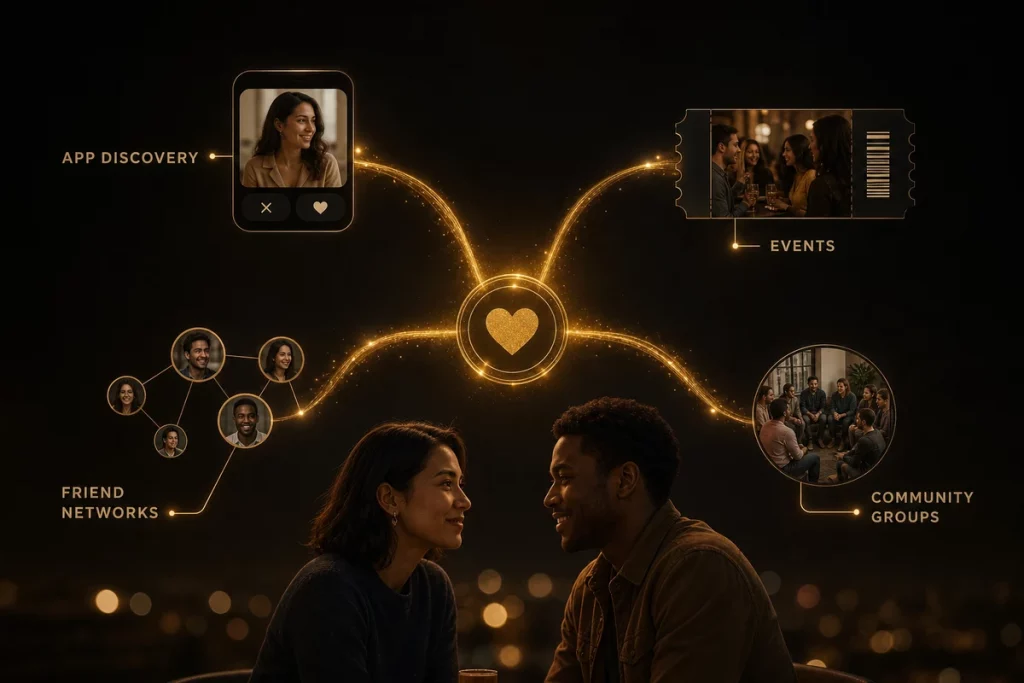
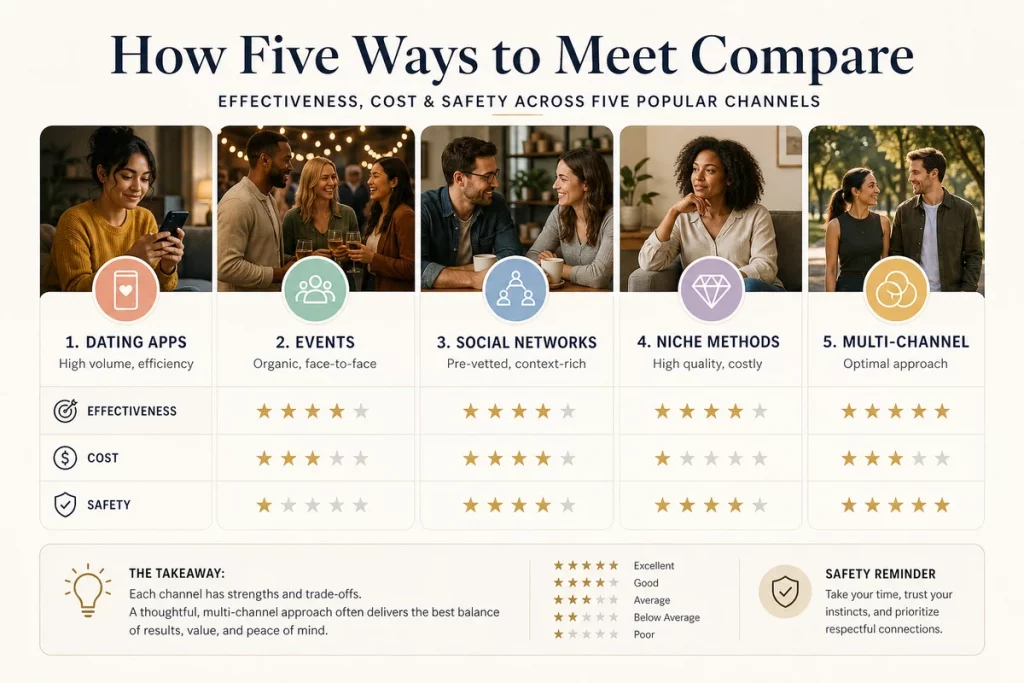
Dating apps provide the highest volume and most efficient matching for active searchers. Friend-of-friend introductions provide the highest quality connections with built-in social vetting. Activity-based meetups provide the most organic, pressure-free connection opportunities. The most effective approach combines 2-3 channels: one dating app used consistently, one regular social activity, and an active social network that knows you’re open to being set up. Searching for singles through multiple channels simultaneously maximizes both reach and diversity of connection types.
Are dating apps still the best way to meet singles?
For efficiency and volume, yes. A single evening of swiping can expose you to more potential matches than a month of social events. However, “best” depends on what you value: apps optimize for volume and efficiency; events optimize for organic interaction; friend networks optimize for pre-vetted quality. See our Tinder vs Hinge comparison for app-specific guidance. Regardless of channel, verify through GuyID’s free tools.
Where can I find singles events near me?
Eventbrite (search “singles events” + your city), Meetup.com (browse singles and social groups), Facebook Events (search local singles mixers), and your city’s local event listings are the best starting points. Many cities also have dedicated speed dating companies that run regular events — search “[your city] speed dating” for local options. For activity-based alternatives, search for hiking groups, cooking classes, and recreational sports leagues on Meetup.
How do I stay safe while searching for singles?
Use the same basic precautions regardless of where you meet: protect personal information, request a live video call, verify important claims through independent sources, and meet in a public place. Tell a trusted person your plans and maintain your own transportation.
Is online or in-person searching for singles better?
Both have advantages. Online provides scale, efficiency, and access to people outside your immediate social circle. In-person provides natural chemistry assessment, organic interaction, and social context that apps can’t replicate. The ideal approach uses both: dating apps for broad reach and efficient matching, plus in-person activities for organic connection and the nonverbal chemistry cues that screens filter out. Neither alone is sufficient for most people — and both benefit from GuyID verification before progressing to emotional investment.
How do I tell my friends I’m looking for someone?
Be direct and specific: “I’m actively looking to meet someone. If you know anyone who might be a good match, I’m very open to being set up.” Specificity helps: “I’m looking for someone who [shares your key values/interests]” gives your friends a filter to apply. The more explicit you are, the more likely your network is to actively think of you when they meet someone who fits. Most people are happy to play matchmaker when asked — they just need the explicit invitation and some criteria to work with.